
All that nasty stuff that happened to you makes good story material

Ne Obliviscaris (forget not) is the motto of the Clan Campbell. And I don’t. When I was in an encounter group, it came out that I rememebered the nasty stuff and wasn’t very forgiving about it.

“Why do you hold on to it?” asked the leader.

“Because sooner or later I’ll write about it,” I said.

Not in terms of revenge, naming names, and teaching people a lesson. No, it just happens to be potent story material, and since it has a huge impact on me, I could put it in a short story or novel and when Idid, the angst came across as real and true.

I don’t care much of “tell all” memoirs that hurt other people. I’m more interested in what I felt when I was, for example, betrayed, because now I can accuratelly write about a character who was betrayed.

I’m not sure this is psychologically healthy. Probably not. But if you’re stuck being unable to forgive and forget, you can write some mighty strong fiction. You have, so to speak, a deep well of nastiness at your disposal that can become a part of your characters.

In general, I’m not a team player. That means I’ve had run-ins with people who are team players but were getting screwed by those whom were most loyal to. I didn’t understand selling out to the devil and they didn’t understand not pitching in. Such encounters sit in mental files waiting for the day when I’ll have a character who sold out to some blind authority figure and I’ll suddenly realize I’m writing what I know.

I’ve always thought that an author’s experiences made for some of their best work because they were telling stories that they lived through. Your “dark side” is a powerful ally when writing.

Sure, it might lead you do drinking too much, but that’s the price we pay for coming up with page-turner stories.
Malcolm

My protagonist, Jock Stewart, doesn’t like authority figures. Gosh, I wonder where I got the information to write about that.
That long line of refugees

When Ernest Hemingway’s dispatches from the Greco-Turkish war of 1922 began appearing in a Toronto newspaper, readers discovered a new style of war reporting that read, in some ways, like a novel, telling a story that put readers in the story.

When I read these dispatches during my journalism school days, I was most taken  by his description of an endless line of refugees: “Minarets stuck up in the rain out of Andrianople across the mud flats. The carts were jammed for thirty miles along the Karagatch road. Water buffalo and cattle were hauling carts through the mud. No end and no beginning. Just carts with everything they owned. The old men and women, soaked through, walking along, keeping the cattle moving. The Maritza river was running yellow almost up to the bridge. It rained all through the evacuation.”

But what impacted me most strongly, was that in a dispatch sent several weeks later, he wrote: “No matter how long it takes this letter to get to Toronto, as you read this in the Star you may be sure that the same ghastly, shambling procession of people being driven from their homes is filing in unbroken line along the muddy road to Macedonia. A quarter of a million people take a long time to move.”

The power was not only the writing, but the fact that in between reports while the world went about its everyday business, this line of people was still on the road.

NewsClick photo

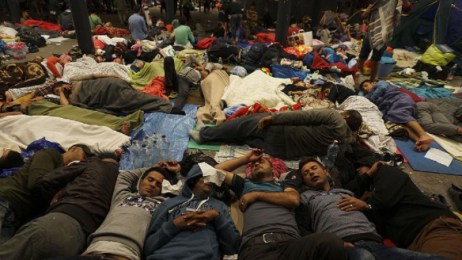
I think of these reports now as I watch or read reports of the long lines of refugees fleeing Ukraine, fleeing from a man who claims his army doesn’t target civilains, and that all the time when I’m not reading the news, those refugees–like the endless line of people from the Greco-Turkish war–have been on the road, cold and hungry while I was having dinner, being shalled while I was sleeping, walking endlesss steps while I was watching television.

The power of the scenes on TV and Internet news sites comes partly from the horrors described. It also comes from the fact that while we come and go, the tragedy in Ukraine is a 24/7 nightmare. While I’m sitting here typing this post and drinking a glass of red wine, another man is walking toward Poland carrying his dying child, one of many in an unending line of other such men and other such children.

Malcolm

Putin thinks he’s shooting fish in a barrel

While the war’s not going the way Putin thought it would, which the world salutes with praise of the Ukrainian people and President Zelenskyy, the end seems sadly predestined.

And the world watches without doing anything to stop the carnage. If Russia weren’t a nuclear power whose mad leader hadn’t threatened to rain ICBMs down on any country that intervened militarily, would anyone have sent in troops backed by air strikes?
I assume so. Logically, nobody wants a nuclear war in response to knocking out Russian tanks, artillary, and planes with conventional weapons. To risk that, seems immoral.

But watching Ukraine being destroyed also seems immoral. I suppose most of us check the news in hopes that Ukraine has somehow prevailed only to find out that, say, a hospital has been destroyed and that–slowed down or not–the Russian advance is continuing.

So, we’re immoral no matter what we do. Not that that makes Putin anything other than a war criminal. But how do we sleep at night?

I don’t think we can.

I suppose the President has asked: (1) Can we kill/capture Putin with a black ops team? (2) Do we know where all of Russian’s missles are and, if so, can we take them out?

If he asked these questions, the answers were probably not to Biden’s liking. So, of course we did nothing. According to the latest poll I saw, most Americans agree with this. As far as I can tell, Europeans also agree with confining our efforts to diplomacy.

So far, I think we’re worrying more about rising gasoline prices than the number of Ukrainians killed daily by the Russians. Some speculate that if Russian isn’t stopped in Ukraine, it will move on to Moldova and Poland. This makes me wonder if doing nothing is really the best option.

What do you think?

–Malcolm

On re-reading ‘The Horse Whisperer’ again

Like many avid–or perhaps crazed–readers, I have several go to books that never disappoint me when I re-read them while waiting for something new to arrive in the mail. I always re-read my favorite books of the year several times–such as those by Ruta Sepetys, Sunetra Gupta, and John Hart. But when I truly want to escape reality, I turn to Pat Conroy’s The Prince of Tides or Nicholas Evans’ The Horse Whisperer.

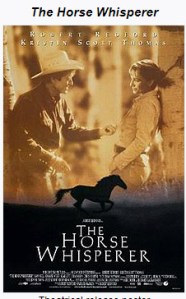
I’ve seen the feaure films based on each of these with opposite reactions. I liked Pat Conroy’s book better than the movie and Robert Redford’s movie better than Nicholas Evans’ book.

I like The Horse Whisperer because it’s a strong story about the healing of a young injurered teenager (Grace) and a severely damaged Morgan horse (Pilgrim). I am among those who think Evans botched the ending of the book with a brutal death scene that was neither foreshadowed nor necessary. In fact, I dislike that ending so strongly, that I stop reading several pages before it occurs.

Fortunately, Robert Redford, who starred in and directed the film, gave us a much more realistic and suitable ending. While the truck wreck scene in the book is handled well, seeing it on the screen has such a strong impact, I think a lot of people who go back to the film again often skip it.

I suppose there are a lot of extenuating personal reasons why people re-read books multiple times. In my case, Montana is my favorite state, I used to ride when I was younger, and have always been fond of Morgan horses. Or, perhaps I just like the chemistry of the story and the characters in it. And then, working a ranch and being a horse whisperer would have suited me just fine.

Malcolm

“Mountain Song” is set on a Montana sheep ranch with absent parents, a nasty grandfather, and a medicine woman, and a Friesian horse, all of whom shape David Ward’s life into the mess that it becomes.

Watch this space

I just saw the cover artwork for something new, something that’s been in the works at Thomas-Jacob Publishing, and it looks great.

But I can’t tell you what it is.

I can tell you that you’re going to like it (or else). I can also tell you that I’ve been having fun working on my part of this “something new.” We had a nasty thunderstorm this afternoon, but I kept working.

Feel free to stop watching this space if you have to use the restroom, walk the dog, or get some shuteye. We understand because we’re understanding people. We’re not going to be watching this space 24/7 either because we’re busy working on the something new.

Around the clock.

Malcolm

AARP Magazine is for a Happening Bunch of People

Apparently, 85 is the new 25. That being the case, AARP readers love seeing a pretty face on the cover, Halle Berry appears in the current issue. If you’re star struck, you’re going to turn to the last page of the magazine which shows stars who have suddenly gotten old–but don’t look old. And usually, there’s a story about somebody older than I am who’s climbing Mt. Everest or ziplining across the Grand Canyon.
I turn to the last page after finding out where Berry found her groove and learn that Carole King is 80 and that at 90, composer John Williams will be scoring “Indiana Jones 5” set for release in 2023. Meanwhile, Garth Brooks is 60. How the hell did that happen?

The magazine is excited about Dolly Parton and her novel, the cover headline being “Dolly Parton Novelist? We love it.” And there on page 13 is a gushing interview (with photo) about how Dolly (76) and James Patterson (74) ended up collaborating on a novel.

Patterson is quoted as saying, “I’ve always admired Dolly, and I had this germ of an idea for a novel. I contacted her and she said, ‘Well, come on down and let’s talk.'”

I had to kick myself (figuratively speaking) that I didn’t call her first. We probably wouldn’t have called our book Run, Rose, Run. Maybe something like, Rose, My Pickup Done Left Me. So far, I’ve seen one blogger/reviewer who hated it.  But I’ll probably read it anyway when the price comes down a bit.

AARP’s “pitch” in general seems to be, “you might be old and sick, but you’re not washed up yet.” I don’t know whether that’s fake news or wishful thinking.

Either way, it’s good to know.

Malcolm

On Location: Tallahassee’s John G. Riley Center & Museum

The John Gilmore Riley Center & Museum for African American History & Culture, Inc. is a historical and cultural gem that sits at the bottom of a hill in downtown Tallahassee, at the corner of Meridian and Jefferson Streets. The Riley House was constructed circa 1890 on the fringe of a community called Smokey Hollow. Its owner was a former enslaved man, John Gilmore Riley, rose to prominence as an educator and civic leader. – Museum Website

This beautifully restored Queen Anne house with its wrap-around porches serves as the perfect headquarters for this museum of African American History and Culture. One night say that the home once anchored the east-side community of Smokey Hollow which was lost due to so-called urban renewal in the 1950s and 1960s.

Currently on exhibit, Legacy and Learning, an “intergenerational exhibit exploring the history and cultural traditions of everyday life.” Artifacts and art show how everyday appliances and other objects hve changed over time. The museum also features Heritage Education, tours, and history trails. Among the tours is the Smokey Hollow Commemorative Site and its “spirit home” models of the shotgun style houses that made up most of the community.

You might also enjoy the jogging and biking and trails at nearby Cascade Park.

If you live in and/or are visiting Tallahassee, all of this belongs on your things to do list. I was initially surprised when an individual in a Facebook group focusing on Tallahassee said he was born and raised there and had never heard of Smokey Hollow. I realized that the once-vibrant African-American neighborhood has been gone for about sixty years. Those of us who lived there sixty years ago knew about the community as well as the debates in government and the press about getting rid of it. But younger people very easily could be unaware of it. The park and the museum fix that problem.

Malcolm

Malcolm R. Campbell is the author of short stories and novels, many of which are set in the Florida Panhandle where he grew up.

Trying to be more like Papa Joe, are you Vladimir Vladimirovich?

Let’s suppose Vladimir Vladimirovich Putin woke up a while back in his latest palace with a woe-is-me attitude and thought: “Проклятиеn, I’m getting old and my life has turned into nothing better than vodka, syphilis, and anonymity with reduced odds of catching up with the great deeds of Papa Joe.”

With nothing on his resume since Crimea, he was tired of oligarchs asking, “So Vladimir Vladimirovich, what have you done for us lately?”

In his heart of hearts, such as it was, he thought of the joy Papa Joe must have felt while he was deporting residents of the Baltic countries to Siberia for real or imagined anti-Soviet behavior in 1941. Since most people didn’t know anything about that, history could safely repeat itself with a “cleansing” of Ukraine, those неблагодарные ублюдки (ungrateful bastards) who dare to turn their backs on the former USSR.

Or, there’s another possibility: he’s nuts. Several days ago, the “Daily Beast” wondered if “Putin Will Throw Mother of All Hissy Fits if Kyiv Attack Fails.” Chances are, he’s already having it even though Ukraine’s survival is looking more and more grim.

Ukraine has surprised everyone with its tenacity. If Putin hadn’t threatened a nuclear attack against anyone who intervened, would we have intervened. Probably not, though in spite of its middle ground posture, Israel might have had the guts to do it.

Putin’s ego(maniac) trip is about to change Europe and NATO forever. Too bad the syphilis didn’t kill him first.

Malcolm

Take Bob, Spare Fido

When wives talk to wives and husbands talk to husbands, shocking things are often said about spouses, how bad they snore, eat with their hands, skip their daily showers, and line up their underwear in neat rows in the dresser drawers. When all this gets a bit much, it turns out–if you’re a fly on the wall listening–that if the angel of death gave a married man or woman a choice, they’d rather see their spouse taken away to the world to come rather than their precious cat or hunting dog.

“After all, Mabel won’t hunt, won’t swim out into the swamp and retrieve the ducks after they’re blasted out of the sky.”

And:

“Bob is never as considerate as Fido because Fido never leaves the toilet seat up or tracks mud in the front door.”

Seriously, though, people who don’t own gets don’t understand that a pet’s death is truly a death in the family. When pets are part of a household for years, they’re still part of the household after they cross the so-called rainbow bridge. So those of us who mourn the passing of pets have lots of empty spaces in our lives where the pets used to be–physically and in our hearts as well.

Sure, we can make nasty jokes about our spouses’ habits, but speaking ill of a pet–except in good fun–is a felony. Sure, the cat tore up the best chair in the livingroom and the dog tore up our favorite pair of boots, but when they leave us, we forgive them everything and remember them fondly.

For spouses, on the othe hand, it’s sometimes good riddance. Or so people say after a few drinks.

I speak from experience when I say that when a pet dies, it takes a while to come to terms with that just as surely as it does when one loses a spouse or brother or sister. The pain is less, but not insignificant.

I’m still trying to get used to he fact that our cat Marlo is gone. I expect to see her everywhere she used to be. It appears that our two other cats feel the same way. None of us are back to normal yet, so give us a little time to grieve even though we’re still stuck with Bob or Mabel.

Malcolm

Malcolm R. Campbell is the author of multiple novels and short stories, including “Conjure Woman’s Cat.”

Dare we hope or are we grasping at straws?

Sunflowers, the national flower of Ukraine.

We hear bits and pieces of good news. . .

Ukraine’s resistance to the invasion is stronger than expected. Putin’s not happy.

A Russian convoy ran out of gas somewhere and another turned around then confronted by civilians.

Protests within Russia are growing.

The EU, U.S., and NATO are on the same page.

Supplies are being shipped to Ukraine.

A U.S. spy plane flies above the country monitoring the war. Ukraine is receiving intel from the U.S. and others.

A growing number of organizations are protesting and/or finding ways to help.

Maybe these are all false hopes. Even so, they’re lights in the darkness Russia has brought to the world.

Malcolm