The National Park Service is seeking tenders for a concessioner to operate its facilities in Glacier National Park. The proposed concession contract would see 18 of the 33 Red buses decommissioned and replaced with new vehicles. This decision was made without any consultation with the public.
The Glacier Park Foundation wants to see the Red bus fleet remain intact. Bidding for the concession closes March 14. The foundation urges all its members and fans of Glacier to raise their voices in any manner they can, including contacting the National Park Service, and Montana state and federal officials. Let them know you oppose any breakup of the Red bus fleet and are requesting a delay in the concession contract process until the matter has been aired in public.
I agree with the Foundation’s suggestion that the contract process should be put on hold until the public is fully informed about the rationale behind the plan as well as the other alternatives available. If you agree, please let the Park Service and your Senators and Representatives know of your concerns.
Can you squeeze both feet onto a 2″ x 6″ piece of rock? What if that rock is 3,000 feet above a cold mountain lake?
Mountain goats, the iconic symbol of Glacier National Park, can place all four feet on a rocky pinnacle or ledge that small, and they can leap from rock to rock. The design of the mountain goats’ legs and feet makes them very good climbers.
Donna Love (“The Wild Life of Elk” and “Henry The Impatient Heron”) filled “The Totally Out There Guide to Glacier National Park” (Mountain Press, 2010) and the free Arts and Activities Guide (PDF download) with facts like these. Illustrated by Joyce Mihran Turley, the book’s visually exciting art work will delight the younger members of the family. The text is written for both teens and adults.
From the Publisher:
Glacier National Park remains a unique ecosystem, one of the most unspoiled in the world, full of wonders to discover. Triple Divide Peak is the only place in the United States where water flows to three oceans west to the Pacific Ocean, east to the Atlantic, and north to the Arctic. The Big Drift, the snowdrift that forms on Logan Pass each winter, can grow to over eighty feet high and takes road crews months to clear each spring. Come discover the Crown of the Continent with The Totally Out There Guide to Glacier National Park, the first in a new book series that encourages kids and their grownups to get off the couch and get totally out there experiencing the wonders of our national parks.
Join acclaimed author Donna Love as she examines the park s twenty-five remaining active glaciers, explains the formation of the park s towering mountains, vibrant valleys, and pristine lakes, and looks at living things from beargrass to grizzly bears. You ll learn about the park s human history as well, from the arrival of the first ancient peoples to the establishment of the park in 1910 to plans for the twenty-first century and beyond. Whether you re taking a real trip or an imaginary adventure, you ll definitely enjoy the journey!
Coming Soon
Donna is working on a similar book for fans of Yellowstone National Park. Donna says on her website that “When our children were young, I found I had the ability to explain nature to them. I believe that the more you know about something, the better care you can give it, so I enjoy learning about new subjects. To learn about the subjects for each of my books, I study it until I understand it. Then I explain it. I think that’s why children, as well as adults, love my writing.”
Editors Ray Djuff and Chris Morrison have released their new anthology of Glacier Park stories. I’m pleased that my essay about the 1964 flood was included.
The Glacier National Park Fund has supplemented the park’s declining federal funding to the tune of $3.5 million dollars for the past 13 years. After looking at the rationale for the Fund’s merger with the Glacier Association (reported in September), I believe the combined organization will offer increased support for the park during the next 13 years,
As a member, I enjoy the late-in-the-year mailings that detail how the Fund’s support has helped Glacier National Park during the recent season as well as getting a heads-up on emerging projects.
In 2012, contributions from the Fund helped the park complete repairs on Sperry Chalet (see 2011 avalanche damage post), the lookouts on Scalplock and Swiftcurrent, and the Belly River ranger station. Year-to-year maintenance on trails continues (as always), with an emphasis on the Ptarmigan Wall, Avalanche Lake, and Loneman Lookout trails. Some 3,500 grade school students participated in the Winter Ecology School Program and the Teacher-Ranger-Teacher training. Research work went forward on harlequin ducks, fishers and bats, bear-proof food storage containers were added to campground, and the citizen science program kept up its use of volunteers for countless projects.
Highline Trail – David Restivo, NPS
Upcoming Needs
You can see a list of the Fund’s 2013 projects online. Here are a few of the highlights:
The creation of a Glacier Conservation Corps youth group to assist with trail maintenance, weed control and restoration. If the Fund raises $50,000 by December 31, it will receive a matching grant from the National Park Foundation.
Damage to the popular Highline Trail during a July thunderstorm will require $20,000 in additional repairs in order to safely open the trail during 2013. (I agree with those who say that if visitors take one hike in the park, this should be it.)
The well-received Citizen Science and Adopt a Trail programs both need additional funding.
Exciting and much needed projects, I believe, that support the Crown of the Continent’s natural beauty and cultural heritage.
Malcolm R. Campbell is the author of nonfiction and fiction focused on Glacier National Park, including “The Sun Singer” which is set in the Swiftcurrent and Belly River valleys.
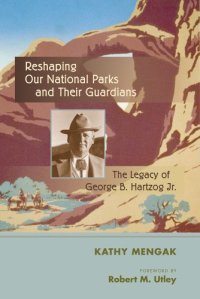
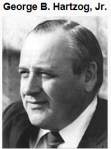
Reshaping Our National Parks and Their Guardians: The Legacy of George B. Hartzog Jr., by Kathy Mengak, with a foreword by Robert M. Utley, University of New Mexico Press (April 2012), 336 pp
When Glacier Park’s Centennial Program Committee received the George and Helen Hartzog Volunteer Group Award for promoting the park’s 2010 centennial, many visitors were unfamiliar with the man who led the National Park Service between 1964 and 1972 or with the award established in 1998 (and subsequently supported via a fund created by his wife) to honor those donating time to help the parks.
Published earlier this year, Kathy Mengak’s Reshaping our National Parks and Their Guardians ably tells the story of the highly successful NPS director who added 72 new parks to the system during a contentious political era in American history. In his book review in the Autumn 2012 issue of “Montana The Magazine of Western History,” Craig Rigdon writes that while the author’s “fondness for Hartzog is evident…she provides a fairly balanced review of his career.”
Originating with Mengak’s dissertation at Clemson University, the book draws heavily on twelve years of interviews conducted with Hartzog and other key officials. Hartzog died in 2008.
Kurt Repanshek (National Parks Travler) writes that Hartzog “was a cigar-chewing, Scotch-loving, Stetson-wearing, lover of fishing, hard-charging director who often knew exactly what he wanted and found a way to get it. One way or another.” His review of the book is posted here.
From the Publisher
Wikipedia Photo
This biography of the seventh director of the National Park Service brings to life one of the most colorful, powerful, and politically astute people to hold this position. George B. Hartzog Jr. served during an exciting and volatile era in American history. Appointed in 1964 by Secretary of the Interior Stewart Udall, he benefited from a rare combination of circumstances that favored his vision, which was congenial with both President Lyndon Johnson’s “Great Society” and Udall’s robust environmentalism. Hartzog led the largest expansion of the National Park System in history and developed social programs that gave the Service new complexion. During his nine-year tenure, the system grew by seventy-two units totaling 2.7 million acres including not just national parks, but historical and archaeological monuments and sites, recreation areas, seashores, riverways, memorials, and cultural units celebrating minority experiences in America. In addition, Hartzog sought to make national parks relevant and responsive to the nation’s changing needs.
I like Rigdon’s comment that while most people remember the National Park Service’s first two directors, Stephen Mather and Horace Albright, Reshaping Our National Parks and Their Guardians demonstrates that “some of the most critical years in the agency’s history took place during George B. Hartzog’s tenure as director.”
West Glacier, MT, September 25, 2012 – The Board of Trustees of the Glacier National Park Fund and the Board of Directors of the Glacier Association (formerly the Glacier Natural History Association) have agreed to a merger of these two Glacier National Park Partners.
The merger will be effective January 1, 2013, and the new organization will be the Glacier National Park Conservancy. The conservancy’s goal will be to generate financial support for the Park in an era of reduced federal budgets through increased private fundraising and philanthropic activities, and continued operation of the bookstores within Glacier National Park and at other federal agency partner sites in Montana.
The Glacier Park Fund has provided close to $4 million to Glacier National Park and is pleased to take another exciting step in growing our commitment and support to Glacier.
From extensive support of trails, to research and management of wildlife and plants, to educational programs and preservation of the red buses and historical records, artifacts and buildings, the Glacier National Park Conservancy (GNPC) will continue in the same tradition of helping to preserve a quality of visitor experience while protecting a very special national treasure.
The Glacier National Park Fund was established in 1999 as the non-profit fundraising partner of the Park. The Glacier Association is a non-profit cooperating association of the National Park Service that was originally formed in 1941 and incorporated in 1946.
–
As a 1980s volunteer with the Glacier Association when it was called the Glacier Natural History Association and as member of both organizations, I look forward to seeing a strengthening of the efforts of both approaches to park stewardship and fundraising through the merger.
–Malcolm
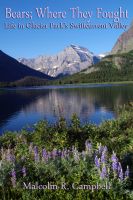
Malcolm R. Campbell, the author of contemporary fantasy and satire, also created the Kindle e-book “Bears; Where They Fought” about the land and history of Glacier National Park’s Swiftcurrent Valley. His article about the Glacier Park flood of 1964 appears in NPS-produced “A View Inside Glacier National Park – 100 Years 100 Stories” available through the Glacier Association on line bookstore.
“After political pressure, money and arm-twisting were applied, the Piegan (usually referred to as Blackfeet) sold the mountain portion of their land for $1,500,000 in 1895. It was half of what they wanted, but they were resigned to losing it anyway. This “ceded strip”represents all of today’s Glacier National Park east of the continental divide. The Blackfeet reservation abuts the park’s eastern boundary at the foot of Lake Sherburne.” – Malcolm R. Campbell in “Bears, Where They Fought”
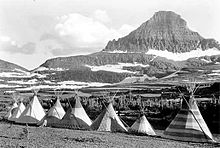
Teepees in Glacier in 1933 as part of the railway’s publicity effort.
The historical lands of the tribes comprising the Blackfoot Confederacy (the term “Blackfeet” is also used) stretched from the continental divide in the Rocky Mountains in Glacier National Park eastward into present-day North Dakota, and on the north near present-day Edmonton, Alberta to the Yellowstone River in Montana. In the United States, this land would be reduced by the Lame Bull Treaty of 1855 to lands”
“. . .lying within lines drawn from the Hell Gate or Medicine Rock Passes in the main range of the Rocky Mountains, in an easterly direction to the nearest source of the Muscle Shell River, thence to the mouth of Twenty-five Yard Creek, thence up the Yellowstone River to its northern source, and thence along the main range of the Rocky Mountains, in a northerly direction, to the point of beginning, shall be a common hunting-ground for ninety-nine years, where all the nations, tribes and bands of Indians, parties to this treaty. . .”
Blackfeet Removal
William E. Farr writes in “The End of Freedom: The Military Removal of the Blackfeet and Reservation Confinement, 1880” in the Summer 2012 issue of “Montana The Magazine of Western History,” that the removal and confinement of tribes was facilitated in 1871 when Congress decided to no longer consider Indian Nations as sovereign. From that point on, landholdings were reduced by executive orders that required no negotiation or consent from the tribes involved.
To this end, President Grant reduced the size of Blackfeet lands by creating a southern boundary along the Missouri River through his orders of 1873 and 1874. The change in policy evolved with the discovery of gold and other minerals in present-day Glacier Park’s Swiftcurrent Valley and elsewhere, and the demands of frontier settlements and travelers on transcontinental migration routes.
Today, the Blackfeet (Southern Piegan) reservation lands begin at the eastern Edge of Glacier National Park. While the Blackfeet sold the eastern half of present-day Glacier to the U.S. in 1895, the enduring association of the tribe with the park (other than for periodic hunting trips) appears to be more a product of legend, imagination and publicity than recorded history.
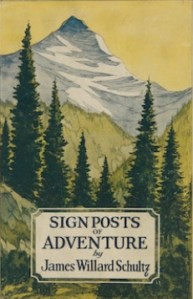
The Southern Piegan were plains oriented, as C. W. Buchholtz notes in Man in Glacier. In addition to the 1895 land sale, he believes that the association of the Tribe with the park as a whole was based on legends that could have arisen during numerous migrations over the course of time from any mountain range, the Blackfeet place names assigned to park rivers and mountains by James Willard Schultz (Signposts of Adventure), George Bird Grinnell and others, and by the Great Northern Railway’s “Glacier Park Tribe” publicity campaign in the 1930s. (The railway built, and originally managed, the park’s historic hotels up until 1960.)
Present-day programs within the park honor the legends as well as Glacier’s Blackfeet neighbors headquartered at Browning. Since park visitors, especially those at Glacier Park Lodge on U.S. Highway 2, are only a few miles away from Browning, it’s easy to include the Museum of the Plains Indian in vacation plans.
Malcolm R. Campbell is the author of two contemporary fantasies partially set in the park, Sarabande and The Sun Singer. He served as an editorial assistant for the publication of the original edition of “Place Names in Glacier National Park.”
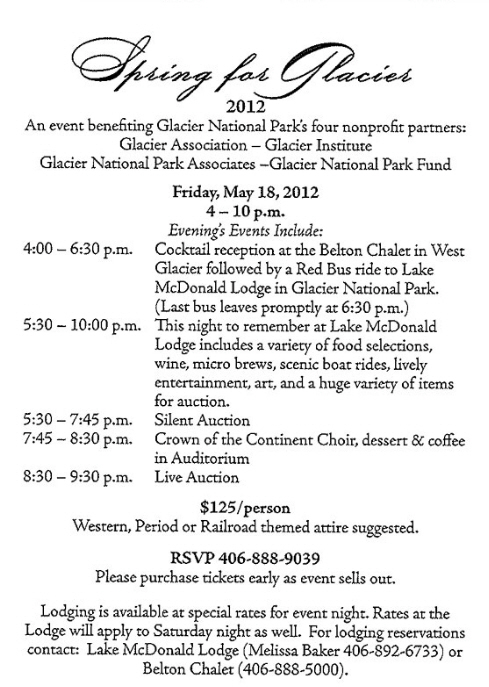
The Glacier Park Fund’s “Spring for Glacier” is a annual fundraising event benefiting Glacier National Park’s four non-profit partners. It features local silent auction items and live auction art from several well known artists. Lodging is also available at a special rate for the event night only – at both the Belton Chalet and Lake McDonald Lodge.
If I didn’t live on the far side of the country, I would definitely put on some railroad man clothes and show up for this event. For more information, click on the invitation graphic here:
While updating the Glacier page on my author’s website, I was happy to discover that the park’s concessionaire, Glacier Park, Inc. has also updated its website with fresh graphics and new information. I like the words on the company site: “Where the ordinary stops and the journey begins.”
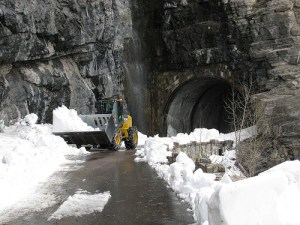
Spring Plowing: According to the National Park Service, “Currently 17.0 miles of the Going-to-the-Sun Road are open for travel. Visitors can drive 11.5 miles from the West Entrance to Lake McDonald Lodge, and 5.5 miles from the St. Mary Entrance to Rising Sun.” With luck, the spring plowing won’t be as lengthy as it was last year. Check here for the latest on road status.
Proposed Apgar Transit Center Parking Expansion: According to NPS Glacier, The Apgar Transit Center Parking Lot Expansion Environmental Assessment conducted by Glacier National Park specialists is available for public review and comment. Comments are due by May 7, 2012. The park is proposing to expand the Apgar Transit Center parking lot to accommodate increased visitor use of the transit center following the relocation of activities of the Apgar Visitor Center to the transit center. Click here if you wish you wish to comment.
11th Annual Crown of Continent Managers’ Forum: The 2012 Crown Manager’s Forum was held March 19-20 at the Lethbridge Lodge in Lethbridge, Alberta with “Tribes and First Nations in the Crown of the Continent” as this year’s theme. For information about the forum, click here.
Glacier National Park Fund Projects: Current projects include Historic Art and Archives, Historic Structures, Red Bus Endowment, Trails Endowment, Trails Rehabilitation and Native Plant Nursery. For information on these projects and ongoing research, click here. While the Fund has a $100,000 annual goal for trail restoration, I’ve seen no information yet on the proposed adopt-a-trail program mentioned in an earlier post.
Many Glacier Hotel Rehabilitation: According to NPS Glacier, “the rehab work is continuing this spring, but it will be complete by the opening on June 15th. All of the rooms will be available unlike last summer. The dining room is complete as well and the ceiling has been restored to its original height. In the future there is a potential there will be more work done, but at present, the rehab work is finished.” Updated 4/14/2012.
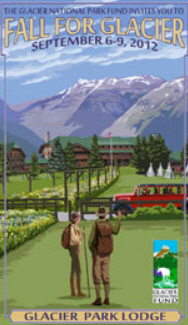
While spring has hardly sprung, especially in the high country, it’s time to make plans for autumn if you’re interested in this year’s Fall for Glacier September 9-12 experience at Glacier Park Lodge, East Glacier, Montana. Enjoy the following on this exclusive weekend:
Exclusive BNSF Railway Private Train Ride from Whitefish to Glacier Park Lodge.
Three nights stay at the century old Glacier Park Lodge in East Glacier including all meals
Blackfeet Reservation and Lewis and Clark historical tour
Special guests and Blackfeet interpretive programs by renowned ledger artist Terrance Guardipee and Native American Music Award winner Jack Gladstone
Red Jammer bus tours
Discover Glacier hikes and scenic boat ride with Park interpretive rangers and researchers.
Glacier High Tea with special guests
Horseback riding and golf in view of the majestic mountains of Glacier
Welcome reception Thursday evening
BBQ cookout and Great Northern Railroad history with special guests on Friday night
Tickets to the Backpackers Ball gala event on Saturday night– dinner, live performance by Jack Gladstone, and a live and silent auction of Glacier art, memorabilia, and outdoor packages.
Call 406-892-3250 for reservations and information or see the website here.
The weekend is sponsored by the Glacier National Park Fund. Stay tuned for information about the Fund’s soon-to-be-implemented Adopt-a-Trail program to help cover the costs of trail maintenance throughout the park.
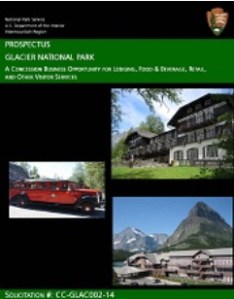 The National Park Service is seeking tenders for a concessioner to operate its facilities in Glacier National Park. The proposed concession contract would see 18 of the 33 Red buses decommissioned and replaced with new vehicles. This decision was made without any consultation with the public.








 Malcolm's Round Table