The Tate’s Hell Stories

“Who was Tate, you wonder? In Sumatra they still tell his story: how he left the frontier village at dusk a century ago with his two hunting dogs and his puppy Spark, to kill a panther that had been raiding Sumatra livestock. He carried a Long Tom shotgun and a Barlow knife, and he thought he knew where the darkening waters ran.”

– Gloria Jahoda, The Other Florida (1967)

Tate's Hell is a Florida state forest located in the panhandle counties of Franklin and Liberty. With diverse habitats, including a notorious swamp, it's named after the legendary Cebe Tate who was killed by a rattlesnake while hunting a panther there in 1875.
Tate’s Hell is a Florida forest located in the counties of Franklin and Liberty.

When my 1950s-era novella Conjure Woman’s Cat came out, my publisher said that with all the book’s mentions of Tate’s Hell Swamp, how about a Kindle series of stories about the place?

Fortunately I had a bunch of things on hand, including a short story from an anthology and scene from my out-of-print novel The Seeker that just happened to be set there and in nearby Carrabelle.

I couldn’t resist the idea of taking snakes to Eden. Most of all, I enjoyed learning more about the animals and their Florida wild places environments for the folktale collection.

I’ve enjoyed coming up with three short stories and one short collection of folktales for the series.
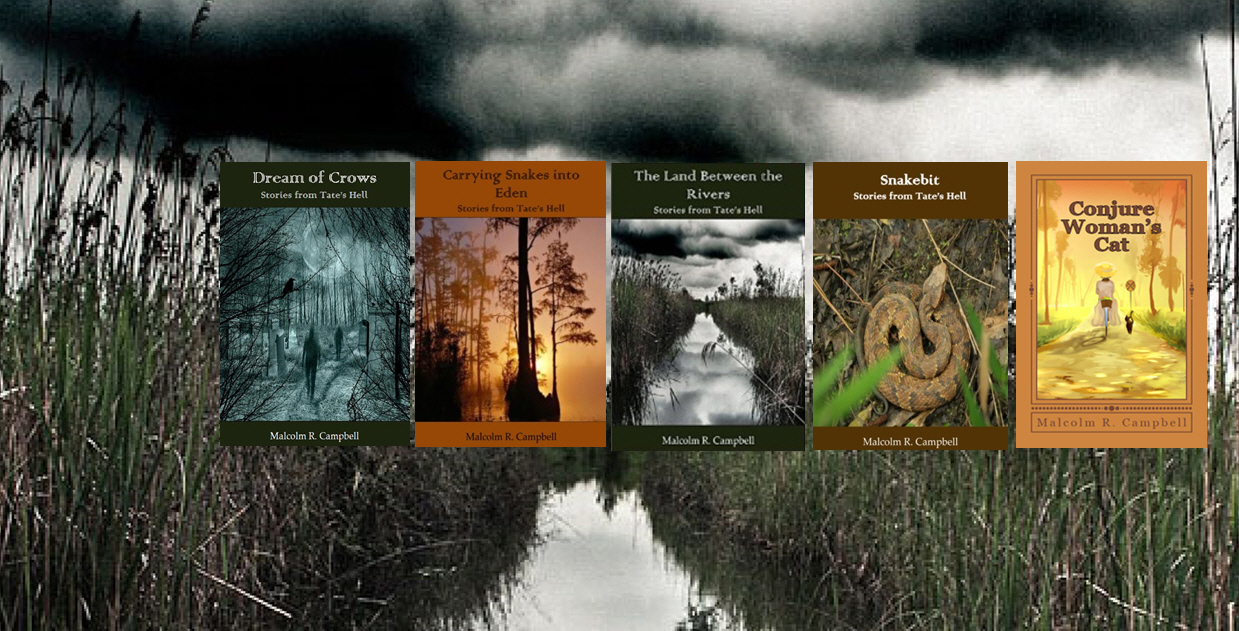
crowssmallcoverDream of Crows: This dark story about a businessman and a sexy conjure woman who lives next to a cemetery on the edge of Tate’s Hell is the most recent. It originally appeared in the Lascaux Prize 2014 Anthology.

If you’re prone to nightmares, be warned that this story is written in the second person and makes the reader the main character. Free June 24-28.

Opening lines: During the coroner’s inquest into the matter of your death, a well-meaning friend or relative will step forward with your affidavit stating that you read Dream of Crows because you saw it in your spouse’s copy of The Lascaux Review, heard several clerks at Barnes and Noble speculating about its deeper meanings, or—more likely—because you were intrigued by the probable connection between the short story and an odd string of assisted suicides in a Florida’s Tate’s Hell Swamp. 
SnakebitCOVERSnakebit: This slightly less dark short story came out just before Dream of Crows. Two college students fall in love while working as seasonal employees at a resort hotel in the northwest.

At the end of the summer, they return to their respective colleges that are far apart. When she’s assaulted on a dark street outside the college gates, she refuses to let him visit her. Finally, when he’s allowed to travel to Florida in June, he finds her much changed. The more he sees, the more he thinks he’ll have to sever the relationship. However, before he does so, the magic of Tate’s Hell intervenes.

The Dream: Then the squalling wheels in the coach’s rear truck in a tight curve fetched up the memory of the caterwauling panther of a nightmare that stalked him thirteen miles up the track. He ran between small ponds beneath a bright moon. Coowahchobee sprang out of a dark stand of hat-rack cypress and chased him through shallow water. He was trapped, suddenly, in an unyielding thicket of titi where the small white flowers exploded overhead like a dying constellation. He saw brown eyes above a deep growl that ran through his soul seconds before the claws snagged his left arm when the large cat dragged him away from the water. 

CarryingSnakesCoverCarrying Snakes Into Eden: “Eden” in this story refers to Florida’s former Garden of Eden attraction on the Apalachicola River. It’s rather a tongue in cheek story about two college students who pick up a hitchhiker with a sack of snakes he captured in Tate’s Hell. He says they’re need in the Garden of Eden.

The students learn that skipping church that Sunday morning may have long-term consequences.

Opening Lines: When John and I drove to Carrabelle on a gray Sunday morning for brunch with the Boynton sisters, skipping church was the least of our sins. Julie and Kathy were seniors, cheerleaders, and the most popular blondes in high school. John and I, mere juniors, wore clean sport shirts and Jade East aftershave. Brunch was canceled when the parents returned from New Orleans on Seaboard’s Gulf Wind a week early. They saved us from prospective sins of the flesh. But we weren’t home free. In fact, our transgression on that April day in 1961 was a first for the Florida Panhandle.

LandBetween2015The Land Between the Rivers: This series of three folktales set in Tate’s Hell at the dawn of time is introduced by Eulalie, my conjure woman in the novella. They begin where the Seminole creation myth leaves off with stories about Panther, Snakebird and Bear–the first animals to walk the earth in the old legends.

Panthers, of course, are highly endangered in Florida. When I was young, there were panthers in Tate’s Hell. Now they’re gone from the panhandle and can only be found in central and south Florida.

Openning Lines: One day when I was just a piddling kitten no bigger than a crow, I fell into Coowahchobee Creek while helping my conjure woman look for crawfish. The cold water spun me around like pinecone. I sulled up into a snarling fit three times my normal size and swatted the rocks and roots along the bank with my claws.
“Hush, little one,” Coowahchobee whispered. “Lena, look directly into Eulalie’s haint blue eyes and your thoughts will tell her you are ready to hear our stories.”
 

FBfivebooksCOVER

These stories all see for 99 cents and occasionally are featured free in book sales. I hope you enjoy them even if you don’t live in the Florida Panhandle.

–Malcolm

KIndle cover 200x300(1)“Conjure Woman’s Cat” is available on Kindle ($2.99) and in paperback ($8.58) and, in addition to Amazon, can also be found at Powell’s, B&N, Smashwords and other online book sellers.


New novella tells the story of a cat, a conjure woman and the KKK

Click here for Kindle edition.

Thomas-Jacob Publishing has released Conjure Woman’s Cat,  a novella by Malcolm R. Campbell (“The Sun Singer”), set in the 1950s Florida Panhandle world of blues, turpentine camps, root doctors, the KKK and a region of the state so far away from everywhere else that it’s often called “the other Florida” and “the forgotten coast.”

Lena, a shamanistic cat, and her conjure woman Eulalie live in a small town near the Apalachicola River in Florida’s lightly populated Liberty County where longleaf pines own the world. Black women look after white children in the homes of white families and are respected, even loved as individuals, but distrusted and kept separated and other as a group.

A palpable gloss, sweeter than the state’s prized tupelo honey, holds the spiritual and temporal components of the Blacks’ and Whites’ worlds firmly in the stasis of their separate places. When that gloss fails, the Klan restores the unnatural disorder of ideas and people that have fallen out of favor.

Click her to see the trailer.

Lena and Eulalie know the Klan. When the same white boys who once treated Eulalie as a surrogate parent rape and murder a black girl named Mattie near the saw mill, the police have no suspects and don’t intend to find any. Eulalie, who sees conjure as a way of helping the good Lord work His will, intends to set things right by “laying tricks.”

Eulalie believes that when you do a thing, you don’t look back to check on it because that shows the good Lord one’s not certain about what she did. It’s hard, though, not to look back on her own life and ponder how the decisions she made while drinking and singing at the local juke were, perhaps, the beginning of Mattie’s ending.

All that’s too broke to fix, but beneath the sweet sugar that covers crimes against Blacks, Eulalie’s pragmatic, no-nonsense otherness is the best mojo for righting wrongs against both the world and the heart.

I hope you enjoy the book.

–Malcolm

Conjure Woman’s Cat website

Paperback Edition at Amazon

Nook Edition at Barnes & Noble

Eulalie's world.
Eulalie’s world.


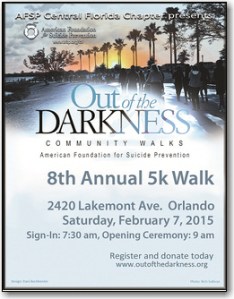
Out of the Darkness Walks – Team STRAT

outofdarknessThe Out of the Darkness Community Walks are the American Foundation for Suicide Prevention’s (AFSP) signature fundraising campaign, bringing together family, friends, colleagues, and supporters at 3-5 mile walks in hundreds of communities across the country.

When you walk in the Out of the Darkness Community Walks, you join the effort with thousands of people to raise funds and awareness for AFSP’s vision to create a world without suicide.

from Barry Campbell:

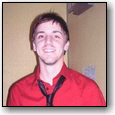
We will be walking on February 7, 2015, for David Campbell (aka STRAT) – beloved son, father, rap artist, poet, and friend.  He touched the lives of many and his footprints on their lives enhanced their world.  Although we have lost him in life, he will live through his son Taylor, his poetry, his music, and many wonderful memories.  He will be forever loved and remembered by his family and friends.

We will be joining with many other people to walk in the Orlando 8th Annual Community Walk, benefiting the American Foundation for Suicide Prevention (AFSP), and we would appreciate any support that you give for this worthwhile cause.

STRAT
STRAT

The American Foundation for Suicide Prevention is at the forefront of research, education and prevention initiatives designed to reduce loss of life from suicide. With more than 39,000 lives lost each year in the U.S. and over one million worldwide, the importance of AFSP’s mission has never been greater, nor our work more urgent.

You can visit the Team STRAT page here. My wife and I miss David (STRAT) as well as his creativity expressed through his songs and poetry. And, like my brother and his wife, we enjoy watching David’s son Taylor growing up even though we live too far away from Orlando to see him as often as we would like.

These walks not only help raise funds but are walks of a million memories.

Malcolm


Sky, from the toes up

“I thank you God for this most amazing day, for the leaping greenly spirits of trees, and for the blue dream of sky and for everything which is natural, which is infinite, which is yes.” – e. e. cummings

When I was in the first or second grade and learned that the earth revolves, I wondered why the ground did not move beneath my feet when I jumped. How perplexing; I come down just where I started, I thought.

My dad explained that the atmosphere moves with the earth and, in fact, if it didn’t, there would be a substantial windstorm blowing us down around the clock.

For years, I viewed the sky as something far way, especially on clear nights when the stars—according to my observations—moved on flight paths much more distant that clouds, airplanes, or the helium balloons that escaped our grasp at the county fair.

I supposed at an early age that an ant’s view of the sky includes everything from my toes up. My feet are shadows and my hands are clouds and my head is a far planet. I believed they were misinformed and/or had poor eyesight because the sky was miles away.

Dog Island (marked with an “A”) is three and a half miles off the coast.

Early on a Saturday morning when I was in high school, I went to Alligator Bay on the Gulf Coast south of Tallahassee, Florida, with Tommy and Jonathan for a boat ride over to Dog Island. Jonathan’s family had a speed boat anchored just off the beach near his family’s summer cottage. The faraway sky was blue and cloudless, and the water was tranquil.

After a day of swimming, snorkeling and sand-dune exploring, we headed back just as a storm began developing farther to the west. The sky grew very dark before we reached the bay sheltered by Alligator Point. The high chop of the waves slowed our progress, so the afternoon was winding down before we set the anchor and waded ashore. We were quite relieved we hadn’t swamped the boat, something we hadn’t done for a year or two.

As we stood watching the storm pass by outside the bay, the setting sun appeared low on the western horizon with one of the most spectacular golden sunsets I have ever seen. The beach, the boat, and the surf were bright orange and glowing with light. Meanwhile, the lightning from the passing storm to the south of us, was also bright orange, and it hissed as it snaked across the sky over our heads and shook the world with its hollow thunder.

We stood without saying a word, and to this day, I think those moments still represent one of the most mystical experiences I have ever had. On that golden beach just out of the storm’s reach, everything was possible and yes and hopeful and connected. “The sky is everywhere, it begins at your feet,” wrote Jandy Nelson in her young adult novel. Yes it is, and on that afternoon, it was clear to me that I stood within the sky and not below it.

–Malcolm

This post originally appeared on my Magic Moments weblog. As I get ready to shut down that blog, I thought I’d run a few of my favorite posts from the archive. Looking back on that day on the beach made it easier for me to understand a quote from “Seth” in the books by Jane Roberts: “There is no place where consciousness stops and the environment begins, or vice versa.”

Hello Florida Readers: Need fantasy, magic and ghosts?

One of my contemporary fantasy novels, three paranormal short stories and a collection of three folk tales have Florida settings. I grew up in Tallahassee and explored most of the state’s panhandle, so I enjoy going back for story locations.

  • The Seeker: (Tallahassee, Panacea, Carrabelle, Tate’s Hell Forest) – Contemporary fanntasy novel about a perfect love gone horribly wrong between a young man from Montana and a young woman from Carrabelle who meet on a summer job in Montana’s Glacier National Park. Misunderstandings arise after the young woman is assaulted on a dark, Tallahassee street.

    Paperback, Kindle and Audiobook, and they are family friendly.
    Paperback, Kindle and Audiobook, and they are family friendly.
  • Emily’s Stories: (Tallahassee, St. Marks) – This three story set of magical paranormal stories features a 14-year-old girl who talks to ghosts and birds to solve problems. She doesn’t want a housing development in her favorite woods, sees a bear stalking her father on a Montana vacation, and wonders why her grandmother loves the sweetbay magnolia tree in her back yard so much. The audiobook was narrated by actress Kelley Hazen who makes you feel like you’re right there in the stories.
  • Cora’s Crossing (Marianna) – In this paranormal story, two college students driving home on a stormy night find their route oddly detoured across an ancient, haunted bridge north of Marianna. What they find there, and the danger it gets them into, will make them truly believe that Bellamy Bridge is haunted. The bridge, which is still there, is closed to vehicles but can be reached by a trail.
  • Moonlight and Ghosts (Tallahassee) – An abandoned and purportedly haunted mental hospital attracts the attention of a young man who used to work there. Something or someone wants him to return and, as it turns out, solve a crime in progress. Needless to say, this is a paranormal story, but it also ties into my experiences years ago as a manager at a center for the developmentally disabled.
  • Spooky Stories (Marianna, Tallahassee) – This two-story set bundles “Cora’s Crossing” and “Moonlight and Ghosts” together in one volume. This edition is also available as an audiobook.
  • Kindle and Audiobook
    Kindle and Audiobook

    The Land Between the Rivers (Tate’s Hell Forest) – This three-story set of folktales features Panther, Snakebird and Bear at the dawn of time as they make their way through the wetlands and flatwoods between the Apalachicola and the Ochlockonee rivers. I camped and hiked throughout this area when I was growing up, so it’s a favorite of mine–one that still needs the determined efforts of those protecting Florida’s endangered species of plants and animals in the state’s at-risk ecosystems.

  • My work in progress is a folk magic story set in Liberty County in the 1950s. The characters include a conjure woman, her cat, her customers, and some really nasty people who need to be jinxed. More on this later.

Malcolm

New Personal Note: The HVAC Georgia Summer Blues

Briefly noted: ‘Mercedes Wore Black,’ by Andrea Brunais

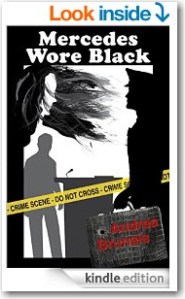
Mercedes Wore Black, by Andrea Brunais, Southern Yellow Pine Publishing (June 14, 2014), 291pp.

mercedesworeblackI’m enjoying this smartly written political thriller set in Florida where I grew up. As a former college publications adviser from a “journalist family,” I see immediately that Andrea Brunais knows the world of reporting and gets it right, especially in the domains of murder, political intrigue and the often-losing out Florida environment.

From the Publisher

Florida Politics. The only thing predictable is the unpredictability. When Janis is fired from her job at the newspaper, she focuses on the causes that matter to her. The environment and the economy. That embroils her in the 2014 election.

When her good friend Mercedes encounters danger and is brutally murdered, Janis begins to investigate. She finds herself in a political maelstrom of big money, lottery, and interests with opposing goals. Will she be able to find the crux of the problem—and Mercedes’ killer? Will she be able to expose corruption before anyone else is put in danger?

Quotes from the Reviews

  • “Fast-paced, exquisitely written, Mercedes Wore Black vividly depicts the underbelly of the newspaper industry and the all-too-real shenanigans of those who are ever willing to sacrifice Florida’s natural treasures” – Joe Guidry, The Tampa Tribune
  • “A fast-moving story with as much Florida flavor as a grouper sandwich.” Daniel Berger, Amazon reader review.

Floridians especially will enjoy this novel for it is rich in recent political history, on-going environmental issues pitting development against the land, and places state residents know well such as Tate’s Hell Forest, Sopchoppy, Bradenton, Tallahassee and Wakulla Springs. While these strengths will endear the book to Florida readers, they could be a little too much for those in other parts of the country–could be, for the intrigue is high level and will carry readers past the heavy local color.

I spent many hours at Wakulla Springs, a half hour south of Tallahassee where I grew up, and I always saw its old-Florida charm as unique and a bit strange. Now, after the protagonist’s best friend is murdered there  in Mercedes Wore Black, I don’t think I’ll ever see this home of snake birds, limpkins, turtles, and icy cold water the same again.

Highly recommended. See the full review here.

Malcolm

Malcolm R. Campbell’s Florida short stories include “Moonlight and Ghosts,” (Tallahassee) “Cora’s Crossing,” (Marianna) “Emily’s Stories,” (St. Marks)  and “The Land Between the Rivers.” (Tate’s Hell Swamp) His novel “The Seeker” includes major scenes at Alligator Point and Tate’s Hell.


On location: your childhood growing up place

“Everywhere that July in 1963 there were the pines, their long needles shimmering in a faint wind under the hot subtropical sun. In the country there were empty dirt roads, rutted by mule carts. In the towns, sprawled unpainted shacks without windows. Ancient Negro women sat fanning themselves with palm leaves as they stared drowsily from rickety porches at their zinnias and coral vines and heavy-scented honeysuckle bushes. Moss-draped oaks and lacy chinaberry trees shaded sandy dooryards. Scrawny dogs, the flies buzzing at their noses, slept among ragged-feathered chickens poking for scratch feed. Locusts whine from tall magnolias and the steady pitch of power saws. But mostly it was those pines and the tang of their resiny branches and the dark straightness of their trunks. All of it looked like the south of the novelists and the poets, heavy with antiquity, romance and misery.” – Gloria Johoda in “The Other Florida.”

longleafforestI was in college in 1963 when my friend Gloria Jahoda wrote those words. Like me, she wasn’t born in Florida, but in her now-classic book about the state’s panhandle she observed and wrote about what many long-time residents no longer noticed or took for granted. “The Other Florida” was other because it wasn’t filled with tourist attractions, widely known beaches and movie stars.

Other than a few childhood poems, I wouldn’t write about the other Florida until recently. My family moved there from Oregon just in time for me to enter the first grade. Out of the culture shock of the move, I also saw the place I would live for 18 years through the eyes of an outsider.

Yes, my family went to St. Augustine, Tampa, Daytona Beach and Key West, stopping at many gaudy tourist attractions in between. But all that was crowded and nearly fake with an overlay of commercial glitz and I was always happy to be home even though much of the panhandle was considered backward and impoverished in spite of having the state capital in the middle of it.

The place is abandoned now, but this was my favorite place to eat down at the coast
The Oaks is abandoned now, but this was my favorite place to eat down at the coast

I haven’t been back to north Florida since the mid-1980s when my parents died and my brothers and I closed up and sold the house the family had lived (by then) for some 35 years.

In my childhood days, I learned the territory like most kids did…swimming in clear, cold sinkholes, camping with the Boy Scout Troop in the piney woods, hanging out with friends at our pristine and uncommercialized beaches, exploring the Florida Caverns at Marianna, deep sea fishing in boats that went out from St. Marks, learning the voices of Snake Birds and Limpkins at Wakulla Springs, delivering newspapers throughout my neighborhood, marching in parades downtown with the high school band. . .

We lived in Tallahassee in a day when mule wagons were still on the streets and many homes were built on unpaved, red clay roads.

I saw what Jahoda saw, partly because I was new, partly because the outdoors was our playground in days before the Internet, and partly because my folks arranged day trips to may special places within the confines of this map. In the days before high gasoline prices, my best thinking place was my 1954 Chevy on a dark country road at night. I don’t know what I solved anything, but I saw a lot on the hundreds of miles of roads I saw every week.

Looking Back

There were 40 pine trees in our yard. Plenty of pine straw to take.

If you’re a writer, I urge you to look back to your childhood places and ponder what it was like, what there was to do, what the people were like, and what kinds of stories and legends you heard. Whether you were happy, sad, or borderline average during those days, the memories are potentially very potent.

In looking back, I’ve written (or am in the process of writing) stories on that map set in Carrabelle and nearby Tate’s Hell Swamp, Marianna and the nearby Bellamy Bridge and Chipola River, Tallahassee, St. Marks, Wakulla County, and the barrier islands. My novella in progress is set at a fictional town not too far from Weewahitchka. You can probably find a similar handful of towns near your childhood home. Each has its unusual traditions, the stories people hope everyone has forgotten, legends, ghostly tales, and plenty of Mother Nature.

Florida seems strange to those who did not live there. The same can be said for other places I’ve lived, worked or visited: Northern Illinois, Minnesota, San Francisco, Montana, North Carolina, and North Eastern Georgia. For a writer, a lot of the appeal of going home (literally or figuratively) for stories is the differentness of the place. That adds a lot of appeal to a story. Take a Florida tradition, add in the weather and the pines, toss in a ghost story, and pretty soon you are telling something fresh and knew and page-turning.

You can ramp up your stories with old memories, smiling again with the the joys, possibly even finding closure for the sorrows; your issues, your cares, your friends, your slings and arrows, your memories can be puzzled and camouflaged into your story. They bring strength and depth because you lived them and know what they were all about.

I’ve about wrapped up my Weewahitchka-area story. It gets a potent childhood issue off my plate of memories. More about that later if the publisher likes the story. I think I’ve written some of my best stuff about the places where I grew up because there is so much “material” there I can turn into fiction. That’s why I often urge other writers to look at the towns where they grew up with fresh eyes and see if they can find some stories there.

–Malcolm

$1.99 on Kindle
$1.99 on Kindle

My stories with Florida settings include “The Seeker” (Tallahassee, Carrabelle, Tate’s Hell), “Emily’s Stories” (Tallahassee and St. Marks), “Cora’s Crossing” (Marianna), “The Land Between the Rivers” (Tate’s Hell) and “Moonlight and Ghosts” (Tallahassee).


Review: ‘Suicide Supper Club’ by Rhett DeVane

suicidesupperclub“Life is crap and the weather is stupid-hot: reasons enough for four small-town Southern women to plan ‘the easy way out,’” the publisher’s description for Suicide Supper Club informs us. Rhett DeVane (“Cathead Crazy”) brings her trademark sparkling prose and deep insights into human nature to this story of the darkness and light in the lives of Abby, Loiscell, Sheila and “Choo-choo.”

Truth be told, the light is in short supply.

The lives of these kindred spirits play out in the Florida Panhandle between Chattahoochee, a small town with a main street dominated by a mental institution, and Tallahassee, the state capital, 44 miles away. Most of the festering family secrets, declining health, estrangement and physical abuse live and breathe in Chattahoochee for Abby, Loiscell, Sheila and Choo-choo. Tallahassee is for shopping, fine dining, cancer treatments and a prospective appointment with a hit man.

Suicide and humor are usually mutually exclusive worlds. But they seamlessly merge through DeVane’s inventive plot, fully realized characters, knowledge of Southern life and customs, and sense of place. Readers cannot help but feel the characters’ reactions to the darkness in their lives and, quite possibly, understand the rationale for a suicide supper club.

The light in Suicide Supper Club comes from the great love and esteem the four women have for each other and the ways they find for coping with the Florida heat and the crap. I grew up in the Florida panhandle, so it was easy for me to see near the beginning of this novel that when it comes to Chattahoochee and Tallahassee and the people who live there, Rhett DeVane gets it right.

You’ll see that, too, long before you reach the last page and learn whether or not Abby, Loiscell, Sheila and Choo-choo are still among the living.

Malcolm

Throwback Thursday: Kim’s Guide to Florida

1950 edition
1950 edition

In 1934, Ethel Byrum Kimball of Anna Maria, Florida wrote the first edition of a soon-to-be-popular publication called Kim’s Guide to Florida. According to a story in The Miami News called Homemaker Writes New Florida Book Guide to State, the guide included “high points of interest, centering about places throughout the state with just enough of comment to stir the imagination or clarify vague knowledge.”

When my family moved from Oregon to Florida in 1950, my father bought a copy of the ninth edition of the guide to help all of us acclimate to the state and plan future vacations that took us from Tallahassee to Pensacola and from Jacksonville to Key West. Based on the guide, we saw attractions that now seem rough and tumble and unsophisticated in their style and presentation compared to the high-style condos and theme parks that would later take over much of the state’s formerly pristine property.

In the introduction to the ninth edition, Kimball wrote, “Ponce de Leon led the way to Florida. During the more than four hundred years since that memorable occasion, Progress has marched valiantly over this ‘Land of Flowers.’ He has left much of the old and added the new, complementing the magnanimous gifts of Nature.”

While I often argue that “progress” went too far in Florida, concealing or destroying many of the ‘gifts of Nature,’ the spirit of the Sunshine State in the 1950s was a heady combination of cattle, orange groves, backwoods and coastal local businesses and tourist attractions. In an article called “The Nation’s Solarium,” the guide said the state was, among other things, “a place for rejuvenating rest to the weary and ill, a place where children grow strong and a nation recreates.”

What to See

Florida was salt war fishing, fresh water fishing, state parks and the Everglades National Park, flowers and plants, forest lands and the “romance of citrus.” Florida was marine shells and subtropical fruists and tourist attractions grouped by city. There were multiple black and white photographs of major points of interest. Ads invited tourists to visit Monkey Jungle, Theater of the Sea, Ravine Gardens, Cypress Gardens, Ste. Anne Shrine, Rainbow Springs and the “Spring of the Mermaids” called Weekiwachee.

We saw the state from Wakulla Springs to Silver Springs and from Castillo de San Marcos to Bok Tower guided by Kim’s Guide to Florida. Many of the older attractions have disappeared over the years, but looking through my 1950s copy of the guide long after the fact, I think that each of our vacations in those days could easily have been filed under the words “it was quite a trip.”

–Malcolm


Saving the Florida Panther – I hope it’s not too late

“The Florida Panther is one of the most endangered mammals on the planet. Less than 160 cats remain in the wild. Most live around Okaloacoochee Slough, including the Florida Panther National Wildlife Refuge, near Naples.” – The Nature Conservancy

floridapantherI grew up in North Florida during the 1950s and 1960s before the state became as overdeveloped as it is now. At the time, there was a captive Florida Panther at a local animal museum that had been injured either by guns or automobiles and was there to recover. It was my favorite animal in the place, one that still lived in the wild in the Florida Panhandle.

In my contemporary fantasy novel The Seeker, (2022 update – now out of print) some of the action takes place at a wild, wonderful and somewhat forbidding tract of piney woods, swamps and wet prairies near the mouth of the Apalachicola River called “Tate’s Hell.” That name comes from the legendary man named Cebe Tate who chased a panther through the swamp because he thought it was killing his stock. He disappeared.

He was bitten by a rattlesnake. When searchers found him, his last words were, “My name’s Tate and I’ve been through hell.”

I grew up with that legend–one that included a folk song about Tate by Florida singer Will McLean–and knew the area well. So naturally, I mentioned the legend in my novel which is set at a time when Panthers were still there.

Catching up on the status of the Panther as I wrote the novel was a sad experience. While I was pleased to hear that in addition to the Nature Conservancy, organizations like Panther Net and Friends of the Florida Panther Refuge were working hard to protect the panther and its vanishing habitat, I was saddened to see how much ground and how many panthers had been lost since the says when I hiked in Tate’s Hell.

One conservation push in many areas of the country is wildlife corridors, protected strips or chunks of land that link up with vital habitats, creating a way for animals to travel between them. In some places, you will see green-space overpasses and underpasses routing animals past Interstate highways. Last year, the Nature Conservancy was able to protect a 1,278 acre tract in Glades County, Florida that Panthers in protected areas can use to increase the size of their range near Naples, FL.

According to the Nature Conservancy, “This acquisition will encourage the natural recovery of the Florida panther population by providing habitat where animals can den and stalk prey, and migrate from southern Florida to areas north of the river. Other species will benefit as well.” The range for a male panther is 200 square miles. The range for a female panther is a 75-mile block within the male’s territory.

I hope the efforts of hard-working people to save the Florida Panther will succeed. In a tourist and development-minded state, playgrounds often trump wild places and vital habitats in the eyes of the government, Chambers of Commerce, and the public. Too bad. It’s a short-sighted view of one’s world.

Malcolm

helppantherbanner