Vila SpiderHawk’s Books Reflect a Love of the Natural World

Vila SpiderHawk is the author of three magical novels that follow the coming-of-age adventures of protagonist Judy Bauman in the disputed German-Polish border territories prior to and during World War II: Forest Song: Finding Home (2008), Forest Song: Little Mother (2009) and Forest Song: Letting Go (2010). Vila is also the author of the Forest Song Cookbook (2009), featuring recipes from the series, and Hidden Passages: Tales to Honor the Crones (2007), a collection of stories about old women and their celebration of life and wisdom. Vila and her husband live in a log house in the Pennsylvania forestland.

Malcolm: Welcome to Malcolm’s Round Table, Vila. You introduced readers to protagonist Judy Bauman in Forest Song: Finding Home set in 1929 to 1933 in territory claimed by both Germany and Poland on the eve of World War II. What attracted you to this time and place for your novel’s setting?

Vila: Thank you for your hospitality and thoughtful questions, Malcolm. It’s very kind of you to do this interview with me.

Why the World War II era in the Polish-German Corridor? I am of German descent and was born in 1945. I grew up in careful silence about the horror of the Holocaust. We didn’t even learn it in school, since it was still too new to be in the history books. It wasn’t until I went to high school that I got my introduction to the period, and that was very sketchy. Nonetheless, I have always felt a pull to the time and place. Call it racial guilt. Call it something else. Whatever it is, I needed to know what caused a people to do such terrible things. And so I studied the era in college.

However, I was never satisfied with the answers the books gave for that terrible time, and so I have carried this need around all these years. Therefore, when I met Judy and she turned out to have lived in that time, I invited her in to tell me her story.

You see, I do not create my characters. They come to me, fully formed and talkative. Judy is downright overbearing sometimes. In any case, I channeled her, since she, too, cares deeply about the “whys” of things.

But there is an additional reason. I worry that our country could become the Germany of the Holocaust. I worry about Guantanamo and the attitude we generally have about Muslims just now. While I am sure some Jews in Germany fit the Nazi stereotype, since all stereotypes have a glimmer of truth to them, I believe and indeed have found that most Jews were just hardworking people trying to live decently and to raise their children well while keeping the bills paid. And, while some Muslims fit the stereotype we have created for them, most, I believe, are like the majority of German Jews. All they want is to live decent lives, to raise moral and educated children, and to pay the bills. It’s not rocket science. People are people. Most are, at bottom, very conscientious.
Malcolm: As I read Forest Song: Finding Home, I discovered an interwoven mix of history, German and Polish life and culture, Craft traditions and rituals, and faerie magic. When prospective writers ask what you write about, how do you describe the Forest Song books’ genre and overarching themes?

Vila: Oh boy it’s really difficult for me to place the Forest Song series into a tidy little box. I have classified it as historical fiction, since it has elements of that. I have also classified it as fantasy, since it has aspects that people like to call fantasy. But in truth, it doesn’t really fit tidily into any single category.

When people ask me what I write about, I usually tell them I write about life, in all its complexities. As is true of all of us, Judy’s is a creature of her culture and her era. Her spirituality is an important aspect of her attitudes as well, as it is with most of us. Sometimes she believes she’s going from point A to point B and she ends up at point H, as often happens in life. My stories are not straightforward, because life isn’t straightforward. This becomes more obvious in the later volumes of the Forest Song series but is already visible in Finding Home.

Malcolm: Fairy tales and myths frequently use the forest outside the city gates as a dangerous and/or magical realm of non-ordinary reality where characters go for heroes’ adventures and seekers’ coming of age stories with a strong focus on the protagonist’s transcendent or psychological “the inner journey.” Did a life-long appreciation of myths and folktales greatly influence your approach to Judy’s story and her drive to leave the claustrophobic and limiting world of her parents’ farm for the freedom of the forest?

Vila: Fairy tales are highly allegorical. The forest in fairy tales usually symbolizes the darkness and the space in which people reflect and learn, acquiring wisdom. Thus Persephone goes into the Underworld as a child and emerges with a woman’s wisdom and responsibilities. The forest is our Underworld.

Having said that, I did not grow up reading and loving fairy tales. That came later. But I have always felt the pull of the woods. I always felt I would not satisfy my destiny until I had escaped the clatter, stench, and hustle of the city and had moved into the green serenity of the trees. And, in truth, I didn’t. Though I have always written, it wasn’t until I had moved here and had explored my inner wisdom that I finally felt ready to write for publication.

Malcolm: I am amazed at the breadth and scope of the Forest Song books insofar as the author’s personal knowledge and research required for the plot and setting. How did you approach and organize the books’ details so that they fit hand in glove with recorded history, actual trees and plants available (and seasonally, when they bloomed) in the disputed territories, local customs, Craft traditions specific to Germany and Poland at that time, relevant folktales, and even kinds of clothing, furnishings and products available in a typical farm family’s house?

Vila: I don’t organize my books. My characters do that. They tell me their basic stories in bare bones language. Then it’s up to me to make art of their tales. Once I have the basic facts, I spend a great deal of time researching. One of the reasons I am such a slow writer is that I try to check every little detail to be sure it’s true. Judy opens herself up to me. She lays herself bare. That requires a great deal of trust. I need to be worthy of that trust. That means that I have to be sure that every detail I include in her story is true. I read many books before I sat down to write this series, and I have read many more along the way.

Malcolm: Your pseudonym combines “Vila,” a goddess, with “Spider” and “Hawk.” How did you choose this unique pseudonym and how does its meaning correlate with the intentions and perspectives behind your writing?

Vila: I chose Vila SpiderHawk very carefully. Vila is an eastern European Goddess of the woods. She is a shape shifter and the protector of the forest and all who live there. She heals with herbs. I identify with all that. She also dances hunters to death. There are times when I really identify with that as well, since I am a vegan. I chose the name long before I realized I’d be telling Judy’s story, though.

Spider is a contemplative creature. Spider spends her time between earth, the concrete, and air, inspiration. She chooses not to hunt. Instead she waits for food to come to her. She is patient. She knows that the Universe will provide her daily needs. She reminds us to see the importance of patience and spirituality. She reminds us to see the divine in all creatures, however small, however mundane.

Hawk, on the other hand, is aggressive. Her vision is sharp, and her reflexes are quick. She is a merciless hunter. She soars. She spreads her wings and touches the clouds. She is as free as it is possible to be in this life.

I am both Spider and Hawk. I am contemplative and introspective. I understand that the Universe will provide what I need as long as I have the wit to ask for it and the patience to accept that it will come in its own good time. But I am also Hawk. I can be aggressive and merciless. I tend to see sharply. And there are times when I positively soar. The Spider in me tempers the Hawk. The Hawk in me reminds me that sometimes it is necessary to be aggressive and to see sharply. And, while it’s wonderful to experience a meditative state, it is such a delight to soar.

Malcolm: In addition to exciting stories, what memories, dreams and reflections do you hope your readers will carry away with them after reading the Forest Song novels?

Vila: What the reader takes away from my books is really up to the reader. Each person brings her own experience, her own baggage, her own spirituality, and her own longings to the books she reads. Each person will take away an individual package of dreams and reflections. I don’t feel I can dictate or even suggest the “right” hopes, the “right” insights for the reader. I simply hope that each book sings to each individual in a way that feeds her soul.
Malcolm: The use of the word “crone” in your Hidden Passages collection of stories straddles a paradox. In mainstream society, the seldom-used word is generally used to malign and discount older women in a patriarchal society. Yet, in historical matriarchal societies and in the Craft and goddess traditions, the word is used as a reverent term of endearment and respect. Did you have any second thoughts or concerns about using the word “crone” in your title or was it especially appropriate to the book’s theme and intent in spite of some mainstream connotations?

Vila: I was very adamant about using the word “Crone” in the title of Hidden Passages. I deeply resent the fact that we dismiss old women in particular but old men too as useless dead weight when, given their experience and wisdom, they have so very much to offer. I think we would be a better society if we actually respected more the feminine principle of giving and nurturing life and if we understood down to the marrow of our bones how very much we owe those wonderful women who raised us.

I grew up in the company of old women. I have always treasured them. And now that I am one, I value old women even more. I understand now that, while those wonderful women who raised me were old and wise and generous and dear, they still had all the eagerness and, yes, insecurities of youth. To me the word “Crone” encapsulates all that is woman—the maiden who is brash and flirty, fearless yet vulnerable; the mother who will sacrifice anything to give her child a better life, the woman who teaches and nurtures and worries and rejoices in and about her children; and the creature we see superficially as the Crone who knows pain, who has experienced death and loss and has endured anyway. The word Crone to me is not simply a title of respect. It is, in my opinion, the finest appellation anyone can call a woman.

Malcolm: Your characters use a lot of herbs found growing naturally in the woods where they live. If one chanced by your log cabin, would they find you out in the woods gathering and drying herbs, and then using them in the teas and meals you serve at your table?
Vila: Oh boy would they ever! Of course, I have an herb garden. Well, I wouldn’t exactly call it that. I’m not sure it’s organized enough to warrant the name “garden”. But I grow all kinds of culinary and other herbs as ground covers instead of grass. And I do cut from the herbs for cooking and other purposes during growing season. I dry herbs in autumn for winter use as well. My house smells like vegetable soup through the autumn with all the herbs drying. But I also harvest herbs from the woods. Mostly that’s just an excuse to go out into the trees and to feel the woodland energy all around me. But yes, herbs are very important to me. Not only do they make food taste fantastic, they have enormous healing power that many European countries still recognize. Hopefully, we’ll get back to more natural healing methods in this country too.

Malcolm: Thank you so much for stopping by and chatting today.

Malcolm

Crawford W. Long Museum Included in Civil War Sites Guidebook

The Crawford W. Long Museum in Jefferson is among the 350 historic sites included in Crossroads of Conflict: Guide to Civil War Sites in Georgia from the University of Georgia Press.

The entry, which includes a photograph of the museum’s historic 1858 Pendergrass Store, notes that the facility “honors the physician Crawford W. Long, who attended the University of Georgia where he roomed with Alexander H. Stephens, the future vice president of the Confederacy. Long is credited as the first physician to use ether for surgical purposes.” Long served in the Athens, Georgia Home Guard and as a surgeon for the Confederacy.

Written by Barry L. Brown and Gordon R. Elwell, the Georgia Civil War Commission publication is an expanded update of the 1994 edition of the guidebook. The 304-page new edition, which arranges Georgia sites into nine regions beginning with the Chickamauga Battlefield in the northwest, includes 65 black and white photographs, 190 color photographs and images, and twenty maps.

According to the University of Georgia Press, “The impact of the Civil War on Georgia was greater than any other event in the state’s history. Approximately eleven thousand Georgians were killed and the state suffered more than one hundred thousand in total casualties. Georgia was extremely influential in this nation’s most tragic conflict, and the war touched every corner of the state.”

Born in Danielsville, Georgia, Crawford W. Long (1815-1878) first used ether for surgical anesthesia on March 30, 1842.

“Do a Georgia resident, friend planning a cultural tourism vacation to the South, or student of the Civil War might enjoy this guidebook? If so, click the Share This button below to send a link by email or recommend this post on your favorite social site.”

Coming Attractions on Malcolm’s Round Table

November 17 – An interview with author Vila Spiderhawk
November 21 – Second Annual Blog Jog Day
December 17 – Virtual VHP Dine-a-Round

Malcolm

Book Review: ‘The Last Templar’

The Last TemplarThe Last Templar by Raymond Khoury
My rating: 3 of 5 stars

Raymond Khoury’s “The Last Templar” (2006) is part of a deluge of novels and nonfiction to step outside mainstream history to explore the real, prospective and imagined secrets about alchemy, the Knights Templar, and the origins of Christianity.

One cannot help but think of Katherine Neville’s “The Eight” (1997) which focused on present-day people fighting over and/or guarding the secrets of the Philosopher’s Stone and Dan Brown’s “The Da Vinci Code” (2003) which speculated about the true meaning of the Holy Grail and the bloodline of Christ. Many of Neville’s, Brown’s and Khoury’s fans were also attracted to such nonfiction as “Holy Blood, Holy Grail” (Baigent, Leigh and Lincoln, 1982) and Lynn Picknett’s “The Templar Revelation” (1997).

It is difficult to read, much less discuss, Neville, Brown and Khoury without acknowledging the fact that fact that they are part of a rather unique genre of spiritual conspiracy fiction that seemed to fill a need in the public psyche for truths thought to be missing from the tenets of Catholic and Protestant theology.

Neville’s “The Eight” was, perhaps, the first to popularize this “genre’s” style and focus: hidden wisdom, long-time conspiracies, compelling present-day mystery/thriller action, and numerous (and lengthy) history lessons. Since her focus was alchemy, Neville’s “The Eight” didn’t ignite the kind of controversy generated by Brown’s “The Da Vinci Code” which, some might say, hit us where we lived if not where we worshipped.

Like Neville, Khoury tells his story with a modern-day and a historical timeline. “The Last Templar” begins with what Booklist called “one of the most gripping opening scenes among recent thrillers.” Four horsemen dressed in Knights Templar regalia steal artifacts from a Metropolitan Museum of Art show of Vatican treasures, including a “decoder.” The other story line focuses on the last days of the Knights Templar as the Holy Land is “lost” with the fall of Acre in 1291 and the subsequent pilgrimage of a few surviving knights to safeguard the Templars’ treasure.

Publisher’s Weekly was less kind than Booklist, saying that the “war between the Catholic Church and the Gnostic insurgency drags on in this ponderous ‘Da Vinci Code’ knockoff.” Many readers criticized Dan Brown in “The Da Vinci Code” for constantly stopping the otherwise full-speed action of the book while one character filled in another character about the secrets of Mary Magdalene, the Grail, the actions of the Catholic Church, and Jesus’ bloodline.

In my view, “The Last Templar” carries such backstory diversions to an extreme. Picture, if you will, whether it’s plausible that FBI operatives investigating the raid on the museum, the stolen treasurers, and the continuing deaths would spend hours discussing Templar history in great detail.

The greatest fault with “The Eight,” “The Da Vinci Code,” and “The Last Templar,” is the fact that some characters must provide other characters with long-winded and unrealistic diversions into history, philosophy and theology because general readers are not likely to know the facts and the latest theories involved. The authors have felt that without these history lessons, the plots wouldn’t make sense.

I liked “The Last Templar” better than Publisher’s Weekly, but not as much as Booklist. The history was interesting, though I’d seen it all before. The plot was imaginative and included some page-turner action scenes involving the church, the thieves, the FBI and protagonist Tess Chaykin, an archeologist who witnesses the raid. The ending, while not wholly unreasonable was, I think, unsatisfactory, especially for those readers who not only want to know what the Templars’ secret but are angry that a real or a fictionalized church would deem it necessary to suppress the truth at all costs.

The romantic feelings between Tess and the head FBI agent add a variety of complications to the story, some of which lead into exciting action scenes even though the relationship within the book is rather forced and tedious.

For readers who have enjoyed the fiction and nonfiction in this wave of spiritual conspiracy books, “The Last Templar” is interesting escapist reading even though those who have seen it all before may speed-read through some of the Templar history.

View all my reviews

Book Review: ‘The Miracle of Mercy Land’

The Miracle of Mercy Land: A NovelThe Miracle of Mercy Land: A Novel by River Jordan
My rating: 5 of 5 stars

This wise, well-told 1930s-era story about a young woman from the back woods of Bittersweet Creek, Alabama, who moves to a nearby city to work for the newspaper will haunt the jaded cloak off a cynic and the bloom off a Southern Magnolia in the arena of pure beauty.

A preacher’s daughter, protagonist Mercy Land is steeped in the spiritual and plain-spoken common sense of the rural South. She carries her heritage deep in her humble soul when she begins work for Doc on the Bay City “Banner.” While Doc is the epitome of a caring, community oriented small town newspaper editor, his kindness contains sad flaws.

The focal point of the novel is a shining book of light that appears out of nowhere on Doc’s desk. The book knows everything, roads taken and roads not taken, about the residents of Bay City. It contains secrets only an arrogant individual would dare to know. But then, why did it appear? To read or not to read is the bittersweet question that follows Doc and Mercy with more urgency than the daily news.

Like any good editor, Doc finds it difficult to sit on the story of a lifetime. Like any young woman who fondly recalls her formative years, Mercy cannot ignore what the book knows about a childhood companion who vanished without a trace years ago.

From Mercy’s point of view, “To say that it became a distraction would be a flat-out lie. It became an obsession. Doc swore me to complete secrecy so that no one in town knew a thing. But that wasn’t the toughest part; he swore me to keep the secret from everyone in Bittersweet Creek.”

As Jordan writes in a note to the reader at the end of the book, this is a story about choices and their impact on a person’s interconnected relationships. The novel’s fine-spun wisdom, mysterious and engaging plot and shimmering magical realism are the stuff of dreams and wondrous storytelling.

View all my reviews

Book Review: ‘Farming Soul: A Tale of Initiation’

Farming Soul: A Tale of InitiationFarming Soul: A Tale of Initiation by Patricia Damery
My rating: 5 of 5 stars

Author and Jungian analyst Patricia Damery and her husband Donald grow grapes and heather in California’s Napa Vally where their biodynamic farming practices and spiritual attention to the land have brought them a rich harvest. That harvest, as described in “Farming Soul: A Tale of Initiation,” is simultaneously agricultural, psychological and transcendent.

“Storytelling opens us to aspects of ourselves that we override in every day life,” writers Damery in the book’s introduction. “It weaves both teller and listener into a larger fabric, suggesting correlations and increasing understanding.”

Damery’s story echoes John Muir’s words, “I only went out for a walk and finally concluded to stay out till sundown, for going out, I found, was really going in.” Going out and going in intertwine in Damery’s journey where the lessons learned en route to becoming a Jungian analyst complement lessons learned in the vineyard.

Rudolf Steiner, the father of biodynamic agriculture, wrote that “All of nature begins to whisper its secrets to us through its sounds. Sounds that were previously incomprehensible to our soul now become the meaningful language of nature.”

We discover through Damery’s holistic journey that Steiner’s words also apply to the process of discovering one’s true self. Damery quotes an old Tewa prayer to Mother Earth and Father Sky that includes the lines, “Weave for us a garment of brightness that we may walk fittingly where birds sing, that we may walk fittingly where grass is green.”

Damery’s memories, dreams and reflections are woven from the warp and woof of her experiences arising out of analysis, meditation, shamanism and farming. “I understood,” she writes, “that the ‘garment of brightness’ from the Tewa song was being woven for me, and that, in time, perhaps I could ‘walk fittingly’ on this earth.”

Farmers, psychologists and other seekers on the path will find many correlations between their own journeys and the one that so beautifully unfolds in “Farming Soul.” Damery’s garment of brightness is kind lamp for eager eyes.

View all my reviews

Book Review: ‘Crush at Thomas Hall’

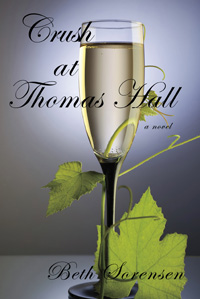
When Cassandra Martin attends Crush Weekend at Virginia’s Thomas Hall Winery with her good friends Sarah and Michael, she experiences the multiple meanings of the word “crush” in Beth Sorensen’s soon-to-be-released romantic mystery Crush at Thomas Hall.

In wine making, the crush–often called a grape stomp when it’s done with bare feet–gently splits the skins of the recently harvested grapes allowing the juice to escape. Thomas Hall’s annual Crush Weekend is a festive event in which long-time friends of the powerful Baker family gather to help with the harvest, taste the wine and enjoy each others company.

Cassandra quickly develops a crush on winery CEO and confirmed bachelor Edward Baker. The feeling is mutual. Yet, she has recently buried an abusive and controlling husband, and Edward–for all his gentle intentions–is used to being in charge. His behavior is not only emotionally crushing, but reminds her of the worst moments of her marriage.

A college professor on sabbatical to rediscover her life, Cassandra is a highly intelligent protagonist, eager to soak up not only the ambiance but the art and science of wine making. Yet, in personal matters, she is indecisive, vacillating between losing herself in Edward’s arms and running away to a safe place where she can avoid the danger of emotional commitments.

Complicating her evolving romance is talk of millions of dollars of funds embezzled from the winery, a dead body in the wine cellar, and an attack that sends Cassandra to the hospital. Beth Sorensen has spun a compelling mystery of champagne dreams and family intrigues in Crush at Thomas Hall. Sorensen’s protagonist must decide whether to continue her round-the-world travels or seriously consider whether she should make a commitment to Edward and his winery. No matter that she decides, she’s in jeopardy, for there is every indication that the killer wants her stomped dead and out of the complicated picture.

Crush at Thomas Hall is an exciting, romantic and highly recommended fine-vintage debut novel.

Malcolm R. Campbell is the author of “The Sun Singer,” “Jock Stewart and the Missing Sea of Fire,” and “Garden of Heaven.”

Book Review: ‘Evenings on Dark Island’

Evenings on Dark IslandEvenings on Dark Island by Rhett Devane
My rating: 5 of 5 stars

What do the rich and famous, a Florida swamp, an expensive upscale spa, a rat-faced dog, state-of-the-art galas, NASCAR, pot, an inner garden of rare hybrid plants and vampires have in common?

The standard answer is nothing.

But in Evenings on Dark Island authors Rhett DeVane and Larry Rock have turned the highly improbable into a hilarious and tastefully bloody neck biter that’s quite something.

Vincent Bedsloe, who has party planning in blood that’s not altogether his, is the flamboyant, details-oriented master of an exclusive spa set in the middle of an isolated Florida island where the rich and spoiled come to be drained of their income–and perhaps a bit more–while they are ramped up into an ecstatic level of health and fitness.

Bedsloe, who ponders over the emotions of his guests–emotions he no longer has–often retreats into an inner sanctum where he watches old movies and gets his kicks by debunking the silly vampire lore flowing out of Hollywood like blood from a burst artery.

Vincent is a kind-hearted vampire who cares about his human guests. Even his NASCAR-crazed, white trash vampire mechanic Jimmy Rob has an occasional redeeming thought: “He led her to the far, shadowy corner of the bar, behind a thick hedge. Kissed her again. Nibbled her neck. Bit down and drank until he felt her knees buckle. He pulled back abruptly. No need to kill the gal. She’d had a hard enough life.”

The only somewhat normal person in the book is DEA agent Reanita Geneva Register who has been inserted into the mix by the Feds at great expense to prove the obscure island is a haven for drug smugglers. Posing as a rich heiress, Register not only feels naked without her gun but a little nonplussed by her ability to enjoy the island’s pleasures.

The tight-lipped Dark Island staff are notoriously loyal to their employer and, with the annual Blue Blood Ball benefit for the American Hemophiliac Association fast approaching, much too busy to be easily questioned about the strange boats passing in the night.

The authors advertise Evenings on Dark Island as a fang-in-tooth spoof of the vampire genre. And what a spoof it is. This book is not only inventive and well crafted, but it’s filled with the kinds of one-liners and puns that will even wake the undead.

The plot, characters and setting work to perfection without blood, gore and body counts. While the spa at Dark Island may not be the transfusion you need for your physical health and well being in real life, DeVane’s and Rock’s collaboration has a high-clotting factor as well as the kinds of hijinks that will have you laughing all the way to the blood bank.

View all my reviews

Malcolm R. Campbell , who would never dream of writing about vampires, is the author of Jock Stewart and the Missing Sea of Fire, a novel that satirizes the blood suckers in government and the newspaper business.

Odysseys – multiple adventures

We can’t see the word odyssey without thinking of the epic Greek poem attributed to Homer that begins (in Robert Fagles’ translation):

Sing to me of the man, Muse, the man of twists and turns
driven time and again off course, once he had plundered
the hallowed heights of Troy.

Indeed, the word stems from Odysseus’ trip, meaning a long and wandering physical or spiritual quest with multiple adventures and changes of fortune.

My novel Garden of Heaven is subtitled “an Odyssey” because protagonist David Ward ends up in many places with many people before returning to the Montana ranch where he grew up.

The novel has multiple locations: Glacier National Park, the Florida Panhandle, Chicago, Hawai’i, the Philippines, the Netherlands, central Illinois, Pakistan, and the Gulf of Tonkin. In each place, new problems and adventures occur.

But there are some common themes. One is his first lover’s relentless quest for revenge which is caused by a problem of which David is unaware. Another is David’s spiritual journey which begins on a vision quest in Glacier National Park and then haunts and inspires him from one end of his odyssey to the other. And, like Homer’s Odysseus, David also has a way with words, though it remains to be seen whether this is more of a blessing than a curse.

Untangling the lies and truths strewn throughout his journey will take David quite a few years. In the process, he will serve aboard an aircraft carrier, climb one of the most difficult mountains in the world, work as a professor at a small college, and consort with horses, eagles and ravens. Garden of Heaven is not one adventure, it’s many. And, as in “real life,” David’s good fortune often looks like bad fortune, and vice versa.

Garden of Heaven is available as an e-book from OmniLit for $5.99.

For more information about Garden of Heaven, see my August 3, 2010 interview on BookBuzzr.

Review: John Atkinson’s ‘Timekeeper II’

Timekeeper IITimekeeper II by John Atkinson
My rating: 5 of 5 stars

In John Atkinson’s 2008 novel Timekeeper, Johnnyboy leaves his dysfunctional Virginia home at fourteen after his father “Bugdaddy” beat him again. In Oklahoma, Chief calls him “Timekeeper” and sends him on a vision quest to find himself. He does, but he is not yet whole.

At the beginning of Timekeeper II, scheduled for a September 21, 2010 release from il Piccolo editions, Atkinson writes, “I went to the Sacred Mountain in the flesh, but didn’t see it clearly until I returned in a ghost world dream.” Timekeeper II isn’t a clock-time, linear novel. It’s a dreamtime novel where all the dualities that haunted Johnnyboy must be brought into harmony in order for Timekeeper to face the world and himself as a fully integrated person.

The dualities arise in Timekeeper’s mind like opposing armies: a humiliated, illiterate man in a world where the ability to read is not only mandatory, but presumed; a man of mixed white and Native American parentage who is unaccepted and foreign in both worlds; a seeker on the path who left home to find himself while leaving his mother and first spiritual teacher Morning Song behind to face the wrath of an abusive father who once said, “Don’t turn Indian on me, boy! I’ll kill you dead in your tracks.”

Timekeeper II is a rare treat, a window that opens and re-opens into a dreamer’s world where events and personages from the world of form and the world of spirit mix and interact and sometimes contradict each other. Neither Chief nor the illusive and powerful Round Woman will give Timekeeper clear and definitive self-help lessons. Instead, he must take on the role of a shaman and enter the ghost world and find spirits who will help him heal himself.

Once again, John Atkinson has conjured up a gritty, highly original story where reality itself turns in upon itself and carries both his protagonist and his readers through the fires of transformation into a world where all conflicts disappear. Timekeeper II is highly recommended for all adventurous readers.

View all my reviews >>

Malcolm R. Campbell is the author of “Garden of Heaven,” “The Sun Singer” and “Jock Stewart and the Missing Sea of Fire.”

Weight Loss Club Uses Novel as Diet Aid

from the Morning Satirical News:

Athens, Georgia, July 7, 2010–The Athens-Clarke County Lard Ass Club (ACCLAC) celebrated its one-year anniversary at the Krispy Kreme on Atlanta highway this morning by announcing they were changing the club’s name to The Buttless Wonders. The club’s one thousand members have lost a combined total of 75,000 pounds during the last 12 months.

According to ACCLAC president Bob “Big Daddy” Horton, club members are now petite enough to carpool to meetings.

“We owe it all to Malcolm Campbell’s novel Jock Stewart and the Missing Sea of Fire,” said Horton. “Last summer when Campbell spoke to our friends of the library group, somebody in the back row shouted out ‘what’s in it for me?'”

“You’ll laugh you ass off,” replied Campbell. “By the look of you, you need the therapy.”

Instead of getting mad, that guy in the back row had an epiphany along with his box of doughnuts: he didn’t need as much ass as he had.

“The greatest moment of my life,” said ACCLAC recording secretary Sue “Big Mama” Patterson, “came during our New Year’s Eve pilgrimage to Junction City, Texas, where we met Jock Stewart. I kissed him on the mouth when he said, ‘Nice to meet you, Little Lady.'”

According to sources at the Junction City Star-Gazer, Stewart “got those ACCLAC people” drunk on cheap Scotch, and then he gave them some words to live by.

“My Dear Old Daddy always used to tell me that it’s a plain and simple fact of anatomy that an asshole is going to be on your tail for your whole life. That being the case, you might as well make it comfortably fit in one chair,” said Stewart.

“We wanted to take those words sitting down,” said Patterson, “but we couldn’t. The chairs in Jock’s house were just too small. Right then and there, we resolved, to start laughing our asses off.”

ACCLAC meetings begin and end with a reading from Jock Stewart and the Missing Sea of Fire. The club’s personal trainer, librarian Naomi Clements, estimates that the club loses an average of 98.6 pounds per meeting even though everyone is “slamming down doughnuts like there’s no tomorrow.”

Small-assed sources in Washington, D.C., claim that ACCLAC has sought FDA approval to start marketing the novel and its special Lard-Ass Reading Guide as a prescription diet aid.

“Laughter really is the best medicine,” Horton said. “Now, when I haul ass, it doesn’t take two trips.”

-30-