It’s really spooky: ‘Moonlight and Ghosts’

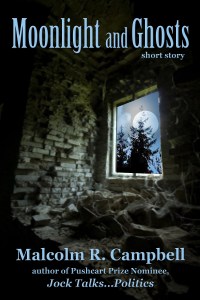
I’m happy to announce my really spooky short story “Moonlight and Ghosts” was published today by Vanilla Heart Publishing in an e-book format.

Publisher’s Description: On a moonlit night, Randy’s intuition is drawing him back to an abandoned psychiatric hospital where he once worked. He and his friend, Alice, have heard the ghost hunters’ claims the building is haunted, filled with strange lights, apparitions and the voices of former patients calling for help. The Forgotten point Randy and Alice to a crime in progress… and there’s not much time to save the victim.

That abandoned building…

There used to be an abandoned psychiatric hospital and developmental center near the house where I grew up. Before it was converted from a secondary hospital for use by the state department of mental health, I visited patients there–and it all seemed normal enough. It closed for a variety of reasons, including lack of funding and ended up sitting as an abandoned and often vandalized building for over two decades.

During this time, it became a magnet for ghost hunters. The more I looked at the pictures on line, the more my imagination started tinkering with an idea for a story. Like the main character in the story, I once worked as a unit manager at a center for the developmentally disabled. Fortunately, I never worked in this building. But what if I had and what if I went back on a moonlit night and found several ghosts waiting for me with an emergency message?  Hmmm…

I hope you like it!

Price: 99 cents on Kindle, and in multiple formats, on Smashwords.

Watch the Book Video on YouTube

Read the beginning on Amazon (use “look inside”) or on Smashwords (use “view sample) for free.

Malcolm

Book Review: ‘Goatsong’ by Patricia Damery

Each chapter heading of Patricia Damery’s beautifully written novel Goatsong begins with the words “tell me about.” Sophie’s daughter Stacey is asking her mother to tell her the old and ever-changing family stories about the days she spent as a ten-year-old child with the three Goat Women on Huckleberry Mountain and was reborn into the fullness of the world.

Young Sophie’s single mother works as a waitress at an all-night diner and sleeps all day, sometimes alone and sometimes with the man she brings home: “Ma didn’t want me making noise during the day while she slept, so I left the house and did all kinds of things most kids would not have the opportunity to indulge in, you might say.”

That summer, Sophie meets Nelda, Dee and Ester on the mountain above the Russian River in northern California, and in the process of learning about herding goats, “logging in” garbage dumped alongside the roads, and dancing naked in the meadow, she discovers love and acceptance from her ad hoc surrogate family. Among other things, Sophie learns to see and acknowledge that which others often miss, roadside trash included.

Wise, practical and nurturing, Nelda knows the Goatsong. Strong, persistent and dependable, Dee takes exception to those who dump garbage on the mountain as well as those who won’t lift a hand to stop it. Forever taking notes as the women do their daily errands, the relatively silent Ester is a witness, logging in the garbage. She finds, for example:

“1 beer bottle, label torn and unreadable, green.
1 plastic freezer bag, Safeway, good condition.
1 16 oz. paper cup, 7-11, good condition.”

The three Goat Women, who know they are “undesirables” from the townspeople’s point of view, accept Sophie as one of their own during their daily adventures on a mountain that Damery describes with the prose of a poet. The novel is a hymn to nature and natural living as well as an eternal and memorable story. Original, unorthodox and wise, the Goat Women provide Sophie with an unfettered, practical and loving worldview that is absent at her home and school.

In their own way, the goats (Natalie, Boris and Hornsby) are also Sophie’s teachers. The author, who has run a biodynamic farm in the Napa Valley for the past twelve years with her husband, said on her blog this past summer that “Walking the goats is truly an art.” Damery brings her knowledge of that art into her novel, creating goat characters who are as three dimensional and essential to the story as the women.

In the introduction, Damery writes that “Goatsong is the mysterious combination of humility and that essential ability to climb above, like a goat, or a song. To know the Goatsong of tragedy, Nelda told me, is to be reborn.”

When you read Goatsong, you are breathing in fresh air off the Pacific ocean, smelling the sweet scent of the bay laurel, and cooling your tired feet in sacred streams flowing through old redwoods in the company of wise women who, without agenda, may well change you as they changed the ten-year-old Sophie in those old family stories about the town of Huckleberry on the Russian River.

Malcolm

a young woman’s difficult journey

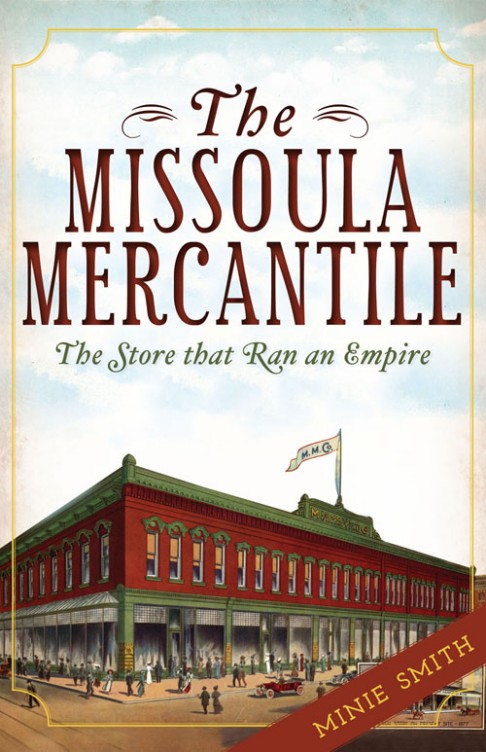
Briefly Noted: ‘The Missoula Mercantile’ by Minie Smith

Minie Smith’s The Missoula Mercantile traces the history of an 1866 Missoula, Montana trading post that ultimately became—according to a story about the book in The Missoulian–“the largest department store between Minneapolis and Seattle.” The 192-page book, which includes 82 historic pictures–was released by The History Press in August.

According to The Missoulian, “Allied Stores Corp. bought the Merc in 1960 but retained the name until the Bon Marche bought Allied in 1978. Federated Department Stores took over in 1989, and the name changed over the years from the Bon to Bon-Macy’s and, in 2005, to Macy’s. Macy’s closed the doors in early 2010.” Smith’s history follows the store up until 1960.

Publisher’s Description: From its log cabin beginnings at a dusty crossroads in Montana Territory, the Missoula Mercantile grew to become the largest department store between Minneapolis and Seattle. Under the guidance of A.B. Hammond and C.H. McLeod and their policy of community involvement and customer satisfaction, the Merc became a household word in Montana, synonymous with square dealing. Join historian Minie Smith as she traces the story of a western institution, remembering everything from the Missoula Mercantile’s hardware department, with its creaky wooden floors and drawers of nuts and bolts, to its ladies’ apparel department, which offered a taste of the big city with silks, satins and velveteens. From horseshoes to hosieries, the Merc had what customers needed and knew what they wanted.

Today’s look-alike stores are pretty much the same from town to town, but the old stores were a part of local history, giving one the impression that if the old walls could talk, one would know everything about a place that could ever be known. Fortunately, the store’s old building is being preserved and The Missoula Mercantile is telling its story.

Book Signing: Smith will be signing copies of The Missoula Mercantile this Saturday Morning at 10:30 at Fact and Fiction Downtown  in Missoula and at the University of Montana Bookstore at 2 p.m. on Friday, September 21.

Malcolm

A Glacier Park fantasy for your Nook.

‘Jock Talks…Politics’ Nominated for 2013 Pushcart Prize

I am honored—and quite stunned—to announce that my collection of (obviously fictional) satirical news stories Jock Talks…Politics has been nominated by Vanilla Heart Publishing (VHP) for a 2013 Pushcart Prize.  Jock Talks…Politics is one of four e-book satire collections based on my Jock Stewart character in Jock Stewart and the Missing Sea of Fire. (Click on the cover graphic to see the YouTube announcement video.)

I am happy to report that my VHP friends Smoky Zeidel (Breakfast at the Laundromat) , Melinda Clayton (Erma Puckett’s Moment of Indiscretion) and S. R. Claridge (Petals of Blood) have also been nominated for a 2013 Pushcart Prize.

According to Wikipedia’s entry, “The Pushcart Prize is an American literary prize by Pushcart Press that honors the best “poetry, short fiction, essays or literary whatnot” published in the small presses over the previous year. Magazine and small book press editors are invited to nominate up to six works they have featured. Anthologies of the selected works have been published annually since 1976.”

My series of Jock Talks e-books is drawn from posts made on my Morning Satirical News weblog, with a few also published here. While my journalism mentors at the former Florida State School of Journalism and my professors at the Syracuse University Newhouse Communications Center would all be totally scandalized if they saw I’d given up writing real news stories in order to turn out satire, the best reply I have is: LIGHTEN UP.

If I weren’t already out of Scotch, I’d be pouring a double to celebrate. Jock himself would, of course, drink straight out of the bottle to keep from dirtying up an extra glass, using extra dishwasher energy and increasing out country’s reliance on foreign oil.

Malc0lm

MY PUBLISHER’S ANNOUNCEMENT POSTER

Briefly Noted: Angel is a Lady and a Mob Boss in S.R. Claridge’s Series of Mystery Novels

In Tetterbaum’s Truth, Angel Martin thought she’d find happy ever after by marrying Tony. Her plans changed when Tony vanished and she took a job at a pub to help her pull herself back together. The pub was a Mafia hangout, but she didn’t know that.

Released in 2011, S. R. Claridge’s Tetterbaum’s Truth began, one might say, both a series of defining moments for Angel and a series of mysteries for readers who like staying up late at night with exciting books.

The “Call Me Angel Series” also includes Traitors Among us, Russian Uprising and this year’s release, Death Trap. Here’s the publisher’s* description for Death Trap:

When Giovanni’s private jet explodes with Angel presumably on board, the family is thrust into a state of crisis and mourning. Learning that the explosion was not due to a malfunction but a well-planned attack,Angel’s men set out on a course for revenge; while Giovanni must face the hard reality of assigning a new Boss to the family.Unknown to anyone Angel is alive,but is forced into hiding from the terrorist group exacting revenge on her grandfather, Salvatore. She watches in horror as her men are lured one-by-one into a trap of death, with their only chance for survival falling on the shoulders of a stranger with an unstable past.

Tempers flare and bullets fly as the lines of family loyalty blur into a melting pot of Mafia destruction, thickening when Angel’s men discover that the stranger behind the attack isn’t a stranger at all. Emotions run high as Angel must face the suffocating reality that her only hope for staying alive is to play dead.

To learn more about the series, check out an interview with Susan on Smoky Talks. All four novels are available on Kindle and Nook, and in multiple e-book formats on Smashwords.
*S. R. Claridge and I are both published by Vanilla Heart Publishing.

Briefly Noted: ‘Voices of the Elders’ by Shelly Bryant

Shelly Bryant (Cyborg Chimera, Under the Ash) is a prolific poet whose work never fails to inspire readers with pointed and poignant images that rise from the earth on the wings of spare words. Her new collection Voices of the Elders from Sam’s Dot Publishing is startling in the risks taken, the variety of its forms and references and the scope of its vision.

The fifty-five poems in this 59-page volume, many of which have appeared in “Aoife’s Kiss,” “Scifaikuest,” “Sloth Jockey” and other publications, are grouped into four sections—seduction, obstruction, destruction and abduction.

Jason Gantenberg aptly describes Bryant’s scope in these groupings in the book’s introduction: “What I’ve always loved about Shelly’s writing is the breadth of genres and periods in which she embeds her thoughts. There are few writers who will quite so fearlessly juxtapose classical Anglo-Saxon fantasies about fairies and dragons with ruminations on supernovae, historical fiction with futurism, cynical politics with whimsy.”

In “Oort” Bryant writes of “a failed planet” that’s “denuded of destiny,” followed by “Styx” an “eternal river” with an “ever-changing flow,” followed by “Bargain Hunter” about a young man in a store who makes a five-dollar purchase out of books for “aficionados with loads of cash.” The poem ends with these lines:

producing pleasure
properly pirated porn
just like the real thing

“Keep it in the Family,” begins:

familiarity
and its child
contempt
creep into familiar lines

And “Voice of the Elder” ends:

the elder dryad
to the swirling storm
raises his dying howl

I will return to “Memories Shared, Standing on Your Balcony,” the writer’s block in “Project,” “Men of Renown” with their Achilles heels and the other fresh-faced words in Voices of the Elders many times, for while they speak to me of today’s world in today’s language, they are, I think, penned by an old and very wise soul.

–Malcolm

Briefly Noted: ‘The Last Selchie Child’ by Jane Yolen

Jane Yolen’s collected poems in The Last Selchie Child, from A Midsummer Night’s Press, are a celebration of storytelling. Part I, Story explores the craft itself; Part II, Stories takes us to the sea and elsewhere into the distant past when the world’s once-upon-a-times were more intangible than they are today; and Part III, Telling the True, gets to the heart of the matter, the veracity of the tales a storyteller tells.

In “The Storyteller,” in Part I, Yolen writes about the fundamental essence of the art of a tale:

It is the oldest feat
of prestidigitation.
What you saw,
what you heard
was equal to a new creation.

The title poem “The  Last Selchie Child” begins Part II:

But I am the last selchie child,
my blood runs cold in my veins
like an onrushing tide.

In Part III, “Family Stories” reminds readers of the childhood stories they heard, but no longer recall:

My brother and I
are pieced together
like crazy quilts.
We keep warm
on winter evenings
with the weight
of all those tales.

Publisher’s Description:

Magical transformations, enchanted mirrors, talking animals, familiar tales in unfamiliar guises, all these and more are found in the pages of The Last Selchie Child.

Retellings of archetypal myths and fairy tales and the nature of storytelling itself are explored in this new collection of poems by Jane Yolen.

This tiny book of tales, published in a 6×4 format, grows larger and larger with each reading of its magical poems.

Malcolm

Some times are good times for a little light reading

Sometimes I run out of new books to read. My official wish list is long, but my wallet isn’t full enough to keep the shelves stocked up with fresh reading. So, I re-read some of my favorites from the past such as “The Prince of Tides” and “The Great Gatsby.” Or, I turn to light reading.

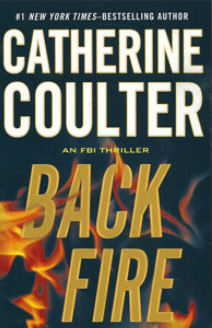
Catherine Coulter probably wouldn’t like to hear me referring to the 16 books in her FBI Series as light reading. Her latest is “Back Fire,” released this month. Here’s the publisher’s description:

San Francisco Judge Ramsey Hunt, longtime friend to FBI agents Lacey Sherlock and Dillon Savich, is presiding over the trial of Clive and Cindy Cahill – accused in a string of murders – when the proceedings take a radical turn. Federal prosecutor Mickey O’Rourke, known for his relentless style, becomes suddenly tentative in his opening statement, leading Hunt to suspect he’s been threatened – suspicions that are all but confirmed when Hunt is shot in the back.

Savich and Sherlock receive news of the attack as an ominous note is delivered to Savich at the Hoover Building: YOU DESERVE THIS FOR WHAT YOU DID. Security tapes fail to reveal who delivered the tapes. Who is behind the shooting of Judge Ramsey Hunt? Who sent the note to Savich? And what does it all mean? Savich and Sherlock race to San Francisco to find out…watching their backs all the while.

Savich and Sherlock are a husband and wife FBI team. They work well together. They solve cases. They’re fun to read about. Judge Hunt is also a great character. No, I’m not reading “Back Fire;” Judge Hunt also appears in “The Target” (1998) which I’m reading now. “The Target” is the third FBI Series book I’ve read in the past month, so Savich and Sherlock seem like neighbors now. (It’s also the third book in the series, though I’m not reading them in the same order they were released.)

For me, one appeal of books in a series such as Coulter’s and Elizabeth Peters’ Amelia Peabody books is the fact that the characters, genre, author’s style and general tone of the books are known going in to each new story. In addition to the familiar characters, the plots have enough mystery and action to keep my interest until the next shipment of official reading list books arrives from Barnes & Noble.

I’m guessing that a lot of avid readers have books and series they turn to when there’s suddenly nothing new waiting on the nightstand. They’re rather like old friends, the kind who stop by for a cold beer and easy conversation on a hot afternoon.

Malcolm

Author Melinda Clayton returns to Appalachia for her new novel

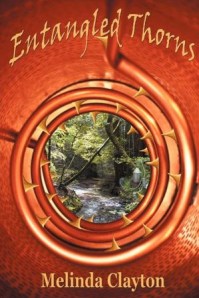
I’m pleased to welcome author Melinda Clayton (Appalachian Justice and Return to Crutcher Mountain) to the Round Table today to talk about her new novel Entangled Thorns. Once again, Clayton heads back to Appalachia for a compelling story about hard times and hard memories. Entangled Thorns, which tells the story of Beth Sloan and the “infamous Pritchett family of Cedar Hollow, West Virginia,” was released by Vanilla Heart Publishing June 27, 2012.

Malcolm: Like Appalachian Justice and Return to Crutcher Mountain, your new novel Entangled Thorns has an Appalachian setting. What draws a Florida author away from the orange groves and sunny beaches into the hills of West Virginia for her storytelling?

Melinda:  My mother’s family is from West Virginia, around the Charleston area.  My grandfather was retired from the mines.  Both of my maternal grandparents passed away when I was a teen, but up until that time we visited every summer.  I loved everything about it:  the people, the mountains, the wildlife.  My mother was born in a tiny place called Big Ugly Holler, which served as the inspiration for Cedar Hollow.  It doesn’t exist now, but we once hiked into the mountains to see what was left of it.  There was no road; by that time, there wasn’t even a trail.  When we finally reached our destination all that remained of Big Ugly Holler were a few foundations and chimneys covered in vines.

Malcolm: In Entangled Thorns, your protagonist Beth Sloan has been running from and/or repressing her troubled childhood until circumstances force her to confront it. Your protagonists in Appalachian Justice and Return to Crutcher Mountain were also wounded as children. Does this overarching theme of your work come out of your experience as a psychotherapist or the kinds of stories you’re drawn to on the nightly news?
Melinda:  I love this question, and the answer is, “both.”  I read a book when I was very young – I’d give anything to remember the title of it – but it was about a social worker who worked with troubled kids.  Ever since then I knew I wanted to work with troubled children and families in some capacity.  I’ve also always been drawn to true crime stories, as morbid as that might seem.  There is something about the workings of the human mind that absolutely fascinates me, particularly when it goes off-kilter in some way.

Malcolm: You recently completed a Ed.D. in Special Education Administration program which required a dissertation. How did you manage to jump back and forth between academic writing with its reliance on sources and a formal style to fiction with its emphasis on people, adventure and an accessible style?

Melinda:  That was a little challenging at times.  The act of writing fiction was a great stress reliever, but I had to work to keep the informal language (contractions, slang, etc.) from entering my academic writing.  It was tempting at times to put in something like, “This research will show that there ain’t no correlation…” for the pure fun of seeing my committees’ reaction.

Malcolm: How does the doctoral work fit into your professional goals?

Melinda:  My ultimate goal is to teach at a college level.  My doctorate sort of combined two fields of study, since my M.S. is in Community Agency Counseling, and my doctorate is in Special Education Administration.  I’d love to contribute to the field by demonstrating how the two fields often go hand-in-hand and should support each other and work together, instead of arguing over funding streams and services as so often happens.

Malcolm: For the general public, Appalachia conjures up such themes as isolated, subsistence living, hard-working and persevering people, coal mining and other environmental excesses, and pure, raw music unlike that from any other part of the country. How do your characters and plots mesh with or run counterpoint to these stereotypes? Does the lure of Appalachia for your storytelling ever translate into other areas, say, in tempting you to move there as a teacher or psychotherapist?

Melinda:  It’s a delicate line to walk.  I know from my own family that the manner in which Appalachia is often portrayed can be a sore point.  At the same time, I want the story to reflect what is, in some areas, true to life.  I relied heavily on not only my research, but also my own memories as well as my mother’s experiences.

I also know from my experiences that the poverty associated with Appalachia exists elsewhere.  There’s no need to travel to Appalachia to encounter it.  In the late 1980s, when I was fresh out of college with a B.A. in social work, my first job was as the coordinator of case management services for a rural mental health center in Tennessee.  My case workers and I were responsible for a three county area, working with the most impoverished of families. Many of our clients were without electricity or running water.  Many also lived in the most basic of housing structures, without floors or internal walls.  I think it’s difficult to believe there are still families living in such poverty in the U.S., but there are.

Malcolm: Thomas Wolfe brought the phrase “You Can’t Go Home Again” into general use. “Going home” can be awkward, embarrassing or frightening on so many levels even for those of us who had relatively normal childhoods. But your characters had strong reasons for avoiding home, yet all of them find that they must go home again. Does this theme grow out of the psychologist’s seemingly favorite “well me about your childhood” question or is it more that home is the only place where the issues of home can be fixed?

Melinda:  Again I have to smile, because it’s both.  My writing of home is a very transparent attempt to create the home I miss.  Until I was about twelve, we lived in my father’s hometown in TN surrounded by aunts, uncles, cousins, and grandparents.  We had fried chicken at Mawmaw’s house every Sunday after church, then spread blankets on the lawn under the pecan tree and visited well into the evening.  A rough couple of years ended all that.  One aunt died tragically in a car accident, another divorced, my grandparents lost their home to a fire, and my family moved away.  I’m sure it wasn’t as idyllic as I remember, but it’s pulled at me ever since.

But I also think it’s necessary to revisit the places that have scarred us, either symbolically (often for safety’s sake only symbolically) or physically.  We have to face our issues before we can resolve them.  Burying them doesn’t work; we have to excise them, examine them, and then choose to heal and move on.

Malcolm: Thank you, Melinda.

Where to Find Melinda on the Internet

Blogs on Xanga and WordPress

Facebook

Twitter

Amazon Author’s Page
Books: Magic Between the Covers

“A well-composed book is a magic carpet on which we are wafted to a world that we cannot enter in any other way.” – Caroline Gordon

My parents orchestrated Christmas Eve and the following morning with skill, making it a time of magic and expectation even though the gifts beneath the gifts beneath the tree were saturated with love rather than money. More often that not, one or more of the carefully wrapped packages beneath the spruce tree contained a book.

More often than not, each book was inscribed with my name, the date, and the name of the person who found the book and thought I might like the story. Pirates, space ships, wild animals and detectives waited between the covers for me to turn the page and enter an alternate universe. I didn’t see stories as alternate universes at the time, but now when I think of books, I smile at the concept of being in two places at one time.

There I was following the Hardy Boys in their latest attempt to help their police detective father crack a dangerous case AND there I was sitting in a comfortable chair in the living room next to a lamp. According to reports, I often didn’t respond when my parents called me to dinner when I was more there than here within the pages of a book like The Twisted Claw.

Portals, Portkeys and Magic Carpets

Caroline Gordon saw books as magic carpets. Ever fascinated with portals, I see books as doorways to faraway lands like the famous wardrobe in C. S. Lewis Chronicles of Narnia. In today’s Harry Potter series terms, readers might well see a book as a portkey that whisks them away the minute they touch it.

While looking at the Amazon page for Mark Helprin’s upcoming novel In Sun Light and Shadow, I found the novel’s stunning 489-word prologue included there as part of the book’s description. The constraints of fair use don’t allow me to cut and paste the entire prologue into this blog as a shining example of an author’s invitation to his readers asking them to step through the door, touch the portkey or settle themselves onto a flying carpet. But, here’s a taste. . .

An Invitation

Helprin’s prologue begins with the line: If you were a spirit, and could fly and alight as you wished, and time did not bind you, and patience and love were all you knew, then you might rise to enter an open window high above the park, in the New York of almost a lifetime ago, early in November of 1947.

The prologue goes on to describe the view from that window, and then the room itself: full bookshelves, the Manet seascape above the fireplace, a telephone, a desk drawer containing a loaded pistol, and a “bracelet waiting for a wrist.” Then the prologue concludes with: And if you were a spirit, and time did not bind you, and patience and love were all you knew, then there you would wait for someone to return, and the story to unfold.

Even though I was, from the viewpoint of my three cats who were hovering around the den door waiting to be fed, sitting here at my desk, I had in fact stepped through a portal to an apartment in New York 65 years ago. I tell you this: I wasn’t ready to return when Katy, our large calico, rubbed against my leg with a no-nonsense purr because I was thoroughly enchanted by the magic between the covers.

Even though a small percentage of the books I read each year come into my hands as gifts, I approach every book with an interesting premise and a cover splashed with promises as a gift. Years ago, I watched a TV western called “Have Gun, Will Travel.” Today, I gravitate more toward Have Book, Will Travel. Each book is an invitation to adventure, lives hanging in the balance, twisted claws lurking in the dark, castles set high above green valleys, and frightened travelers walking down roads in sunlight and in shadow.

Books cast spells and carry us away and while we are gone, we are changed, writ larger by the experiences now living within our consciousness, and ready to see the word of here with the visions we had while we were there.

Malcolm

Travel to mountains and magic for $4.99. It’s cheaper than Amtrak and Delta Airlines.