The subjectivity of literary taste and who’s telling you what’s good

“Taste is subjective. It is built from our personal experiences, our values, what we have read and watched and listened to all through our lives, and even stuff such as gender, race, nationality, and so on. Taste is political. Most of us would prefer our art to simply reinforce, rather than challenge, our worldview, so we tend to read writers who share our backgrounds, our values and so on. We create little artistic bubbles and don’t question them nearly enough.” – Jessa Crispin in Enough David Foster Wallace, already! We need to read beyond our bubbles in The Guardian
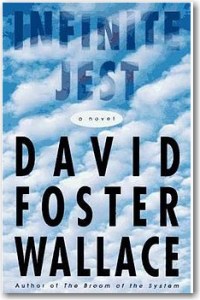
I’m an old white man. But unlike a lot of other white men, young and old, I disliked David Foster Wallace’s 1996 novel Infinite Jest so much, that I couldn’t even finish it. That’s rare for me. I was taught to clean up my plate and to finish the books I started. No matter, this book was like collard greens simmered in squid ink with a topping of chocolate-covered ants.

But, I digress. The point of Crispin’s article isn’t simply that women and some men are tired of white men telling them they must read Infinite Jest because “it’s important,” it’s that for years the elite of literary critics were eastern-based white men who had so much in common with each other in the small bubble where they lived and read and formed opinions so similar that they tended to recommend the same books that–when it came down to it–supported what they believed about literature and life.

In short, they created the canon because they told the rest of us what’s good and what’s not.

Times are changing in spite of the fact that Americans read a notoriously small number of books from outside the western world. But, we’re seeing more women and more non-Caucasians in the mix of books reviewers are finally reviewing, writing about and recommending.

Perhaps that means more readers are listening to new advice. Perhaps that means there’s more diversity in the origins of the printed word.  I’m sure my reading habits support my own world view; it’s just that my world view is (and has been) at odds with the eastern white men pontificating from their little literary bubble.

We all like what we like. That’s fair enough. But when and why did we start liking what we like? Perhaps those snobbish white men whispered in our ears without our knowing it.

Crispin’s article is a reminder that we all need to be more adventurous when we read. It’s not like that adventure is going to brainwash us into people we no longer recognize in the mirror. We’ll probably change, but for my money, change beats stasis and more of “the same old same old.”
Malcolm

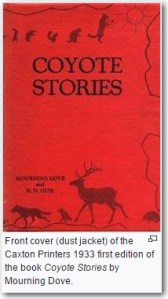
Briefly Noted: ‘Coyote Stories’ by Mourning Dove

In the spring of 1930, Colville [Washington] author Christine Quintasket wrote to her non-Indian colloborator, Lucullus McWhorter, offering reassurance. “I am going to the mountains again in August,” she informed him, “when flowers of mystery are in full bloom, and then I shall ‘do my stuff.’ Our book is going to be a success. [My] Indian beliefs will prove it.” As these words suggest, Quintasket applied her ancestral training in support of her contemporary aims: to advocate for her Colville people and to preserve their collective culture. – Laurie Arnold in “Montana The Magazine of Western History, Spring 2017

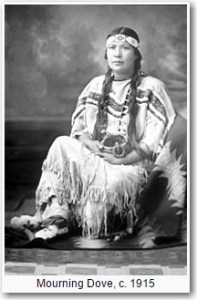
Quintasket (1884-1936), who wrote under the name Mourning Dove (Hum-Ishu-Ma) is known for her novel Half-Blood: A Depiction of the Great Montana Cattle Range (1927) and her folklore collection Coyote Stories (1933). Both books are still available today.

Her novel was the first to be written by an Indian woman with an Indian protagonist. The novel explores the challenges faced by native American mothers who were married to white fathers. Greatly edited by McWhorter without Quintasket’s knowledge, the book did poorly.

Coyote Stories is a collection of tales Quintasket heard from tribal elders, including her grandmother. In his foreword to the book, Chief Standing Bear wrote,  “These legends are of America, as are its mountains, rivers, and forests, and as are its people. They belong!” Coyote stories sold well and received much critical acclaim.

Publisher’s Description (2013 edition)

Wikipedia Photo

A powerful force and yet the butt of humor, the coyote figure runs through the folklore of many American Indian tribes. He can be held up as a “terrible example” of conduct, a model of what not to do, and yet admired for a careless. anarchistic energy that suggests unlimited possibilities. Mourning Dove, an Okanagan, knew him well from the legends handed down by her people. She preserved them for posterity in Coyote Stories, originally published in 1933.

Here is Coyote, the trickster, the selfish individualist, the imitator, the protean character who indifferently puts the finishing touches on a world soon to receive human beings. And here is Mole, his long-suffering wife, and all the other Animal People, including Fox, Chipmunk, Owl-Woman, Rattlesnake, Grizzly Bear, Porcupine, and Chickadee. Here it is revealed why Skunk’s tail is black and white, why Spider has such long legs, why Badger is so humble, and why Mosquito bites people. These entertaining, psychologically compelling stories will be welcomed by a wide spectrum of readers.

Jay Miller has supplied an introduction and notes for this Bison Books edition and restored chapters that were deleted from the original.

According to Laurie Arnold, “As a child of the 1880s, Quintasket was a member of the first generation of Colville people who needed to be bicultural in order to maintain Native community ties and to control their participation in a Western world that was trying to overtake and assimilate them.”

As the Handbook of Native American Literature by Andrew Wiget notes, the Daily Oklahoman wrote in 1934 that Coyote Stories represents “a spiritual heritage that can never be replaced.” A. B. Guthrie said in the Lexington Kentucky Leader said that Mourning Dove is an effective storyteller with “a fine simplicity of expression.”

Malcolm

Malcolm R. Campbell is the author of two Florida folktale novels, Conjure Woman’s Cat and Eulalie and Washerwoman.


Subscribe to our newsletter and receive a free book

Thomas-Jacob Publishing is offering free copies of Melinda Clayton’s novel Making Amends to those who sign-up for our newsletter via the InstaFreebie site. This offer is good through the end of this month.

Just enter you name and e-mail address, and then choose the file type you want: MOBI, EPUB, or PDF.

We promise not to send you a deluge of stuff. We hope you’ll like what we do send: announcements of new books, a few poems, and a bit of news.

I enjoyed reading Making Amends. Here’s the publisher description from Amazon:

On a beautiful fall evening, in the middle of a game of hide-and-seek, five-year-old Bobby Clark is kidnapped by his estranged father, a shiftless man with a history of domestic violence and drug abuse. Bobby’s twin brother Ricky watches, terrified, from his hiding place behind the bougainvillea, while mother Tabby, who also struggles with addiction, lies inebriated on the living room floor. Bobby isn’t seen by his loved ones again until a fateful morning twenty-five years later, when video of his arrest dominates the morning news. He has been charged with the murder of his father, but before the trial can begin, he manages to escape. As Tabby and Ricky absorb the news of Bobby’s return and subsequent escape, Tabby is convinced he’ll come home to the quiet Florida street from which he was taken so long ago. But when events begin to spiral out of control, she’s left to wonder: is a child born to be evil, or shaped to be evil? And in the end, when it’s time to make amends, does it really matter?

I hope you enjoy the book and the Thomas-Jacob newsletter. The next issue should be out near the end of this month.

–Malcolm


Review: ‘Parade of Horribles’ by Rhett DeVane

The people in Rhett DeVane’s new novel Parade of Horribles are the kind of folks, foibles and all, that most of us wish we knew, wish we could call kin, and when danger and hatred intrude into our lives, wish we had looking out for us. Chattahoochee is a real town in the Florida Panhandle and, as the book’s back cover description tells us, it really does have a “state mental institution on the main drag.”

Do Elvina Houston, Hattie Lewis and Jake Witherspoon really live there? Probably not. But they are so real in Parade of Horribles that–in telling their story–DeVane has seemingly conjured them out of the cosmos and placed them there, 37 miles west of Tallahassee as the crow flies, alongside the Apalachicola River. A notable feature in the town, the river is a figurative and literal feature in DeVane’s well-told story. It’s both a haunting reminder of old wounds and a restful escape from the 24/7 preparations for the upcoming harvest festivals and a growing number of signs there may be a dangerous serpent in this Garden of Eden.

DeVane hints at the danger early on the way Hitchcock would show a trace of something wrong near the beginning of his feature films. But the townspeople’s attention and the reader’s attention are drawn to the mix of daily life and harvest festival duties. The horribles, as Jake thinks of them, steep like tea half forgotten on a back burner and, as the story moves toward its unexpected ending, grows all the stronger and more foul tasting for the wait.

Parade of Horribles is the seventh book in the “Hooch Series.” As we saw in earlier novels such as Cathead Crazy and Mama’s Comfort Food, this very Southern author deftly captures the way people in her panhandle world think, talk, work, support each other–and, yes–gossip about what’s in plain sight and what’s not yet apparent to everyone else. Residents of the Florida Panhandle know that in many ways it’s a country unto itself, not like south Georgia and even further and farther removed from the snowbirds and tourist destinations of the peninsula.

Reading DeVane’s Hooch Series is an immersion into this country; Parade of Horribles is wonderful mystery/thriller and a highly recommended addition to a body of work that makes “the other Florida” and “Florida’s forgotten coast” altogether real and impossible to forget.

Malcolm


Review: ‘White Tears’ by Hari Kunzru

White Tears pays homage to the blues, the blues that grew out of pain and a mix of organic musical styles that was sung by down and out African American men and women in the 1800s and ultimately recorded by hundreds of performers on 78 records during the early 1900s–Ma Rainey, Blind Lemon Jefferson, Charley Patton, Robert Johnson and others whose names are long lost to most current day audiences even though the influences of the blues run through the heart of American music itself. It has been said that Robert Johnson achieved success as a singer by following an old conjure procedure of selling his soul to a black rider at the crossroads. Whether you believe the legend or not, the music known as the blues carried the souls of its performers as they cried out the cruel injustices of their lives.

Hari Kunzru tells the story of two white students in their twenties who love the blues, though that love may be more of an affectation or an obsession than anything true. Carter is rich. Seth is poor. The music draws them together and they create a music studio dedicated to analog sound and music out of the past. Seth, who’s a bit of a geek without firm boundaries about who he really is, records sounds and music off the streets, and one day he captures the voice of a bluesman he never sees singing a song that will define the two young men’s lives. They run the words through their sophisticated equipment and end up with a recording that sounds like an old 78 record that might have been rescued or stolen from a southern barn or back porch. They put the recording on the Internet and announce that it’s real rather than mocked up. They name the singer Charlie Shaw.

The sound is a sensation.  But then they hear from collectors and other aficionados that Charlie Shaw was a real person who really did record a song that began with the words “Believe I buy a graveyard of my own.” A collector says he heard it years ago. Another collector turns heaven and earth to find the original, and maybe he does. The boys are spooked, to say the least: how can their faked record of a modern-day street singer suddenly be a real song by a person whose name they made up? If Charlie Shaw is real, Carter and Seth have stolen his soul.

At this point, readers will have been experiencing an immersion in the blues, well told through Hunzru’s deep understanding of the music and his very well crafted prose. While the novel remains compelling, it becomes somewhat fractured after Carter is–for unknown reasons–beaten senseless in “the wrong part of town,” and as he evolves into a hospitalized man in a vegetative state, his rich family decides that Seth was just a follower who lived off Carter’s money and really didn’t contribute anything to their business partnership. Denied access to Carter and the studio, Seth drifts, begins to think maybe the past or the blues or the real Charlie Shaw is after him. The novel fractures from the atmospheric realism that was following a plot into some lengthy slice-of-life sequences in which past, present, future–and bluesy reality–meander aimlessly rather than directly serving to storyline.

Yet, new incidents occur (mostly bad and/or unfair to Seth), magical realism or real depending on the moods of the moment and the novel shifts into a thriller chasing down a ghost story. The protagonist for three quarters of the novel is primarily Seth.  But Kunzru changes the point of view throughout the last several chapters in a chilling way. These chapters are powerfully written but, on balance, the strong ending of White Tears seems based more on shifting genres in mid stream and word-smithing trickery rather than the natural unfolding of a story. The message–white boys appropriating black music and making it their own–is a strong theme throughout the book. It’s not a bad theme. The story suffers, however, because of the author’s need to preach a cultural appropriation sermon rather than let his message speak for itself through the characters words and actions.

Nonetheless, it’s impossible to discount the power of the book, the author’s technical mastery of his language, or the journey through the blues. Yes, this book is the blues, and those who love the music will probably read the book from beginning to end, seeing its flaws as little more than the scratchy static on an old 78 record.

–Malcolm

Review: ‘Making Bombs for Hitler’ by Marsha Forchuk Skrypuch

Making Bombs for HitlerMaking Bombs for Hitler by Marsha Forchuk Skrypuch
My rating: 5 of 5 stars

Ukrainian Canadian author Marsha Skrypuch writes–as one interview said–“War Fiction: Writing the stories that haven’t been told.” She writes about genocide and displaced persons with an eye toward well-researched historical detail often given a personal touch through interviews with survivors who lived through the very stories her fiction brings to readers who often begin each book with little or no knowledge about the stories that have been covered up, overlooked, or allowed to fall through the cracks of our baseline knowledge about man’s inhumanity to man because fictional and historical accounts often focus on politics and battles rather than on those who suffered.

In “Making Bombs for Hitler,” Skrypuch–author of twenty books for young people–focuses on the Nazi practice of rounding up Polish, Ukrainian and other children and using them as slave labor in work camps on behalf of the Reich. Those who were too young or too infirm to be productive were eliminated. Some were drained of blood that was sent to the front for use by wounded German soldiers. Others, like the novel’s protagonist, Lida, were forced into camp jobs, rented out to local farmers and others, or pressed into factory work.

While Lida is a strong character, she is a child as are the others in her cold barracks room. So, young readers will be able to identify with her fears and concerns, including her worry about the fate of her younger sister who was taken somewhere else. Those sent to the bomb making factory are caught between their will to survive and the morality of making weapons for the Nazi war machine. It’s difficult to read this without wondering “As a twelve-year-old child, what would I do under similar circumstances?”

One strength of the book is the way in which Skrypuch portrays the bonding on the characters under deplorable conditions. They come together out of an inner strength much stronger than a simple will to survive, but out of a heartfelt and very human need to help each other. This is a heroic story that will stay with its readers long after the last page has been turned.

I have read most, if not all of Skrypuch’s novels because all of them are strong, well written and dear.

View all my reviews

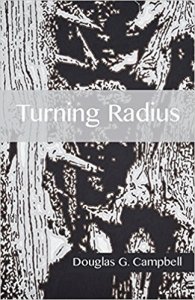
Briefly Noted: “Turning Radius’ by Douglas G. Campbell

Reader reviews and editorial book reviews written by husbands, wives, brothers, sisters, mothers, fathers, colleagues and next door neighbors are quite rightfully looked upon with a jaundiced and cynical eye by prospective readers. So, I cannot review my brother’s book of poems Turning Radius (Oblique Voices Press: March 2017). Nor can I rate it with stars on Amazon or GoodReads.

I can tell you that it exists.

From the PublisherA book of 100 poems written during the years before the author’s stroke in 2012. Rather than organizing the poetry as a volume with a single formal or thematic focus, this book’s seven sections coalesce as something more like an omnibus, or, on closer reading, like a jewel with seven facets, each of which displays a different aspect of the author’s rigorously lived inner life.

The book’s seven sections are Lemonade Days, Canticles of Humanness, Turning Radius, Spirits of the Earth, Nature’s Continuum, Listen to the Earth, and War and Art. In his foreword, William Jolliff writes that these sections suggest “an unsettling consistency, and that consistency is discovered as a complex of attributes that have characterized all of Campbell’s artistic work: an attention to everyday details, startling in its intricacy; a sense of irony that laughs and rages but is slow to anger; a knowledge of natural phenomena that attests to many hours in the wilderness as well as in the studio; and a practiced craft that inevitably chooses the perfect form for the message conveyed.”

From “Dark Canticle”When I should be resting/vast empty spaces of the earth/ swallow my heart.

From “Carnival”Embrace your wrinkled exteriors/for they are your salvation;/in this nation of smooth talkers/they are a testimony/bearing witness to truth.

From “Turning Around”Too many times/I have not stopped/to turn around/to stoop/to bring into focus/some curiosity/clinging/to the edge of sight.

The book is available in paperback. I enjoyed reading it from cover to cover: I think I can tell you that.

Malcolm


In fifteen minutes, it will be time to feed the cats

I have no ideas for a fresh blog post. That’s why I typed the header about the cats. Right now, none of my three cats are anywhere. They lurk. I think they actually have a Narnia-wardrobe somewhere in the house and disappear for voyages on the Dawn Treader with Lucy, Edmund, Eustace, and Prince Caspian.

Fine, maybe they’ll start writing sage and quasi-luminous posts in exchange for their four squares a day.
[time passes as I wonder how many people reading blogs today know what four squares a day means.]

In ten minutes, it will be time to feed the cats. I’ll probably get to the kitchen on time because I’ve decided that those who don’t know what “four squares a day” means can Google it.

I thought perhaps I’d announce a book sale or an Amazon giveaway. Tomorrow, I think. Watch my twitter account (https://twitter.com/MalcolmCampbell) for notices. That’s where I mention Amaon giveaways because those come and go way too fast for a WordPress post.

The lights just flicked. One thing about being hard of hearing means that I don’t hear rain. The weather radar, which is showing red for this part of the county, indicates it’s raining like hell outside. Who knew?

Maybe that’s why the cats are missing. They’re under a bed or a couch.

[time passes while I go look outside]

I hope the weather radar liars got their pay docked today. It’s not yet raining like hell outside. But now that I wasted time going to look, I’m probably going to be late feeding the cats.

It’s what they’ve come to expect. I don’t know about you, but just looking at the photograph of their dinner makes my mouth water.

Keep watch on that twitter account tomorrow for some great giveaways.

–Malcolm


Re-reading a classic: ‘The House of the Spirits’

“One of the strongest impressions I took away from this book was that despite everything there is an optimism about the book’s ending. Throughout the book one has felt strongly the inevitability of events – that the blindness of the right-wing Esteban to the liberalism of his family, which one might argue is inherited from his wife’s parents, will lead to disaster, that Esteban’s casual abuse and rape of peasants will rebound on future generations of the family – and yet at the end Alba breaks the cycle of anger and hatred.” Zoe Brooks in Magical Realism

Books change each time we read them–unless we’re cursed with a photographic memory. Presumably, the words don’t re-arranged themselves on the pages, nor do heretofore unknown pages creep into the book with new characters and subplots from Central Casting.

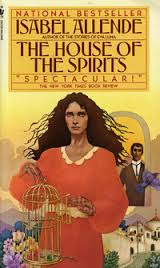
The world is probably stranger than we know, so it’s safe to assume we change in between the readings. I’m not the same person I was when I first read The House of The Spirits in 1986 when my Bantam mass market paperback edition was published. Years have passed and governments and attitudes have come and gone since then.
Imagine the differences in first-reading perception of this 433-page saga between the rushed college student who has a few weeks to read it for a 400-level college course in order to compare and contrast it with the somewhat similar multi-generational magical realism sagas The Hummingbird’s Daughter and One Hundred Years of Solitude, and his/her twin reading the book on a rainy afternoon in a mountain cabin.

The first will be speed reading, taking notes, and writing in the margins. The second, (depending on whether the rain has interrupted planned outdoor activities or not) may be either relaxed or bored. They won’t see the same book. A third person who is reading the book leisurely in order to savor every line will come away with a very different memory of the story.

Like The Hummingbird’s Daughter (Mexican setting) and One Hundred Years of Solitude (South American setting), The House of Spirits (unspecified Latin American setting, but presumably Chile) includes peasant workers and their beliefs, strong patróns who control the people’s temporal destiny, harsh and potentially unstable governments, and leftist or other guerrillas seeking change.

To my mind, the magic in One Hundred Years of Solitude is more overt and widespread than the magic in the other two books, one with the young girl Teresita (in the very mystical “Hummingbird” based on  a real person) who can heal, the other with the family matriarch, Clara, who talks to spirits and moves objects without touching them. Before re-reading The House of the Spirits during the last several days, my memory of the book was that it contained a lot more magic than it does.  I remembered its gritty realism, but had blocked out the worst of it.

Had I taken a lie-detector test about the story in Allende’s debut novel several weeks ago, it would probably show (with no hint of fabrication) that my mind had mixed some of the characters and circumstances with those from her other books and that I recalled a much more ethereal tale than physically exists on the pages of my 31-year-old paperback. I don’t read books with the eye of a college English professor who also reads critical reviews and in-depth analyses of the books s/he teaches in class and/or writes papers about. So, if somebody asks me to tell them what the books I’ve read are about, my knowledge of the plots and characters will always be imperfect.

Somehow, books read by many an avid reader often run together over time unless the stories are constantly studied and compared with other books in the same genre. If there’s a blessing in a poor memory, it’s that in re-reading a book, the opportunity for fresh discoveries is all the greater for it. I suspect The House of the Spirits changed me more this time than it did in 1986, for now I am seeing more clearly a story that I had mythologized over the years. I am older, so I see the aging Clara with fresh but older eyes and, having come to terms to some extent with the amount of hatred and evil in the world, I see Alba’s hope at the end of her horrid torture as more authentic than when my anger–as a younger, more volatile man–at her treatment blinded me to her transformation.

Like absent old friends, old books usually aren’t the books we remember exactly. That’s the beauty of meeting up with them again and then going away all the wiser for it.

–Malcolm

Malcolm R. Campbell is the author of the magical realism novels “Conjure Woman’s Cat” and “Eulalie and Washerwoman.”


Review: ‘The Invisible Library’

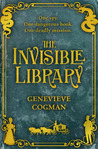
The Invisible Library (The Invisible Library, #1)The Invisible Library by Genevieve Cogman
My rating: 4 of 5 stars

This is a very clever fantasy involving a protagonist who works for a library that exists between worlds. Her mission, which is rather like a James Bond in search of books, is to find and obtain meaningful texts in alternate worlds and bring them back to headquarters.

In some ways, the book is mix of fantasy, faerie and steampunk because the alternate realities have their own systems and amount of magic, including fae, werewolfs, and dragons. The main character, Irene, is a junior level librarian with a fair amount of experience. On the current mission, she’s assigned to take a long a student for whom she will be a mentor. This makes her job more difficult while making the plot more interesting.

As it turns out, there are many factions in the “London” to which she is sent, all of whom seem to know about the rare book. She has to figure out who, if anyone, can be trusted.

The book has a lot of talk in it, and by that I meant Irene and her student have to talk a lot, but are also thrust into situations where they–and potential allies and villains alike–are constantly having to explain things to each other. This is somewhat reminiscent of the Bond films wherein when the bad guy gets the upper hand, he always has an egotistical need to explain the wonders of his technology and his plans–giving Bond a chance to get the drop of him and win the day.

Nonetheless, there’s plenty of intrigue here along with some action scenes that will knock your sox off. The book kept my interest enough to tempt me into placing the next book “The Masked City,” on my reading list.

View all my reviews