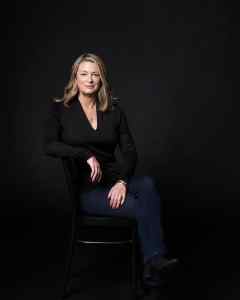
‘The Women,’ by Kristin Hannah

“Hannah’s tale, rich with period detail, is an impassioned tribute to the heroism of the many thousands who did serve, as well as a hymn to female solidarity in the darkest of settings. It’s a surprisingly original take on a well-trodden subject.” ―The Times (London)

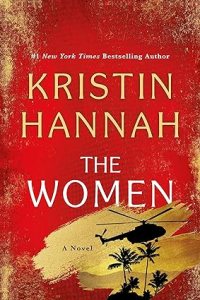
From the Publisher

“Women can be heroes. When twenty-year-old nursing student Frances “Frankie” McGrath hears these words, it is a revelation. Raised in the sun-drenched, idyllic world of Southern California and sheltered by her conservative parents, she has always prided herself on doing the right thing. But in 1965, the world is changing, and she suddenly dares to imagine a different future for herself. When her brother ships out to serve in Vietnam, she joins the Army Nurse Corps and follows his path.

“As green and inexperienced as the men sent to Vietnam to fight, Frankie is over-whelmed by the chaos and destruction of war. Each day is a gamble of life and death, hope and betrayal; friendships run deep and can be shattered in an instant. In war, she meets―and becomes one of―the lucky, the brave, the broken, and the lost.

“But war is just the beginning for Frankie and her veteran friends. The real battle lies in coming home to a changed and divided America, to angry protesters, and to a country that wants to forget Vietnam.

“The Women is the story of one woman gone to war, but it shines a light on all women who put themselves in harm’s way and whose sacrifice and commitment to their country has too often been forgotten. A novel about deep friendships and bold patriotism, The Women is a richly drawn story with a memorable heroine whose idealism and courage under fire will come to define an era.”

“One of the greatest storytellers of our time, Kristin Hannah, tackles one of the most cruel and despicable wars of the last century, the Vietnam War. The Women reveals the powerful contributions and horrific sacrifices of the American military nurses who served in a war whose agencies refused to acknowledge that they were even there. Perhaps no words can bring closure to a nation still ashamed of booing our returning heroes, but the heroine, Frances McGrath, stirs a deep, overdue compassion and tears for every single soldier―and especially the forgotten women who sacrificed so much. Never has a novel of war metamorphosed so profoundly into a story of the human heart.” ―Delia Owens, author of Where the Crawdads Sing

-Malcolm


Book Giveaway – ‘At Sea,’ a Vietnam War novel by Malcolm R. Campbell

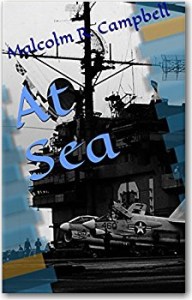
My Vietnam War novel At Sea will be free on Kindle from October 25 through October 29 in advance of an upcoming price increase.  This giveaway is my thank you to all of you who have supported my work.  The novel is inspired by my service aboard the aircraft carrier USS Ranger (CVA-61) off the coast of Vietnam.

Long-time readers of this blog may remember that I was part of a group that campaigned to get the ship donated to a museum that would have been on the Columbia River. Our effort did not succeed; the ship was scrapped and its history (including being the first carrier with an angled deck and services through Operation Desert Storm) was lost.

Synopsis

Even though he wanted to dodge the draft in Canada or Sweden, David Ward joined the Navy during the Vietnam War. He ended up on an aircraft carrier. Unlike the pilots, he couldn’t say he went in harm’s way unless he counted the baggage he carried with him. As it turned out, those back home were more dangerous than enemy fire.

While aboard, he discovers that an aircraft carrier truly is a floating city, though a dangerous one from the flight deck to engineering spaces and especially for the pilots of the A-4, the F-4 Phantom, the A-7 Corsair, and the A-6 Intruder.

The cover photo is one of my pictures of the ship.

–Malcolm

How many of you are ‘out there’ anyway?

Wikipedia graphic showing two versions of Schrödinger’s Cat.

Long-time readers of his blog know I subscribe to the many-worlds interpretation of quantum mechanics, which states that when an alternative choice exists, both outcomes occur—one in another universe. If so, then when I decided painfully not to go to Sweden in 1967 with a young woman I was dating in a Dutch work camp, I actually did go home with her, and that existence is ongoing in a universe far away.

I don’t know how to visit that other universe to see how things went.

But I have always wondered. Anna and I might have gotten married in Göteborg (shown in the photo). I would have learned Swedish and looked for a job–with the assistance of the Swedish government as a requirement for being granted asylum. While I thought I might never see the U.S. again, Jimmy Carter granted amnesty in 1977. Would I have come home? Well, probably for a visit. Obviously, I know what happened here that would not have happened if I had chosen Sweden.

Even without the quantum factor, I think most of us wonder what life would have been like if we’d moved to another state, taken a different job, or married a different person. Over time, I’ve made a lot of bad choices–how different life would have been if I hadn’t!

In 1967, I thought leaving Anna and Sweden was a bad decision. I don’t ponder it often now because that would be a discount of all the good things that occurred in my life as it has been.  I have no idea how Anna’s life unfolded because we decided it would be too painful to stay in contact. In later years, I looked for her unsuccessfully. That’s probably a good thing since in 2024, I can’t imagine not meeting and marrying my super wife or being without my cool grandchildren.

So, I believe we can always “have our cake and eat it too” even though I don’t know how to savor that experience.

–Malcolm

Malcolm R. Campbell is the author of magical realism and fantasy novels and stories; that shouldn’t surprise you after reading this post.

This week in fabricated history

Maddox

“On August 4, 22 illusory torpedoes were launched by North Vietnamese patrol boats against the U. S. destroyers Maddox and C. Turner Joy in the Gulf of Tonkin. Born a world away from the lotus falling into a sea of fire, the sweet fictions of credibility gap sustained them long enough for the prescribed protocols to ensure the hardship of 58,175 deaths, the price of 153,303 wounded, and the burden of a national psyche forever scarred.” The Seeker, Malcolm R. Campbell, 2013

Stemming from this was the Gulf of Tonkin Resolution that gave the President the authority to use “all necessary measures to repel an armed attack against the forces of the United States and to prevent further aggression.”

Until the last one of us who served in Vietnam is dead, the war will continue to be a blemish, not because we lost it, but because we were there at all–based on a provocation that never happened.

–Malcolm


Body counts and broken dreams

During the Vietnam War, the primary news was daily body counts. While the consensus was that was no way to cover a war, nobody thought of anything better. As for the collateral damage in wounded and broken men, mostly forgotten along with their equally broken families, we’re still living with it forty-five years later.

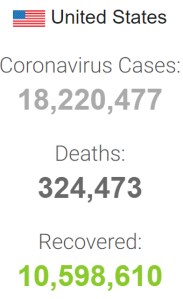
During the COVID-19 invasion, the news has also provided daily body counts, primarily cases, and death tolls. Once again, these figures didn’t tell us much about the pandemic, except that it got better, and then it got worse. As for the collateral damage of grieving survivors, a shattered health care system, lost jobs, bankrupted businesses, and related and unrelated social unrest and violence, we can say with a fair matter of certainty the pandemic has broken just about everything.

There are now rays of hope as a second vaccine is set to begin distribution tomorrow and Congress, in its typical dinosaur fashion, races deadlines to get a new stimulus package approved. So now the wait begins: how long will it take for the vaccines to make a dent in the deluge of body counts and broken dreams?

No matter what happens, we can count on dealing with the repercussions of COVID for the rest of our lives. The 45-year Vietnam fallout will be long forgotten before the door will finally be closed on the long term pandemic impacts.

In general, I’m an optimist in spite of my bouts of cynicism, so I’m going to hold onto my dream of a healthy, unified United States that provides opportunities for everyone. But we will need to pitch in and work at it. I hope we’re willing to do that.

Malcolm

Remembering May 4, 1970

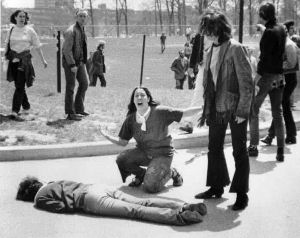
The Kent State shootings occurred 50 years ago today when the Ohio National Guard fired 67 sounds into an unarmed crowd of anti-war protesters, killing four and wounding nine. Among other things, the “Massacre” is said to have helped end the Vietnam War, bring down the Nixon administration, and ask hard questions about just how police and national guard personnel are supposed to disperse protestors.

At the time, the shooting led to a strike of some four million high school and college students and the closure of many schools. Nixon, of course, had been elected (among other things) on his stated objective of ending the war. The protest was sparked when the U.S. expanded the war by bombing Cambodia.

While I was still in the navy on May 4, 1970, I would leave the service as a conscientious objector four months later. I supported the protestors but disagreed strongly with protests that caused violence. Riot control police have become more dangerous to everyone since Kent State as the police become have more militarized. This isn’t helpful now and it wasn’t helpful then.

I took part in anti-war protests prior to joining the navy (to avoid being drafted into the army) and my sympathies were almost always with the students UNLESS they committed the kind of violence they were protesting.

I wonder if we have learned anything since Kent State. As I watch news stories which show police SWAT teams that look more like Army Rangers and Navy Seals than the police, I tend to doubt it.

–Malcolm


Excerpt from ‘At Sea’

If you were around during the Vietnam War, you’ll probably remember that much of the news coverage dealt with body counts, to show the progress the U.S. was making in ridding the country of the Viet Cong. In my novel At Sea, the protagonist’s grandfather (“Jayee”) keeps his own listing of those from Montana who were killed in the war.

Jayee’s Lists


Jayee’s Lists (The Poor Sons of Bitches who Died) lay faded in a low kitchen drawer beneath batteries, broken pencils, expired dog food coupons, forgotten pink birthday candles, gum erasers, and other unsorted miscellany.

Superimposed over the small battlefield of the ranch, where lambs and eagles met largely unrecorded deaths on a rangeland framed by fences, box elders, cottonwoods, and a narrow creek carrying water off the backbone of the earth in years of drought and years of flood, the old man recorded soldiers’ names and souls.

He read the news from Vietnam with morning coffee and evening spirits, and with a fine surveyor’s hand, he tallied the bare bones of body counts between narrowed-ruled lines in lightweight Bluehorse notebooks intended for the wisdom of school.

After dinner, he walked out through the bluebunch wheatgrass and settling sheep to his ancient Studebaker pickup truck. He carried a sharp yellow pencil and a pack of Chesterfields, tools for doing his sums, “calculating Montana” in a cloud of cigarette smoke from “vintage tobaccos grown mild, aged mild, blended mild.”

On the first page of the first book he wrote, Here are the poor sons of bitches who died. On the last page of the last book, he wrote, The dead, dying, and wounded came home frayed, faded, scuffed, stained, or broken.

On the pages in between, he wrote the name of each Montana soldier who was killed or missing in recorded battles far away. Sipping bourbon, smoking like a lotus in a sea of fire, he ordered, numbered, and divided the names by service branch, by casualty year, by meaningful cross-references, by statistically significant tables, by the moon’s phases and the sun’s seasons, and by the cycles of sheep.

Jayee remarked from year to year that the notebooks grew no heavier with use. He saw fit to include the names of the towns where the dead once lived, fathered children, and bought cigarettes. These names he learnt were also lighter than the smoke.

The current of his words between the pale blue lines of each thin page arose in fat, upper case letters that scraped the edges of their narrow channels. They began as a mere trickle from 1961 to 1964 that grew in volume in 1965 before the first spring thaw, to become a cold deluge that crested in 1968, wreaking havoc across the frail floodplain of pastures and pages, carrying the dark, angry names scrawled with blunting pencil, and broken letters, through irregular gray smudges, over erasures that undercut the page deep enough and wide enough to rip away the heart from multiple entries. There was little respite in 1969. After that, the deaths receded and most of the physical blood dried up by 1973.

The pages were dog eared, marked with paperclips already turning to rust, and fading to pale dust behind the list of towns: RICHEY, WHITEFISH, HELENA, CHOTEAU, BOZEMAN, BUTTE, KALISPELL, THOMPSON FALLS, THREE FORKS, STEVENSVILLE, TROUT CREEK, BILLINGS, CHOTEAU HINSDALE, GREAT FALLS, HARDIN, SACO, SIDNEY, HAVRE, HELENA, GREAT FALLS, HELENA, BOZEMAN, BUTTE, DODSON, ARLEE, REEDPOINT, HAVRE, BIG  SANDY  MISSOULA, BILLINGS, WHITLASH, ROUNDUP…

Jayee’s tallies added up like this: USA—169 USAF—16 USMC—59 USN—23 TOT—267

The old man made 267 trips around Montana between 1961 and 1972 that no surveying jobs could account for. He said little to the family about it and they didn’t often ask.

During Jayee’s second trip to Havre in 1966, Mavis, a waitress at the Beanery, noticed a stack of 44-inch white crosses sticking out from beneath a tarp in his truck. On each cross, there was a name. When she suggested that Jayee was stealing them from roadside accident scenes, he said he made them per spec to repay old debts.

Mavis asked Katoya if Jayee was all right and Katoya said: “right enough.” He returned to the restaurant multiple times to prove he was right enough and was sitting there on August 31, 1967, when the 77-year-old Great Northern restaurant served its last bowl of Irish stew and closed its doors for good. When the building was torn down the following February, he pounded “an extra cross” into the rubble where the counter once stood and said it was the best he could do.

Months passed and additional stories surfaced about an old man crisscrossing the state searching for the families of the fallen, and of warm conversations lasting long into the dark hours. Jayee remained solitary and taciturn in the face of public or private praise or blame and traveled from town to town methodically, as though he was marking chaining stations along an endless open traverse.

After each individual’s name, he wrote XD (cross delivered), XR (cross refused), or CNF (could not find).

On October 18, 1974, Jayee died (surrounded by old relatives and the close perfume of vintage tobacco) with a freshly sharpened yellow pencil, with a half-smoked pack of Chesterfields, with lists and spirits close at hand, waiting for closure, he always told those who asked about them.

Reverend Jones stood before the mourners in the small church and read the names of those who wished to remember and to be remembered, and one upon one, they created a great hymn that rose up over the banks of their consciousness and flowed down the rivers of their perception in a crowned deluge.

Copyright © 2010, 2016 by Malcolm R. Campbell


On this day of memories, an excerpt from ‘At Sea’

My favorite writing, I think can be found in my linked novels Mountain Song and At Sea. The books are true in ways I can never tell you and they speak of loss and other sad things and looking for oneself. At Sea is my Vietnam War novel. It’s still patiently waiting for the right audience to find it. Here’s an excerpt on a day when we remember those who didn’t return:

At Sea

On his last night aboard ship, David stood on the catwalk after stopping by the head to wipe the blood off his hands only to discover there were no damn towels. He wondered who, if anyone, he had betrayed: Píta, his golden eagle messenger, perhaps, and the dead on Jayee’s Lists; those who called him into the center of the lotus in the sea of fire or those who called him away from the lotus. Or even Jill, one way or another. He sought clues. Yet, with the ship steaming as before at various courses and speeds on Yankee Station at condition yoke on a clear commander’s moon of a night, with sleeping birds behind him with folded wings, with eight bells struck in pairs announcing the end of the first watch, he was blind.

Angelita once told him while they were treading water at the foot of Magdapio Falls, surrounded by sheer cliffs and a hovering rain forest, “God brings to us the ones we love if our calls are pure and strong.” She looked tiny and cold in the shower of spray and quite distracted by the everlasting call of the water, but he asked her nonetheless what one ought to do if his pure call spoilt over time. She climbed out of the water on to one of the many sun-warmed rocks, grabbed a towel, and chattered out a reply. “Ask God if your true love has a sister. If she doesn’t, then call an angel.”

He headed home nonetheless, wondering how many angels a man could scare away in a lifetime: To Danang, South Vietnam, aboard the ship’s C-1A Trader. To Cubi Point aboard a nondescript plane. To the Galaxy Bar in Olongapo to say goodbye to the angel who saved his life. To Clark Air Base aboard an HU-16 Albatross. Then, to Travis AFB in California via a TransInternational DC-8, arriving on January 1, 1970.

His orders granted him an honorable discharge, for reasons of conscientious objection and though the system said it was his right to do it, he would not be much liked for signing his name on that line. Anti-war protesters at the base spat on him and called him a baby killer. Ultimately, his liberal parents would yell at him on the phone and call him a hypocrite—it would not be the last time.

Jill was not at Travis to watch him run the gauntlet of the war protesters’ love-in beneath cumulonimbus clouds spinning the scattered late afternoon sunlight into threads of gold. Her parents had lured her into their snowy world along the Lake Michigan shore for the holidays, knowing—as did she—that he would show up wherever she was whenever he showed up. Using his bulky seabag as a battering ram, he pushed through the ranting flower children toward a dull blue military bus for the ninety-minute ride to the Alameda Naval Air Station.

“Mr. Ward?”

A tall, large-boned, gangly blond woman stood apart from the crowd with her hands on her hips. She had bangs; they hung loosely above her pale brown eyes, while her long hair swept back into a ponytail that was determined to catch in the collar of her denim work shirt.

“Yes?”

“I’m Eleanor Rose, Jack’s wife.”

He dropped his sea bag with a thud and they shook hands. “How did you recognize me? Are you meeting somebody?”

“Chief Coleman, of your recent employer, called me. He told me you looked emaciated, sick almost unto death. Hard to miss that. I’m here to meet you unless you want to ride to Alameda on that bus.”

“I don’t, unless you’ve got something worse.”

She picked up his sea bag as though it were weightless.

“Come on, Mr. Ward,” she said. “I’ve got a bright red Mercury M-250 pickup. It rides fine.”

“Call me David.”

“Your Chief Coleman was also right about your wife.”

“What about her?”

“She’s not here.”

“I didn’t expect her.”

Eleanor slung the sea bag into the back of the truck. “Get in,” she said. “It’s not locked.”

“Jill’s spending Christmas with her parents.”

“With all due respect,” she said as she guided the truck out of the parking lot, “she ought to be here.”

“I wish she were,” he said. “Not that you’re chopped liver.”

“I understand. You’ll need a home-cooked meal, I expect.”

“Are you offering?”

“I am.”

“Lucky break for me. I was expecting shit on a shingle at the base.”

“Jack loved this truck,” she said, and settled back in the seat like she wasn’t expecting a response.

The world flowed by, a normalcy of sorts. She looked at him from time to time, a pragmatic smile washing across her squarish face. South of Pinole, she told him the first money from Chogori was sending her back to school to get her teaching credentials. South of El Cerrito, she told him he would have to convince her over her best pot roast that Jack really had a fair hand in writing the book; it seemed so unlike him. As they drove through Berkeley, he told her about the hell-bent-for-leather Mt. Olomana climb, and she said that was Jack.

Then she said, “Your wife should have met you at Travis, not because you came home from a war or even because you survived. Survival isn’t our first duty. When you took a stand and became a conscientious objector, you became your true self.”

“I am not without regrets.”

“I don’t doubt it. They’re battle scars. Your family and friends will never see them. You will always feel them, don’t you think?”

“I do,” he said, happy that she couldn’t see the blood on his hands.

Copyright © 2010, 2013, 2016 by Malcolm R. Campbell

Malcolm

Review: ‘Hope in the Shadows of War’ by Thomas Paul Reilly

When injured Vietnam War veteran Timothy O’Rourke returns home in 1973, an open wound accompanies him. Today, we might call it PTSD or survivor’s guilt. When his helicopter was shot down and then attacked by the Viet Cong on the ground, he was able to save one of the men with him–but not both. The prospective roles of fate, destiny, fairness, and second-guessing oneself plague him as surely as a virus

Vietnam War veteran Thomas Paul Reilly saw the war for himself and subsequently applied that knowledge and his degrees in psychology as an author (Value-Added Selling) and public speaker focusing on the importance of hope, attitude, and value. He effectively uses this background to create a realistic, yet troubled protagonist in this novel which will be released on Veterans Day.

In the chronicles of war and returning veterans, Timothy’s issues aren’t unique, but in an era where veterans’ issues were not well understood, he believes he is alone in trying to heal his psychological wounds. He’s attending college, works multiple jobs, drives a falling-apart old car, has a steady girlfriend named Cheryl, and remains one step ahead of bankruptcy. Friends and family either can’t or won’t help him when he’s confronted with unexpected expenses such as replacing the ancient furnace in his mother’s house where he is staying. Cheryl has money to lend, but he refuses to accept it.

Co-workers at a Christmas tree lot where he’s working to earn extra money tell him that college and dreams aren’t for “guys like us” and that he needs to quit college and get a real job. In almost every area of his life, he is without hope. Among other things, he’s driving away Cheryl, who unconditionally loves him, by constantly telling her he’s not good enough for her.

Reilly has created a character who epitomizes veterans who have reason to believe fate and their country are conspiring against them. Broke and in ill health (emotional or physical), they end up living on the streets as one of society’s festering wounds that seems impossible to heal. A co-worker, Hoffen, at the Christmas tree lot casually talks to Tim about hope, perseverance, and attitude. The man speaks like a sage down from the mountaintop, but will his advice be enough to convince Tim that the open wound he brought home from Vietnam will never heal until he lets it heal?

If Tim were in therapy, his analyst might ask him if he wants the wound to heal. His memory of the helicopter crash–which is well written and rings true–replays over and over as though he either wanted to be rescued from the wounds it caused or return to the scene and die along with the buddy he couldn’t save. Tim is a character who is easy to admire for his dilligent attempt to save his dream against great odds. He is less easy to like because his overly hopeless attitude, as demonstrated in his thoughts and his conversations with Cheryl and others, comes close to whining, justified though it may be.

The book would be stronger if the plot focussed on the major highs and lows of the story and left out the step-by-step “transcripts” of minor–or recurring–thoughts and actions. The inspiring ending would be stronger if readers felt that, other than his stubbornness, Tim had played a more active role in making it happen.

Reading Hope in the Shadows of War should be a cathartic experience for struggling veterans and those who want to understand veterans’ issues and motivations. This is the story’s strength. So is the message of hope from Hoffen and others. Readers will probably take that message with them after they finish the novel.

Malcolm


Current Promotions – Malcolm R. Campbell

  • The Kindle edition of Lena, the third novel in the Florida Folk Magic trilogy, is the prize in an Amazon sweepstakes that runs through August 22. Four copies are available. The winners will be selected at random when the sweepstakes ends and sent to those with the winning entries by Amazon. There’s no purchase necessary. Entrants will be asked to follow my Amazon author’s page which is something I know you want to do anyway. Click on the book cover to go to the sweepstakes page.
  • The Kindle edition of Mountain Song, a Montana novel with a few scenes in the Florida Panhandle, is Free on Amazon between August 16 and August 20. David, who grows up on a Montana sheep ranch and wants to spend his life climbing mountains, meets Anne Hill from Florida who is a child of the state’s swamps and blackwater rivers. They meet as seasonal hotel employees at Glacier National Park. A summer romance begins. But will it last?
  • The Kindle edition of At Sea, a Vietnam War novel and the sequel to Mountain Song, is free on Amazon between August 18 and August 21. David is assigned to an aircraft carrier serving on Yankee Station off the coast of Vietnam. This book was inspired by my time aboard the carrier USS Ranger (CVA-61).

Good luck and enjoy the books.

Malcolm