Navy to Scrap Historic Aircraft Carrier – 2015 UPDATES (now in Port of Brownsville)

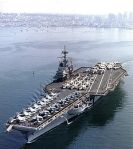
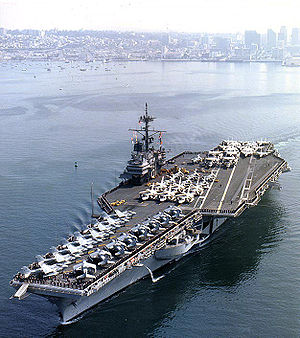
Ranger - Wikipedia Photo
Ranger – Wikipedia Photo

“The seventh USS Ranger (CV/CVA-61) is one of four Forrestal-class supercarriers built for the US Navy in the 1950s. Although all four ships of the class were completed with angled decks,Ranger had the distinction of being the first US carrier built from the very beginning as an angled deck ship.” – Wikipedia (See continuing updates at the end of this post.)

In matters of war, I am a pacifist.

That said, I believe our troops merit our support whether or not the war they’re fighting in is popular or not.

I also think history and historical artifacts, objects and memorabilia are important, for they help communicate the stories of other eras. It’s been a pleasure working with museums as a grant writer and as a collections manager and seeing first hand how excited people can get when shown historic equipment, documents and photographs.
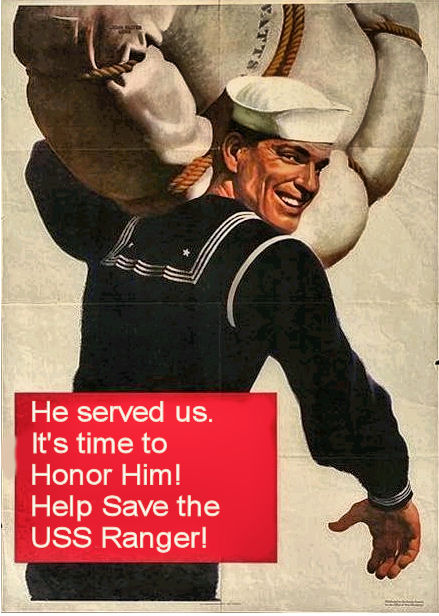
RangerPosterI served aboard the USS Ranger (CVA-61) during the Vietnam War. The war was probably the country’s most unpopular war. When I appeared in public wearing my uniform, I was intentionally bumped into on the street, spat on, and called a baby killer. Yet our history and memories of that time must be preserved.

So, in matters of history, especially those that focus on museums and other educational experiences, I am an activist. In Charleston, I have seen the displays on the USS Yorktown and I have seen the reactions of tourists and school groups as they toured the flight deck, the hangar deck, the mess decks, bridge and ready rooms of the old ship.

When the USS Ranger Foundation was formed in Oregon with the hope of following the examples of those who saved the USS Yorktown in Charleston and the USS Midway in San Diego as museums, I was happy to join up even though I don’t have the financial means to donate money nor the proximity to the ship and selected museum site to volunteer.
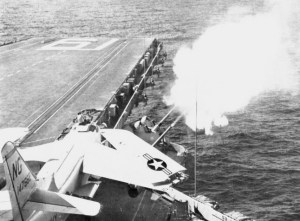
Ranger in 1961 - Kemon01 photo on Flickr
Ranger in 1961 – Kemon01 photo on Flickr

First, the educational opportunities here are immense. It’s one thing to read about military history. It’s quite another to walk through a fort, battlefield or restored ship. Aircraft carriers have evolved since the Vietnam War—I can hardly even recognize the modern navy uniform. As I write this, there have been tests of flying drones off of carriers rather than expensive manned aircraft. As a museum, Ranger could have been a piece of history on the Columbia River at the donated site in Fairview for many years to come.

Second, museums and other cultural tourism sites bring dollars and jobs into communities. Many studies have been done showing that a tourist destination such as the USS Ranger can bring in a higher percentage of every tourist dollar than other attractions.

Apparently this is not to be
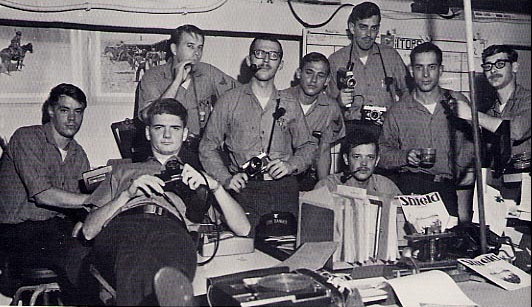
USS Ranger Public Affairs Office on the 03 level. I am second from the right.
USS Ranger Public Affairs Office on the 03 level. I am second from the right here in 1968.

I salute the long hours and dedicated efforts of the volunteers and directors of the USS Ranger Foundation. But I think I missed a memo.

The application process for the acquisition of a decommissioned navy ship is difficult, expensive and lengthy. Unfortunately, the Foundation’s application was rejected by the Navy last October. (See Foundation to Fight NAVSEA Decision to Scrap Ranger) At that time, the Foundation was looking for ways to have that decision reversed.

Over the Christmas holidays, the Foundation said that constraints were keeping them from having more time to develop their application. Here’s where I missed the memo, I think.

I never heard what those constraints were, what (if anything) was missing or incomplete in the Foundation’s original application, or whether or not the support of influential people in and out of government could influence the Navy to provide more time, reconsider, or otherwise work with the Foundation to save the ship rather than scrapping the ship.

rangerlogoNow, the Foundation is looking for another ship. That’s probably a reasonable backup approach. Nonetheless, I think we need to know:

  • Why the application was rejected.
  • What, if anything, could be done to make the application acceptable.
  • Who, if anyone, could be enlisted to garner political and public attention to urge the Navy to delay the scrapping schedule and,
  • Who, if anyone, could raise additional funds and increased public support within the State of Oregon to save the ship and bring it to the Portland area.

We don’t know any of these things. Perhaps, in knowing them, we would see that placing a historic aircraft carrier in a Columbia River museum site had too many insurmountable obstacles in it to ever succeed even if the navy waited five more years or ten more years.
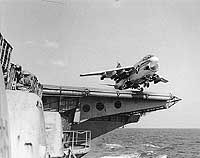
A-4 Skyhawk landing in 1980 - Kookaburra2011 photo on flickr
A-4 Skyhawk landing in 1980 – Kookaburra2011 photo on flickr

I have worked with museums and I have seen the impossible done before. Those in the know said “It will never happen.” But it did happen, with money left over and with the partnering help of those who had been thought, by those afraid to ask, to be the least likely to assist a museum.

So it is, that I do not like seeing this project fade away without a ramped up, viral PR campaign and without the help of high-level thought leaders and influencers who might be able to make a USS Ranger museum a reality. A successful aircraft carrier museum helps everyone, including the Navy. A scrapped ship frees up space at a pier and brings in a few dollars, but otherwise helps no one.

Worse yet, our history is lost in the bureaucratic shuffle. Rather than fading away, I would have preferred seeing this project end, if it had to end, with nothing less than a noisy, failure-is-not-an-option, Hail Mary, damn-the-torpedoes effort.

As always, I wish the Foundation fair winds and following seas.

Malcolm R. Campbell, Journalist
USS Ranger Public Affairs Office and Naval Station Great Lakes  1968 – 1970

Update – January 9, 2014

Those of you who live in the Bremmerton area may have a better means of finding out whether the ship has been scrapped already than I do. However, I have checked with the Navy about the rationale for disposing of the ship (in addition to the costs of maintaining mothballed ships).

From the Navy’s perspective, the USS Ranger Foundation’s progress throughout the entire application process was slow and it finally appeared that little or no progress was being made on some fairly large obstacles:

  • En route to the ship’s proposed mooring site, the BNSF bridge at river mile 80.9 had not been solved. Basically, the ship couldn’t clear the bridge without a major effort on the railroad’s part.
  • The foundation’s cost estimates for the project were incomplete. They gave an overall figure to the Navy about projected costs, but only documented a fraction of those costs.
  • The USS Ranger was placed on a donation hold in 2004. Even though the foundation had expressed an interest in the ship in 2003, the application wasn’t filed until 2009. With the ship available for an eight-year period and with major obstacles not being resolved, it seemed unlikely that the foundation would ever present a complete and viable application. Unfortunately, the Navy’s assessment about this is probably correct.

Update – February 3, 2014

More Updates:

–Malcolm

Malcolm R. Campbell, who  served on the USS Ranger during the Vietnam War, is the author of the Jim Crow era novella “Conjure Woman’s Cat.”
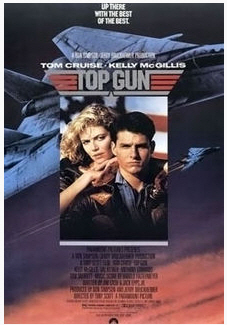
‘Top Gun’ on the Big Screen in Gresham, Oregon

Did you know that many of the scenes in the 1986 action/adventure movie “Top Gun” were filmed aboard the aircraft carrier USS Ranger (CVA-61) pretending to be the USS Enterprise?

Now decommissioned, the USS Ranger is en route to becoming a museum in Fairview, Oregon through the efforts of the USS Ranger Foundation.

In support of this project, the foundation is sponsoring a 25th anniversary showing of “Top Gun” as a fundraising project on Sunday, May 6, 2012 at the Mt. Hood Theatre, 401 E. Powell Blvd, Gresham, OR 97030, 12-3pm.

Click here for more information along with a nice film trailer showing some realistic launch and recovery operations along with the kind of flying hi-jinks you might expect out of any character played by Tom Cruise.

If you live in or near Gresham, this movie will make for a great afternoon of entertainment in support of a good cause!

Malcolm

New USS Ranger Foundation Video

The USS Ranger Foundation, currently working to transform the decommissioned carrier into a museum and heritage center in Fairview, Oregon, has posted a new video of YouTube.

The video displays a combination of great in-service photographs along with a selection of current-day photographs.

Fairview has a population of slightly less than 10,000 residents.

Project Overview (from the foundation web site)

The USS Ranger Foundation is dedicated to preserving USS Ranger as a community heritage center through public and private partnerships.

Ranger represented our country’s interests around the world as the “Top Gun of the Pacific Fleet” from 1957 through 1993. Earning 13 battle stars in Vietnam and taking a lead role in Desert Storm in the Middle East. She also supported humanitarian missions like Operation Restore Hope off the African coast.

The supercarrier is more than three football fields long, towering 15 stories above the waterline. A floating city that held over 5,000 crew members, Ranger has a 4.5 acre flight deck, 60-bed hospital, communications center and classrooms.

With Ranger’s active service over, the USS Ranger Foundation is working with the Navy to secure her donation and preserve important Naval history. Ranger will serve her new mission as the centerpiece of a destination complex. This will include a museum, memorial to those who served, educational training facility, emergency preparedness site and civic /convention resource.

Chinook Landing Marine Park, on the Columbia River in Fairview, Oregon, will be Ranger’s new home. Market research confirms the potential for the new
destination complex is significant, boosting local and regional economies. Support for the project has been widespread given the favorable research and
the obvious impact on jobs, business growth and a significant resource to the community.

The Foundation has launched a major fund raising campaign to support ship acquisition, site development, and completion of the heritage center.
The success of Ranger’s new mission will be the result of partnerships that create an exceptional public resource and the largest floating museum in the world. For more information on this project, please check our website at http://www.ussranger.org, or call 503-558-8519.

Malcolm
I served onboard the U.S.S. Ranger on two Western Pacific cruises (1968-1970) and based parts of my novel Garden of Heaven: an Odyssey on my experiences.

Eagle Scout Goes to Hell

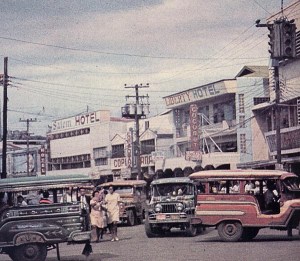
Olongapo as it was then

Everyone aboard every Navy ship that cruised between California and Vietnam in the late 1960s knew about liberty in Olongapo, Republic of the Philippines. The city stood just outside the main gate of the U. S. Naval base at Subic Bay, a regular port of call for Western Pacific (WESTPAC) ships.

Old salts called the town “hell” and promised Seaman Recruits coming on board the carrier USS Ranger out of bootcamp that anyone leaving the main gate of the base on liberty would be corrupted immediately by booze, drugs, girls, gambling and crime. They called the drainage ditch separating the base’s main gate from the town “the shit river,” though I saw it as the River Styx.

I crossed the shit river multiple times and found the world there to be everything the old salts described. As a former Eagle Scout, it crossed my mind on more than one occasion, “if only my Scout master could see me now.” Our Scout troop was sponsored by a church, so the Scout master was the least of my worries when I thought of how the deacons, elders and Sunday school teachers should they ever see a photo taken on Magsaysay Drive.

As a writer in training, I saw Magsaysay Drive and the Galaxy Bar and the touts and the constant ruckus in the streets as “research.” But I doubt my Scout master would have understood, or anybody else I knew, for that matter. Luckily, webcams and cell phones hadn’t been invented yet. There was no Facebook either in 1968. This meant that no pictures of me crossing the shit river appeared anywhere–and since a lot of time has gone by since then, I doubt they ever will.

Everyone who might know the Eagle Scout and paperboy who went to hell and then put his research into a novel called Garden of Heaven is long gone by now. So, I think I can safely post this excerpt without word getting back to the old neighborhood.

Excerpt from Garden of Heaven:

Standing on the bridge over the Shit River listening to the half-naked children in flimsy boats below shouting for a handful of centavos, the city in his face was—with more pride than apology—very much a city with its tattered underwear showing. If Magellan only knew what was here now. If Dad only knew David was here now.

Night was settling down over the hazy first lights of the bars and hourly rate hotels along Magsaysay Drive and the razor-sharp edges of Kalaklan Ridge like an old whore.

David dropped several 25-centavo coins over the railing, heard an explosion of whitewater, heard the laughter and the shouting, ‘Salamat, Joe, Salamat.’

He crossed Perimeter Road, ignored the hopeful greetings of the money changers behind their well-caged windows, then dodged a badly mixed throng of sailors, girls and honking multi-coloured jeepneys that swelled out into the Gordon Avenue intersection. He cut across the street, smiling, waiving at imagined friends in the distance, and moved with the deliberate intent of a man who had crossed this street hundreds of times.

‘Casual alertness, that’s the key to surviving Olongapo’s jungle of thieves, gangs, girls, high-strung Marines, bored Shore Patrol and Hard Hats, and drunk boatswain’s mates and snipes,’ Lowell had said.

“Hey Joe, cold beer cold beer cold beer, nice girls.”

Touts were everywhere below the slapdash smorgasbord of disheveled signs and awnings, leaning telephone polls, and the rag-tag assortment of buildings with upper floors stacked up in odd strata.

Assorted conversations flew past, barely audible in the close heat… ‘Hintayin mo aki,’ …‘Magandang amaga, Carlo, kumusta ang bagong sanggol?’… ‘Hey Joe’… ‘Tao po! Tao po!’… ‘Hoy, tulungan mo akong magdiskarga sa trak na ito, pwede ba?’… ‘Good food here, Joe!’…Galing akong Maynila. Nasaan ang Zambales Bank?’… ‘Balut, Balut!’… ‘Tayo na’t kumuha ng makakain’ ‘Magandang ideya, handa na ako sa napunan’… ‘Nagustuhan mo ba ang bago kong kamera?’

The sign for the Galaxy Bar was plainer than most. An unadorned interior stairway led to the second-floor club, a large room strewn with tables occupied by sailors, many with girls whose eyes caught the low light like predators or gods. David didn’t see anyone he knew. He had a small envelope in his back pocket for Maria.

Two girls who had bathed in perfume and spackled their faces with makeup were leaning against the bar watching a waitress organise a tray full of San Miguel beer bottles.

“Maria, tingnan mo itong malambing na lalaki.”

“Lamayo ka sa kanya, Adelaide.”

Assuming he’d actually heard her name in those quick Tagalog comments, Maria was the one wearing a red dress, thrusting herself forward to him as he approached, posing her sweet curves, allowing her long hair to seductively frame her face, smiling as though they were friends with a history. He could almost see himself in the high gloss of her lipstick.

Copyright (c) 2010 by Malcolm R. Campbell

USS Ranger (CVA-61)

Ranger - Wikipedia Photo

The USS Ranger has been decommissioned. The USS Ranger Foundation is working diligently to convert the aircraft carrier into a museum on the Columbia Driver near Portland, Oregon.  The effort requires multiple phases, the next being a comprehensive environmental site analysis of the propose mooring location.

The Foundation is seeking donations to help pay for its on-going work. If you would like to contribute to the $15 million dollar fund raising project to bring a historic ship to Oregon as a museum, please click on the link above. Once you’re there, you’ll find some handy PayPal buttons.

Branding at Sea: Lone Ranger Aboard the USS Ranger

This story about the beginning of the USS Ranger’s “Lone Ranger and Silver” theme appeared April 7, 1969 as U.S. Navy News Release 101-69 (USS Ranger) and subsequently in the May, 1969 issue of the ship’s magazine “Shield.” The Ranger, a Forrestal Class aircraft carrier, was in service between April 10, 1957 and July 10, 1993. Decommissioned after Desert Storm, the ship is currently docked in Bremerton, Washington. The USS Ranger Museum Foundation is working to save the former TOP GUN of the Pacific Fleet and preserve it for use as a museum and educational facility at Fairview, Oregon.

Flight Ops

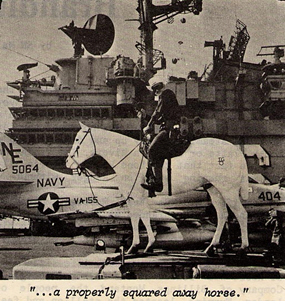
USS RANGER (CVA-61) April 7, 1969–Early this year, Ranger was informed by the sheriff and stockmen of Freemont County, Wyoming, that the ship was violating the state’s range laws. The problem was not that the carrier was steaming wildly up and down Wyoming’s North Platte or Big Horn Rivers. The violation was the fact that the Lone Ranger’s horse Silver was running wild on Ranger without a brand.

Sheriff C.A. “Pee Wee” McDougall directed that the horse be branded as soon as possible. A copy of the brand should, then be sent to him for forwarding to the Registrar of Brands, State of Wyoming.

Even though the fiberglass, life-sized model horse was foaled at the Alkire Fiberglass Company of Billings, Montana, the people of Lander, Wyoming, located the stallion and feel responsible for its welfare.

Lander, Wyoming Connection

Captain Livingston wrote to the people of Lander and expressed concern that his command was in violation of their range laws.

He wrote, “The desirability of the brand was brought most forcibly and near tragically to the attention of all hands during Ranger’s last in-port period at Subic Bay, Republic of the Philippines.

“While grazing on authorized liberty, the great white stallion was rustled by a band of shifty eyed varmints professing to be United States Marines. Only the exceptional alertness of the ‘Top Gun’ crew prevented the scoundrels from carrying Silver to Vietnam.”

Finding the TOP GUN BAR NONE Brand for Silver

Captain Livingston assured them, however, that the horse was recovered unharmed and that a contest was being started to allow the crew to design a suitable brand. The prize for the best brand submitted would be $50, money that would be handy in Yokosuka, Japan, when the ship pulled in there in late March.

In the “Plan of the. Day,” Executive Officer CDR H. Edward Graham told the crew; “Help keep varmints from rustling Silver and the sheriff from capturing the Captain.”

And the crew responded. Over 200 entries were turned in to CDR R.J. Brunskill (AIMD), Ranger’s Horse Control Officer. On March 24, during a bingo game in the hangar bay, Captain Livingston announced the winner, AEI Charles 0. Brill from Mobile, Alabama. Petty Officer Brill is the shop supervisor of AIMD’s Shop.

Brill, who reported a-board Ranger in August 1966, submitted the brand “Top Gun Bar None.” Brill, who has had experience on an Alabama dairy farm and has done some branding, said that a brand should be simple, original and must say something.

The brands were judged by a panel of three Ranger cowboys, all of whom have worked on ranches. The men were CDR Louis Page (CAG), from Cushing, Oklahoma; LT Richard “Cowboy” Neifert, (VA-I54), from Townsend, Montana; and DC3 Bob Creech (DC Division), from Waco, Texas.

CDR Page said that of all the brands, about 40 were real brands. He said that a brand is somewhat like a sentence that conveys a thought or expression. Petty Officer Brill’s “Top Gun Bar None” brand was appropriate for Ranger. “A real cowboy, knowing of Ranger’s nickname, could read the brand in a snap,” Page said.

LT Neifert said the panel of judges looked for a brand that stood out and was registerable. Brill’s entry was just that, as well as being subtle. Petty Officer Creech said hat the “Top Gun Bar None” brand was catchy and was a normal looking brand that could be made into an iron. The judges all mentioned that they were looking for a realistic brand that had a special significance for Ranger.

Brand Officially Registered

Horse Control Officer, CDR Brunskill made arrangements to have a copy of the brand send to the Wyoming State Registrar of brands. CDR Brunskill had Silver shipped to Ranger from Billings, Montana, and has been responsible for the horse’s feeding and stabling. (NOTE: Ranger’s brand was dropped in 1975 when it was not renewed.)

One thing is certain, and that is the greater feeling of security aboard Ranger not that Silver has been properly branded. The Ranger ranch encompasses the largest grazing area in the world, from California to Japan. And if the horse were missing out there somewhere in the seaweed sagebrush, the Lone Ranger would have no horse to ride across the flight deck when the ship pulls in and out of port. As it is, he can brandish his six-guns and yell “Hi, Yo Silver, Away” from a properly squared away horse.

Ensign Jim Block as the Lone Ranger

Article and news release by Malcolm R. Campbell who, in 1969, was a Navy Journalist in the Ranger Public Affairs Office. While public affairs officer Ensign Jim Block sat the horse (firing his six guns) as Silver “trotted” along the flight deck at the end of underway replenishments, the enlisted men in the office pushed the cart on which the fiberglass horse was positioned.

thesailorcoverMy days aboard the USS Ranger were the inspiration behind my 2013 novel, “The Sailor.” Unfortunately, the Ranger is being, or already has been, scrapped in 2014.

Connect on Facebook

Heave Out and Trice Up

When a sailor reports aboard Navy ship right out of boot camp, s/he will have four immediate concerns: (1) Not being fooled by old salts into searching the boat from stem to stern for pieces of equipment that don’t exist, (2) Getting lost, (3) Following the proper General Quarters “traffic pattern,” and (4) learning Navy phraseology.

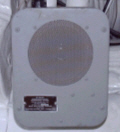
1MC Speaker

The Navy insists upon standard phraseology in its deck logs, phone talker communications, reports and 1-MC (ship-wide public address system) announcements. 1-MC announcements are accompanied by boatswain’s pipe calls which all sound the same at first.

While I was working on a novel about the sea, I remembered what it was like being transferred to the aircraft carrier USS Ranger (CVA-61) right out of boot camp. Compared to boot camp, the ship was much better duty, but there was still a lot to learn.

When I reported aboard, I was informed that I had been assigned to a floating city with an airport where the residents spoke a foreign language. Soon, I would have to learn what was supposed to happen when we “set condition zebra” (a readiness condition with certain hatches and fittings closed); and that a “shot line” didn’t refer glassware on a bar but to a small-diameter line fired over an alongside ship prior to an underway replenishment (UNREP).

Reveille throughout the city came a lot earlier than one expected even though the chief petty officers in charge of our boot camp companies at Great Lakes had brainwashed us that squared-away sailors loved getting up early. But they didn’t tell us that aboard ship a BMOW (Boatswain’s Mate of the Watch) would announce over the 1-MC to “Heave out and Trice Up.”

My first thought was that everyone aboard ship was being asked to vomit on command in the head. I was wrong. The phrase means get up. If you’re sleeping in a hammock, tie it up. If you’re sleeping in a rack (bunk) tilt it up against the bulkhead (wall). This makes it possible for the sweepers or compartment cleaners to sweep the deck (floor) underneath it. In the old days, a trice hook held the rack/hammock to the bulkhead.

The Public Affairs Officer as the Lone Ranger

Planning to join the Navy and–as we always said–let the world see you? Be ready to learn fast. When it’s time to get up, you won’t have time to study your Bluejacket’s Manual for instructions. But one way or the other, you’ll need to know the difference between heave, heave in, heave around, heave out, heave to, and heaving line.

Scuttlebutt (gossip) isn’t always “the straight skinny” (accurate facts) especially when it comes from the fabled all-knowing (and mythical) “port butter cutter.” With luck, the old salts will soon tire of sending you off to find fictional left-handed crescent wrenches, cans of relative bearing grease, buckets of prop wash, or of asking you stand “mail buoy” (huh?) watch on the bow. Then they’ll remind you (if you need reminding) that all stairs on ships are called ladders and doors are called hatches and dogs are what keep them closed.

Maybe they’ll tell you the handy general quarters acronym FUSDAP so that in the three-minute rush to get to your duty station you’re moving with traffic rather than against it. Forward and up on the starboard side, down and aft on the port side is very handy to know.I hope they don’t have to tell you not to head for the flight deck looking for a Quidditch game when the BMOW comes on the 1MC and says “sweepers sweepers man your brooms.”

On the other hand, our ship really did have a horse, fiberglass, that is, so if the chief sent you to give it a bucket of oats, it was best to disappear for a while until everyone else in the compartment was done laughing at the joke.

Update: Since this post was written, the USS Ranger was sold for scrap because in all the years it was available to be purchased by a group willing to turn it into a museum, no viable plan was submitted to the navy. Movie stars spend more on their houses than was needed to preserve this ship and all the history it contained. Screwed up priorities, I guess.

Malcolm


AtSeaBookCoverMalcolm R. Campbell is the author of the Vietnam War-era novel set on board an aircraft carrier, “At Sea.” For David Ward, going in harm’s way seems to apply more toward the people back home than life in the sailor towns and the ship.

Take a few notes: you might write about this place some day

In fiction writing, we have the freedom to create settings of our choice. But readers will pick up on phony settings pretty quickly. The more realistic and more interesting your setting, the more likely the characters who inhabit it will be believable and interesting to the reader. — Robert Hays (“The Life and Death of Lizzie Morris”)

Liberty Port in the Philippines
When I was in high school, I tried multiple times to keep a log or journal. But that required more extended discipline than I had. While I began each attempt with the best of intentions, the entries quickly morphed from wordy and detailed into sketchy and infrequent.

A little discipline then could have saved me a lot of trouble when I began writing my novel “Garden of Heaven.” It uses settings I should know well: Glacier National Park, Montana; Tate’s Hell Forest and Tallahassee, Florida; Olongapo, Philippines; the aircraft carrier USS Ranger; Decatur, Illinois; Gronigen, Netherlands.

Each of these places holds memories for me that fit the plot and themes of the novel. Yet, when it comes to nitty-gritty details, memory can be tricky. When exactly did the USS Ranger leave Alameda for Vietnam in 1968 and what stores existed on Tallahassee’s College Avenue a few years before that? What year did the Decatur transfer house get moved and how far was the Galaxy Bar from the main gate?

Fortunately, books, magazines and online research helped fill in the gaps. So did e-mail correspondence with people at Glacier, Tate’s Hell, and Decatur. Frankly, a good journal would have taken me a lot less time. Not that I would have recorded everything I might have needed in a novel written decades later. But recording my observations would have given me a good start.

USS Ranger (CVA-61)
Since it’s quite likely that a writer will end up using places he has a passion for or where defining moments occurred–whether it’s the town where he grew up, the theater where his military service unfolded or the destination for his favorite vacation–I’m thinking it just makes good sense to become a bit more of a packrat.

In addition to photographs, a few notes, brochures, newspaper clippings, ticket stubs, itineraries, and other materials will not only reinforce the writer’s observations when he’s there; they’ll support his memory years later when he puts his protagonist into the deep swamp he saw when he was a kid or the sailor’s liberty town he saw when he was in the Navy.

Such details don’t need to turn into the pages and pages of description readers of today’s novels often skip over. They do bring a place to life. They’re the difference between a setting with depth and one that appears plastic and ill-formed.

And if you have the discipline, keep a diary, log, journal or notebook: your readers will thank you and your writing will be all the stronger for it whether you’re writing about stealing cookies on the mess-decks of an aircraft carrier or the sound a panther makes in a notorious Florida Swamp.

Memorial Day – Remembering

“Somewhere behind the haze-gray façade of bulkheads there are people.
People too important to be likened to small cogs in a massive
non-human machine. Each man has a distinguishable face and personality, a specific job to perform and memories of a world an ocean away.” –M. R. Campbell and M. B. Marmaduke in Cruisebook, USS Ranger (CVA-61), 1969-70.

Classic Ranger photo by Edward Weeden from 1979

The U.S. Ranger Foundation is working to convert the decommissioned aircraft carrier into a floating museum to be moored in Portland, Oregon. On Memorial day, it’s fitting to wish them fair winds and following seas on this massive project. For more photographs by Weeden, click here.

I served aboard this ship in 1968 and 1969 and, unfortunately, knew men who were lost in action. See my fictionalized excerpt called Jack Rose – Only a Memory.