Did you sign up for National Novel Writing Month (NaNoWriMo)?
Good for you.
If you participated last year, as I did, then you’ve probably gotten a few e-mails from program director Lindsey Grant with links and advice. Here’s a crucial reminder from a recent note: Warn your friends, family, neighbors, and pets about the upcoming challenge. The more people who know what you’re working on, the more accountable you’ll feel and the likelier you are to hit the 50,000-word goal.
Now is the time to write at flank speed. If you weren’t in the Navy, flank speed means “fast.” Others will remind you to either shoot your inner editor or lock him or her in a closet this month. You can’t write at flank speed if you’re cutting, pasting, backspacing, using the thesaurus, or playing Angry Birds while you try to think of the perfect word.
All good.
While writing my recently released contemporary fantasy novel Sarabande during last year’s NaNo, I also used a theme song. Actually, it was a theme album.
Some people go to sleep every night listening to a DVD with a selection of restful music, an appropriate radio station, or a white noise machine. The music, or the surf or waterfall on the white noise machine, quickly become associated with sleep. The sound works somewhat hypnotically…sleep…sleep.
I picked a CD with Native American flute music by Mary Youngblood. I knew it would work because I’d used it before. I also knew it wouldn’t make me sleepy. Whenever I sat down for my NaNo writing, I put on my headphones and started the music. It was a jumpstart, and it automatically got me thinking of my characters and plot.
For best results, try not to listen to your writing music when you’re not writing. That might dilute its impact during NaNo when you need at least 1,667 words a day to reach that 50,000-word goal.
I’ve written three novels using theme song music. Sarabande was the second time out for Mary Youngblood’s Beneath the Raven Moon. While writing The Sun Singer, I used a new-age instrumental album called Nivana Road by Deuter. In my case, the music had a double connection. First, it became hypnotic and associated with writing. Second, Sarabande has Native American themes and The Sun Singer has new age themes.
You may not find music that mirrors what you’re writing about. If you do, it’s a bonus. If you don’t, I’m guessing that after listening for a couple of flank-speed, NaNo sessions, you’ll soon find those word counts a bit easier to reach because you will be in the zone with your work—thanks to the theme song.
While I was working as a seasonal, college-student employee at Glacier National Park, my father said, “One day you’ll write a book about this.” As I walked the mile between the hotel and the camp store for Cokes, candy bars and other “health foods,” I visualized long nature articles about the park for National Geographic Magazine that would combine with proposed climbs of K2 and Mt. Everest and canoe rides down the Amazon into a hiker’s guide to exotic trails.
Little did I know I would one day set three novels in the park.
Like most college students, I was used to walking—and sometimes running—across a campus to get from one class to another. While working at the park, I not only walked around every lake near the hotel, but hiked to every waterfall, tunnel, mountain pass, and alpine meadow. Why? For a lot of reasons. For a Florida boy, the mountains were an exciting new environment. Plus, in those days, seasonal employees weren’t allowed to bring cars into the park. So, we talked. Going to the camp store was child’s play. By the end of the summer, a 25 mile hike as an easy stroll.
A Sack of Guidebooks
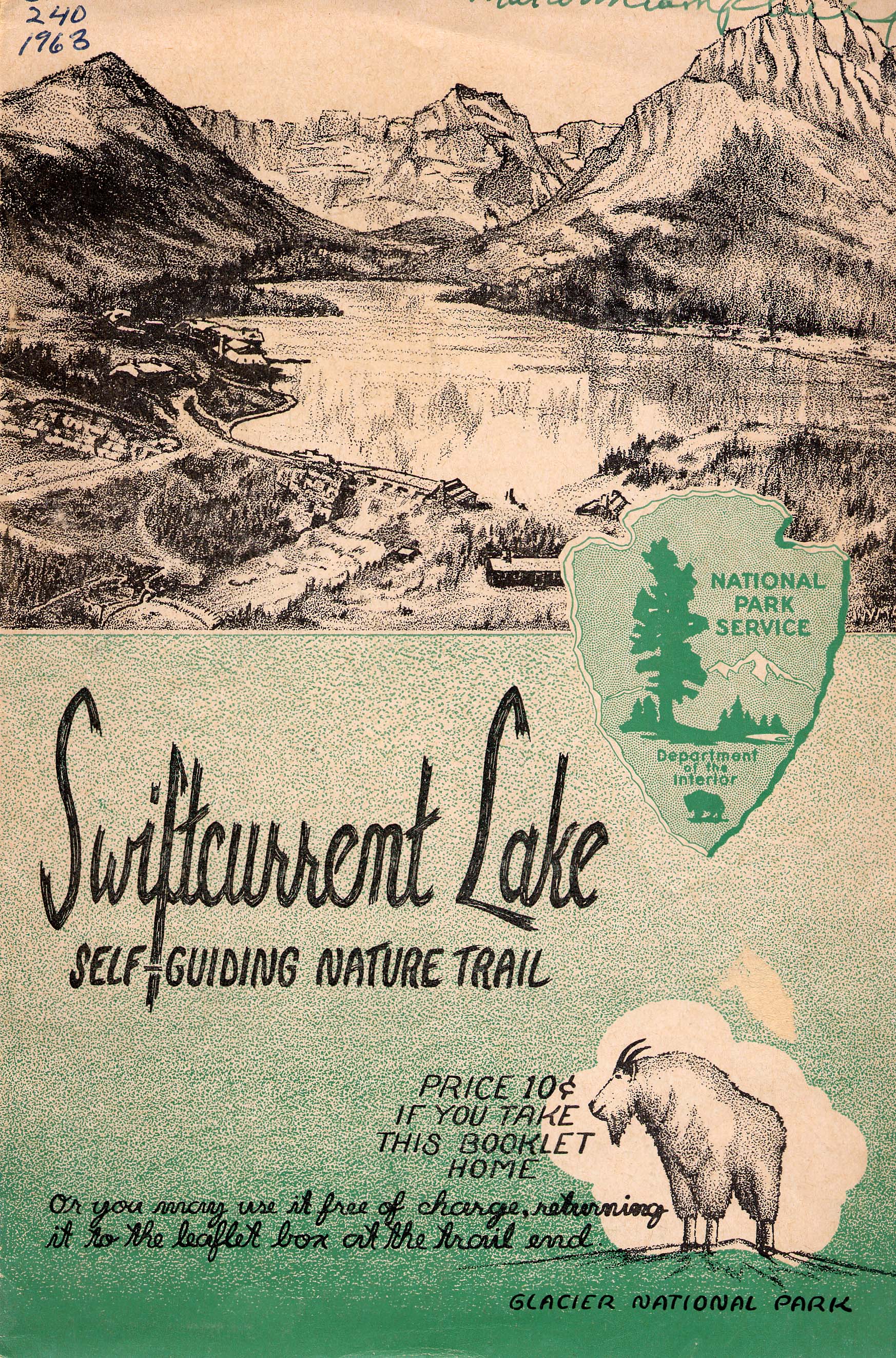
There used to be a wood box on a post near Many Glacier Hotel with a handfull of walking guides for tourists taking their first hike around Swiftcurrent Lake. If you wanted to keep the guide, you put a dime in a slot. If not, you put the guide into a similar box where the trail neared the camp store. I kept mine and along with it, brought home a sack full of guidebooks.
These materials are a writer’s dream. They allow me to merge my imagination and memories of the trails and mountains with specific factual information about the trees (subalpine fir, willow), wildflowers (fireweed, beargrass), and mountains (Grinnel, Allen). Even though I write contemporary fantasy, I want the setting to be as realistic as possible, and while I didn’t know it when I was a hotel bellman, all thosde after-work hikes were taking place in a world that would one say be part of The Sun Singer, Garden of Heaven: an Odyssey, and my new novel Sarabande.
I never wrote those National Geographic Magazine articles, much less climbed K2 or Everest, but I did write a few articles and essays about the Swiftcurrent Valley in Glacier National Park. Looking at the valley from a journalist’s or feature writer’s perspective helped me collect my thoughts for the fiction I would set there later. Unfortunately, I haven’t been back to the park for many years, but all that time walking around in the setting of my future novels rather engraved the sights and sounds in my memory.
Sarabande Excerpt – from a Fictional Cabin at the Park’s Lake Josephine
Lake Josephine and Mt. Gould - twbuckner photo
The bright yellow of a late morning sun filled the bedroom when Sarabande awoke. She felt the light move before she opened her eyes and pulled the tangled folds of the quilt away from her face. A summer breeze followed the light, fluttering the blue curtains with a breath that smelled of fir trees, larkspurs, gentians, and stones from snow-melt streams. Pine siskins chirped to each other amongst the ferns and mosses, olive-sided flycatchers pipped from tree-top perches, and children laughed. The laughter came and went with the coming and going of a rumbling, technology-sounding hum. Sensing no threat in the sound, she projected outside and found that a boat traveling up and down the lake with visitors was powered by whatever made the pervasive hum. The visitors got off the boat, looked around, laughed, and then got back on the boat and went away. They surrounded the cabin with their smells of strange soaps and fabrics, completely unaware of the magic in their midst. Whether it was the good night’s sleep or the rhythms of the water in the box of warm rain, her normally sharp senses intensified while she slept. Within the quilt of interlocking rings, she acquired—or was acquiring—Bear’s sense of smell, Eagle’s sight, and the quivering alertness of chipmunks and butterflies.
In Garden of Heaven: an Odyssey, my protagonist David Ward is convinced that some of the people we meet on rainy city sidewalks and between the dry-as-dust shelves in ancient libraries began their lives as fictional characters. Whether they first strayed through a writer’s thoughts as a random notion, stalked him along the boundaries of his waking world in twilight dreams, or arrived at the very moment the pen first kissed the paper with their name, such individuals are called into life because an empty space must be filled.
David claims he wrote a novel about a woman who meets his protagonist at an old transfer house where the city’s streetcar lines come together, allowing people to transfer from one city car to another or from a south side local to a north side interurban. It’s impossible to know whether Ward dreamt up a character whose depth and outlook were the very same as the depth and outlook of the soul mate he was seeking or whether his muse was moonlighting as a matchmaker.
At a time when David was lost, the fictional character appeared in his life as a living, breathing woman, and while she was in the process of saving his life, he asked how she happened to meet him by happenstance on a warm, Indian summer afternoon. She said he called her when he wrote what he wrote about the transfer house. Clearly, he needed her too much for her to live out her existence on a printed page. She is, in David’s mind, a very real woman who is filling a very real empty space.
He’s fair certain the gods tampered with the workings of the temporal world on the day when she had her first independent thought. He’s convinced of her reality, and I believe him.
As an author of fantasy novels, I can’t claim what my characters claim. I will not try to convince you that David Ward stepped out of Garden of Heaven: an Odyssey, and became real, much less that a character in one of my character’s stories became real. Speculation along such lines leads to lunacy or into the “many worlds interpretation” of quantum mechanics that suggests that things that can happen, do happen.
Sarabande has entered dark territory
My protagonist in Sarabande was, for the many months I was actively at work on the novel, a very strong presence in my thoughts. She had a story to tell. Like a living and breathing person, it took her awhile to trust me enough to share the most personal events and feelings that had, for so many years, lurked powerfully in her thoughts. Figuratively speaking, I followed her on her journey from Montana to Illinois and back as a silent scribe. I could not intervene because my powers as an author do not allow me to tamper with the workings of my stories.
Now, the novel has been written and published and I feel rather lost because, fictional though she is, Sarabande’s voice—as interpreted by my muse—has been a voice constantly speaking. She needed me to hear her and disseminate her story to those who love fantasy worlds that hover close enough to our world that they rattle the windows as well as our thoughts while we’re reading a story.
When Sarabande was published, Sarabande stopped talking. There was nothing else for her to say. My muse became quiet as well. At the end of the novel, Sarabande understood many things. I understood them, too. Then she stepped into a well-lighted mountain cabin with two friends and closed the door. They have much to discuss, but I am no longer hearing Sarabande’s voice. I have no idea what is being said and done on the other side of that door. In the railroad business, “dark territory” refers to sections of the line where there’s no communication between a train and the outside world. That’s an apt description for Sarabande’s current whereabouts.
Many authors feel a bit lost when the finish writing a short story or a novel. The intense focus on the story for many months or many years is rather hard to replace with the chores of a normal day. The missing story-in-progress leaves an empty space. I can understand why a reader or a writer might speculate about his characters finding the wherewithal to transition from the world of fantasy into the world of reality as we currently understand it.
What’s Next?
Yet, Sarabande ended at a natural place. Tempting as it may be to write past that ending, I think my words would not ring true.
A friend of mine asked, “What next?” I really don’t know. Perhaps I’ll write about stone masons in 16th century France or mountain climbers on the summit of Mt. Everest. Perhaps Sarabande will ask my muse to ask me to write another story about her life in the universe next door. She’s independent of me now and, in that regard, just as real in my memory as the people I’ve met on rainy city sidewalks and between the dry-as-dust shelves in ancient libraries. I can no longer tell you what she’s thinking.
I don’t know what’s next. No doubt, there are a lot of probable fictional characters out there with stories to tell. Hopefully, there are dreamers amongst them who need a scribe who loves mixing fantasy and reality in the same glass. When one of them is ready to talk, my muse knows my phone number and we can talk about what’s supposed to follow the words “once upon a time.”
–
Coming September 6
Author Smoky Trudeau Zeidel (On the Choptank Shores – A Love Story) will be here with a guest post offering a bit of advice for unpublished authors called “Knock it Off.”
As the August 31st release date approaches for my concemporary fantasy novel Sarabande, I am celebrating with a book give-away on GoodReads. Three free copies are available. All you have to do is surf over to GoodReads, click on the ENTER TO WIN button and fill out the form. (If you’re not a member of GoodReads, registration is free.)
Sarabande is the 80,000-word story about Sarabande’s journey from her alternate-universe home deep in the Montana mountains to central Illinois in search of the once-powerful Sun Singer. She needs his help to rid her of the haunting ghost of her sister Dryad whom she killed in self-defense three years ago. She knows she has a 1,650 trip ahead of her. She does not know that the journey itself will be just as perilous as confronting the evil temptress Dryad.
Released by Vanilla Heart Publishing, Sarabande can be read as a stand-alone novel or as a sequel to The Sun Singer. The e-book edition of Sarabande was released August 13 and is already available on Kindle.
Best of luck in the give-away. The entry deadline is October 1.
After her sister, Dryad haunts her from beyond the grave for three long and torturous years, Sarabande undertakes a dangerous journey into the past to either raise her cruel sister from the dead, ending the torment…or to take her place in the safe darkness of the earth.
Sarabande leaves the mountains of Montana for the cornfields of Illinois on a black horse to seek help from Robert Adams, the once powerful Sun Singer, in spite of Gem’s prophecy of shame. One man tries to kill her alongside a deserted prairie road…one tries to save her with ancient wisdom… and Robert tries to send her away.
Even if she persuades Robert to bring the remnants of his magic to Dryad’s shallow grave, the desperate man who follows them desires the Rowan staff for ill intent… and the malicious sister who awaits their arrival desires much more than a mere return to life.
Welcome to the world of fantasy. My name is Malcolm, and I’ll be your server this evening.
Today’s special is Sarabande, a bone-chilling new adventure about a young woman named Sarabande who risks a dangerous journey into her own past. With the help of the Sun Singer, she plans to raise Dryad from the dead so that her cruel sister’s ghost can no longer cause pain and suffering throughout a peaceful mountain valley.
Fantasy is a Dangerous Place
You’ll be reasonably safe in the world of fantasy while I am here to guide you. Otherwise, may I suggest that you read Sarabande during the daylight hours in the company of others. Do not read the novel at night unless the doors are locked.
Like abandoned mines, fantasy leads deep into the heart of strange landscapes, forbidden worlds and dreams, places where everyday reality fears to tread. Be careful and do not wander off alone, for the mysterious world of fantasy can be dangerous. That’s why I’m posting a warning sign here just like the one I saw recently in Virginia City, Nevada where gold and silver were once extracted from the earth.
Mining Fantasy Novels for Gold and Silver
While growing in a house full of books, I discovered high-quality ore in such fantasies as The Once and Future King and Lord of the Rings. Recently, others have discovered gold and silver in the Harry Potter books. The gold of dreams and the silver of mystery are not only exciting—they jump start the imagination.
I hope you’ll enjoy Sarabande. It’s available today in multiple e-book formats at Smashwords. Other editions will follow soon, including paperback. Dig deep, enjoy the ride, but please, read safely in well-lighted places.
My wife and I have been leasing and purchasing Dell computers since the 1980s. Suffice it to say, we’ve sent you a lot of money over the years. So, when I’m in the middle of finishing my adventure novel Sarabande, I feel rather let down when my two-year old Dell Inspiron 330 quits on me with a hard drive crash.
The PC is totally non-functional. Won’t boot. Using some trusty SpinRite software, I find that the hard drive is so bad that even trying to extract my data from it might cause it to be even more trashed than it is—whatever that means.
So now, we are forced to buy a new box, complete with new software because—naturally—the software we purchased with the 330 can’t be moved to another PC. Yes, we’re buying from you guys again, but we’re less than pleased.
Finished Novels
I realized several days after the Dell Computer crashed how lucky it was that I had backed up the most recent version of Sarabande on a flash drive a nanosecond before the computer was toast. Consequently, even though the book was done, I kept tinkering with it because it was a miracle it existed at all.
I did add a new scene that I dreamt about adding in the middle of the night, so I think my muse was right about that. But otherwise, I was just tinkering, just refusing to let go. So, I sent it to Vanilla Heart Publishing yesterday just to get it out of the house. It should be available this fall.
Smoky Talks Books
My friend and colleague Smoky Zeidel is having a VHP Day on her blog Smoky Talks Books this coming Monday, July 25th. She will be chatting with Vanilla Heart Publishing authors Malcolm R. Campbell, Vila Spiderhawk, Robert Hays, Melinda Clayton, S R Claridge, Collin Kelley, Charmaine Gordon, Marilyn Celeste Morris, and Janet Lane Walters.
Fortunately, I didn’t go on a rant about Dell computer because that would have taken up all the space on her blog. Stop by and see what makes us tick rather than what ticks us off.
When my next novel Sarabande is released this fall by Vanilla Heart Publishing, it will become my third novel set partially in Glacier National Park. Sarabande’s Glacier Park locations include Mt. Gould, the Angel Wing, Lake Josephine, Swiftcurrent Lake, Many Glacier Hotel, and Chief Mountain.
When the novel begins, my protagonist Sarabande has just finished spending the night on top of the Angel Wing. I’m sure the park service prohibits this practice, but then she lives in a look-alike universe that is accessed via several portals in the park. Her world is the 1970s. Our world, at the time the novel is set, is the 1980s.
99 cents on Kindle
She has much to learn about our world, from electricity, to the existence of a major hotel sitting where there’s an empty space in her world, to cars and highways, and how to travel across country. The Many Glacier area, as I mention in my e-book Bears; Where they Fought: Life In Glacier Park’s Swiftcurrent Valley, is rich in history, trails and mountains to climb.
The popular valley is not only a draw for tourists, but is my favorite place in my favorite park. I can think of no better place for an adventure novel. We have the extremes of weather, of dangerous high places and the chances of meeting grizzly bears or moose or ospreys or wolverines.
I’m looking forward to the release of Sarabande for many reasons. It’s my long-promised sequel to The Sun Singer. It’s told from a female protagonist’s point of view—a first for me. And it gives me an excuse to write again about Glacier National Park. I have been posting about the heroine’s journey itself in my Sarabande’s Journey weblog. It’s been fun to explore the differences between the solar journey in The Sun Singer, which follows Joseph Campbell’s well-known series of mythic steps in The Hero with a Thousand Faces, and the lunar journey which is quite different.
Lunar journeys are usually much darker and much for frightening because they focus on the lore of the night and the unconscious and, as we see in many myths, the domain of the underworld. Nevertheless, Sarabande is an adventure story with its primary scenes in a mountain world that park visitors know so well. The story also unfolds along U.S. Highway 2, the wetlands of northeast Montana’s prairie pothole region, and in Decatur, Illinois where Robert Adams, the Sun Singer lives.
As we get closer to the release date, I’ll begin posting excerpts of the book. It will appear first as an e-book on Amazon’s Kindle and in the other formats available at the smashwords.com site. A bit later, it will also be available as a paperback. If you’re a fan of Glacier National Park, I hope you will enjoy both the story and the location.
 Did you sign up for National Novel Writing Month (NaNoWriMo)?
 I picked a CD with Native American flute music by Mary Youngblood. I knew it would work because I’d used it before. I also knew it wouldn’t make me sleepy. Whenever I sat down for my NaNo writing, I put on my headphones and started the music. It was a jumpstart, and it automatically got me thinking of my characters and plot.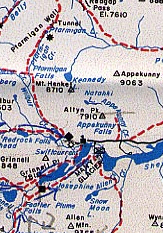


 In Garden of Heaven: an Odyssey, my protagonist David Ward is convinced that some of the people we meet on rainy city sidewalks and between the dry-as-dust shelves in ancient libraries began their lives as fictional characters. Whether they first strayed through a writer’s thoughts as a random notion, stalked him along the boundaries of his waking world in twilight dreams, or arrived at the very moment the pen first kissed the paper with their name, such individuals are called into life because an empty space must be filled.





 Malcolm's Round Table