In some ways, this post is a shameless promotion. My apologies.
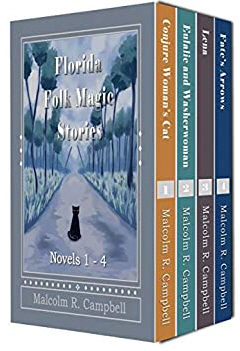
 The four books in my Florida Folk Magic Series have female primary characters. I had already written one book, Sarabande (contemporary fantasy) from a woman’s viewpoint. It’s the opposite of The Sun Singer (the sequel) about a young man following a plotline based on the hero’s journey popularized by Joseph Campbell in The Hero With a Thousand Faces.
When I began thinking of a sequel to The Sun Singer, I discovered a lot of controversy among writers and mythologists about how a woman would go on such a journey. Many people said the woman would simply follow the standard tropes of the man’s hero’s journey; others thought that was absurd because men and women generally have different mythic focuses. I agreed: I needed a heroine’s journey, not a tweaked hero’s journey.
So after researching mythologists who wrote about strong mythic females, I opted to write Sarabande from a woman’s point of view by using a mythic journey, that of Inanna, an ancient Sumerian goddess, as a basis in a very general way. Research took a long time mainly because I needed to get to the point where the narrative sounded true to a woman’s thoughts and actions rather than to a man pretending to know how a woman would think and feel about the experiences encountered in the story.
 I decided maybe I had accomplished this when a female reviewer, speaking of an assault scene in the novel, said the scene worked and that she had to keep reminding herself it had been written by a male author. The mythic elements and the fantasy genre probably played a lot in my accomplishing this; had the woman been a modern-day character in typical real-life situations, I don’t think my characterization could have come out sounding true–that is, as a woman would think and feel.
However, when it came to the “older-than-dirt” African American conjure woman in the 1950s-era Florida Panhandle, this white boy knew better than to write from her point of view. The gulf in our ages, cultures, and experiences was just too great even though the conjure woman is loosely based on a person I knew while in junior high and high school; then, too, I lived within the period when the book was focused and had observed the things I was writing about.
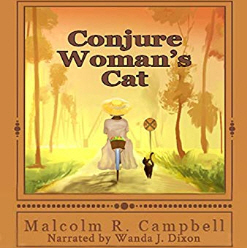 That’s why the narrator is a cat, something I thought I could get away with since the novels are written in the magical realism genre. That allowed me to do things that wouldn’t have worked in a non-genre book. I was helped in this ruse by having lived with one to three cats in the house since the 1980s when my wife turned me into a cat person. My “take” on how a cat might act and think was probably more believable than trying to write directly from my character Eulalie’s viewpoint. Readers worried more about something bad happening to the cat (Lena) than the people. I didn’t count on that, but I got used to it.
The writer’s “trick” is to write around the things s/he can’t possibly write “property.” Sometimes it works, and sometimes it doesn’t work.
–Malcolm
 Malcolm R. Campbell is the author of the contemporary fantasy novel “The Sun Singer.”


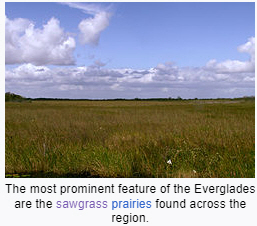 “A particular place in the land is never, for an oral culture, just a passive or inert setting for the human events that occur there. It is an active participant in those occurrences. Indeed, by virtue of its underlying and enveloping presence, the place may even be felt to be the source, the primary power that expresses itself through the various events that unfold there.” – David Abram
 Several days ago, I

 If you watched Ken Burns’ 1994 documentary “Baseball,” perhaps you felt the magic in the sport. PBS called the film, “An American epic overflowing with heroes and hopefuls, scoundrels and screwballs.” If you sense this magic at the ball field or even while watching a game on TV, perhaps you can understand why Canadian author W. P. Kinsella (1935-2016) used magical realism in Shoeless Joe, The Iowa Baseball Confederacy, and his later novel Butterfly Winter.
 The spirit of the magic is aptly summed up in the New York Times review of Shoeless Joe that includes the following excerpt that appeared after a character was discovered to have been lying about his baseball experience: “I imagine Eddie Scissons has decided, ‘If I can’t have what I want most in life, then I’ll pretend I had it in the past, and talk about it and live it and relive it until it is real and solid and I can hold it to my heart like a precious child. Once I’ve experienced it so completely, no one can ever take it away from me.'”
 Wikipedia says,” The Iowa Baseball Confederacy (1986) another book blending fantasy and magical realism, recounts an epic baseball game a minor league team played against the 1908 World Champion Chicago Cubs” and Butterfly Winter as “The story of Julio and Esteban Pimental, twins whose divine destiny for baseball begins with games of catch in the womb, the novel marks a return to form, combining his long-held passions of baseball and magical realism.”
 I am re-reading The House of the Spirits for the first time since it came out in English in 1985, most likely from the copy I read then. Allende is one of my favorite writers (perhaps above all others) because the stories she tells resonate with me as does the fact she begins each of her books–and I’ve read most of them–without knowing where the story is going. The House of the Spirits didn’t disappoint me in the mid-1980s, and yet, I was afraid to go back to it for fear the most perfect novel would have become imperfect over time like a first lover you don’t dare meet again after both of you have grown up.
 Malcolm R. Campbell


 Malcolm's Round Table