 I was amused at the semantic chaos a character in a recent novel fell into while trying to explain the various pagan groups to an individual who (a) was a born-again Christian with Baptist-oriented beliefs, and (b) thought anything labelled “pagan” or “witchcraft” was pure and simple “devil worship.”
I blame both the Catholic Church and Hollywood for creating and sustaining the ignorant idea that pagans and/or witches and/or Wiccans and/or hoodoo practitioners all worship the devil. Many of those “charged” with worshipping the devil don’t believe in the devil. The devil is more or less a Christian notion.
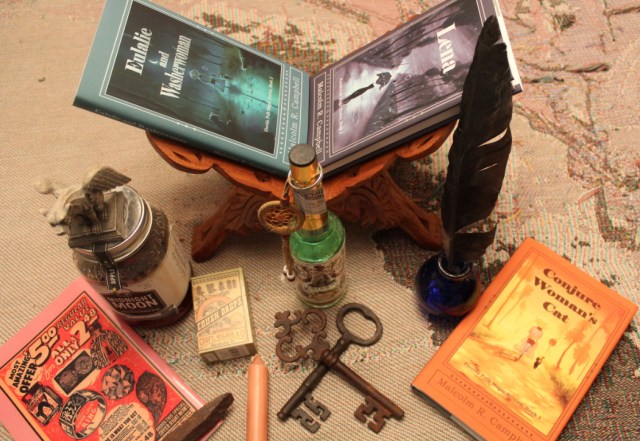
I call my series of conjure novels “folk magic” which, in many ways, is like conventional witchcraft. The terms get muddled because many Wiccans call themselves witches while others mix up Voodoo and hoodoo.
Wicca, like Voodoo, is a religion. Hoodoo and conventional witchcraft are practices usually with a strong link to nature and spells drawn on what is observed in the natural world. Those who practice hoodoo, with its origins in Africa, are often very strong Christians and see no conlflict between the two belief systems.
I find it easy to write stories about conventional witchcraft and hoodoo because they seem to me to be very natural to those who notice the ways and means of the seasons and the natural world. Both allow the practioner to worship the gods and goddesses of their choice, Christian or otherwise.

The Wicca Academy website states that, “Wicca is a contemporary, nature-based, pagan religion. It refers to the entire system of practices and beliefs that comprise the modern pagan witchcraft spectrum. Although people often think that the terms Witchcraft and Wicca mean the same thing, that is not the case. All Wiccans are witches, but not all witches are Wiccans.”
The Green Man website states that “Drawing Witches into a cohesive identifiable group of any sort is truly like herding cats! And Traditional Witchcraft is no exception! So to cover my ass I think it best to state that all I can share is my own perspective based on my own practices, beliefs and understandings. These I have gleaned over more than 4 decades as a Traditional Witch and over two decades of leading a Coven and Tradition as well as teaching and presenting Trad Craft to the general public. All that said, there are many others with valid experiences and credentials who, coming from other Traditional foundations, would present Traditional Witchcraft in quite a different manner. As with all such explorations, look for multiple, diverse sources and find what speaks to you personally. That is in fact an approach that would be perfectly in accord with Traditional Witchcraft practices, as I present it. As Traditional Witchcraft is rooted in one’s personal senses or rather extra-sensory abilities, built upon one’s intuition, we call it “The Sight” aka “The Gifts”. Informed through direct communion with the many forms and expressions of Spirit, a Traditional Witch is then guided by their own sense of right and wrong employing what one might call one’s Ethical Compass. It is this personal and direct communion relationship a Traditional Witch has with Spirit that sets them as a Heretic: meaning outside of all forms of organized religion and circumventing any priesthood authority mediating Spirit or imposing a codified “One and True practice” or belief with regards all things related to Spirit. ”
In general, I like the practices better than the religions because I don’t really trust systems in which others tell me what I can do or what I must believe. Truth, I think, comes in following what we believe rather than what a hierarchy of leaders and rules say we must believe.
My two cents as a solitary.
–Malcolm




 I tend to think we create wherever it is we’re going. If fear is a mind-killer, then I step forward from that thought and think that doubt is also a mind-killer. I’m not against being prepared–as we were taught in the Boy Scouts. Yet, I can’t help but think time spent with negative negative concerns such as fear and doubt is not an example of being prepared. Instead, those repeated concerns not only demonstrate to the universe we have no confidence in what we’re doing (praying, casting a spell, intuiting a situation far away, transmitting healing energies), they also create the very conditions our fear and the doubt are focused upon.
 This plant symbolizes immortality and, as such, can be used to communicate with the dead. It can be mixed with holy water or burnt as an incense. You can also use it as an aid to psychic dreams and visions.. According to Occult1.com, Acacia can be “used as a Holy Oil for candles and your Altar. You will find this oil mentioned in the bible Exodus chapter 25. This is a very holy oil, used to anoint items that are used on the altar, used in the bath for Jinx Removing.rituals or at a time of prayer. You may also anoint your body at times of worship. • Due to the holy influences, Acacia is also known to be a protection oil, and one used for blessings, it should be worn on your wrists, palms and heart.”


![Florida Folk Magic Stories: Novels 1-4 by [Malcolm R. Campbell]](https://m.media-amazon.com/images/I/51JM4A8GQFL.jpg)
 Regardless of the approach one takes, the one aspect that cannot be overlooked no matter how perfectly one follows the directions and prescriptions for an intended result is belief. Magic requires belief in order to function, or, as some might say, your beliefs create your reality. One point I emphasized in my

 Malcolm's Round Table