The beauty of this place we now call Montana inspires such awe that words frequently fail us. And that’s when we call for the poets. The book in your hands is a campfire of sorts, around which eleven poets laureate have gathered. Their legacy joins thousands of years of voices speaking across this landscape.
Twenty years is a blip in the reckoning of this place, but in that time Montana’s poets laureate have chronicled the scale and shape of its grandeur and its grace, and the hardships and hopes of the people who call it home. This collection is a glimpse into their work and the importance of the spoken word to this best of places.
Published by the Montana Arts Council in collaboration with the Montana Historical Society, This Place the Gods Touched Earth collects work from Montana’s eleven poets laureate to date, celebrating their responses in words to the people and places of the Big Sky, and commemorating their two decades of service to Montana’s literary landscape so far.
“This Place the Gods Touched Earth is the first poetry anthology to come out of the Montana Historical Society Press. But it’s much more than that—speaking as the historian that I am, this anthology is the bottled zeitgeist of Montana over the past two decades of the Poet Laureate program,” says Jeff Bartos, editor, Montana Historical Society Press. “It’s a primary source for the language arts in Montana in the twenty-first century, compiling—by discretion of the individual poets—their most meaningful writings and profound observations into one volume.’
The anthology is a collection of Montana’s Poets Laureate, 2005 – 2025.
When I was young, nobody told me what getting older was like.
My grandparents had the usual complaints. Lumbago. Failing eyesight. Being ignored. Awake all night.
Some said our elders were all-wise and all-knowing.
I never thought I would feel l wise like Dumbledore or that, instead, age brings as many regrets as it does. But I look back and see what I shouldn’t have done or could have done–and that I should have learned to forgive.
FDR was President when I was born. Did you suspect that? Most people don’t because they’ve forgotten FDR and history in general. At the time, I didn’t know he was President or that Truman dropped the bombs. I never forgave Truman. My first knowledge of world events came during the Korean War. I never forgave anybody for that mess–or Vietnam, either.
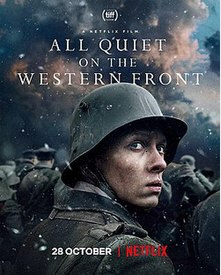
Looking back takes time because it’s a long trip. I do remember reading All Quiet on the Western Front and knowing–even as I read it–I would carry the scars of that story forever. That book is one reason I became a pacifist. I’m not sure about everything I think I see while looking back because I’ve used so many of my personal stories in my fiction. So I wonder, did that really happen or did I make it up. Most of the people who could answer that question are gone or, perhaps, fictional. In my youth, the KKK was real and my first real fear. They were everywhere. They burnt a cross on my minister’s lawn. All that was too evil to make up so it made its way into my books. I changed the names of the people I knew who were members of the very visible invisible empire. The same goes for the real people in my Navy experience.
My writing output has slowed down with age. I didn’t see that coming. In some ways, I’m just too tired to slog through the real and imagined memories anymore. I think that happens to a lot of people who were born when FDR was President. Hmm, I might be making that up.
This new book is a must for students, researchers, authors, and hikers in Glacier National Park, Montana. Released March 27, the book is another in a string of titles about the park by long-time researcher and former geography professor David R. Butler who has worked and hiked through the park since the early 1970s.
From the Publisher
“Pioneering Women of Glacier National Park examines the role of early pioneering women in the pre-park period up through the first three decades of Glacier Park (1910-1940). The concept of ‘pioneering women’ includes a wide range of activities that were atypical for women during this time period. These activities range from Blackfeet and other Native American women carrying out extraordinary feats, to women homesteaders, wives of early Park rangers, writers visiting and writing about the park, artists engaged in outdoor painting, influential artists’ wives who furthered their husbands’ careers, and pioneering outdoorswomen. All helped advance the cause of putting female faces and names, largely ignored and anonymous up to this point, into the history of the park. The book also has several modern photographs taken by the author and others, illustrating landscape changes in Glacier Park since the early period of the park.”
Butler provided me with a list of the table of contents headings which one would normally see provided by the publisher had they activated Amazon’s “look inside” feature:
Contents
Acknowledgments
Introduction
Native American Pioneering Women
Pioneering Women Homesteaders and Settlers
Ranger Wives: Pioneers of a New National Park
Pioneering Women Authors of Glacier National Park
Influential Wives of Early Glacier Park Artists
Pioneering Women Artists of Glacier National Park
Pioneer Outdoorswomen of Glacier National Park
Afterword: The Lasting Legacy of the Pioneering Women of Glacier Park
Endnotes
Bibliography
–Malcolm
Malcolm R. Campbell, who also worked as a summer employee in Glacier National Park, has written fiction set in the park, and his account of the 1964 flood appears A View Inside Glacier National Park: 100 Years – 100 Storiesedited by Kassandra Hardy.
A Black Woman’s West: The Life of Rose B. Gordon, by Michael K. Johnson, 256pp, will be released on April 22 by the Montana Historical Society Press. It’s available for pre-order on Amazon. As a member of the society, I look forward to the release of important new books by the MHS Press.
From the Publisher
Born in the Barker mining district of central Montana Territory, Rose Beatrice Gordon (1883-1968) was the daughter of an African American chef and an emancipated slave who migrated to the West in the early 1880s. This book tells the story of the Gordon family―John, Anna, Robert, Rose, John Francis Jr., George, and Taylor―and pays tribute to Rose, who lived most of her life in White Sulphur Springs. In her youth, Rose excelled academically and distinguished herself as a musical performer. As an adult, she established her economic independence as a restaurant owner, massage therapist, and caregiver. She also made a place for herself in the public sphere through letters to the editor and eventually through a regular newspaper column for the Meagher County News―a remarkable undertaking at a time when Black women in America were largely denied a public voice. As a Black woman in the West, Gordon’s life was ordinary in terms of its day-to-day struggles but extraordinary in its sum.
Editorial Review
“The story of a single life, well told, always amounts to more than the sum of its parts. Critically, Johnson allows the lives that Rose Gordon and her family led in White Sulphur Springs to stand on their own. But through Rose’s story, he recovers a much wider history of Montana’s society and culture that is seldom told. As a book meditating on race, belonging and the meaning of home, A Black Woman’s West has much to say to all students of Montana and Western history.” – Anthony W. Wood, author of Black Montana
Author
Michael K. Johnson is a Professor of American literature at the University of Maine at Farmington. His previous works include Black Masculinity and the Frontier Myth in American Literature, Hoo-Doo Cowboys and Bronze Buckaroos: Conceptions of the African American West and Can’t Stand Still: Taylor Gordon and the Harlem Renaissance.
“Another major experiment which affected Glacier was also to affect many other national parks. The program was part of President Franklin D. Roosevelt’s New Deal and was called the Civilian Conservation Corps. In 1933, almost immediately after this program’s enactment, young men from all over the United States were organized into work crews in camps in national parks and forests. Responding to the Depression economy and vast unemployment, Roosevelt intended this labor to enhance the conservation of natural resources while providing a livelihood for indigent young men. Nationwide, over a thousand camps organized by the Army employed some three hundred thousand young men, and in Glacier, some sixteen hundred enrollees arrived and eight camps were established in 1933.” – C. W. Buchholtz in Man in Glacier, 1976, Glacier Natural History Association
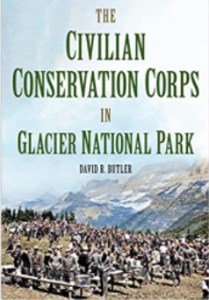
Those of us who became addicted to Glacier National Park over half a century ago, learned more about the park by reading books and monographs published by the former Glacier Natural History Association, for which I was a volunteer, that drew on the expertise of those whom I consider the first generation of modern-day park historians including Jack Holterman, Clyde Lockwood, Curt Buchholtz, Michael J. Ober, and others. For today’s generation, I should add David R. Butler (Fire Lookouts of Glacier National Park) to that evolving list for providing another readable chapter to the park’s knowledge with the current volume released by Arcadia Publishing in February.
From the Publisher
“The Civilian Conservation Corps (CCC), one of the most successful of all New Deal programs, was heavily involved in creating and improving the infrastructure of Glacier National Park. Between 1933 and 1942, a total of thirteen CCC camps were located on both sides of the Continental Divide that bisects the park roughly from north to south. CCC-I.D. (Indian Division) camps also existed along the eastern edge of the park on the Blackfeet Reservation. CCC “boys” were employed in fighting forest fires and clearing areas of burned trees, clearing brush and debris, sawing logs, creating trails, building fire lookout towers, constructing Park Service buildings, assisting with bridge construction, and building phone lines to connect east and west sides of the park. President Franklin Delano Roosevelt visited in August 1934 and gave one of his famous radio “fireside chats” from the park, in which he praised the efforts of the CCC in helping improve the country’s national parks. Chapters examine CCC camp life, the nature of the work carried out by the CCC boys, structures built in the park by the CCC, and FDR’s visit.”
In his April 6 review for the Hungry Horse News, Chris Peterson wrote, “You can’t drive into the west entrance of Glacier National Park without seeing the work of the Civilian Conservation Corps. They not only replanted the entire surrounding forest, they built the entrance station itself.”
And yet, most of today’s visitors come and go without knowing of the tremendous influence of the CCC on all aspects of the park, second only to the work done by the Great Northern Railway’s hotel company. I’m very pleased to see this new book by Butler (who’s been in the park almost as long as I have) who sees it with a professional vision and love of history.
The book will have an impact on you because the more you know about Glacier National Park, the more you love it and understand the constant hard work it has taken–and will continue to take–to preserve it.
Yesterday, I mentioned those Facebook memes in which an old appliance is displayed and people are asked if they know what it is. Dial telephones, can openers, cassette tapes, paper cutters, all kinds of office, kitchen, and workshop stuff. I’m amazed at the number of people who don’t know what it is.
Do you know what this is?
Most of the stuff shown was common as “recently” as 20 years ago. Some things are actually still around. If people aren’t using those things now, they would have seen them in their parents’ houses while growing up. Or in old movies and clips from old TV shows. Maybe I show my age when I say this, but anyone who’s watched a western movie or TV show will even know what a lot of objects are that were common in homesteads and ranches a hundred years ago. (Shows like “Little House on the Prairie” and “Medicine Woman” are, for example still running in syndication, showing us the tools and appliances from a hundred years ago.)
How about this?
Perhaps those Facebook memes are phony and everyone and their brother knows what the stuff is. Perhaps so much new stuff is coming on the market, it’s harder to remember what was around 20 years ago. Perhaps fewer people watch old movies and old TV shows these days and don’t see the objects in those memes in use. Maybe the people who watch documentaries on the History channel (where there’s a lot of old stuff) aren’t on Facebook and never see the memes.
Or, do fewer and fewer people care about the past–and all the stuff in it–because today’s issues are occupying all of our attention? The impression I’m getting is that fewer people these days are aware of recent history, much less old office, and kitchen appliances. What do you think?
Have we lost our love affair with times gone by and all the stuff people used in those days?
“They” say that Scots and those of Scots ancestry are cheap. “They” might be right since we’re part of that group who spends both sides of every penny.
Bookwise, this means that unless a book is on my “MUST HAVE IT RIGHT NOW” list, I’m going to wait for the trade paperback, or even the mass market paperback, edition of books I’m waiting for. Oddly, these days the paperback version might be more expensive than the hardcover.
I do the same thing with movies because trying to set up closed captioning at a theater is a who needs it, so I seldom see any film before it reaches TV with closed captioning. I guess this is just part of getting old. By the time I read a book or see a film, the discussion has moved on to something newer. Sigh.
So, while waiting for the cheapest edition of the newer books, I’m constant grabbing books off my shelves and reading them again. (I think that if I read it two or three times, that cuts the cost by 1/2 or 1/3 and gets me into less trouble with my wife for sneaking books into the house.)
Yes, there’s Kindle, but that’s not my thing. I read stuff off the screen all day, so that’s the last thing I want while reading for 30 minutes before going to sleep.
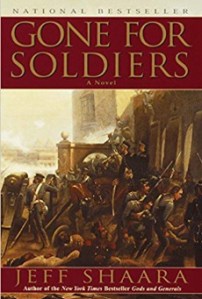
Right now, I’m re-reading another Jeff Shaara novel, Gone for Soldiers, about the U.S. invasion of Mexico in 1846 while we fought over just where the southern border of Texas was going to be. Many of the soldiers who became well known during the Civil War fought in this war.
Sometimes historians call the Korean War the forgotten war. One might say the same thing about the Mexican War. It falls into one of those gaps in our history lessons in school. I’ve always found history interesting, so this is an enjoyable book to read while waiting for the John Hart novel I ordered from B&N.
What about you? Do you hold out for the cheaper editions of new novels or do you say, “what the hell?” and buy them as soon as the hardcover edition is released?
In times of war, the rich usually do get richer and the poor are still poor, yet free. Somewhat. This well-researched telling of the well known and not so well known who put their money into biting the very hand that was feeding them. In order to have control over what they grew and who they sold to this young country and its leaders were far from perfect and often put their own interests above the country.
I love reading history, especially carefully written books that are intended for a general audience and don’t sound like PhD dissertations. So, I’m pleased to find one of my favorite book bloggers writing about a history book–and tempting me to take a look at it.
While this blogger’s reviews are usually short and sweet (or, as needed, caustic) I wish this review had had a little more depth, possibly showing a list of chapter titles and/or an example a founding father or two who got rich.
We can often give readers an idea of a novel with a review that sounds like a positive or negative elevator pitch. But I think nonfiction requires a bit more, in part because if your blog isn’t dedicated to history, most readers won’t be familiar with the authors and may need a little more pizazz to grok both the review and the book under consideration.
In our kitchen, we keep a colorful scenic calendar, sometimes featuring wildlife and sometimes featuring scenes from national parks and other inspiring landscapes. In my den, I always have a calendar of historic black and white photographs. It comes with my membership in the Montana Historical Society (MHS). These old photographs tell many stories and I never tire of looking at them throughout the year. As more and more archives are digitized, pictures such as those in the calendar are often available for research online. Here’s the cover of my MHS calendar for 2019:
Hmm, we seem to have a problem here. When I worked as a volunteer at a railway museum, our library included a lot of photographs of wrecked locomotives. One of our members had once worked on steam locomotives for the railroads. When I asked him what happened to the locomotives in the pictures, he said they hauled them into the shop, fixed them, and put them back on the line. Today, I suppose the insurance company would come out and mark the equipment as totaled.
These old pictures are better than rare treasure for history enthusiasts; fans of (for example) trains, old cars, historic buildings; teachers who are working on lesson plans for K-12 classes that focus on state history, authors, and others. The national park services has an archive of old photographs.
You can find other photographs online at the Library of Congress and in the archives of many states under such names as Florida Memory and Georgia Encyclopedia. (Some of these sites include teacher lesson plans.) This access has improved from the old days when one had to travel to a museum on the far side of the country to see roughly classified boxes of papers and photographs in a storage area. Likewise, the historical societies in many states also support the digitization of old newspapers, many of which are appearing in databases sophisticated enough to allow for searches on words in the news stories and photograph cutlines.
Here’s a sample from Florida Memory of the kind of resources available for teachers.
It bothers me when I hear that many state school systems no longer teach state history lessons. I know it’s often hard to squeeze in local history when courses must include all of world history or all of U.S. history into an hour a day for one or two semesters. Historic old pictures, when available in a print format, give school systems the opportunity of placing a few of them in frames (with captions) in hallways and classrooms. They might just attract student attention. My wife once curated and mounted an exhibit of old photographs in a high school where we used to live. Opening day attracted a lot of attention, including a news story in several papers.
I’ve been happy to see many of these old pictures showing up on Facebook, sometimes from sources such as “Smithsonian Magazine” that remind people of lesser-known events and people. Many of them get a lot of LIKES and comments, including “Why wasn’t this information in my school history books?” (I often wonder why as well.)
If you know about your state’s history, I think you have a better shot at understanding why things there are as they are. You can also help combat misinformation in hastily researched news stories and online essays in which the writer clearly doesn’t know what happened in his or her state prior to last week. Growing up in Florida, I constantly saw (and still see) mistaken pronouncements about the reasons for the Seminole Wars or about the conflicts between Spain and France to control the region. You can probably cite similar examples from the state where you live.
Old photographs won’t fix the gaps in our educational systems, but they might attract some attention to the many things we don’t know about the places where we live.
—Malcolm
Sometimes I think historical research for my novels set in Montana (“The Sun Singer” and “Sarabande”) and Florida (“Conjure Woman’s Cat,” “Eulalie and Washerwoman,” and “Lena”) took more hours than writing the novels. I didn’t mind because the old photographs and newspapers were very addictive.
What a shame that this book had to wait so many years to find a publisher. But we finally have Cudjo Lewis story. In her beautiful foreword, Alice Walker writes that “I’m not sure there was ever a harder story to read than this…” I agree. The story is unique in many ways: Cudjo, whose real name was Kossola, tells a story that includes his life in Africa and his life during the “Middle Passage” voyage to the United States after the slave trade was banned. Most histories don’t include life in Africa or on the slave ship.
His story is dear because he wanted to tell it and because Hurston was a skilled anthropologist and knew how to collect stories. The story is dear because you can feel its truth in your bones; Hurston did not intrude herself or her perspectives into the narrative. And then, too, Curjo speaks in his own English dialect and that adds great depth and reality to the tale. We hear that Hurston couldn’t publish the book when she wrote it because the publishers wanted her to get rid of the dialect. I didn’t find it to be a problem even though a fair number of Amazon reader reviews say the dialect was hard to read. No, it wasn’t.
Cudjo has some traditional tales of his own to tell. These appear an appendix so that they won’t disrupt his story about being captured by blacks, placed in a barracoon (slave house), sold to whites, and then having to endure many days at sea before ending up at a plantation where he was expected to work. The experience seems incomprehensible to him. So, too, is the fact that once he’s set free, he has no money and no land, so where is he supposed to go?
Deborah G. Plant has done a fine job editing the material and writing an afterword and a glossary that place Cudjo’s story in perspective. Readers have a choice because the editor’s comments were placed in this separate section rather than being distributed throughout the narrative as lengthy and jarring footnotes. As such, you can read the story and then look at the added material–or simply read the story as a lover of Hurston’s works and/or oral history.
Cudjo’s story is filled with great loss, great wisdom, and–strange as it may seem–more humor than anger for a man torn away from the country of his birth and forced to live and work and endure a hard existence in a country where he was never whole again.
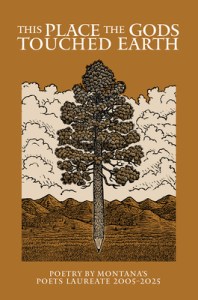 The anthology is a collection of Montana’s Poets Laureate, 2005 – 2025.
 L
L o
o oking back takes time because it’s a long trip. I do remember reading All Quiet on the Western Front and knowing–even as I read it–I would carry the scars of that story forever. That book is one reason I became a pacifist. I’m not sure about everything I think I see while looking back because I’ve used so many of my personal stories in my fiction. So I wonder, did that really happen or did I make it up. Most of the people who could answer that question are gone or, perhaps, fictional. In my youth, the KKK was real and my first real fear. They were everywhere. They burnt a cross on my minister’s lawn. All that was too evil to make up so it made its way into my books. I changed the names of the people I knew who were members of the very visible invisible empire. The same goes for the real people in my Navy experience.

 Malcolm R. Campbell writes fiction set in the park. Unfortunately, his only nonfiction contribution is out of print.

 I do the same thing with movies because trying to set up closed captioning at a theater is a who needs it, so I seldom see any film before it reaches TV with closed captioning. I guess this is just part of getting old. By the time I read a book or see a film, the discussion has moved on to something newer. Sigh.


 Malcolm's Round Table