January deadline for Glacier Park artist-in-residence applications

From NPS Glacier

Lake McDonald - NPS photo
Lake McDonald – NPS photo

The program offers professional artists the opportunity to pursue their artistic discipline while being surrounded by the park’s inspiring landscape. The program seeks professional artists whose work is related to the park’s interpretative themes and supports the mission of the National Park Service.

The program provides an artist with uninterrupted time to pursue their work and the opportunity to engage and inspire the public through outreach programs.   Park housing is provided for a four-week session during the summer or fall season.

The artist is required to present several public programs during their residency.  The programs must be related to their experience as the artist-in-residence and can be demonstrations, talks, exploratory walks, or performances. Digital images of selected work produced as a part of the residency may be used in park publications, websites and presentations for education and outreach.

Artists of all disciplines are encouraged to apply. Applications are available online at https://www.callforentry.org. The deadline to apply is January 30, 2014. For more information contact the park at 406-888-7800.

Click here for a list of Glacier’s past artists in residence.

Malcolm

A Glacier Park novel on Kindle

Walking My Future Novel’s Setting

While I was working as a seasonal, college-student employee at Glacier National Park, my father said, “One day you’ll write a book about this.” As I walked the mile between the hotel and the camp store for Cokes, candy bars and other “health foods,” I visualized long nature articles about the park for National Geographic Magazine that would combine with proposed climbs of K2 and Mt. Everest and canoe rides down the Amazon into a hiker’s guide to exotic trails.

Little did I know I would one day set three novels in the park.

Like most college students, I was used to walking—and sometimes running—across a campus to get from one class to another. While working at the park, I not only walked around every lake near the hotel, but hiked to every waterfall, tunnel, mountain pass, and alpine meadow. Why? For a lot of reasons. For a Florida boy, the mountains were an exciting new environment. Plus, in those days, seasonal employees weren’t allowed to bring cars into the park. So, we talked. Going to the camp store was child’s play. By the end of the summer, a 25 mile hike as an easy stroll.

A Sack of Guidebooks

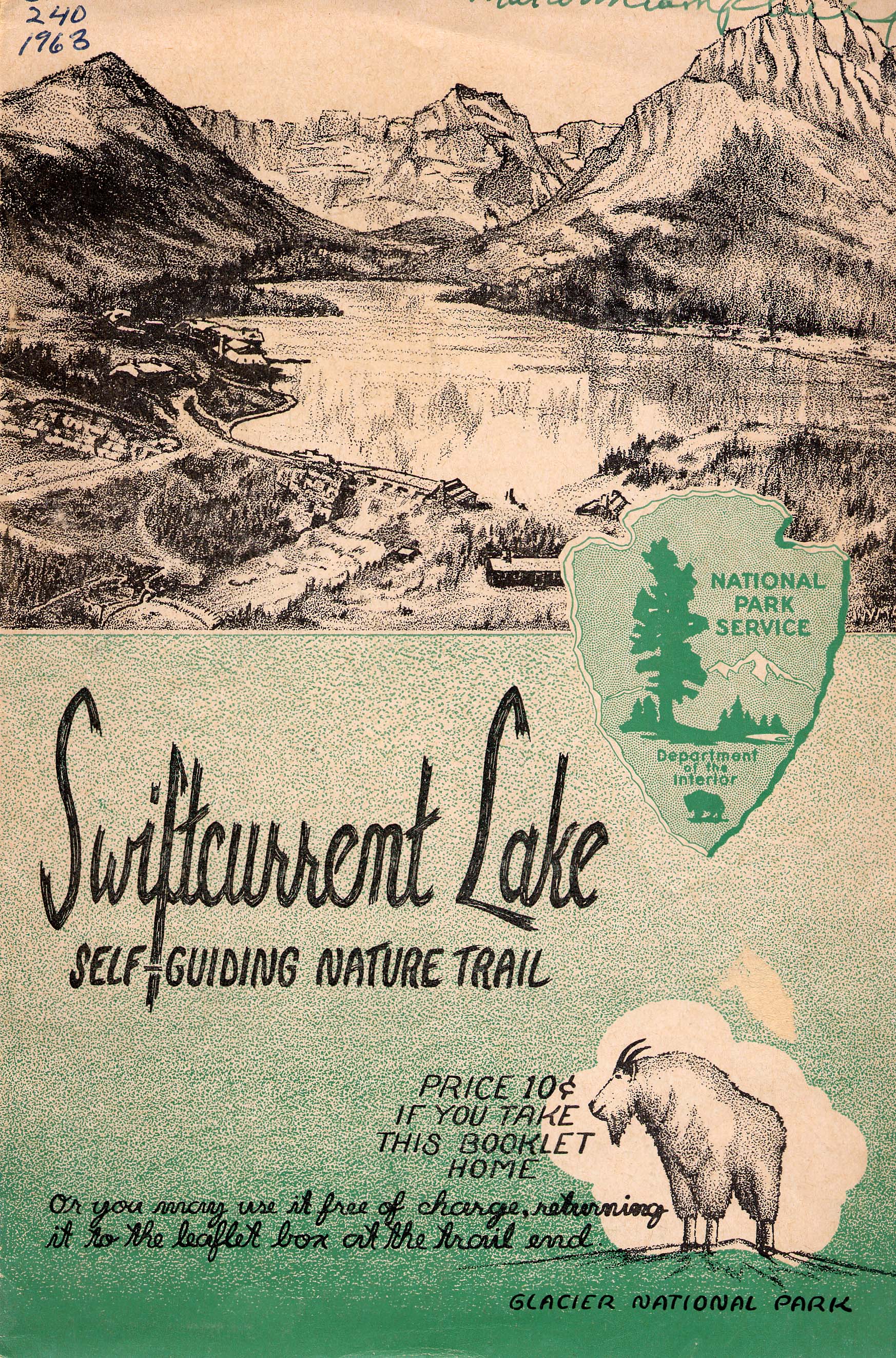
There used to be a wood box on a post near Many Glacier Hotel with a handfull of walking guides for tourists taking their first hike around Swiftcurrent Lake. If you wanted to keep the guide, you put a dime in a slot. If not, you put the guide into a similar box where the trail neared the camp store. I kept mine and along with it, brought home a sack full of guidebooks.

These materials are a writer’s dream. They allow me to merge my imagination and memories of the trails and mountains with specific factual information about the trees (subalpine fir, willow), wildflowers (fireweed, beargrass), and mountains (Grinnel, Allen). Even though I write contemporary fantasy, I want the setting to be as realistic as possible, and while I didn’t know it when I was a hotel bellman, all thosde after-work hikes were taking place in a world that would one say be part of The Sun Singer, Garden of Heaven: an Odyssey, and my new novel Sarabande.

I never wrote those National Geographic Magazine articles, much less climbed K2 or Everest, but I did write a few articles and essays about the Swiftcurrent Valley in Glacier National Park. Looking at the valley from a journalist’s or feature writer’s perspective helped me collect my thoughts for the fiction I would set there later.  Unfortunately, I haven’t been back to the park for many years, but all that time walking around in the setting of my future novels rather engraved the sights and sounds in my memory.

Sarabande Excerpt – from a Fictional Cabin at the Park’s Lake Josephine

Lake Josephine and Mt. Gould - twbuckner photo

The bright yellow of a late morning sun filled the bedroom when Sarabande awoke. She felt the light move before she opened her eyes and pulled the tangled folds of the quilt away from her face. A summer breeze followed the light, fluttering the blue curtains with a breath that smelled of fir trees, larkspurs, gentians, and stones from snow-melt streams. Pine siskins chirped to each other amongst the ferns and mosses, olive-sided flycatchers pipped from tree-top perches, and children laughed. The laughter came and went with the coming and going of a rumbling, technology-sounding hum. Sensing no threat in the sound, she projected outside and found that a boat traveling up and down the lake with visitors was powered by whatever made the pervasive hum. The visitors got off the boat, looked around, laughed, and then got back on the boat and went away.  They surrounded the cabin with their smells of strange soaps and fabrics, completely unaware of the magic in their midst. Whether it was the good night’s sleep or the rhythms of the water in the box of warm rain, her normally sharp senses intensified while she slept. Within the quilt of interlocking rings, she acquired—or was acquiring—Bear’s sense of smell, Eagle’s sight, and the quivering alertness of chipmunks and butterflies.

–Malcolm

an exciting adventure for only $4.99 on Kindle

Glacier National Park’s Garden of Heaven

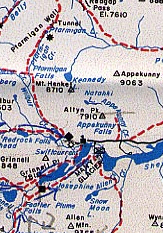
Section of current NPS map
The Garden of Heaven was a name suggested for a valley between Glacier National Park’s Morning Eagle Falls and Lake Josephine by naturalist Morton J. Elrod in 1924.

Elrod, who wrote the park’s NPS-approved hiking handbook called Elrod’s Guide and Book of Information of Glacier National Park described the Garden of Heaven as follows:

“The open narrow valley along Cataract creek for perhaps two miles below Morning Eagle Falls, beginning where the trail comes out into the open, is a very beautiful flower garden in July and August. At the foot of the towering Garden Wall, flanked on all sides but one by protective mountains, the writer has called it and wishes others might call it, ‘The Garden of Heaven.’ By wandering away from the trail and examining the mossy banks of the meandering streams, the fully beauty of the wonderful garden will be understood.”

Elrod’s guide was published in 1924 and revised in 1930. Unfortunately, the name for this valley on the trail to Piegan Pass didn’t make it into park naturalist George C. Ruhle’s Guide to Glacier National Park when it replaced the Elrod guide as the official park trail handbook in 1949.

Instrumental in forming the park’s ranger naturalist program, Elrod and Ruhle worked together. So, it’s probable that Ruhle was well aware of Elrod’s name for the valley. In fact, much of the information in the Ruhle guidebook–which went through three editions–closely approximated Elrod’s facts and descriptions.

I have found no other park reference to the Garden of Heaven other than in Jack Holterman’s encyclopedic 1985 Place Names of Glacier/Waterton National Parks, on which I worked as an editorial assistant at the Glacier Natural History Association. I have never found the name on a map or mentioned in any other park trail guide.

Elrod’s description is apt. The trail above Lake Josephine between Mt. Gould and Mt. Allen is a wonderful spot. The falls itself is a little over five miles from Many Glacier Hotel. Hikers can “cheat” on the walk by taking the Swiftcurrent Lake and Lake Josephine launches.

The rare, long out-of-print park guidebook by a prolific writer and photographer is the origin for the title of my 2010 novel Garden of Heaven: an Odyssey. (Some readers have thought that took the title from the 14th-century poet Hafiz’s poem by that name.)

If anyone ever finds a postcard, guidebook, or trail map that refers to the park valley by this old name, I would appreciate hearing about it.

–Malcolm

Glacier Park hosts ‘Winter Nights’ moonlit ski trip

from NPS Glacier:

WEST GLACIER, MONT. – Ever wonder what’s going on during cold winter nights when the world seems still? On the evening of Saturday, February 19 the public is invited to join a free, four-mile, ranger-led cross country ski excursion into the winter night to discover how the park’s winter residents survive the cold and harsh months. This guided outing is suitable for intermediate-level skiers of all ages.

Supported by a grant from the Glacier National Park Fund, this moonlit cross country ski trip will be offered on February 19, the Saturday evening nearest the full moon in February (weather and snow conditions permitting). The ski excursion begins at 7 p.m.

In the event of severe weather or insufficient snow, individuals should call Apgar Visitor Center at 406-888-7939 to confirm the ski trip. All participants must bring their own cross country ski equipment as well as extra layers of clothing, a headlamp and water. Skis are available for rent at retail locations outside of Glacier National Park in West Glacier and other gateway communities.

The moonlit tour will begin at the Camas Road gate, a three-minute drive from the Apgar Visitor Center. There is no group size limit and no reservations are taken.

Park visitors are reminded that although this winter activity is free, valid park entry is required except when fees are waived. Even when entrance stations are not staffed, park entrance fees are required. Upon entering the park, visitors are directed to follow posted instructions to pay entrance fees at self-pay stations. Glacier’s winter entrance fee is $15 for vehicles and $10 for single entrants (hiker/bicyclist/motorcyclist) for a seven-day pass. Annual park passes, valid for unlimited visits to Glacier National Park for 12 months from the date of purchase, are also available for $35 and currently can be purchased on weekdays at the Backcountry Permit Office located in Apgar Village and on weekends from entrance stations when staffed.

For more information or to confirm the cross country ski program, please call the Apgar Visitor Center at 406-888-7939, on weekends, between 9 a.m. and 4:30 p.m.

All Aboard for Glacier National Park

When Glacier National Park, Montana, celebrated its centennial last year, 2.2 million visitors came to the park, setting a new attendance record. While Amtrak’s Empire Builder serves the park, most of today’s visitors arrived by plane and automobile.
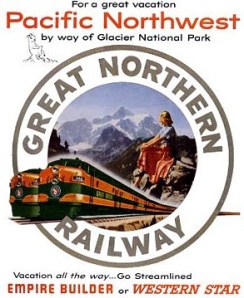
The park’s hotels and early infrastructure were developed by James J. Hill’s Great Northern Railway (GN), now a part of the Burlington Northern Santa Fe (see downloadable history), as a means of increasing passenger rail traffic on the route between Minneapolis and Seattle. The route, which went through North Dakota, Montana and Idaho, is the northernmost transcontinental railroad in the United States. Hill and his railroad prided themselves in the fact that, unlike other transcontinental railroads, GN used no federal land grants to built the track.

Before Amtrak took over most U.S. intercity passenger rail service in 1971, Great Northern delivered visitors to East Glacier and West Glacier via many named trains over the years, the last of which were its premier Empire Builder and the Western Star. Considered a secondary passenger train, the Western Star (train #27) left Minneapolis daily for the west coast, arriving in East Glacier before breakfast the following day. When Amtrak took over passenger service on the route in 1971, it kept the Empire Builder and discontinued the Western Star which had been in operation since 1951.
Carol Guthrie’s All Aboard for Glacier National Park (2004) captures the heady days of passenger rail travel and the park.  Even though the trains are mostly gone, you can still see the Great Northern Railway’s influence throughout the park, especially in the hotels managed by Glacier Park, Inc. (The company was owned by the railroad until 1960.)

When I worked as a bellman at the park’s Many Glacier Hotel in the 1960s, I traveled from my home in Florida to the park by rail, and that included the Western Star. The railroad still offered hotel employees reduced-fare tickets even though most railroads’ passenger trains were, by then, operating at a loss. Since the train ride was part of my Glacier National Park experience, I couldn’t help but include the Great Northern Railway and the Western Star in my novel Garden of Heaven. (Now out of print.)

Garden of Heaven Excerpt

In the novel, my main character David Ward gets to do what I always wanted to do: run the Western Star for a few miles just east of Glacier National Park:

“Climb up, Mr. Ward, it’s only 24 miles, and I’ll be close by.”

“You run like a god damned freight engineer,” said Jim as he lit another cigarette, “and there will be hell to pay.”

“I won’t spill a drop of coffee,” said David.

They followed him up into the cab. Jim slouched in the fireman’s seat with his newspaper and Big Ed stood by silently while David sat, noted the positions of the brake handles and the needles on air gauges, then looked out the window at the track ahead of them. There was seldom any rust on these rails lying easy on the fine, well-drained roadbed, and now as the day wound down, the tracks were becoming a true hi-line into night. Ahead, in the middle distance, two tall trees stood equidistant from the center of track—the right bathed in full sun, the left now in shade—a gate to the future, all aboard for Blackfoot, Sundance, Cutbank, Shelby, and points east with connections to RTC Great Lakes and Vietnam. He stepped on the dead man’s pedal and looked back at Ed and said he was ready.

“It’s 5:12 and we are clear to proceed,” Ed said. “You won’t need the transition lever, go easy out of here and then one day tell your grandkids you ran the Western Star.” Ed punctuated the sentiment with two loud blasts of the horn.

He put the reverser lever in forward, pushed the throttle into notch 1 and felt the engines load as he carefully feathered off the independent brake.

“Good,” said Jim. “Big Ed didn’t leave any slack in the train.”

“Damn sure didn’t,” said Ed. “I care very deeply about those Pullman passengers and their eagle eyes conductor back there.”

David eased the throttle out a notch at a time, slowly, so far so good, he hadn’t jostled anybody, felt the automatic transition as they passed between the two trees and throttled back to avoid any wheel slip, then began easing the throttle forward again until they reached track speed.


SunSinger4coverMalcolm R. Campbell is the author of “Conjure woman’s Cat” and “The Sun Singer.” “The Sun Singer” is set in Glacier National Park.


Take a few notes: you might write about this place some day

In fiction writing, we have the freedom to create settings of our choice. But readers will pick up on phony settings pretty quickly. The more realistic and more interesting your setting, the more likely the characters who inhabit it will be believable and interesting to the reader. — Robert Hays (“The Life and Death of Lizzie Morris”)

Liberty Port in the Philippines
When I was in high school, I tried multiple times to keep a log or journal. But that required more extended discipline than I had. While I began each attempt with the best of intentions, the entries quickly morphed from wordy and detailed into sketchy and infrequent.

A little discipline then could have saved me a lot of trouble when I began writing my novel “Garden of Heaven.” It uses settings I should know well: Glacier National Park, Montana; Tate’s Hell Forest and Tallahassee, Florida; Olongapo, Philippines; the aircraft carrier USS Ranger; Decatur, Illinois; Gronigen, Netherlands.

Each of these places holds memories for me that fit the plot and themes of the novel. Yet, when it comes to nitty-gritty details, memory can be tricky. When exactly did the USS Ranger leave Alameda for Vietnam in 1968 and what stores existed on Tallahassee’s College Avenue a few years before that? What year did the Decatur transfer house get moved and how far was the Galaxy Bar from the main gate?

Fortunately, books, magazines and online research helped fill in the gaps. So did e-mail correspondence with people at Glacier, Tate’s Hell, and Decatur. Frankly, a good journal would have taken me a lot less time. Not that I would have recorded everything I might have needed in a novel written decades later. But recording my observations would have given me a good start.

USS Ranger (CVA-61)
Since it’s quite likely that a writer will end up using places he has a passion for or where defining moments occurred–whether it’s the town where he grew up, the theater where his military service unfolded or the destination for his favorite vacation–I’m thinking it just makes good sense to become a bit more of a packrat.

In addition to photographs, a few notes, brochures, newspaper clippings, ticket stubs, itineraries, and other materials will not only reinforce the writer’s observations when he’s there; they’ll support his memory years later when he puts his protagonist into the deep swamp he saw when he was a kid or the sailor’s liberty town he saw when he was in the Navy.

Such details don’t need to turn into the pages and pages of description readers of today’s novels often skip over. They do bring a place to life. They’re the difference between a setting with depth and one that appears plastic and ill-formed.

And if you have the discipline, keep a diary, log, journal or notebook: your readers will thank you and your writing will be all the stronger for it whether you’re writing about stealing cookies on the mess-decks of an aircraft carrier or the sound a panther makes in a notorious Florida Swamp.

Your Library: Myth v. Fact

from geekthelibrary.org…

Myth: I’m already funding my library by paying my late fees and purchasing items at book sales.

Fact: Late fees and book sale dollars provide a very modest contribution to libraries and support replacement of materials lost and items not returned. Fees and fines are not sufficient to support operating or program activities.

I worked my way through school as a student and graduate assistant at the libraries of Florida State University and Syracuse University. While college library funding is different than your public library’s city budget allocations, I saw first hand how far the fines and fees we collected at the desk did NOT go.

Whatever you geek (love, like, adore), the library is there to support you. Today, I needed to find an old book about Glacier National Park. My local library didn’t have it, but they found it quickly within our regional library system.

geekbanner