New Glacier Park E-Book Explores Swiftcurrent Valley

Swiftcurrent Valley two months ago - NPS photo

“The road up to Swift Current in its present condition has been known to make a preacher curse, and I have my opinion of the man who makes the trip over this road (!) without breaking the 3rd commandment or perhaps all ten of them.” — Dupuyer, Montana “Acantha,” March 3, 1900

Bears; Where They Fought: Life in Glacier Park’s Swiftcurrent Valley, a new e-book by Malcolm R. Campbell, steps back in time to the short-lived mining boom town of Altyn that prospectors and developers believed would be Montana’s great center of copper and gold mining.

Today, the remains of Altyn sit at the bottom of Lake Sherburne less than a mile from the present-day location of Many Glacier Hotel. Altyn came and went as did the two grizzly bears whose fight attracted the attention of a Piegan hunting party about 1860 and lent a long-forgotten place name that came out of one of the valley’s many stories.

The new e-book, from Vanilla Heart Publishing, looks at some of the valley’s other milestones between those long-ago fighting bears and, the hotel’s construction and development by the Great Northern Railway and the floods of 1964 and 1975.

After employees saved Many Glacier Hotel from the Heaven’s Peak Fire in 1936 and wired the Great Northern that the structure survived, the railroad sent a telegram back with the word “Why?” Though the railroad was beginning to doubt the viability of its Glacier Park holdings, they owned an operated Many Glacier and other hotels and chalets in the park for almost another 30 years.

The hotel was saved in 1936 and, since then, it’s become a National Register property and another enduring legacy of a valley that stretches far back into the past in the land of shining mountains. I first walked into the Swiftcurrent Valley in 1963. Since then, I’ve gone back many times. Bears: Where They Fought is my way of capturing the spirit of the most beautiful country on the planet.

Bears; Where They Fought is available for 99 cents on Kindle and in multiple e-book formats (including PDF) at Smashwords.

“On a quiet day, however, those walking alongside the relatively recent Lake Sherburne reservoir may hear the voice of grandfather rock whispering a secret: within the scope of geologic time, all rivers are new, and the men and women who follow them are as ephemeral as monarch butterflies on a summer afternoon.” — “Bears; Where They Fought”

Malcolm

Montana: Glacier Park Issue

Readers, tourists, hikers, and climbers who are fans of Glacier National Park will enjoy the Summer 2010 centennial issue of Montana: The Magazine of Western History beginning with the John Fery painting on the cover.

The issue not only contains a great overview of the park, but includes dozens of photographs and paintings in support of the text. Read it for the information, then keep it as a collector’s item.

Here’s what you’ll find inside:

“Conceiving Nature: THE CREATION OF MONTANA’S GLACIER NATIONAL PARK” by Andrew C. Harper

“Where the Prairie Ends and the Sky Begins: MAYNARD DIXON IN MONTANA” by Donald J. Hagerty

“Glacier National Park: PEOPLE, A PLAYGROUND, AND A PARK” by
Jennifer Bottomly-O’ looney and Deirdre Shaw

“The Miraculous Survival of the Art of Glacier National Park” by Hipólito Rafael Chacón

Cover Art: “The iconic mountain goat on the front cover is a detail from a painting by John Fery, one of the park’s foremost painters. Fery made it the centerpiece of his untitled collage of Glacier views (n.d., oil on canvas, 65″ x 115″) commissioned by the Great Northern Railway.”

Congratulations to the editors, writers and photographers on a wonderful commemorative issue.

Malcolm

Available in multiple e-book formats for only $5.99

Glacier Centennial: Green Business Program

from NPS Glacier…

The National Parks Conservation Association has teamed up with the Centennial Program to launch a Green Business Program. This program will empower local businesses to reduce their environmental impact, resulting in a more efficient and sustainable means of doing business.

Through collective action, Glacier Centennial Green Businesses will help to reduce the environmental impact on our region; decrease the amount of unnecessary waste that goes into our landfill, reduce energy use, conserve water, and foster a healthy local economy by supporting local businesses.

Mark your calendars! Join us for several Green Business Activities on April 20-22, 2010. Stay tuned for more information.


Click here for more information and a PDF application form. Even if you’re not applying, the form itself has a lot of valuable tips and links.

Malcolm

Glacier Centennial: Caroline Lockhart

Newspaper reporter, bestselling novelist and rancher Caroline Lockhart (1871-1962) was probably the first woman to go over Glacier National Park’s Swiftcurrent Pass. Working for a Philadelphia newspaper under the pseudonym “Suzette,” she came to Altyn, Montana in 1901 and spent the rest of her life in the West.

At the time, Altyn was a boisterous mining boom town in the Swiftcurrent Valley in present-day Glacier National Park, a town its promoters said would soon become the rich center for gold, silver, copper and even oil. (See my essay about Altyn and the Swiftcurrent Valley in the upcoming “Nature’s Gifts” anthology to be released in March.)

In Cowboy Girl, an excellent biography of Caroline Lockhart, John Clayton writes that “Suzette’s arrival represented major news for Altyn, which had been born less than three years previously, when a strip of land was taken from the Blackfeet Indians and thrown open to mining. Altyn’s prospectors believed that within a few years its destiny would be decided: ‘the richest and biggest camp on earth or nothing.'”

By all accounts, Lockhart was ornery, strong-minded, strong-willed, and outspoken. (She called novelist Zane Grey a “tooth-pulling ass!”) Some suggest that her liberated personality kept Lockhart and her novels–several of which were made into movies–from being better known over the long term. Her novels include Me-Smith, Lady Doc, The Man from Bitter Roots, and The Fighting Shepherdess.

Lockhart owned a newspaper in Cody, Wyoming, where she also served as the first president of the Cody Stampede. Her fight against prohibition would keep Lockhart and her paper in the public’s often-angry eye. Even though she came west as a Phildelphia “Bulletin” reporter, she had grown up on a ranch; she found her dream again when she bought a ranch at Dryhead, Montana near the Pryor Mountains. She increased the size of the ranch and became, in her mind, a true cattle queen. The ranch is now owned by the National Park Service as part of the Bighorn Canyon Recreation Area.

In his article “Project Slows Decay at Lockhart Ranch,” Clayton addressed challenges of restoration–historical authenticity vs. practicality–when he noted that “the research also provides delicious evidence of how characters of the past dealt with hardships. For example, Lockhart had an old-style plank floor in her kitchen. She liked the look of it, but mice could easily creep through its gaps. So she kept two bullsnakes in the house to kill the mice. Today, by contrast, the Park Service uses gravel fill beneath the planks to keep out the rodents.”

Lockhart came west via the Great Northern Railway looking for adventure. By all accounts she not only found it but became a part of it. According to a the National Park Service’s Caroline Lockhart page, the aging liberated lady wrote, “There are no old timers left anymore. I feel like the last leaf on the tree.”

Copyright (c) 2010 by Malcolm R. Campbell, author of two novels, “The Sun Singer” (set in Glacier Park) and “Jock Stewart and the Missing Sea of Fire” (set in an imaginary Texas town).

Glacier Centennial: Grace Flandrau

GNRR Booklet

“It is due to the discovery made by John F. Stevens in 1889 that four years later the evil spirit of the Blackfeet fled forever from Marias Pass before the onrush of a transcontinental express. A continuous highway of steel at last connected, by the straightest and lowest route, the headwaters of the Mississippi with Puget Sound.” — Grace Fandrau, “The Story of Marias Pass,” 1925

Author Grace Flandrau (1886-1971) was a journalist between the 1920s and 1940s who received high acclaim for her short stories and novels. Her novel “Being Respectable” is, perhaps, her best known.

At the time when the Great Northern Railway was seeking popular writers such as Mary Roberts Rinehart to help promote the wild country of Glacier National Park, they selected Flandrau to write a 24-page booklet about Montana’s Marias Pass.

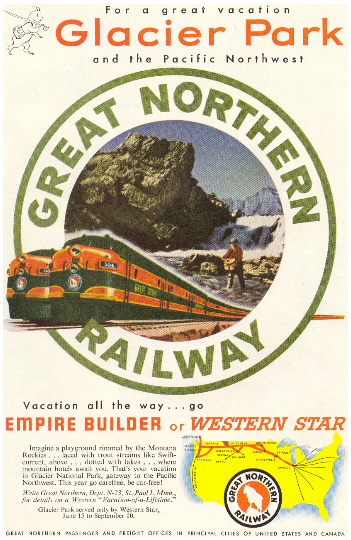
1940s GN Ad
Rail travelers on today’s AMTRAK Empire Builder, named for the famed Great Northern train of an earlier era, see Marias Pass as the train traverses the Continental Divide south of Glacier National Park. U.S. Highway 2 also uses the pass.

Flandrau’s booklet promotes the discovery of the pass by Great Northern civil engineer John F. Stevens in 1889. “Travelers, unless they happen to be civil engineers, which, of course, most of them are not, are in the habit of taking the passing of railroads through mountain ranges, entirely for granted,” she writes on the booklet’s first page.

The booklet promotes a high point of Montana railroading history: it’s epic stuff, perfect for the eyes of prospective passengers who might be enticed to head west and experience the grandeur of the Backbone of the World first hand.

You can learn more about the career of Grace Flandrau in Georgia Ray’s 2007 biography of the author, “Voice Interrupted.”

In his review of the biography, Paul Froiland writes that “Ray has elevated St. Paul, Minnesota, novelist and journalist Grace Flandrau from obscurity to her rightful place alongside her contemporaries — Scott Fitzgerald, Sinclair Lewis, Willa Cather and Ring Lardner. This book is the first step in rehabilitating the reputation of one of the great — and most undeservedly forgotten — descriptive writers of the twentieth century.”

Copyright (c) 2010 by Malcolm R. Campbell, author of “The Sun Singer,” a novel set in Glacier National Park. My article about the park’s Swiftcurrent Valley appears in “Nature’s Gifts,” an anthology of fiction, nonfiction and poetry celebrating nature to be released by Vanilla Heart Publishing in March.

Glacier Centennial: Helen P. Clarke

As the 2010 centennial of Montana’s Glacier National Park approaches, I’ve been looking at the histories and stories of those who are part of the park’s heritage.

Helen Piotopowaka Clarke (1843-1923)–known by many as “Miss Nellie”–was the first woman in the Montana Territory to be elected to public office (1880) when she became Superintendent of Public Instruction for the county now named Lewis and Clark. Previously, she had worked as a teacher in Ft. Benton.

After the Indian Allotment Act was passed by Congress in 1887, Clarke, helped the Blackfeet establish their allotments, and then was appointed as an allotment agent by President Benjamin Harrison in October 1890. She worked with multiple tribes out of the Ponca Agency in the Oklahoma Territory where she was the only female agent.

When prospectors and developers found gold, copper and other minerals on the Piegans’ mountain land in the years after the Civil War, public pressure forced the Federal Government into negotiations to obtain the land so that legal claims could be filed and worked. Helen helped her tribe in the negotiations that eventually led to the sale of the land east of the continental divide in today’s Glacier National Park in 1896. The boom–which included a mining town named Altyn in the current park’s Swiftcurrent Valley–lasted only a few years before it was obvious that the mineral deposits were insufficient to support mining operations. This mountain land has historically been called the ceded strip. The park was created in 1910.

Helen’s parents were a Scottish-American fur trader and rancher Egbert Malcolm Clarke and Kakokima (often spelled Cothcocoma), daughter of the Piegan (Blackfeet) Chief Big Snake. Malcolm Clarke had an excellent relationship with the Piegan in spite of the growing hostilities between whites and the Piegan at the time. His Piegan name was Nisohkyaiyo (Four Bears). In addition to Helen, he and Kakokima had three other children, Horace, Nathan and Isabel.

Helen P. Clarke’s name often surfaces in history as a survivor of the night when Piegan relatives murdered her father and wounded her brother Horace after weeks of disputes over Malcolm Clarke’s stolen horses. The Piegan side of Helen’s family had always been welcome on her father’s ranch on Prickly Pear Creek along with others from the tribe; most of the tribe mourned his murder. Helen blamed only Eagle Ribs (who killed Clarke) and Pete Owl Child (who wounded Horace). Owl Child was Helen’s mother’s cousin and Eagle Ribs was a son of Mountain Chief.

The public saw Clarke’s murder as another in a long series of incidents of unacceptable unrest in the territory and demanded retribution against the overtly hostile Mountain Chief. While a grand jury had indicted five Piegans in the murder of Malcolm Clarke and had requested their apprehension by the Army, General Philip H. Sheridan preferred to “strike” Indian Camps. William T Sherman, General of the Army, approved of Sheridan’s approach even though officers in Montana said the solution required a police-style approach.

Colonel E. M. Baker was sent with a troop to “chastise” Mountain Chief and his band of Piegans. The orders stated specifically that friendly Chief Heavy Runner and his band on the Marias River was not to be harmed. On the morning of January 23, 1870, Baker’s troop swept through the village of Heavy Runner, killing the Chief and 173 others, including 140 women and children. Even though he was told by his scouts it was the wrong camp, Baker would maintain later that he did not know this. Baker’s superiors supported his action. The action is now known alternately as “The Baker Massacre” and “The Marias Massacre.”

After the death of her father, Helen went east where she studied drama. Subsequently, she would perform for a short period of time to much acclaim, especially her Shakespeare, in London, Paris and Berlin. After serving as the school superintendent and the allotment agent, she taught briefly in San Francisco before returning to a ranch with her bother Horace in Midvale (now East Glacier) on land that came from their allotments.

Glacier Park Lodge in East Glacier, sits on a portion of Horace’s allotment which was purchased by the Great Northern Railway for the hotel site. The Hotel was built in 1913.

Although the source of Glacier National Park’s Lake Helen is debated, explorer, writer and friend of the Piegan Jame Willard Schultz attributes the name to Helen Clarke.

Author Jack Holterman has written that when Miss Nellie was in her 70s, she was described as a woman with a large bony, stooped frame, black sparkling eyes, beautiful white hair, and a deep theatrical voice. She is buried in the family cemetery at Midvale.

Today, more people know of her for her father’s murder than for her own good works. Helen’s Piegan name, Piotopowaka, is certainly apt. It is best translated as “The Bird That Comes Back.”

For More Information, consult the following books in addition to Internet resources:

Who was Who in Glacier Land, by Jack Holterman
Walking in Two Worlds: Mixed-Blood Indian Women Seeking Their Own Path, by Nancy M. Peterson
The Blackfeet: Raiders on the Northwestern Plains, by John C. Ewers

Copyright (c) 2009 by Malcolm R. Campbell author of “The Sun Singer,” a novel set in Glacier National Park.

Glacier Park Centennial: Post Card Contest

from NPS Glacier

Glacier's Chief Mountain
Glacier National Park Invites Students to Celebrate, Inspire, and Engage Through Art for a Postcard Contest

Glacier National Park’s Education Program and the Glacier Association are again sponsoring a postcard contest for K-12 students. As Glacier approaches its 100th anniverary, the focus for this year’s contest relates to the Centennial themes of “Celebrate, Inspire, and Engage.” In particular, to “engagement” as the next 100 years of Glacier’s future depends on the participation of today’s youth in helping to protect and preserve park resources.


The purpose of the poscard contest is to promote learning and stewardship of Glacier National Park through the creation of messages from local students to future Glacier National Park visitors. First place winning entries in each category will be made into postcards to be given to the visiting public at Glacier Association bookstores throughout the park.

Winners will be announced by the end of November. The first place winning entry in each category will receive a Glacier Association gift certificate for $25 and be made into a free postcard to be handed out at Association sales areas. The second place winner will receive a $15 gift certificate. Third place and honorable mention entries in each category will receive a book from the Association.

The Glacier Association is a non-profit cooperating association of the National Park Service. Glacier Association helps to support Glacier National Park’s educational, interpretive, cultural and scientific program needs.

Deadline is October 31, 2009. Details and entry form here.

Many Glacier Hotel Fans: My mountain adventure novel The Sun Singer is set in a fictionalized version of the hotel and Swiftcurrent Vally. The book’s action fits hand-in-glove into the park’s eastern-side environment where I climbed mountains, hiked and worked as a seasonal employee.

Coming Soon, a discussion with author Pat Bertram about gangsters, quests, and her new book Daughter Am I.

West Hollywood Book Fair: Volunteers set up and staffed my publisher’s (Vanilla Heart) booth even though most of the books and promotional items intended for display were stolen by burglars several days before the October 4th fair. See Jock Stewart’s commentary on this contemptible theft, Waking Up in LA.

Fortunately, a few copies of Jock Stewart and the Missing Sea of Fire escaped the thieves’ notice and made it to the booth!

Malcolm

To view my “Wonderful Books” FriendFeed posts, click on the icon below.

Subscribe to me on FriendFeed

Book Review: ‘Fate is a Mountain’

Fate Is A Mountain Fate Is A Mountain by Mark W. Parratt

My rating: 5 of 5 stars
Mark, Monty and Smitty Parratt had a big back yard between 1950 and 1964, the million-acre Crown of the Continent in northwestern Montana called Glacier National Park. The boys’ father, the late Lloyd Parratt and his wife Grace brought the family to the shores of the park’s St, Mary Lake every summer where Lloyd worked as a seasonal ranger naturalist for the National Park Service. Later, Mark Parratt served as a fireguard and the late Monty Parratt worked on a Blister Rust crew.

Since Mark and Monty were avid fishermen, the book includes many great fishing stories along with climbing and hiking adventures, the trials and tribulations of living in a remote cabin accessible only by rail, a stormy night in a fire lookout, canoeing on a rough St. Mary Lake, and encounters with wildlife.

For local residents, these stories will bring back old memories; for park visitors, the delightful exploits of three young men in their coming-of-age years will cast the trails, lakes and mountains along the back bone of the world into a deeper perspective. Comments appended to some of the stories note how the park has changed over the years.

The harrowing centerpiece to the book is “The Otokomi Grizzly Bear Attack” of July 18, 1960. Ten-year-old Smitty Parratt was badly mauled by a grizzly bear as he returned from a fishing trip to Lake Otokomi with two ranger naturalists and two tourists. The story of the attack, the injuries, the rescue and the aftermath demonstrates courage, resourcefulness and grit while serving as a cautionary reminder that wild places are wild.

The “Fate is a Mountain” (June 1962) and “Lone Climber Missing” (July 1963) stories describe mountain search and rescue operations at Mt. Henkel near Many Glacier Hotel and at Going-to-the-Sun Mountain in the St. Mary Valley. Search-team members routinely place themselves in harm’s way while looking for missing climbers, as Parratt describes in a late-night moment on the slopes of Mt. Henkel:

“Suddenly, a tremendous crash echoed from above. Instinctively, we all dove into crouching positions next to a nearby cliff face. A shower of lose scree was rapidly followed by a thunder of large bounders that careened over our heads and plummeted toward the valley below. Smaller pieces of snow and rock pelted our hard hats for several moments.” (This reviewer has climbed Mt. Henkel and appreciates the challenges of a rescue attempt.)

Compiling these stories was obviously a labor of love and of remembering bygone days where a family’s life intersects the world of a beloved tourist destination and wildlife preserve. If there’s an omission here, it’s the lack of a story about the Montana flood of June, 1964, quite possibly the state’s worst natural disaster, that caused extensive damage to roads and facilities throughout the park including those at St. Mary.

The book provides a rich, insider’s look at the world of Glacier National Park as it was over 40 forty years ago. As the park approaches its 2010 centennial, these stories as part of its history add to our understanding of the place and the people who worked and played there.

View all my reviews >>

Published by Sun Point Press in Whitefish, Montana, the book is available on line at Barnes & Noble and Amazon and at selected stores near the park.

SOFbanner1