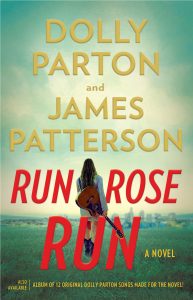
 There’s a scene in the Dolly Parton/James Patterson novel Run Rose Run when an emerging singer with a raw and powerful voice is being styled into clothes, makeup, and a hairdo prior to a publicity shot. When she sees the result, she leaves the room for a few minutes only to return wearing her comfortable clothes, minimal makeup, and her hair simply brushed out into its natural way of being. The stylists are shocked. She doesn’t care. Even though she looked like a diva, looking like a diva wasn’t for her. It didn’t feel right. That meant it was all wrong.
At this point in her introduction to Nashville and the country music business, AnnieLee Keyes is still learning “how things are done.” However, she’s defiant in a lot of ways and wants her voice and her songs to carry a career in which she can ignore how things are done.
I can identify with that because, as an author, I’ve always felt my words should be what people care about, not the clothes I’m wearing. I like blue jeans and tee-shirts with a denim or a flannel “jacket” depending on the weather. If it still ran, I’d drive up to any gathering in my old Jeep Universal or possibly an ancient 3.2-liter Jaguar Sedan. The cars would never be washed or waxed and I’d look like I hadn’t either.
In the old days, Sunday afternoons were the times when people dropped by each other’s houses unannounced, and that meant that my two brothers and I had to wear church clothes until supper. What a drag. Did anyone really think that was how we dressed day to day? In fact, I kept asking why I had to wear church clothes to go to church. That’s how things are done, I was told.
The only way to live, I always thought, was to ignore “how things were done” I always liked the song “My Way” because what other way was there? But, as many have learnt, that way is a rough way to go. The thing is, cleaning up nice feels like selling out–like how I look and how I act is just being a marionette controlled by the strings of tradition.
One has to be true to himself/herself, I think, and that means not dressing up like somebody you are not just because the wedding planner or the funeral director is claustrophobically traditional.
Good luck to you, AnnieLee Keyes.
–Malcolm
 Malcolm R. Campbell is the author of the Florida Folk Magic Series which can be purchased at a savings in this four-in-one Kindle set. Folk magic means hoodoo. And hoodoo means having a weapon for fighting the KKK in 1950s Florida.
 When the novel was released on March 7, it began its life at number one on the New York Times bestseller list. It’s currently at number five on Amazon with 11,207 ratings with a 4.5 average. The companion album by the same name, Parton’s forty-eighth solo studio album, a mix of bluegrass and country, is described as high energy with a lot to like. Meanwhile, “Variety ” reports that a movie deal is already in the works with Reese Witherspoon’s company. The whole project appears to be doing well.
 From America’s most beloved superstar and its greatest storyteller—a thriller about a young singer-songwriter on the rise and on the run, and determined to do whatever it takes to survive.
 Apparently, 85 is the new 25. That being the case, AARP readers love seeing a pretty face on the cover, Halle Berry appears in the current issue. If you’re star struck, you’re going to turn to the last page of the magazine which shows stars who have suddenly gotten old–but don’t look old. And usually, there’s a story about somebody older than I am who’s climbing Mt. Everest or ziplining across the Grand Canyon.
 I’m a fan of James Patteron’s Alex Cross series that began in 1993 with Along Came a Spider and continues with Patterson as the sole author for 29 books to Fear No Evil released in November of last year. According to Wikipedia, Alex Cross is an African American detective and psychologist based out of the Southeast quadrant of Washington, D.C. He started in the homicide division of the Washington, D.C. Metropolitan Police Department (MPDC), but eventually becomes a Senior Agent with the Federal Bureau of Investigation (FBI). Cross returns to private psychology practice, but continues to work with the police as needed, ultimately rejoining the MPDC as a special consultant to the Major Case Squad.



 Malcolm's Round Table