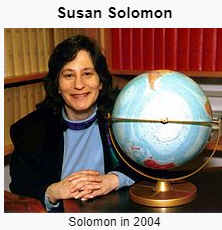
‘Solvable: How We Healed the Earth, and How We Can Do It Again’ by Susan Solomon

This book, from the University of Chicago Press, was released today. Solomon  “is known for pioneering work on the Antarctic ozone layer and for landmark studies of the timescales of climate change.”  Amazon Link

From the Publisher

“A compelling and pragmatic argument: solutions to yesterday’s environmental problems reveal today’s path forward.

“We solved planet-threatening problems before, Susan Solomon argues, and we can do it again. Solomon knows firsthand what those solutions entail. She first gained international fame as the leader of an expedition to Antarctica in 1986, making discoveries that were key to healing the damaged ozone layer. She saw a path–from scientific and public awareness to political engagement, international agreement, industry involvement, and effective action.

“Solomon, an atmospheric scientist and award-winning author, connects this career-defining triumph to the inside stories of other past environmental victories–against ozone depletion, smog, pesticides, and lead–to extract the essential elements of what makes change possible.
“The path to success begins when an environmental problem becomes both personal and perceptible to the general public. Lawmakers, diplomats, industries, and international agencies respond to popular momentum, and effective change takes place in tandem with consumer pressure when legislation and regulation yield practical solutions. Healing the planet is a long game won not by fear and panic but by the union of public, political, and regulatory pressure.

“Solvable is a book for anyone who has ever despaired about the climate crisis. As Solomon reminds us, doom and gloom get us nowhere, and idealism will only take us so far. The heroes in these stories range from angry mothers to gang members turned social activists, to upset Long Island birdwatchers to iconoclastic scientists (often women) to brilliant legislative craftsmen. Solomon’s authoritative point of view is an inspiration, a reality check, a road map, and a much-needed dose of realism. The problems facing our planet are Solvable. Solomon shows us how.”

–Malcolm

Climate Change – Is Resistance Futile?

If you watched Star Trek, you saw the spaceship built like a giant cube. You know that this cube attacked everyone in order to assimilate them into the cube. Those in the Borg gun sites were told: “Resistance is futile.”

I think of this when I think of climate change. Individually, have we decided that resistance is futile; or, as Robert Swann said, “The greatest threat to our planet is the belief that someone else will save it.”

I do not think Marianne Williamson has a chance of becoming President. But I do think her statement on her website about climate change is worthy of consideration:

“Our biggest crisis regarding the climate emergency is humanity’s massive state of denial that it exists on the scale it does. Yet a willingness to recognize the depth of the problem is a prerequisite to our solving it. It is a psychological and moral challenge to face the horror of what stands before us over the next ten years should we not act; yet there – in our standing raw before the truth that it confronts us with – lies our only hope for surviving it.
“And our environmental crisis is not only climate; it is also water, air, food, and soil. Our earth is like a body beginning to experience an all-systems breakdown. The glacial ice melt is so extensive that the sheer weight of melted polar water is changing the shape of the earth’s crust.”

The problem is so huge, all most of us can do is hope that some smart person will come along and fix it. We balk, though, at many of the proposals because they are inconvenient and ask us to greatly change our habits and our attitude about what the environment needs to survive. In some respects, people use a similar excuse to the one they use when they don’t vote: “My vote won’t make any difference.” And so we say, my “green car and green house” won’t make any difference.

When millions of people think this way, then we’ve basically written off the planet and decided that while the planet will support us, it won’t be here for our children and grandchildren. “Kids, it was just too much trouble to leave you a viable world.”

So, we’re sitting here watching it happen as though doing anything about it is futile.  I have to say, I don’t understand this attitude.

Malcolm


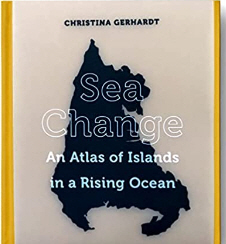
‘Sea Change: An Atlas of Islands in a Rising Ocean,’ by Christina Gerhardt

I cannot help but think of the title of Rachel Carson’s 1951 masterpiece The Sea Around Us as I write here about Christina Gerhardt’s University of California Press book that will be released May 23. If you live on an island, the sea has always been around you, but with climate change, the sea may soon be above you. The book, which New Scientist calls One of the Best Science Books of 2023, is available for pre-0rder on Amazon and elsewhere.
From the Publisher

“This immersive portal to islands around the world highlights the impacts of sea level rise and shimmers with hopeful solutions to combat it.

“Atlases are being redrawn as islands are disappearing. What does an island see when the sea rises? “Sea Change: An Atlas of Islands in a Rising Ocean” weaves together essays, maps, art, and poetry to show us—and make us see—island nations in a warming world.

“Low-lying islands are least responsible for global warming, but they are suffering the brunt of it. This transportive atlas reorients our vantage point to place islands at the center of the story, highlighting Indigenous and Black voices and the work of communities taking action for local and global climate justice. At once serious and playful, well-researched and lavishly designed, Sea Change is a stunning exploration of the climate and our world’s coastlines. Full of immersive storytelling, scientific expertise, and rallying cries from island populations that shout with hope—’We are not drowning! We are fighting!’—this atlas will galvanize readers in the fight against climate change and the choices we all face.”

From the Booklist Review

“How often does an atlas command immediate attention, warranting a page-by-page perusal? This offering from Gerhardt and mapmaker Molly Roy is much more than a geological survey of the many islands around the world being affected by rising sea levels caused by climate change. There are compelling maps that indicate current coastlines and what the coastlines consist of (volcanic rock, ice shelves, mangrove forests) and project what coastlines will look like in 2050 and 2100. Lengthy essays introduce the inhabitants of these often-remote places, detailing their unique languages, histories, and ways of life.” See the full review here. 

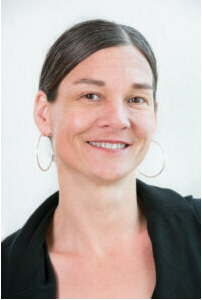
Christina Gerhardt is Associate Professor at the University of Hawai’i at Mānoa, Senior Fellow at the University of California, Berkeley, and former Barron Professor of Environment and the Humanities at Princeton University. Her environmental journalism has been published by Grist.orgThe NationThe Progressive, and the Washington Monthly.

As a university press book, Sea Change is priced slightly higher than a similar large traditional publisher’s price. However, it’s well worth it even for people who live in Kansas and think they’re immune to sea changes.

-Malcolm

If we stick our heads in the sand, maybe the oceans won’t rise enough to drown us

“One of the penalties of an ecological education is that one lives alone in a world of wounds. Much of the damage inflicted on land is quite invisible to laymen. An ecologist must either harden his shell and make believe that the consequences of science are none of his business, or he must be the doctor who sees the marks of death in a community that believes itself well and does not want to be told otherwise.”
― Aldo Leopold, A Sand County Almanac

As for climate change, what do you think? Is it an excuse for more goverwent overreach, dire predictions from environmental groups who want your donations, or the reality we all face?

Let’s suppose NASA developed a shuttle system to transport people to a distant planet that is more or less exactly like Earth was before we screwed it up. I wonder how many people would leave.

Would you?

I don’t think I would, but I suppose there would be a long line of people looking for a cheap and easy fix. That is, to leave the sinking ship.

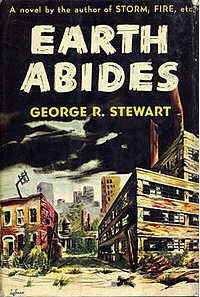
I remember the title of a long-ago novel called Earth Abides. Personally, I think the earth will last, though most of us may not be here to see it. It’s just easier to keep doing what we’re doing. That’s my  guess. As George Stewart wrote, “Men go and come, but earth abides.”

Let’s suppose we believe Earth is bigger than the problems we have wrought, does that justify continuing to destroy it? Or, is it easier to keep destroying it and let the end come when it will?

We should be smarter than that, allowing the world to go down hill into chaos, but I wonder if we are.

What do you think?

–Malcolm

Facing the Climate Catastrophe

On August 9, the Intergovernmental Panel on Climate Change released its assessment of the state of the climate — the panel’s grimmest yet. The window to stop some of the worst effects of the climate crisis is rapidly closing, the report found, and world leaders must act with urgency to prevent catastrophe.

The report, prepared by more than 200 top scientists around the globe and approved by the 195 UN member states, is the first of three expected this year to inform emission reduction commitments at the 26th annual international summit known as the Climate Change Conference of the Parties (COP26) this November in Glasgow, Scotland.

Photo: Sunset over St. Mary Lake at Glacier National Park. The namesake glaciers at this park are rapidly melting as a result of climate change. In 1850, the region had 150 glaciers. There are now just 25 left. Photo © Kan1234/Dreamstime.

Source: Facing the Climate Catastrophe: What We Do Now Matters · National Parks Conservation Association

Do most people worry about climate change? Apparently more people are taking it seriously as shown, in part, by their willingness to switch to products that they think are better for the environment.

In this article, the NPCA suggests four critical areas we can focus on:

  • Reducing emissions from cars.
  • Retiring power plants to clear skies of haze pollution.
  • Reducing methane, one of the most potent climate-warming emissions, from oil and gas development.
  • Securing critical climate provisions in the federal budget.

Climate change is such a huge issue, it often seems outside the power of the individual to address. Articles like this one help us narrow down target areas where we can focus our efforts.

Malcolm

We could have ended the world sooner and at a lower cost

Apparently, the movers and shakers of humankind have been working diligently to end the world. If not, we wouldn’t be where we are on so many fronts.

Except for various clans of deniers, including those who think history, science, and the notion of a round earth are bunk, most people are accepting climate change as inevitable. How do we know this? Because they’re keeping quiet, just watching it happen. Some people are fighting, speaking out, but it’s too little, too late.

The movers and shakers who–for reasons of insanity or short term gratification of the riches gained from habitat destruction–want the world to call it a day missed their chance to end life as we know it years ago. They could have kept the U.S. out of World War II, let Hitler and Hirohito have it all, and head toward the resulting, predicted ruin.
We had enough nuclear weapons to do the job, but we didn’t. It would have been quick, possibly a spectacular sight to aliens watching from a universe far away. Instead, we’ve opted for the slower annihilation of climate change–the fires, the hurricanes, the rising oceans, the diseases, the chaos. Where is the honor in that?

We’re all accomplices, though, aren’t we? We’ve accepted the notion that we were somehow different than the rest of the world’s flora and fauna and that “taming the land” was okay even if it meant destroying the land because we’re superior to mere rivers and forests, much less the problems of oceans with plastic and rivers with toxic waste..

The land is having its say, but we’re not listening. I’m surprised that the molecules that make up human beings haven’t fled the planet out of guilt and embarrassment to return to the dying stars whence they came. Many have spoken on the land’s behalf, individuals like Edward Abbey, John Muir, Wendell Berry, David Brower, Rachel Carson, and organizations like Audubon, Nature Conservancy, Sierra Club, National Parks and Conservation Association, Wilderness Society. Many like what they hear from these people, but then they go back to sleep.

I don’t have any answers. I can suggest that every time the current administration rolls back environmental protections that took decades to put in place, that we put a stop to it. I can suggest that when we hear of measures–getting rid of plastic, for example–that are good ways to combat climate change that we implement them in our lives rather than saying, “No worries, that’s just climate change BS.”

When it comes down to it, I suspect a lot of people have suggestions for things we can do thwart those who are intent on ending the world. Sure, most of those suggestions are inconvenient and cost money. But then, the impact of climate change is also costing money–for example, the lives and money lost due to the western wildfires along with the cost of fighting the fires.

Doomsday-clock-wise, we have 100 seconds left. So at the end of this rant, let me say that it’s time to shift our attention away from our celebrities and cell phones and cars and focus our concerns on saving the planet. Once we accomplish that, we can watch the next season of “Survivor” with the proven knowledge that the show is about us.

Malcolm

Malcolm R. Campbell’s latest novel is “Fate’s Arrows.” His novel “The Sun Singer” is free on Kindle through September 18th.


‘They’ say the first step is always the hardest.

“Whatever we believe about how we got to be the extraordinary creatures we are today is far less important than bringing our intellect to bear on how we get together around the world and get out this mess we’ve made. That’s the key thing now. Nevermind how we got to be who we are.” – Jane Goodall

When quotations like this appear on Facebook or in news stories and articles, they get a huge number of LIKES and positive comments. I want to ask, “So, after you clicked LIKE or wrote ‘so true,’ what did you do next?”

Likewise, when people encounter charities and various crowdfunding initiatives that are collecting money for programs that will make a better world, I’m curious what people did after donating their $25 or $50. The same thought comes to mind about what people do after signing petitions that are trying to raise the public’s (or an elected official’s) awareness about a problem.
Many people appear to believe that talking about an issue is the same thing as actively working to “fix” whatever needs to be fixed. Being concerned about something, while commendable, isn’t the same thing as putting your money where your mouth is or putting your brains and brawn where your money is.

Needless to say, some people who donate $50 to one group and sign a petition in support of another group really think they’ve done their bit.

I don’t have a list of the things people ought to be doing, but joining nuts and bolts volunteer groups is one place to begin. Once you join, you’ll see an old truism governs how much gets done: 20% of the members usually do 80% of the work.

In churches, the concept of the tithe usually refers to money. Yet, we can also apply it to time, as in, giving 10% of one’s time toward fixing the mess we’re in. Even though some government officials, corporations, and lobbying groups are giving 100% of their time to make the mess worse, if enough people chipped in enough time to thwart those who are destroying nature and freedom and equality and peace, then we might have a chance of actually fixing something rather than talking about fixing something.

One way or the other, we need to take that first step toward action.

Malcolm

Malcolm R. Campbell is the author of “Special Investigative Reporter,” “Conjure Woman’s Cat,” “Eulalie and Washerwoman,” “Lena,” “Sarabande,” “Mountain Song,” “At Sea,” and “The Sun Singer.”


Do you actively worry about the state of the world?

There are weeks, aren’t there, when all the news is bad, when new studies come out that tell us texting, climate change, and lack of personal eye contact with each other will be the ruination of everything. Maps are published that show how rising seas will eat away at coastlines, then states, then countries.

My grandparents thought radio and then TV and then Elvis were signs of a degraded populace. Every generation seems to point at some habit or phase of the next generation that spells doom. As we get older, we find out that not only our parents’ generation but our parents themselves were wilder when they were kids than they would acknowledge when we were growing up and pushing various envelopes.

The soothsayers seem to rejoice in proclaiming “The end is near.”

With gobal warming, I begin to wonder if the end is near. A lot of people are denying that it’s happening–in spite of the evidence. And that includes the current administration, one that is also rolling back clean air and water protections and other environmental rules. I remember when Jay Leno, on the old Tonight Show, used to interview people on the street about historical and other facts that my generation saw as baseline knowledge. More often than not, people didn’t even know the name of our President, where California is, and other basic facts.

Is our texting generation creating anew this aura of general stupidity about how the world works, where states and countries are, and whether or not rising seas constitute a real problem? I hate texting–so, I have a bias. But sidewalks filled with people who are looking at their cellphones is disturbing. What the hell can y’all possibly be talking about that’s more important than where you are and the people around you?

Do things like this worry you?

I’m beginning to wonder if I should start a new blog called “The end is near.”

Malcolm

We’re saying goodbye to the natural world

I think many poets, myself included, are struggling with how to keep writing in the face of the environmental degradation that is looming over us and our children, the beauties and seasons that will be lost, the diversity of flowers and trees and butterflies and fish. These are in danger of vanishing before the words for them do. Poetry is extremely hardy—it was around before the alphabet and will outlast many kinds of human technology. I am robustly optimistic about poetry, but that is maybe the only thing I am optimistic about.

I think a lot about Richard Wilbur’s “Advice to a Prophet”: “Whether there shall be lofty or long-standing / When the bronze annals of the oak-tree close.” So much of our language is rooted in the old seasons, and in a miraculous natural world. It is terrifying to think that the language will outlast some of these. On the other hand, I suppose there will be new metaphors, and the poets of the future will find a way forward. – A. E. Stallings

Should writers be political? I think the answer is “yes,” though in many countries being political results in a death sentence or life imprisonment. Each of us does this in our own way. We don’t write in a vacuum. It’s hard to ignore the slings and arrows of fads, bad government, and horrible business decisions. However, many of our potential readers say they’re tired of logging on to Facebook and other services, much less the news sites, and seeing a continuous flow of bad news.

I’ve been an environmentalist for a long time, so Stalling’s words resonate with me. My response in my fiction has usually been to celebrate the natural world. Perhaps this is not enough. It appears that more people want to celebrate suburbia than the world as it was created. So, how do writers approach that point of view?

Many writers have focused on climate change. Yet readers seem to think such works are “over the top” and that climate change either isn’t happening, isn’t caused by humankind, or that the worst scenarios won’t play out for hundreds of years. I’m not a scientist, so I can’t say how soon the Earth’s environment will collapse. But we’ve been warned, I think. The least writers can do is celebrate the environment and have their fictional characters worry about global chaos.

The best we can do, perhaps, is allowing our characters the opportunity of expressing the kinds of fears we have. This way, we’re not beating our readers over the head with politics and activism. We’re telling stories in which folks have the same worries many of us have. I doubt that most people read stories that sound like a list of the political arguments of the day.  So, unless we have a seriously hardy theme, we need to be careful about how political we are.

Our readers want stories, not political tracts. Yet, we can inject our opinions if we are careful about how we do it.

Malcolm

EPA to Implement Cistern Plan to Solve Rising Seas Problems

Washington, D.C., July 25, 2019, Star-Gazer News Service–The Environmental Protection Agency (EPA) will soon begin placing rows of used crude oil storage tanks, each capable of holding 16 million gallons of liquid, in the open spaces at solar farms, wind farms, abandoned military bases, and Alien holding cells at Area 51. These tanks will be linked to a vast pumping station and pipeline network that will extract seawater from the oceans to counteract rising sea levels.

At this morning’s press conference, EPA Deputy Manager of Oceans, Leilani Moana reported that while the agency has not reversed its position about the unreality of climate change and related rising sea levels, it recognizes that small, short term climate anomalies are causing a public panic about the future of states like Hawai’i and Florida.

“Since the EPA feels your pain,” Moana said, “our top scientists and engineers  have devised a system of pumping stations, pipelines, and aqueducts to remove water from coastal areas and store it inland until it can be safely released.”

Some of the pumping stations would be tied into desalinization plants that would reduce the pressure on river systems for potable freshwater during times of drought.

According to a NASA white paper, launching water into the sun on Saturn V rockets would be cost-prohibitive even though some experts said such a program would cool the sun slightly, allowing Arctic glaciers to reform to help stabilize sea levels.

“The world’s excess heat is primarily caused by heated arguments about climate change that are turning the entire issue into a self-fulfilling prophecy,” Moana said. She added that groups claiming that the weight of the water in the cisterns would push the U.S. deeper into the ocean are unfounded.

Scientists told reporters this morning that the water held in the cisterns would always remain available to be pumped back into the oceans should weather anomalies ever decrease sea levels to the point where cruise ships were scraping bottom trying to get in and out of popular tourist destination ports.

“The Earth’s water supply is a closed system,” said EPA Chief Oceanographer Porter “Po” Seidon. “The water we have is all the water we have. All we’re doing is improving upon the Creator’s design to better manage that water in times of weird high temperatures or weird low temperatures.”

“We think we’ll have the system up and running before we lose southern Florida,” Moana said.

Story filed by Jock Stewart, Special Investigative Reporter