My parents favored spruce for their Christmas trees. Perhaps this came from my father’s family living for many years in Colorado where spruce trees grow. My wife and I have carried on the tradition. The branches and needles easily lend themselves to lights to strings of lights, ornaments, and icicles. Their scent fills the room and, as I think I wrote elsewhere, conjures up a near-living presence from the tree in the living room.
One year, my wife and I bought a live blue spruce with the seemingly one-ton root ball for our Georgia home. When we took down our decorations on January 6th, we planted the tree in a shady spot in the yard. To our surprise, it flourished there perhaps because I often sprayed it with water or because conditions were accidentally right many miles from its high country range.
When we moved away, the tree was taller than the house. I’ve often wondered if subsequent residents have wondered how a spruce was growing in a Georgia yard.
Now we use an artificial tree to save money. It’s a Spruce, of course.
Got a tip from a reasonably informed source: “The Christmas people are at it again.”
Even though it was March, I drove downtown in my 1950 A4 Checker (for you young people, that’s a car, not an Internet fact checker) in a cold wind that raged drunkenly beneath black clouds that looked like they’d been painted onto a frightening sky by Salvador Dalí during one of his less-lucid moments.
Arrived at the Max Value Department Store at high noon, heard a clock ticking, saw a used-up department store Santa singing “Do not forsake me oh my darling.” He waived as though we were the same kind of people even though we aren’t.
There was a line of Christman trees with bright burning candles in the store window (actually behind the window) hovering over a pile of brown pine needles, crumpled tinsel, last year’s gifts, and last year’s dreams.
I waited until September and drove downtown again, saw that Max Value had burnt to the ground, demonstrating the danger of placing candles on Christmas trees. Nearby stores that hadn’t burnt down yet due to the vicissitudes of mob looting that is no longer a crime in most cities, already had factory-fresh trees and garlands, ribbons and bows, stacks of toys I’d never heard of, and signs that proclaimed, “To Hell With Hallowe’en and Thanksgiving, we’re merrily geared up for Christmas.”
I felt lower than Jimmy Hoffa at the bottom of the river with concrete shoes.
Skipping Hallowe’en was fine with me because I think the holiday is meant for dead people. But Thanksgiving. Ignoring that day is a crime in enlighted cities that feature skies painted by Thomas Kinkade. My town was still stuck with Dalí skies, Piccasso streets, and Picasso people that had eyes in all the wrong places. It was obvious to me why nobody cared about Hallowe’en or Thanksgiving: the world was filled with people who can’t see straight or who are blind or who escaped from an asylum.
I walked up to a store manager and said, “It’s not even Black Friday yet.” He laughed like that evil doll in a movie I wish I’d never seen and said “Corporate Calls the shots. Next year, we’re putting up our Christmas displays during the dog days of August.” “I assume there’s a discount for the fleas,” I said. “Hardly. Folks give them to their cat-loving friends as gag gifts.”
I left before I got angry enough to kill him.
The clean-cut Santa standing outside the main door was so fat, I decided he was already eating turkey. When I got home, I heated up a roast turkey TV dinner, thankful that everyone who knows me won’t accept any cards or gifts from me because “I’m out of touch” and proud of it.
We often say we wish we could go back to the old days when the times and the people were more innocent and everyone lived off the grid of strife and disease and daily hardships. That nostalgic myth is difficult to resist even though anyone reading a good history book will be hard-pressed to find a long-lost utopian era when everything was wonderful.
My weakness is the Victorian Christmas card because it portrays kids and adults as though they lived in a halcyon era when Heaven existed on earth.
Surely joy and love and innocence existed in those days. It’s tempting to say that was the norm and dream of going back to such a wondrous time. We’re in love with the myth and the artwork, though, rather than the reality of days named after Queen Victoria (1837 – 1901). My parents tried very hard to re-create this myth during the Christmas holidays. They did achieve magic for my brothers and me, something I think parents can still do in spite of darker issues of the day.
Today’s young may not believe in that magic for as many years as we believed in it. Too bad: they lose their innocence so young. But those who are open to magic, family gatherings, songs, spiritual themes, and the beauty of decorated homes: whatever magic we can create for them nourishes them forever and is worth the effort.
There’s still time within the lives of our children to show them the beauty of giving rather than receiving. There’s still time to show them that special days are important for family and friends. And that even if we all know more about the evils of the world than we did at their age a century ago, we can put all that on hold for a day or a week or a month and focus on the better times within the scope of the holidays we celebrate.
In other words, we need to give our kids the gift of childhood. Yes, the time will be all-too-brief. Yet no matter how brief it is, it will be carried within their thoughts for a lifetime, not so much as a reality but as a possibility, one that they can convey to their own children years from now. I’ve always had an appreciation for families that manage to pass down the good things of their lives generation after generation in spite of hard times. They don’t have to allow hatred to win, much less prosper.
That’s what we attempt to teach our kids via the magic of the holidays. It’s not a goody-two-shoes view of the world, but a wonderment we can find if we look hard enough. Our kids must be streetwise, but with wisdom that transcends the streets.
That’s a gift we strive to give our children.
Perhaps the greatest gift we can give our children, in addition to unconditional love and acceptance of their life’s choices is an optimistic outlook that no matter how much bad stuff they know, the spirit of the world is pure. Then, perhaps, they will live off the grid of the cynicisms of our era and see that re-creating the innocence of old holiday cards is a goal worthy of their hopes and dreams.
My parents sent out a yearly Christmas letter, one that–by the time they passed away–had well over a hundred people on it. As he moved up in the University teaching profession, my father taught at many universities. Each one added to those who got a copy of the letter. Many of their friends also sent out letters or cards with a lot of info on them, so we all saw (figuratively) a lot of people growing up whom we hadn’t seen in years.
When my father passed away, it fell to me to let people know on his Christmas letter list. The following Christmas, I heard from them because many of them knew the history of my life through Dad’s letters. So I added those people to my own Christmas letter list. They were up in years, so we lost them off the list year by year, and that was kind of sad, really, because while I had never met most of them, they were in many ways an extended family.
My wife and I sent out our own Christmas letter for 10-15 years but gave it up when most everyone on the list knew all the news already from MySpace or Facebook or e-mail. Long before we gave up on this, Christmas letters had become kind of a joke, partly because people sent out the good news and downplayed or hid the bad news.
I don’t know how my dad maintained an interesting letter from 1942 to 1986 because I found Christmas letters a real chore. We only send out 35-40 of them, but still, I was never sure what kind of information to send out and what to ignore. Those letters belong to another age and another generation and I’m glad we have it all up some years ago.
We have copies of our parents’ Christmas letter. Oddly enough, it’s a history of our growing up years. Whenever we can’t remember what year something happened, we look it up in those old letters.
We still send out some Christmas cards each year, though the number is declining. The cards cost more these days and so does the postage, And people seem to care less about cards that come in the mail when they can simply say “Merry Christmas” or “Happy Holidays” to everyone on their e-mail and Facebook lists by clicking on SEND.
We still get a few Christmas letters every year. Some are interesting. Some are boring. Great letters are, perhaps, a lost art.
These Victorian Christmas images are expressions of one of the greatest gifts we can give our children, the parental support within a happy home that allows them to begin their lives safe within the innocence of childhood.
Children will learn the harsh truths of the world soon enough. Some say, their kids have a better chance of survival when they’re reared from day one in a boot camp-style environment with Pop as the Great Santini and Mom as the Wicked Witch of the West. I don’t agree. A few years of innocence made me stronger because those years taught me that strength and honesty don’t require us to wear cynicism and brutal honesty on our coats like badges of honor.
Once lost, recapturing the magic of innocence lost too soon is more difficult than unringing a bell. Children, then young adults, and then adults can build on that magic forever regardless of the slings and arrows they see or experience as they grow older. Like all wonderful memories, the innocence that’s given time to grow can be drawn on later on in life as a talisman against everything that’s ugly and unjust.
The old question “when do you tell your kids Santa isn’t real in the way portrayed in Christmas cards?” seems to represent the dilemma most parents face about all kinds of truths they must ultimately explain to their children. Sooner or later, we’re all told not to take candy from strangers or accept a ride home from school by an adult we don’t know. It’s hard to say “why not?” without communicating the reason why not. Today’s parents have opted for postponing that explanation for a while by driving their kids to school when older generations of kids rode bikes or walked. A lot of variables come into play when deciding, for one’s own children, when to take away some of the magic and when to take away some of the freedom available when they slowly gain their independence from a parent’s smothering and watchful eye.
In a world where instances of child abuse and human trafficking are higher than many adults allow themselves to believe, some will ask how we can celebrate the innocence of any child by displaying Victorian Christmas cards or other positive messages of the season when many children are suffering. My response, is how can we not? We can’t solve the wrongs of the world by keeping quiet about what’s right with the world.
Every child, I think, deserves a chance to experience the innate goodness into which s/he is born. Then they’ll always have that strong magic do draw upon when confronted by those who have no magic or goodness.
Malcolm R. Campbell’s hero’s journey novel “The Sun Singer” and heroine’s journey novel “Sarabande” are based on the concept that that while the trials we survive can make us stronger, the magic each of us carries ensures we’ll survive those trials.
At some point in my life, giving gifts became a lot more fun than receiving gifts–not that I plan to turn down gifts. I don’t know when it happened. Perhaps, I became less greedy as I got older after left my parents’ household and started my own. Perhaps, my focus was on utilitarian needs that seemed too lame to serve as Christmas gift ideas for those who asked for them. I’m at a loss to explain when it happened.
Thomas Nast, 1881 – Wikimedia Commons Photo
As for why, that’s easy. Whether one see’s Christmas as “Yule” or Chrismas as a Christian holiday, Spirit takes precedence over getting stuff. We invite Spirit into our homes with wreathes and garlands and trees and lights–and for those of us who recall earlier times–with holly and Yule logs and candles and those twelve days between December 25th and Twelfth Night. Spirit encourages us to see the smiles on loved one’s faces when they open their gifts. And yes, Spirit reminds us to be gracious when we open our own gifts, items others have carefully chosen.
Spirit reminds us how to love each other within the ancient continuity of the changing seasons and their holy days. When we listen to Spirit, we see Christmas and/or Yule as more than a race to the Christmas tree on Christmas morning. It’s a series of days, a time of beauty and lights and song, a time of doing for others, a time that shows us how wonderful the world would be if the Spirit of that time stayed overtly with us throughout the year.
I’m not sure Spirit is with us on Black Friday because on that day, excessive consumerism seems to grab us by our throats and propel us toward big dollars and large numbers of presents (often from children’s lengthy Christmas lists) rather than finding that one special gift that will never be forgotten. Okay, if we get it at half price, I guess that’s okay, but not if we have to wrestle a horde of shoppers in multiple store aisles to filch it from the unwashed rabble.
Spirit probably doesn’t mind how we focus our celebrations–Hanukkah, St. Lucia Day, Christmas, Kwanza, Yule, Epiphany/Twelfth Night–as long as we conjure that Spirit into our lives and share it with others. Trappings and gifts without Spirit are empty. If you have a favorite movie that helps you step away from the cares of the world into the wonders of this time, Spirit approves whether you prefer White Christmas or A Christmas Carol or Holiday Inn or The Polar Express or It’s a Wonderful Life. No doubt, Spirit loves more songs than we can count.
My intuition tells me Spirit loves eggnog because, as an 1890 article in the Times said, “And what is eggnog? Worcester says, “A drink made up of spirit, milk, sugar, and eggs beaten up together.” I like eggnog almost as much as mulled wine and mince pies and an endless pot of hot chocolate. Since these things are among those that remind me of Spirit, Spirit smiles upon them.
Spirit is not a shelf of booze, though being a little tipsy from time to time might help us notice Spirit because losing ourselves is the only way to find Spirit. The morning hangover reminds us there are better ways to conjure Spirit than getting drunk. Most of us know that, of course. However you celebrate this time of year year, I hope you find the true spirit of your beliefs and share your smiles with those you love.
Every generation has its best memories of Christmas. Those with yearly holiday family reunions probably have lifetimes of scattered Christmas memories on a mental mix-tape of humorous and Kodak moments from many past years. I have many great memories, many of which recall Christmases celebrated with my wife.
My sense of Christmas celebrations, though, comes from the magic of December 25th as my parents conjured the day on an always-tight budget. We almost always had a spruce tree in a corner of the living room. The ornaments on it had been collected for many years by my father and mother and their parents. Since our Christmas tree lights were often lent to the schools we attended, our tree about December 25th went up after the lights came home from school.
Gifts arriving by mail, or delivered from in-town friends, went under the tree whenever they showed up. Ultimately, my two brothers and I would put gifts we bought for family members there. Most of the gifts showed up sometime between bed time on the 24th and when we were allowed to see the tree on the 25th.
On Christmas morning, the living room was kept dark until after breakfast. I could have done well enough with a bowl of Frosted Flakes. Mother always wanted to serve a full breakfast because (a) that’s what her mother and/or home economics classes taught her to do, (b) she really believed we would go hungry waiting for Christmas dinner if we didn’t start the day full, (c) this gave everyone’s anticipation time to build.
Some families seem to ring a starting bell after which everyone dives under the tree and opens his or her own gifts without paying much attention to what the others are doing. I like our tradition better: we took turns opening gifts as my father handed them out one by one. He engineered the whole thing so that the most spectacular gifts were opened last.
It’s hard for me to visualize Christmas any other way. As I got older, I realized how much work it was for my parents to create the magic. It was mainly for my brothers and I. After one becomes a parent, the focus changes on buying for one’s children, grandchildren, and friends. When families live in different parts of the country, this includes buying gifts early enough to wrap and mail them in time for Christmas.
Now, we’re the ones trying to conjure the magic. We can’t really re-create the Christmases we had when we were kids, though I think those long-ago days probably influence what our children experience–without the 78rpm records and movies on video tape. We have to give a wink and a nod to progress without turning the day into a commercialized mess.
I grew up in Florida where we seldom saw snow. Even so, this is how I still see Christmas–perhaps because of that song we all know.
I have no idea what songs kids listen to during the holidays now. I see that many of our old favorites such as “White Christmas,” which first appeared in the movie “Holiday Inn,” have been re-recorded by numerous singers since 1942. I grew up with Bing Crosby’s version, so that’s the one I like to hear. In part, I visualize Christmas as it was in “Holiday Inn” and the subsequent movie “White Christmas.” All this was, so to speak, the “what-Christmas-is-like standard” I was born into.
Later generations may see Christmas as it was in “The Polar Express” with Tom Hanks or “A Wonderful Life” with Jimmy Stewart or “Scrooged” with Billy Murray. A lot of people remember the hymns they hear in church or the carols they sing in high school choral productions or when they go caroling. Maybe their memories include “Jingle Bell Rock” and “Snoopy’s Christmas.”
You probably have your “this is Christmas” favorites of holiday movies and sings. How many of them come from what you saw at the theater or heard on the radio when you were in primary and secondary school?
I never could imagine what my parents might have listened to when they were children; I’m sure our kids can’t imagine what we listened to when we were young even though they can now Google about anything and see what was popular year after year. No doubt, somebody, somewhere has written a doctoral dissertation showing what percentage of Christmas songs kids listen to are brand new and what percentage are classics. I’m not going to go and look that up for this post.
I admit I’ve played Diana Krall’s Christmas album a lot since it came out ten years ago. I like jazz, and she does just fine with a fresh look at old favorites. I doubt that today’s youth is concentrating on jazz, so their Christmases will probably be formed out of other memories while their children last year and this year and next year. I like Christmas, Winter, and snow, so my memories come from childhood filled with spruce trees and movies and songs created before I was born.
We conjure Christmas for our children and for others who are special to us. Our perspective has shifted from “what am I going to get” to “what am I going to give.” As we grow up, we begin to understand the magic from inside out.
We have seen unnatural darkness this year, that coming from hatred, intolerance, patriarchy, dominance over others, lusts for power and wealth and political and social advantage.
Live Oak
Winter brings us natural darkness, a time when seeds and dreams wait beneath snow and soil for rebirth and spring.
Long before Christmas trees were brought into our homes, evergreens had for centuries symbolized hope, rebirth and everlasting life.
Spruce
The symbolism of evergreens resonates with us today whether we’re conversant with the multiple traditions of holly, fir and other evergreens.
Their fragrance throughout the house, with without ribbons and bows, is a subtle reminder that natural darkness is not forever.
And with the hope of springtimes, perhaps we will have the strength and wisdom to combat unnatural darkness wherever if appears.
Holly
Whatever pathway brought you to this holiday season, perhaps you will find hope and peace here and the knowledge that the soul is truly evergreen.
Put out more bread crumbs and sunflower seeds for birds.
Remind cats not to eat birds.
Put link to Montucky’s snow photographs on my Facebook page.
Have “precautionary shot” of Scotch to keep from getting flu.
Ask Obama why he appointed Ken Salazar to Interior post.
Lure more people to Writer’s Notebook weblog with post giving away first secret of storytelling.
Adopt a wolf.
Refurbish dreamcatchers for 2009.
Send SPAM Christmas cards to Tammy22, Viagra Bob, EasyCredit Sue, and Mrs. Libertado Andelusia in Liberia as my way of saying thanks for all the goof ball e-mail you sent me this year.
Buy ammo for shooting people with bah humbug attitude.
We’re told these are hard times and it’s easy to believe it.
So, we’re contemplating a more frugal Christmas than usual. Good news: books are cheaper than most of the gifts people flock to the stores to buy.
Author Joshua Henkin (Matrimony) notes in a guest post in today’s Emerging Writers Network blog that with book sales down 40%, publisher layoffs being announced, and more independent bookstores closing that “what’s at stake is the future of books, and of reading culture.”
Sure, he says, Rowling, Meyer and other authors will continue to publish, but what does the future hold for other authors?
Long term, I’m not worried about the industry, for I think publishers will see that their old business models have become wasteful and ineffective. That will change. So, too, the way we read books. There will be less paper and more Kindle. This will take time.
For now, Henkin suggests that “You really can make a difference. A typical paperback novel costs less than fifteen dollars, far cheaper than a necklace or a sweater or dinner at a nice restaurant.”
Authors Guild President Roy Blount, suggests we should buy books now and stockpile them for birthdays throughout the year and even pick up children’s books for friends who look like “they may eventually give birth.”
If you need ideas, take a look at the Books for the Holidays site. And then, if you’re children are still young enough, read them some fresh bedtime stories. If they’ve left the nest, read a story to yourself rather than watching TV or checking the feed on Twitter before you turn in for the night.
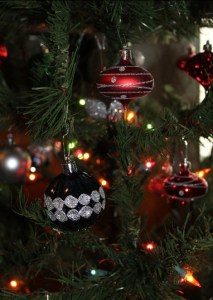
 My parents favored spruce for their Christmas trees. Perhaps this came from my father’s family living for many years in Colorado where spruce trees grow. My wife and I have carried on the tradition. The branches and needles easily lend themselves to lights to strings of lights, ornaments, and icicles. Their scent fills the room and, as I think I wrote elsewhere, conjures up a near-living presence from the tree in the living room.
 Even though it was March, I drove downtown in my 1950 A4 Checker (for you young people, that’s a car, not an Internet fact checker) in a cold wind that raged drunkenly beneath black clouds that looked like they’d been painted onto a frightening sky by Salvador Dalí during one of his less-lucid moments.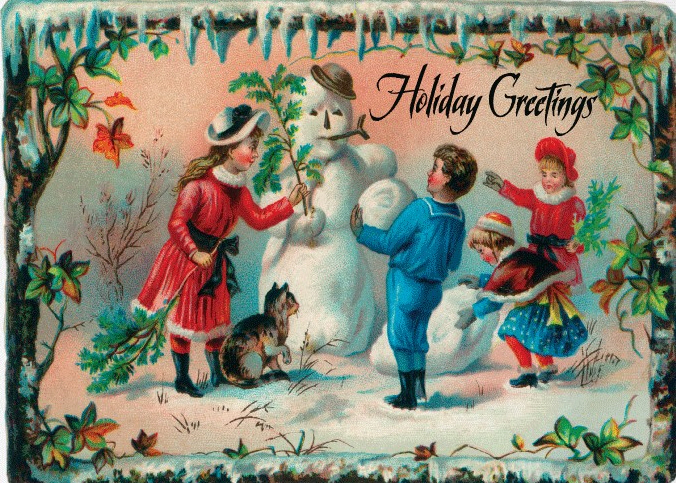
 Today’s young may not believe in that magic for as many years as we believed in it. Too bad: they lose their innocence so young. But those who are open to magic, family gatherings, songs, spiritual themes, and the beauty of decorated homes: whatever magic we can create for them nourishes them forever and is worth the effort.

 When my father passed away, it fell to me to let people know on his Christmas letter list. The following Christmas, I heard from them because many of them knew the history of my life through Dad’s letters. So I added those people to my own Christmas letter list. They were up in years, so we lost them off the list year by year, and that was kind of sad, really, because while I had never met most of them, they were in many ways an extended family.
 Children will learn the harsh truths of the world soon enough. Some say, their kids have a better chance of survival when they’re reared from day one in a boot camp-style environment with Pop as the Great Santini and Mom as the Wicked Witch of the West. I don’t agree. A few years of innocence made me stronger because those years taught me that strength and honesty don’t require us to wear cynicism and brutal honesty on our coats like badges of honor.
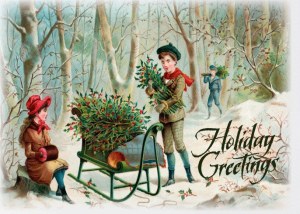 In a world where instances of child abuse and human trafficking are higher than many adults allow themselves to believe, some will ask how we can celebrate the innocence of any child by displaying Victorian Christmas cards or other positive messages of the season when many children are suffering. My response, is how can we not? We can’t solve the wrongs of the world by keeping quiet about what’s right with the world.
 My sense of Christmas celebrations, though, comes from the magic of December 25th as my parents conjured the day on an always-tight budget. We almost always had a spruce tree in a corner of the living room. The ornaments on it had been collected for many years by my father and mother and their parents. Since our Christmas tree lights were often lent to the schools we attended, our tree about December 25th went up after the lights came home from school.
 Some families seem to ring a starting bell after which everyone dives under the tree and opens his or her own gifts without paying much attention to what the others are doing. I like our tradition better: we took turns opening gifts as my father handed them out one by one. He engineered the whole thing so that the most spectacular gifts were opened last.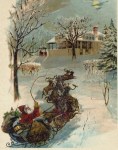
 I admit I’ve played Diana Krall’s Christmas album a lot since it came out ten years ago. I like jazz, and she does just fine with a fresh look at old favorites. I doubt that today’s youth is concentrating on jazz, so their Christmases will probably be formed out of other memories while their children last year and this year and next year. I like Christmas, Winter, and snow, so my memories come from childhood filled with spruce trees and movies and songs created before I was born.



 Malcolm's Round Table