Glacier Begins Vehicle Idling Awareness Campaign

from NPS Glacier National Park

West Glacier, MT – Glacier National Park and the Glacier National Park Conservancy are instituting an Idling Awareness Campaign aimed at educating visitors and employees about how they can reduce vehicle emissions in order to decrease pollutants which contribute to health problems and climate change. *

Idling pollution has been linked to respiratory problems such as asthma that increase vulnerability to COVID-19.

Transportation emissions play a significant role in fueling climate change, the effects of which are seen in the reduction of the park’s namesake glaciers. Vehicle idling occurs in Glacier in parking lots, at scenic viewpoints and trailheads, and while stopped in traffic and road construction. Glacier has received around 3 million annual visitors in recent years, most traveling by car. Limiting idling times to no more than two minutes will save money on gas and benefit the health of both the public and the park resources.

Glacier National Park is committed to reducing vehicle idling among employees and the public. Strategies for employees include enactment of a management directive limiting idling time for park vehicles, training visitor-facing staff on idling reduction messaging, and all-employee communications about idling. For park visitors, the campaign will focus on education and outreach.

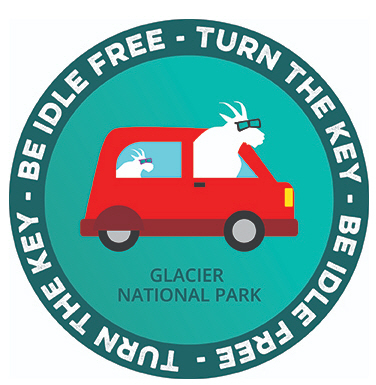
The Glacier National Park Conservancy funded the design and printing of stickers depicting cartoon mountain goats traveling in a red vehicle with the slogan, “Be idle free – Turn the key.” The stickers will be free to visitors and will be available from rangers outside the Apgar and Logan Pass Visitor Centers and in the Rising Sun area. The logo will also be used in park messaging to remind employees and visitors to shut off their vehicles while waiting.

“This is such an easy way for each of us to do something small that can cumulatively have a big, positive impact”, said Doug Mitchell, Executive Director of the Glacier National Park Conservancy.  “There’s just no downside to this innovative program.  Not only will turning our cars off save fuel and make parking lots and pullouts quieter and more enjoyable for all of us, but one simple twist of the wrist by each of us will improve the air quality for all of us, human and animal alike.”

* Note: This program began in August. — Malcolm

Review: ‘Good Girls Lie’ by J. T. Ellison

Good Girls LieGood Girls Lie by J.T. Ellison
My rating: 5 of 5 stars

Good Girls Lie is deftly written with a plot to die for: yes, there are a few casualties. And, there’s more lying than the prestigious Goode Boarding School’s honor code allows. The dean’s mother, who previously ran the family-owned school in Virginia was fired when a student died on her watch. Now her daughter Ford Westhaven is in charge and the intrigues are spinning out of control, almost enough to damage the prep school’s reputation, heaven forbid.

This school is for the daughters of the rich and famous. Most of them do well and are subsequently accepted into the best universities. The protagonist, Ash Carlisle expects to follow the same route into the world of the elite after escaping an abusive father in the U. K. A stipulation in his will (yes, he and his wife seem to have died recently in a murder/suicide incident) says that Ash will inherit the money when she’s 25 if she has a college degree by then.

The author, who attended Randolph-Macon Woman’s College knows how boarding schools for women work; she uses her first-hand experience to bring reality into the sheltered world of the Goode School–how the students interact, the secret societies, the honor code, and daily life on the campus. She points out, however, that Goode is pure fiction and that the novel is not a dissertation about Randolph-Macon.

The plot is a delightful tangle of lies, strange relationships, bullying and hazing, student-teacher interaction, and everything else that makes a fantastic thriller and–for the characters–a rather dangerous education. By the end of the novel, readers might wonder if they can trust anybody; and they have cause worry. After all, things at Goode School can’t be all that good when the story begins with a dead girl hanging from the front gate.

Malcolm

Malcolm R. Campbell is the author of the recently released mystery, “Fate’s Arrows.”

View all my reviews

How do writers think of stuff like that?

Writers are often asked where they get their story ideas. We’ve talked about that here before. We’re observant and we like using our imaginations.

In day-to-day conversations, I’m likely to say one thing or another that results in somebody asking, “How can you think of something like that?”

What I want to say is “How can you not think of it?” The “it” always seems so obvious whether it’s humorous, ironic, sarcastic, or a lyrical or unique play on words. I don’t want to downplay one’s imagination, but when it comes to words, thinking of stuff is part of the biz.

Police, firemen, doctors, mechanics, lawyers, and others think of a lot of things the rest of us don’t because they know their business and are rather expected to see and understand things about it that would never occur to the rest of us. If a doctor tells us we have a peanut allergy, for example, we don’t blurt out, “How in the hell did you think of that?” When s/he thinks of that, we’re getting what we hoped to get when we went to the clinic: answers we didn’t know or only suspected.

A writer’s daily conversations, however, are usually not held in his/her office where, perhaps, somebody might come, asking for help writing a business letter, a speech, or a college admissions essay. If they had done that, they would have expected some writing help and probably wouldn’t have acted surprised to get it.

But out in public is where people are surprised when we say what we say because they’re not used to seeing a writer out in the wild. I find such reactions amusing because I’m just talking like I talk. It’s not as though I’m doing something overt like speaking in Limericks or Faulkner-length sentences.

Many of the writers I know also say they get a lot of surprised reactions from others during normal conversations. At least, they seem normal to the writer until the other person bursts out laughing and says, “How do you think of stuff like that?”

Yes, it’s often amusing, but it’s also tiring because their reactions to what we say really can derail a great conversation.  Perhaps playing nicely with others means we should stop being ourselves.

Malcolm

Malcolm R. Campbell is the author of the recently released “Fate’s Arrows” in which a young woman fights the Klan in her small north Florida town of the 1950s.

New Anthology Of Native Nations Poetry

“There are many of us and we’re not just poets. We’re teachers. We’re dancers. Essentially, we’re human beings. And you would think that at this time we would not have to say that. But we still are in the position, strangely enough, that we still have to remind people and the public that: We’re still here, we’re still active. We have active, living cultures and we are human beings and we write poetry.”

Joy Harjo, NPR Interview

When the Light of the World Was Subdued, Our Songs Came Through: A Norton Anthology of Native Nations Poetry is a remarkable book because of the power of its words, because of its scope (160 poets from 100 indigenous nations), and because it exists at all.

Publisher’s Description

“This landmark anthology celebrates the indigenous peoples of North America, the first poets of this country, whose literary traditions stretch back centuries. Opening with a blessing from Pulitzer Prize–winner N. Scott Momaday, the book contains powerful introductions from contributing editors who represent the five geographically organized sections. Each section begins with a poem from traditional oral literatures and closes with emerging poets, ranging from Eleazar, a seventeenth-century Native student at Harvard, to Jake Skeets, a young Diné poet born in 1991, and including renowned writers such as Luci Tapahanso, Natalie Diaz, Layli Long Soldier, and Ray Young Bear. When the Light of the World Was Subdued, Our Songs Came Through offers the extraordinary sweep of Native literature, without which no study of American poetry is complete.”

Anthology’s Introduction

Executive editor Joy Harjo’s (Mvskoke/Creek) introduction grounds us and prepares us for the great circle of words of power we will take through the book’s five sections: Northwest and Midwest; Plains and Mountains; Pacific Northwest, Alaska, and Pacific Islands; Southwest and West; and Southeast. Each of these regions begins with a descriptive preface, and the work of each poet includes a mini-biography.

The focus, intent, and power of this work are aptly summarized by Harjo’s opening lines: “We begin with the land. We emerge from the earth of our mother, and our bodies will be returned to earth. We are the land. We cannot own it, no matter any proclamation by paper state. We are literally the land, a planet. Our spirits inhabit this place. We are not the only ones. We are creatures of this place with each other. It is poetry that holds the songs of becoming, of change, of dreaming, and it is poetry we turn to when we travel those places of transformation, like birth, coming of age, marriage, accomplishments, and death. We sing our children, grandchildren, great-grandchildren: our human experience in time, into and through existence.”

Harjo notes that while the United States has been here only a few hundred years, “Indigenous peoples have been here for thousands upon thousands of years and we are still here.” Yet unknown to most people, an afterthought to others, and long presumed to be illiterate by most; there never was a level playing field once the outsiders arrived, and so because of all of this, it’s remarkable that this anthology has been lovingly compiled out of the subdued light into our national consciousness. Let’s hope the powerful work it represents remains there.

The Poems

The wonders of four centuries of poetry cannot be adequately summarized or displayed here, much less explicated. So here are a few brief excerpts that caught my attention:

From the Northeast and Midwest

  • EMILY PAULINE JOHNSON (TEKAHIONWAKE) (1861–1913), Mohawk, “Marshlands”

Hushed lie the sedges, and the vapours creep,
Thick, grey and humid, while the marshes sleep.

  • OLIVIA WARD BUSH-BANKS (1869–1944), Montaukett, “On the Long Island Indian

But there came a paler nation
Noted for their skill and might,
They aroused the Red Man’s hatred,
Robbed him of his native right.

Now remains a scattered remnant
On these shores they find no home,
Here and there in weary exile,
They are forced through their life to roam.

From the Plains and Mountains

  • ZITKÁLA-ŠÁ (GERTRUDE SIMMONS BONNIN) (1876–1938), Dakota, “The Red Man’s America”

My country! ’tis to thee,
Sweet land of Liberty,
My pleas I bring.
Land where OUR fathers died,
Whose offspring are denied
The Franchise given wide,
Hark, while I sing.

  • N. SCOTT MOMADAY (1934–), Kiowa, “The Gourd Dancer”

A vagrant heat hangs on the dark river,
And shadows turn like smoke. An owl ascends
Among the branches, clattering, remote
Within its motion, intricate with age.

From the Pacific Northwest, Alaska, and Pacific Islands

  • MARY TALLMOUNTAIN (1918–1994), Koyukon, “There Is No Word For Goodbye”

Sokoya, I said, looking through
the net of wrinkles into
wise black pools
of her eyes.

What do you say in Athabascan
when you leave each other?
What is the word
for goodbye?

A shade of feeling rippled
the wind-tanned skin.
Ah, nothing, she said,
watching the river flash.

She looked at me close.
We just say, Tłaa. That means,
See you.
We never leave each other.
When does your mouth
say goodbye to your heart?

She touched me light
as a bluebell.
You forget when you leave us;
you’re so small then.
We don’t use that word.

We always think you’re coming back,
but if you don’t,
we’ll see you some place else.
You understand.
There is no word for goodbye.

  • FRED BIGJIM (1941–), Iñupiaq, “Spirit Moves”

Sometimes I feel you around me,
Primal creeping, misty stillness.
Watching, waiting, dancing.
You scare me.

From the Southwest and West

  • PAULA GUNN ALLEN (1939–2008), Laguna, “Laguna Ladies Luncheon”

     on my fortieth birthday
Gramma says it’s so depressing—
all those Indian women,
their children never to be born
and they didn’t know they’d been sterilized.
See, the docs didn’t want them
bothered, them being so poor and all,
at least that’s what is said.
Sorrow fills the curve of our breasts,
the hollows behind the bone.

  • EMERSON BLACKHORSE MITCHELL (1945–), Diné, “Miracle Hill”

I stand upon my miracle hill,
Wondering of the yonder distance,
Thinking, When will I reach there?

I stand upon my miracle hill.
The wind whispers in my ear.
I hear the songs of old ones.

From the Southeast

  • JOHN GUNTER LIPE (1844–1862), Cherokee, “To Miss Vic”

My spirit is lonely and weary,
I long for the beautiful streets.
The world is so chilly and dreary,
And bleeding and torn are my feet.

  • RUTH MARGARET MUSKRAT BRONSON (1897–1982), Cherokee, “Sentenced”

They have come, they have come,
Out of the unknown they have come;
Out of the great sea they have come;
Dazzling and conquering the white man has come
To make this land his home.

We must die, we must die,
The white man has sentenced we must die,
Without great forests we must die,
Broken and conquered the red man must die,
He cannot claim his own.

The editors of this anthology read each poem aloud, better to understand, hear them, savor them, and drink them into themselves like a rare elixir. Should time permit–and why would it not?–you will do the same.

Malcolm

We could have ended the world sooner and at a lower cost

Apparently, the movers and shakers of humankind have been working diligently to end the world. If not, we wouldn’t be where we are on so many fronts.

Except for various clans of deniers, including those who think history, science, and the notion of a round earth are bunk, most people are accepting climate change as inevitable. How do we know this? Because they’re keeping quiet, just watching it happen. Some people are fighting, speaking out, but it’s too little, too late.

The movers and shakers who–for reasons of insanity or short term gratification of the riches gained from habitat destruction–want the world to call it a day missed their chance to end life as we know it years ago. They could have kept the U.S. out of World War II, let Hitler and Hirohito have it all, and head toward the resulting, predicted ruin.

We had enough nuclear weapons to do the job, but we didn’t. It would have been quick, possibly a spectacular sight to aliens watching from a universe far away. Instead, we’ve opted for the slower annihilation of climate change–the fires, the hurricanes, the rising oceans, the diseases, the chaos. Where is the honor in that?

We’re all accomplices, though, aren’t we? We’ve accepted the notion that we were somehow different than the rest of the world’s flora and fauna and that “taming the land” was okay even if it meant destroying the land because we’re superior to mere rivers and forests, much less the problems of oceans with plastic and rivers with toxic waste..

The land is having its say, but we’re not listening. I’m surprised that the molecules that make up human beings haven’t fled the planet out of guilt and embarrassment to return to the dying stars whence they came. Many have spoken on the land’s behalf, individuals like Edward Abbey, John Muir, Wendell Berry, David Brower, Rachel Carson, and organizations like Audubon, Nature Conservancy, Sierra Club, National Parks and Conservation Association, Wilderness Society. Many like what they hear from these people, but then they go back to sleep.

I don’t have any answers. I can suggest that every time the current administration rolls back environmental protections that took decades to put in place, that we put a stop to it. I can suggest that when we hear of measures–getting rid of plastic, for example–that are good ways to combat climate change that we implement them in our lives rather than saying, “No worries, that’s just climate change BS.”

When it comes down to it, I suspect a lot of people have suggestions for things we can do thwart those who are intent on ending the world. Sure, most of those suggestions are inconvenient and cost money. But then, the impact of climate change is also costing money–for example, the lives and money lost due to the western wildfires along with the cost of fighting the fires.

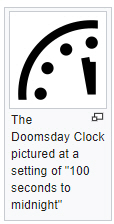
Doomsday-clock-wise, we have 100 seconds left. So at the end of this rant, let me say that it’s time to shift our attention away from our celebrities and cell phones and cars and focus our concerns on saving the planet. Once we accomplish that, we can watch the next season of “Survivor” with the proven knowledge that the show is about us.

Malcolm

Malcolm R. Campbell’s latest novel is “Fate’s Arrows.” His novel “The Sun Singer” is free on Kindle through September 18th.


‘Therefore Choose Life’ by George Wald

“I tell my students, with a feeling of pride that I hope they will share, that the carbon, nitrogen, and oxygen that make up ninety-nine per cent of our living substance were cooked in the deep interiors of earlier generations of dying stars. Gathered up from the ends of the universe, over billions of years, eventually they came to form, in part, the substance of our sun, its planets, and ourselves. Three billion years ago, life arose upon the earth. It is the only life in the solar system.” — George Wald

The Nobel Prize-winning scientist George Wald gave the 1970 Massey Lecture on CBC radio called “Therefore Choose Life,” focused on life, the universe, and our relationship to it.

Long considered one of the best lectures from a series of broadcasts that began in 1961 to provide a podium–as CBC has said–for writers, thinkers, and scholars who explore important ideas and issues of contemporary interest, the lectures are generally produced as published books after the broadcasts. Except Wald’s. He was working on the typescript when he died in 1997 and subsequently the manuscript was lost for years.

I heard a tape recording of Wald’s lecture just after it was given. It profoundly impacted my life and my view of the cosmos.  Wald’s ideas, presented in nearly poetic words, in terms non-scientists could easily understand, placed the workings of the universe before my eyes. His words haunted me since then, and it would be forty-seven years before I found them again in 2017, when they were finally published and just as relevant then (and now) as they were in the aftermath of the turbulent 1960s.

From the Publisher

“All men, everywhere, have asked the same questions: Whence we come, what kind of thing we are, and at least some intimation of what may become of us . . .”

So begins Nobel Prize–winning scientist George Wald’s 1970 Massey Lectures, now in print for the first time ever. Where did we come from, who are we, and what is to become of us — these questions have never been more urgent. Then, as now, the world is facing major political and social upheaval, from overpopulation to nuclear warfare to environmental degradation and the uses and abuses of technology. Using scientific fact as metaphor, Wald meditates on our place, and role, on Earth and in the universe. He urges us to therefore choose life — to invest in our capabilities as human beings, to heed the warnings of our own self-destruction, and above all to honour our humanity.

I hope thousands of people will find this book and, for a mere $9.99 on Kindle, see the “big picture” and their part in it.

–Malcolm

Malcolm R. Campbell’s novel “The Sun Singer” is available free on Kindle September 14 through September 18. But for goodness’ sakes, read “Therefore Choose Life” first.

‘Somebody said an airplane crashed into a building’

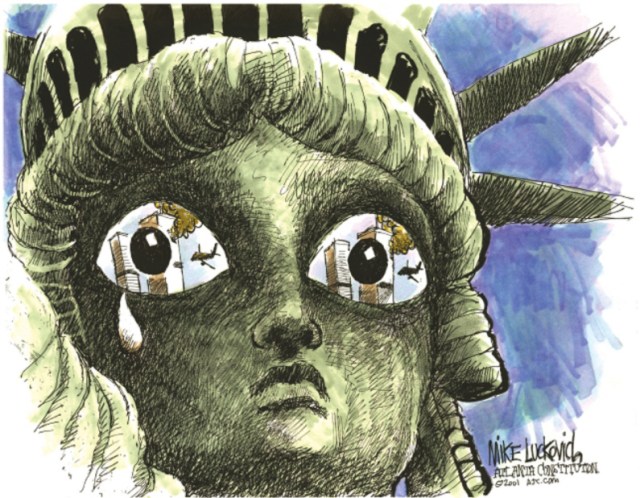
So the comments at work began on a Thursday morning in 2001. When the second plane hit a building, we knew this was more than a simple crash.

Most of us went home and watched the news, saw both buildings fall, hoped until the last minute that United flight 93 would survive, but as we learned what happened, we could only praise the heroism of those who fought back against their hijackers.

Later we remember the President visiting ground zero, people saying they couldn’t hear what he was saying, and then he grabbed a bullhorn and said, “Can you hear me now?” Those words were what we needed.
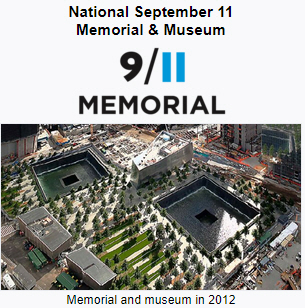
I learned that an online friend of mine was in one of the buildings when the plane hit, how she made her way down countless stairs, emerged into windswept ash and the cries of the lost and wounded, and walked a mile in a pair of shoes she found on the street.

The stats–the number of dead, the dollars of damage done, the squabbles over what to do with the site, the size of an attack that dwarfed Pearl Harbor–all failed to catch our attention when compared to the work of the first responders and everyday people who were heroic in spite of their fears on that day.

I don’t know how New Yorkers feel when they visit the memorial. The project had so many competing ideas, I remember thinking at the time that the result was going to look like everything done by a committee. Nonetheless, I think we did the best we could, and I hope people are reverent there and treat it as sacred ground, in the same manner we respect of Battleship Arizona memorial and the Tomb of the Unknowns.

So far, I haven’t had the opportunity to visit this memorial, and if I did, I think it would be too much to bear for I would hear the voices still screaming there as I do when I quietly walk through Civil War battlefields and cemeteries. Each of us interprets the aftermath as we can even though we may not understand the memories of the dead or the survivors who suffered this tragedy in person: one can only feel humble in their long shadows.

–Malcolm


So, you think Art Fleming was the first host of Jeopardy!

Or, possibly, you don’t think that because you weren’t yet born during the years 1964 to 1975 when Fleming was the host or you’ve just assumed that Alex Trebek has always been the host going back to the days when the Psalms were being written.

Actually, Laurence R. Campbell (my dad) was the first host of the show even though we never could find a network to pick it up. Word is, Merv Griffin created Jeopardy!  in 1964, and that’s true. What’s left out of the story if the fact that Merv stopped by our house in Florida for dinner when we were playing a spirited round of “Questions” (as we called it) around the dinner table.

We had a pot roast that day. And Parker House rolls. And Merv taking a lot of notes and phoning in ideas to the network brass. So, he went down in history as the originator of the show first called “What’s the Question?” and we didn’t even get into the credits.

Dad asked all the questions. They were random. My two brothers and I shouted out answers. Mother occasionally answered a question when it was obvious none of us knew the answer. There were no winners or losers. There were no prizes. Just a rollicking good time.

Dad was a university professor. It occurred to me that “Questions” was more than a good time. It was homeschooling before the term became popular and it was Jeopardy! before Art Fleming began the televised show as the host. The family watched Jeopardy! in those days, and we tuned in almost every night, but it was never quite the same as answering questions around the dinner table while eating pot roast and Parker House rolls.

For those of you who don’t know what Parker House rolls are, I’m sorry, but that information is classified.

Malcolm

Malcolm R. Campbell is the author of “Fate’s Arrows,” released a few days ago by Thomas-Jacob Publishing.

It’s fun having a website again

I cancelled my old website because it was becoming expensive, truth be told, it cost more than my books were making. Now I have a new one. I’m using Homestead again, and have found an inexpensive plan. It doesn’t include a domain name like my old sites, but at least I can afford it.

You can find the website here: https://malcolmcampbell.homesteadcloud.com/

I know, I know, that URL isn’t memorable. But it’s cheap.

This time out, I’ve resolved not to allow the web site to become as cluttered as my desk. So far, it has a home page, and about me page, books, contact, and audiobooks

I’ve made that resolution before, but then as time went by, I kept tinkering with my websites, adding a little here and a little there, until the whole shebang was quite a mess. “More” turned out to be “less,” a confusing site where visitors didn’t know what the hell they were supposed to do.

Will the new website sell thousands of books? Probably not. But for better or worse, it’s an online presence, something all writers are supposed to have. We’re not sure why we’re supposed to have it, but if we don’t have it, we’re considered wannabees, and good lord, that’s a fate worse than death.

–Malcolm

Everybody knows everybody here, so a drowning brings out all the neighbors

A steady line of cars has come and gone at the house across the road where the parents of the 34-year-old man who drowned in a nearby lake yesterday live. The son died on his father’s birthday and his daughter-in-law’s child’s birthday.

Lake Allatoona, GA.

We don’t know them well, but well enough to know the news and that the family gathered at the son’s house last night and told stories into the night.

Now, nothing will never be the same. Those who remain seem to bear the brunt of a family member’s death, for they are still here and have to cope with it, settle all that needs to be settled–his house, his company, his will, all he left behind.

I cannot imagine a parent celebrating his/her own birthday again with this tragedy inscribed on the date. My brother and his wife lost their son to suicide and they make sure they are never home on that sad anniversary. Our neighbors might end up doing the same thing, avoiding everything that reminds them of yesterday afternoon.

As weekends go, the Labor Day weekend holds its share of accidents and other tragedies. For the most part, we don’t know those whom we lost. Today, I know his name and his parents’ names. He was a great guy, folks are saying, and I don’t doubt them. I didn’t know him but I think it’s sad that he’s gone. I worry about his family most of all and how they will move forward. I hope they can.

–Malcolm