“The Hunt for Red October is a 1990 American submarine spy thriller film directed by John McTiernan, produced by Mace Neufeld, and starring Sean Connery, Alec Baldwin, Scott Glenn, James Earl Jones, and Sam Neill. The film is an adaptation of Tom Clancy’s 1984 bestselling novel of the same name. It is the first installment of the film series with the protagonist Jack Ryan.
“The story is set during the late Cold War era and involves a rogue Soviet naval captain who wishes to defect to the United States with his officers and the Soviet Navy’s newest and most advanced nuclear missile submarine, a fictional improvement on the Soviet ICBM capable Typhoon-class submarine. A CIA analyst correctly deduces his motive and must prove his theory to the U.S. Navy before a violent confrontation between the Soviet and the American navies spirals out of control.” – Wikipedia
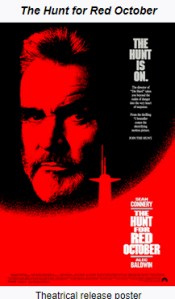 I’ve seen this film multiple times and always enjoyed it for the story, special effects, and acting. Fortunately, by the time Connery made this film, the public was getting used to him playing roles other than James Bond even though his last Bond film was made in 1983 “Never Say Never Again.” He was convincing as the aging captain of the Russian submarine Red October. The film did well, including a good review from Roger Ebert.
I doubt I was reading anything in the military/thriller/espionage genres in those days, so I hadn’t read the novel, a book that was well received and, needless to say, transformed the life of 30-year insurance broker Tom Clancy. Fans of Clancy know that his books became (and remain) an ongoing publishing business even though he died in 2013. His name is on the covers of the books though they’re all written by somebody else for the franchise. I’ve read many of these–and similar novels–in recent years and have found them cathartic, a mental health intervention so to speak, for those of us who are often overpowered by the evils of the world, including the books we write.
A copy of the novel arrived today. I’m looking forward to it, partly for mental health reasons, but mainly out of curiosity. I want to see the original version of the story, one that was loosely drawn on true events, and see how it was translated to the screen.
The book is, by the way, cheaper than paying a Jungian analyst $300 per session to help me cope with my own writing.
Me: Doc, it hurts when I write.
Doc: Stop writing.
Me: I’m under a spell that won’t let me stop.
Doc: Probably your shadow.
Me: You got that right.
–Malcolm

Malcolm R. Campbell
Publisher: Thomas-Jacob Publishing
 I stopped watching years ago because the show was: (a) too long, and, (b) filled with snarky, politically correct preaching. Talk about movies and the arts and stay away from politics, I want to say. But–I think you can guess this–nobody asked me.

 Typically, two of the characters will go for weeks obviously interested in each other while desperately striving to keep things professional and avoid having to go to human resources and submit a consent form stating that they are intimate. Then, one night after a tough day in the E.R. and the O.R., the two people are walking down a darkened hallway talking about the emotions of the day when, SUDDENLY, their eyes lock into a mutual “come whither” look and they go nuts.

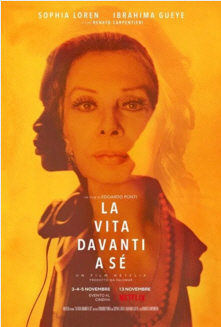 Sometime between 70 and 100, we lose track of well-known people if they’ve retired. When Sophia Loren starred in “The Life Ahead” last year, people had to reassess, deciding that (a) she’s not dead, (b) “out of it,” and (c) “still has it.” Good for her, people were saying.


 I still have the second book that appeared about the time the movie “Gypsy” was released in 1962. When I didn’t return it to the tall shelf, nobody mentioned it. It appeared after the book about how to have sex, though I didn’t need a set of instructions to enjoy Gypsy Rose Lee’s 1941 detective novel
 Quid pro quo (“something for something” in
 Malcolm's Round Table