Mountains. . .before I got too old to climb them

Now as I was young and easy under the apple boughs
About the lilting house and happy as the grass was green,
The night above the dingle starry,
Time let me hail and climb
Golden in the heydays of his eyes. . .

from “Fern Hill” by Dylan Thomas

When I first explored the mountains of Glacier National Park, “time let me hail and climb golden in the heydays of his eyes.” I thought those trails and those days would go on forever even though I had read the Dylan Thomas poem many times and knew how it ended. Even though grandparents are around us when we are young, we still think we will always be young and, that if we won’t, old age is eons away in a future too far away to fathom.

When we’re young, it’s hard to imagine being old. When we’re old, it’s easy to remember being young just as I remember the first time I read “Fern Hill” and was concerned about the words: “ In the sun that is young once only, time let me play and be golden in the mercy of his means.”

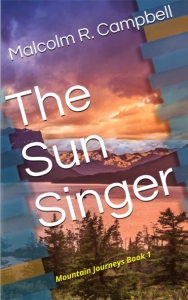
As I write a novel now about a character following a trail near Piegan Mountain, I must rely on the videos and descriptions of younger men and women, those who are still healthy in time’s golden era. If I’d only known, some 50 years ago, that I’d be writing this novel, I would have taken a hundred photographs along the trail that led from Going to Sun Road to Many Glacier Hotel. But I was too enchanted within the moment to create a photographic diary on Ektachrome film. (Regrets, I’ve had a few.)

If there’s a learning experience in all this, it’s to push on with the writing using the resources I can find rather than wishing (a) I could be young again, (b) took 1000 photographs of everything, and (c) ruined my life experiences by slavishly documenting them for those old-age years when they would be beyond reach.

When we have finally followed time out of grace, our memories must suffice, all the more sweet because they are so tangled and unclear rather like a dream of once walking the high country when knees and ankles and breath were strong and the sky was blue and full of endless promise from side to side.

–Malcolm

Malcolm R. Campbell
Publisher: Thomas-Jacob Publishing

Website

Facebook Author’s Page

Amazon Author’s Page


Sad to leave my favorite organization after 34 years

I left because one of the officers chewed me out on a related private Facebook group in front of nearly a thousand other members. The thread started off decently, then deteriorated into a lecture from her that never addressed the question I initially asked. Of course, I am completely blameless in every possible way (hmm).

Online exchanges tend to lend themselves to a high number of misunderstandings. I’m not sure why this is. Maybe it’s because–other than private groups–10000000 people might be reading the exchange, something that adds a lot of pressure that isn’t there when two people talk over a cup of coffee in a Waffle House.
Yet, as a writer, I’m still amazed at how often the posts that begin with the best of intentions turn into an argument that can’t be saved. I wonder how many “real-life” friendships are destroyed online.

So, I left the Facebook group and then canceled my membership in a related non-profit organization. I still support the organization’s work but see no viable role for me in it if what I experienced in the group represents what management thinks of its members. I feel sad about leaving as well as justified in leaving. I’ve heard a lot of people say this about “real life” as well as online clubs/groups.

Suffice it to say, the “heat of the moment” is always a dicey place for intelligent decision-making. Most of us have been there, in that heated moment where we made long-term decisions that might have been better made a week or two later. I’m still feeling justified in my decision, but a month from now, I might wish I hadn’t made it.

That’s part of being human, I guess.

–Malcolm

Malcolm R. Campbell

Publisher: Thomas-Jacob Publishing

Website

Facebook Author’s Page

Amazon Author’s Page

I need a lawn tractor with power steering and A/C

When my wife and I finish several hours of yard work, we feel like we’ve been beaten up by a badass chapter of Hell’s Angels. Everything hurts. I should point out that both of us have slipped past middle age, probably while drunk or asleep, and now (gasp) are probably presumed to be senior citizens. That means we’re wise and/or wiseass and need to be revered and respected by younger people.

So, last night after mowing at least an acre of high grass, I fell into a recliner with a bottle of Highland Brewing Gaelic Ale and more or less watched something or other on TV. I think it might have been Master Chef Legends followed Crime Scene Kitchen. I vaguely remember that people were cooking stuff, some of which looked worse than anything I fix for supper and some of which looked great.

Three or four of these might help.

Getting back to this post’s header, my proposal to the Feds is to pass a bill that mandates all senior citizens with a riding mower/lawn tractor will get a free upgrade to automatic transmission and A/C. We live in a rural area where we have about three lots worth of mowing to do and we need government money to smooth things over, mainly the property which randomly gets tromped to oblivion when the neighbor’s cows get out and wreck the yard.

So, what I need for you to do is call your senator and representative and say, “People older than dirt are still mowing their yards with riding mowers that function like a hot and sweaty bucking bronco.”

I’m not making this up.

All we need is several hundred grand to fix the problem. Since we’re filled with wisdom that is free, we don’t think this is too much to ask.

–Malcolm

Malcolm R. Campbell

Publisher: Thomas-Jacob Publishing

Website

Facebook Author’s Page

Amazon Author’s Page

Dear consultant, you want me to pay you to tell me about the software I don’t want?

Perhaps you saw this e-mail. A writing/marketing consultant sent me an e-mail “offering me a seat which wasn’t free” to an upcoming webinar about novel-plotting software. He did give recipients a free tip: after analyzing multiple programs, he liked Plottr best. Plotter’s slogan is Plan Your Books The Way You Think.

I cruised through the website and what I saw reminded me of the note cards, outlines, and other annoyances that English teachers used to force on us every time we wrote a paper. My answer to Plottr is the same as my answer to English teachers 50 years ago: Nobody thinks like this.

Perhaps a programmer using C, COBOL, or assembly language thinks like that, but writers certainly don’t. I’ve written computer programs and noted the difference between their structure and the structure of a story.

So, after seeing what the consultant wanted me to learn more about, my mood went from pleasant to bad. It got worse when I saw that the way to learn more was through a webinar. Holy hell, I thought, that’s about the slowest possible way to impart information. Very linear. Much slower than a booklet with headings and subheads that let me go directly to the points I want to know more about. With a webinar, I have to suffer through the whole darn thing to get to the points I care about. I have no idea why this is such a popular method of dispending information. It’s probably cheap.

Now, if the webinar came with a transcript I could refer to later, I might give its creator a little slack.

While on the Plottr website, I kept seeing mini-testimonials flashing on my screen from people who loved the application. I didn’t see any testimonials from well-known novelists. Joe Doaks says Plottr is great. Okay, wonderful. What’s the name of a novel he wrote using the program?

You can see, I think, that I’m not in favor of this kind of software. If it helps a writer, that’s fine. Nevertheless, I tend to see it as a detrimental approach that gets in the way of a story’s development. For goodness sakes, I don’t need a thousand-word dossier on every character before writing the words “Once upon a time.”

Enough, already. I’ve said most of this before.

–Malcolm

Malcolm R. Campbell

Publisher: Thomas-Jacob Publishing

Website

Facebook Author’s Page

Amazon Author’s Page

Some things are too close to write about

In recent years, authors have written memoirs or memoir-style novels based on the crimes and conditions the authors suffered while growing up. I think of Natasha Trethewey’s 2020 book Memorial Drive: A Daughter’s Memoir, for example.  The country needs to hear these words, especially from marginalized people.

I have no such words, nothing personal to say that impacts the national discourse en route to the equality of all people. I’ve thought about writing a novel about my uncle who was murdered in Fort Collins in 1919. But the moment is at once too close and too far away.
And in the end, assuming I could ever research it, I would probably see another inept police force that made assumptions about what happened and let the case go cold. (I contacted that police force years ago and they have no records of anything.) Usually, these kinds of cases are handled by having the courthouse burned down, providing plausible deniability for everyone.

And, I certainly wasn’t going to interview my father and his two remaining siblings to learn, as reporters ask, “how did it feel to hear your older brother had been shot to death while walking to church?” I was trained as a journalist, but that’s one unforgivable question I don’t ask anyone.

I may have, over the years, allowed a bit of spite to get into some of my books, things said with the names changed about people who wronged me in various ways. They wronged me in such creative ways, I couldn’t resist including what they said and did. If I had James Patterson’s readership, those people might have found themselves in my work. I don’t, so they didn’t. There’s an old joke: “Don’t mess with me or I’ll put you in my next book.” That’s true enough, though libel laws force us to cover up the perpetrators so they don’t even recognize themselves in the plotlines.

Most authors, who have personal stories less interesting and important than Natasha Trethewey’s are tempted to “speak out” in print. But are stories, while often universal, are often “too usual” (spurned lovers, schoolhouse bullying, the ills of military service, etc.) to make a compelling novel. So, there’s much we cannot share. To this day, I don’t know if that’s good or bad.

Yet, our lives become tangled with our novels in many ways, so discerning readers can probably find us if they read between the lines. Who we are is “large in our works” as Virginia Woolf wrote in Orlando. We can’t hide even though we think we can hide because the truth will out. As we grow older, we accumulate a  lot of memories that are bitter-sweet.  To write about them or to keep quiet, that is the question.

Will it serve a purpose if we write about ourselves under the guise of fiction? I think most writers are doing that without realizing it. But intentionally, like a tell-all story sold at grocery stores. That seems kind of sordid and probably has no overarching redeeming value.

–Malcolm

Malcolm R. Campbell

Publisher: Thomas-Jacob Publishing

Website

Facebook Author’s Page

Amazon Author’s Page

Family murder never solved

My uncle, Frank M. Campbell, was murdered in Fort Collins, Colorado in November 1919 while he was walking to church. The murder was never solved. Some said it was probably a holdup attempt. Some said it was a case of mistaken identity. He was twenty years old, and the loss would haunt my father all his life and, from time to time, it haunts me even now long after the fact.

Some years ago, I tried to find out if the police department had any information. They didn’t. The case was open but too far back in time to be relevant. I even asked a psychic. He told me it was an ether-related crime, this at a time when ether was a drug problem like heroin and cocaine are today. My assumption was that Frank was approached by somebody who needed money to support his habit.

My grandparents and their three other children left Fort Collins and moved to California (the Los Gatos area) where they still were when I was born many years later in Berkeley. I don’t think this kind of crime ever leaves a family unscathed. My father and his two siblings, and of course their parents, carried this moment with them forever.  Even now, over a century later, I find myself angered and perplexed by it.

I wonder as I read the daily news about crimes across the country, when (if ever) the horrific memories of violent crimes ever fade away. I think the survivors never forget even though the news stories are gone with the wind.

–Malcolm

Malcolm R. Campbell

Publisher: Thomas-Jacob Publishing

Website

Facebook Author’s Page

Amazon Author’s Page

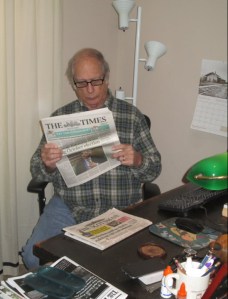
My office is closed to tours

FSU main library

To look at this place (my office), nobody would ever guess that I worked my way through college as a student assistant, and then a graduate assistant, in the Florida State University and Syracuse University libraries. In those days, I knew all about the Dewey Decimal System, the Library of Congress System, vertical files, special collections and papers, and (of course) how to collect fines. Whenever a professor assigned a research paper, I always knew where to find stuff.

Today, however, whenever my muse assigns a new novel, I don’t know where to find anything. In the first place, stuff was never organized when it was created. After various hard drive crashes, moves to new houses, changes in software, etc., notes, books, papers, general ephemera, lists of sources, and so-called work products became widely scattered, often labeled simply as “stuff.”

Office

Tour busses used to bring 1000000 people a year to my house for a personal tour of my den because somehow my house got listed in the “places to go” section of the online guide about the city where I lived. People came inside, after paying their $10 entry fee and asked where things were. I said, “right here,” but then they pressed for more information and all I could do was shrug. Nobody thought a shrug was worth $10, especially when one could go to the local brothel and get a whole lot more for a whole lot less.

So, the Better Business Bureau and the Chamber of Commerce told me to find my stuff or cancel the tours.  I told them that my office tours were an example of chaos theory in action. They didn’t buy it. But let’s face it, organizing my stuff was just too much trouble. It would have caused my PTSD even though the tours were more profitable than my novels.

Case in point: In my last post, when I wrote about the Monticello, Florida opera house, I wanted to include information from Cathy L. Berlow’s 1981 thesis from the University of Florida about the 1890 building. But, where was my copy? Even the cats didn’t know. And, if they didn’t know, nobody knew. So, the post was less informative than I planned.

I used to get frustrated with this sort of thing. Now I just shrug.

–Malcolm

Malcolm R. Campbell

Publisher: Thomas-Jacob Publishing

Website

Facebook Author’s Page

Amazon Author’s Page

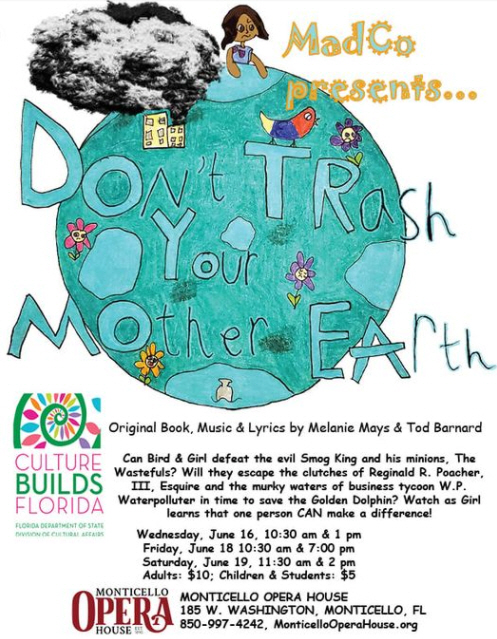
Monticello Florida Opera House

This beautifully restored opera house, once home to Vaudeville, was built in 1890. The work on the building has been a labor of love–one that’s ongoing. Since I’ve been involved in historic preservation, I highly approve of those who have the vision and stamina to restore old buildings and keep them vibrant and in use in today’s world. A big plus for me is the Monticello Opera House’s support of local and regional theater.
If I still lived in North Florida, I would be an active member of this group, involved in fundraising and publicity, and grant writing.  They still need to focus a bit more on ephemera, old playbills, and lists of performers to help put the building’s significance into perspective. Such work would probably require a humanities grant and a devoted intern or two for Florida State University.

The opera house is on the National Register under the name “Perkins Opera House.” The paperwork, filed in 1971, is disappointing because, unlike more recent applications, it doesn’t include “statements of significance” which would have listed historical and architectural information. 

Here’s their current offering, one with a great poster:

–Malcolm

Malcolm R. Campbell, who writes magical realism novels set in the Florida Panhandle, has  also worked as a grant writer for nonprofit organizations, including a successful National Register application.

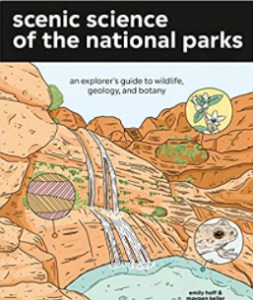
‘scenic science of the national parks,’ by Emily Hoff and Maygen Keller

This beautifully illustrated, well-written guide presents a capsule of information about each U. S. National park in an easy-to-use format that will make this a take-into-the-field companion. There’s even a place for each park’s “passport” stamp.

For each park, you’ll find a superlative statement, crowd-pleaser hikes, primary mammals and plants, a so-called “iconic experience,” and a “worth noting” fact. This book uses illustrations rather than coffee-table-book photographs. These are immensely helpful in making quick identifications of what you’ll see in the park.

When I first picked up this book, I looked up the parks I know well and found the information to be accurate and spot-on in terms of each park’s ambiance and character.

From the Publisher

Explore the fascinating science behind the national parks in this charming illustrated guide.

The national parks are some of the most beloved, visited, and biodiverse places on Earth. They’re also scientific playgrounds where you can learn about plants, animals, and our planet’s coolest geological features firsthand. Scenic Science of the National Parks curates and breaks down the compelling and offbeat natural science highlights of each park, from volcanic activity, glaciers, and coral reefs to ancient redwood groves, herds of bison, giant bats, and beyond. Featuring full-color illustrations, information on the history and notable features of each park, and insider tips on how to get the most out of your visit, this delightful book is the perfect addition to any park lover’s collection.

From the Opening Pages

We know this looks like a book, but our collection of pages is actually more like a secret decoder ring or a pair of X-ray glasses because it will help you see some of the most iconic landscapes in the United States in a whole new way. Whether you’re traveling through the national parks by car, bicycle, boat, or foot, or even in your imagination, this is an opportunity to unlock the scientific stories behind the scenery.

This guidebook will teach you to spot the extraterrestrial-like organisms lurking in Yellowstone, the spiky teddy bear clones in Joshua Tree, the slick snails of Acadia—and more! Contained here are true stories about plants, rocks, animals, bodies of water, and the night sky that you aren’t likely to find anywhere else than in these parks. We’ve steered away from people-centric history and from big, obvious questions (like, How did the Grand Canyon form?) in favor of more fascinating, offbeat questions (like, How are strange ocean animals that look like plants connected to the rocks that make up the Grand Canyon?). This is an invitation to be inquisitive and pay attention to the small details that bring the big picture into view.

We had a blast writing this book and hope our work sets you off on a question-asking frenzy of your own. Go forth and get curious!

This is the best general national parks guidebook I’ve seen in a long time. Better yet, it was an early Father’s Day gift from my daughter.

–Malcolm

P.S. I had her permission to open the package early!

Malcolm R. Campbell

Publisher: Thomas-Jacob Publishing

Website

Facebook Author’s Page

Amazon Author’s Page

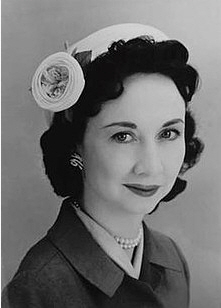
What happened to Dorothy Kilgallen?

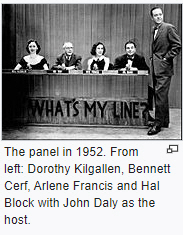
Crime and courts reporter, columnist, and 15-year “What’s My Line” panelist Dorothy Kilgallen died on November 8, 1965. I remember when it happened because I watched “What’s My Line” in those days and thought that there was something odd about her death.  I liked her because she was very good at figuring out contestants’ occupations on the show and, in a media world dominated by men, she was one of the best reporters in the business (Hemingway was among those who thought so).
Mark Shaw has written two books about her, The Reporter Who Knew too Much and Denial of Justice in which he clearly believes she was murdered, and lays out as much evidence as he can find to support that theory. While her death was generally presumed to be an accidental overdose of sleeping pills combined with alcohol, two of the drugs in her system, and in the residue of one of two glasses on her nightstand, weren’t drugs prescribed for her and that she was never known to take.

There was never a formal police investigation even though the circumstances surrounding her death were odd and should have raised multiple red flags. Shaw wants the case to be re-opened, but that seems unlikely since most of the witnesses are gone and the crime scene in her home is gone. By the time I finished reading Shaw’s books (“Denial” is largely a rehash of The Reporter Show Knew Too Much) all I had was a long list of suspects.

Suspects include: Her husband (they led separate lives), Frank Sinatra (long-time feud), FBI/CIA (to stop her JFK/Ruby/Oswald investigation that might uncover secrets the government didn’t want to be known), organized crime (that might have been complicit in the JFK assassination). Certainly, her husband had the easiest opportunity while those who think, as Kilgallen did) that there was something fishy about JFK’s death and the government’s handling of it, will suspect, possibly, the CIA.

Shaw has done a lot of research (click on his name above for more info), but the books are not really organized well (my opinion), so when one finishes them there’s a great sense of frustration, mainly at how badly the police and the medical examiner handled things in 1965 and partly because Kilgallen’s family hasn’t been as supportive of Shaw’s efforts as one might hope.

The books raise more questions than answers, but certainly provide a lot of information about the probable answers to those questions. We may never know, and it’s quite possible that people are around who want to make sure we never know.

–Malcolm

Malcolm R. Campbell

Publisher: Thomas-Jacob Publishing

Website

Facebook Author’s Page

Amazon Author’s Page