Robbie knows what he wants, so he comes and gets me when he wants it

I’ve written about Robbie before, I think, the cat who was probably dumped out in the country by the asshole who owned him, and ultimately found us softhearted enough to feed him once we learned nobody in the neighborhood had lost a cat. He was healthy, but ultimately we took him to the vet to make sure, and now we have an indoor/outdoor cat.

Robbie has figured out how to run across my desk without hitting the keyboard or the wine or coffee that’s providing fuel for my work.

When he wants to go back outside, he runs across the desk and stands by the front door.

He leads me to the food bowl in the kitchen when it’s empty or to the water bowls when they’re empty.

Robbie expects us to watch TV at night, so if things get late, he’ll come and get me and head for the living room

Since our cats are allowed in the bedroom overnight where they sleep, but not any other time, both Robbie and Katy get antsy when the TV has been off for a while around midnight and the bedroom door is still closed. Katy sits by the closed door in a sulk. Robbie finds me and leads me to the closed door to let me see for myself that it’s not open.

Maybe he watched all the old Lassie shows on TV at his last house and got the idea that pets are supposed to go get people when somebody calls in a well or the food bowl is empty.

Oh, well whenever he sees me outside, he follows me around to see what I’m doing. I’m not sure that’s a good sign. I keep wondering where this behavior is going to lead.

Malcolm

Earphones Winner from Audio File magazine.

Sunday afternoon potpourri

  • According to Radio Free Europe, “Russian officials have accused Ukraine of mounting a helicopter attack early on April 1 on the fuel depot located near Belgorod, not far from Russia’s border with Ukraine.” My first thought was, “Stop Whining. You’ve destroyed Ukraine and now you feel put upon when they strike back?” While conceding the depot was a viable target, Ukraine says they didn’t do it. Oh really. Well then, kudos to whoever did do it.
  • Spring means watching the yard get shaggy and then trying to figure out what it’s going to take to get the riding mowers running after a winter of just sitting there. One finally cranked up after we put the trickle charger on the battery for a while. Apparently, the other one will need a new battery inasmuch as the charger message said BATTERY SHOT TO HELL.
  • I’m looking forward to reading The Librarian of Auschwitz, next up on my nightstand. Written by Antonio Iturbe, the novel is based on the true story of Dita Kraus. Here’s the publisher’s description: “As a young girl, Dita is imprisoned by the Nazis at Auschwitz. Taken from her home in Prague in 1939, Dita does her best to adjust to the constant terror of her new reality. But even amidst horror, human strength and ingenuity persevere. When Jewish leader Fredy Hirsch entrusts Dita with eight precious volumes the prisoners have managed to sneak into the camp, She embraces the responsibility―and so becomes the librarian of Auschwitz.”
  • Meanwhile, author Luis Alberto Urrea announced on his Facebook page a soon-to-be-released book of poetry. I like his work a lot, so I’ll be looking forward to Piedra as soon as it becomes available on Amazon and other online sellers. While I’m waiting, perhaps I should re-read my favorite from him The Hummingbird’s Daughter, a historical novel.
  • Speaking of new books, my publisher Thomas-Jacob will soon release a collection of poetry, excerpts, and short stories that includes my story “The Smokey Hollow Blues.” I’m excited about this volume and am looking forward to reading everyone else’s contributions.

Malcolm

Refuge Eye shows us the world through the eyes of refugees

The world, and our understanding of it, expands when we read the stories from other cultures. The online hub Refugee Eye facilitates this wondrous expansion of our knowledge. In addition to its other work, Refugee Eye recently created a museum exhibit called “MY GAZA: A City In Photographs” which opened on March 11 and runs through May 8 at a new San Francisco gallery at 849 Valencia Street.

According to the organization’s website, Refugee Eye is a visual storytelling hub where we redirect the refugee’s content to the public, attempting to bridge between dual worlds in a time of building walls—adding up refugee perspectives to the public discourse by offering vivid stories from their exile environments.

​”Through Land and sea, millions of refugees leave everything behind to their uncertain fate. The towns and villages where we live or come from are getting connected more than ever before. So it’s inevitable for our progressing world to start collectively examining and thinking out the challenges we face. Refugee Eye is a home for personal narratives and a bridge between worlds. We spread awareness and spark creativity.”

Co-editor Lara Aburamadan said in a McSweeney’s interview, “We’re attempting to capture images that bring authentic experiences to the refugee policy debate at a time when the international community’s ability to respond to these crises is stretched thin. We hope to refute the stereotypes about refugees, spread empathy, and help lead the next generation of refugees by meaningfully contributing to local issues on the ground in our countries of origin and the U.S.” Her co-editor and co-founder is Jehad al-Saftawi.

The website will soon add an E-Zine. The site is looking for volunteers to help staff the gallery exhibit and to contribute their stories to the E-Zine. Interested parties can learn more at info@refugeeeye.org.

Jehad al-Saftawi said that “Conceptually, Refugee Eye is the experience that refugees like us undergo when moving from everything they have ever known into a totally new environment, all in search of a sense of belonging.”

They have stories to tell us.

Malcolm

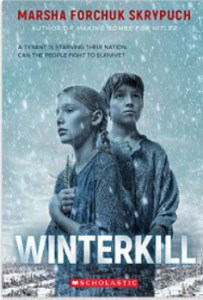
‘Winterkill’ from the award-winning Marsha Forchuk Skrypuch coming in September

The Holodomor, also known as the Terror-Famine or the Great Famine, was a famine in Soviet Ukraine from 1932 to 1933 that killed millions of Ukrainians. The term “Holodomor” emphasizes the famine’s man-made nature and alleged intentional aspects such as rejection of outside aid, confiscation of all household foodstuffs, and restriction of population movement. The Holodomor famine was part of the wider Soviet famine of 1932–1933 which affected the major grain-producing areas of the country. Ukraine was home to one of the largest grain-producing states in the USSR and as a result, was hit particularly hard by the famine. Millions of inhabitants of Ukraine, the majority of whom were ethnic Ukrainians, died of starvation in a peacetime catastrophe unprecedented in Ukrainian history. Since 2006, the Holodomor has been recognized by Ukraine alongside 15 other countries as a genocide against the Ukrainian people carried out by the Soviet government. – Wikipedia

I met Marsha online some 30 years ago when CompuServe and its forums were kings of the Internet. It was obvious to me then that she had both the passion and the talent to bring obscure historical events (as we view history in the States) to light in award-winning novels. As Ukraine fights, once again the evil thrust upon it from Russia this is the perfect time to remind people that such atrocities have happened before. I hope a large number of people will pre-order this novel.

From the Publisher:

Ukrainian Canadian author Marsha Forchuk Skrypuch tells a gripping story of how the Soviet Union starved the Ukrainian people in the 1930s — and of their determination to overcome.

Nyl is just trying to stay alive. Ever since the Soviet dictator, Stalin, started to take control of farms like the one Nyl’s family lives on, there is less and less food to go around. On top of bad harvests and a harsh winter, conditions worsen until it’s clear the lack of food is not just chance… but a murderous plan leading all the way to Stalin.

Alice has recently arrived from Canada with her father, who is here to work for the Soviets… until they realize that the people suffering the most are all ethnically Ukrainian, like Nyl. Something is very wrong, and Alice is determined to help.

Desperate, Nyl and Alice come up with an audacious plan that could save both of them — and their community. But can they survive long enough to succeed?

Known as the Holodomor, or death by starvation, Ukraine’s Famine-Genocide in the 1930s was deliberately caused by the Soviets to erase the Ukrainian people and culture. Marsha Forchuk Skrypuch brings this lesser-known, but deeply resonant, historical world to life in a story about unity, perseverance, and the irrepressible hunger to survive.

National Museum of Holodormore-Genocide

Malcolm

Jim Wrinn led Trains Magazine with passion

WAUKESHA, Wis. — Jim Wrinn, who aspired since his youth to be the editor of Trains magazine and served in the role for more than 17 years, died at home on March 30, 2022, after a valiant 14-month battle with pancreatic cancer. He was 61.

Wrinn’s longevity in the editor’s role was second only to that of the legendary David P. Morgan, who led the magazine for more than 33 years and died in 1990 at age 62. Morgan’s editorship and writings deeply influenced Wrinn, who began reading Trains in 1967 at age 6.

History left it to Wrinn to preside over a challenging, transitional era for Trains, which Kalmbach Media predecessor Kalmbach Publishing Co. launched in November 1940. As editor in chief, Wrinn was fortunate to serve generations of readers who grew up on the print magazine while at the same time broadening the magazine’s appeal to a new digitally oriented audience.

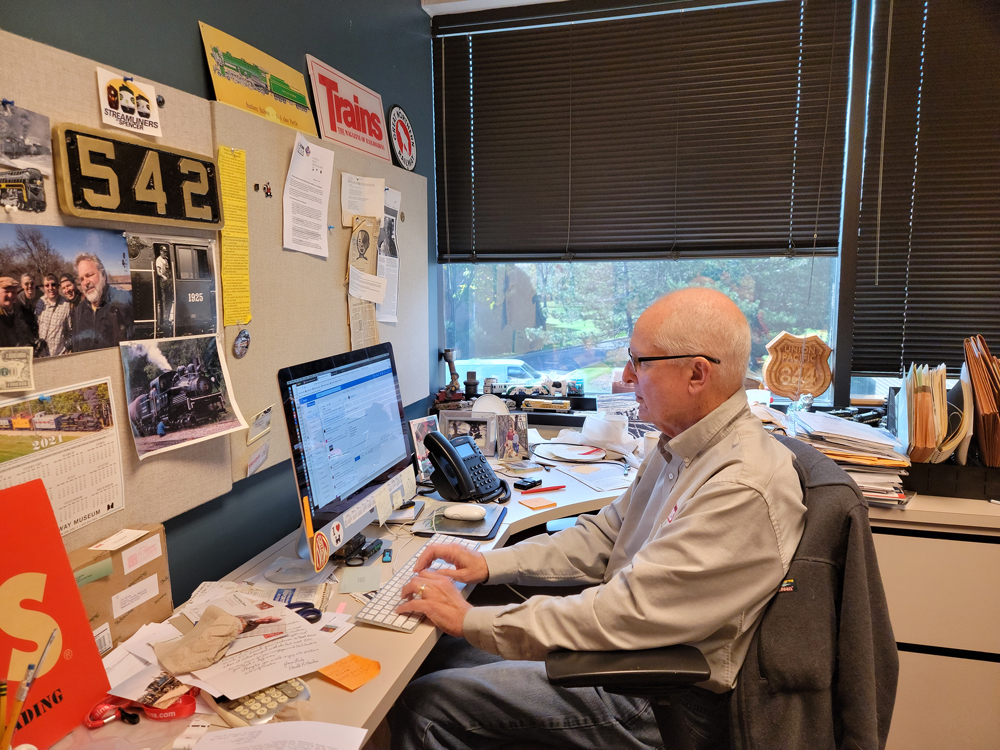
Source: Jim Wrinn led Trains Magazine with passion – TrainsWrinn at the Trains “81 for 81” event at the Nevada Northern Railway Museum in October 2021. Under his editorship, the magazine broadened its scope to include events like photo charters. (Cate Kratville-Wrinn)

I met Jim Wrinn in the early 1990s when he was a reporter for a North Carolina newspaper and a volunteer at the North Carolina Transportation Museum. At the time, my wife and I were volunteers at the Southeastern Railway Museum in Atlanta. We visited each other’s museums, learned a lot from his experience, drank his beer, and stayed in his house whenever we were in Salisbury, NC. His books and articles were an education in themselves. I will miss him, and the railroading world from professionals to railfans will miss his voice and his leadership.

–Malcolm

‘The House of the Spirits’

“When I start I am in a total limbo. I don’t have any idea where the story is going or what is going to happen or why I am writing it. I only know that—in a way that I can’t even understand at the time—I am connected to the story. I have chosen that story because it was important to me in the past or it will be in the future.” – Isabel Allende

I am re-reading The House of the Spirits for the first time since it came out in English in 1985, most likely from the copy I read then. Allende is one of my favorite writers (perhaps above all others) because the stories she tells resonate with me as does the fact she begins each of her books–and I’ve read most of them–without knowing where the story is going. The House of the Spirits didn’t disappoint me in the mid-1980s, and yet, I was afraid to go back to it for fear the most perfect novel would have become imperfect over time like a first lover you don’t dare meet again after both of you have grown up.

I can’t imagine knowing where a story is going when I start writing it and fear that if I did, I wouldn’t be able to write it, or that if I wrote it anyway it would be less true. As I re-read this magical realism novel, I’m not disappointed the second time out and I feel inspired now as I did over thirty years ago; I see again that the story unfolded as it had to unfold because it was (and is) all of a piece that existed in and of itself before Allende wrote the first line: “Barrabus came to us by sea.”

“I think that the stories choose me,” she has said.

When I chanced across author Mark David Gerson’s book The Voice of the Muse in 2008, I was surprised to find a book for writers that acknowledged the truth that stories exist untold until we find them and/or until they find us. As I wrote in my Amazon review of his book, “Gerson believes stories pre-exist, waiting hidden away in dreams to come alive. But while I’ve worked more or less as a blacksmith hammering them into this world, he provides ways to tune into the ‘muse stream’ whereupon life flows onto the page like a warm sweet river.”

I suspect Allende knows this to be true. Otherwise, she couldn’t have written this:

He could hardly guess that the solemn, cubic, dense, pompous house, which sat like a hat amidst its green and geometric surroundings, would end up full of protuberances and incrustations, of twisted staircases that led to empty spaces, of turrets, or small windows and could not be opened, doors hanging in midair, crooked hallways, and portholes that linked the living quarters so that people could communicate during the siesta, all of which were Clara’s inspiration.

I’m relieved to discover that I’m still in love with this novel and that life might have been better if I hadn’t stayed away from it for so many years.

Malcolm

My stories come upon me out of nowhere and that’s for the best.

Septic Tank Service Day

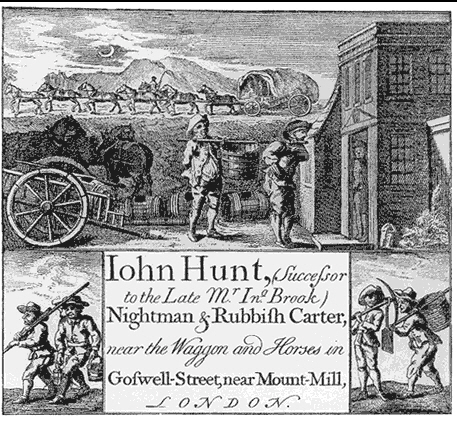
The Soylent Green Company truck stopped by the house today and pumped out the septic tank. The first house on this lot had a privy. A year before we built our house on the land where my wife’s grandparents had their house (long gone), the county changed its rules about septic tanks. Previously, a simple perc test was all it took to get approved for a septic tank. But then progress came along and septic tank systems had to meet stricter requirements and that cost a lot more money.

My comment when we found this out late in the home building game was, “So there are 80 cattle doing their business on the other side of the fence without any restrictions, and you guys are worried about the two humans inside the house?”

Apparently so. There’s not a lot of money in the nigh soil business these days. We’re more toxic than the birds and the bees and the critters out there in the woods.

So no, I did not take a selfie of myself posing in front of the honey wagon and post it on Facebook or, worse yet, keep it to share with all of you in this post. In fact, I don’t know why I’m writing this post.

That is to say, modern-day job hunters aren’t flocking to the septic tank business in droves. And, a career as a night soil coolie never caught on in this country. Actually, I thought about all this yesterday when I was writing about climbing 8,000-meter peaks where the problem, on Mt.  Everest, for example, is dealing with human waste. It’s out of control, actually.

Short term, we could FedEx that waste to Putin. Long-term, what the hell do we do with it? It goes to waste treatment plants, though I often wonder how much ends up in the river. Or the food trucks on main street. Or gravy.

Malcolm 

High-altitude dreams

K2 – second-highest mountain

When I was in middle school, I decided I wanted to climb mountains. I was influenced by the fact my father climbed mountains in Colorado while he was in college (something I would do later when I was in college). I was also influenced by the books in our house about early mountaineers’ attempts in the Himalayas (including Mt. Everest) and the Karakoram (including K2) mountain ranges. I never knew for sure whether my father had these books because climbing quests made exciting reading or because he often hoped to climb those peaks himself.

Then, in 1953, when newspapers told the story of the first successful climb of Mt. Everest by Edmund Hillary (New Zealand) and Tenzing Norgay (Nepal), I was sold on the idea that such climbs were possible. K2, which is more difficult, was successfully climbed by an Italian expedition a year later. The family applauded my 14,000-foot peak climbs in Colorado but thought my notions of climbing Everest and K2 were insane. “So what?” I asked.

One of the larger family arguments occurred when I wanted to sign up with a trekking tour group to hike to the Mt. Everest base camp. I admit it was a bit costly (it’s more expensive now!) In part, nobody believed that once I visited the base camp for several weeks I wouldn’t ultimately push for an actual climb later. I probably would have.

For non-climbers, the statistics don’t look good: 14.1% of those who attempt Mt. Everest die on the mountain; 22.9% of those who attempt K2 never come back. But I look on the bright side: more people came back than don’t. Plus, I always said, one isn’t going to die on the mountain unless his/her number is up. If your number’s up, you’ll die some other way–like falling off a stepladder while changing a lightbulb. The family and I didn’t come to a meeting of the minds about the dangers.

Among other things, they weren’t excited about the fact that most of those who die on 8000-meter peaks are still there, impossible to recover. That didn’t excite me either, but it never changed my high-altitude dreams. My family can rest easy now. People my age are no longer allowed to climb Mt. Everest. So now I grieve what might have been and allow the characters in my novels to see the top of the world, a vision that changes everyone who makes a round trip.

Malcolm

I include high-altitude dreams in my novels “Mountain Song” and “At Sea.”

Sunday potpourri on Saturday

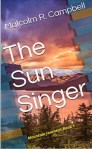
  • My contemporary fantasy The Sun Singer will be free on Kindle from March 27 through March 31. This is a hero’s journey novel set in Glacier National Park.
  • I’m happy to say that after having hormone shots every six months to supplement the radiation treatments I had for prostate cancer several years ago, I’m now done with the shots. The last one was Wednesday. They’re worse than tetanus shots when you get them and provide you with a few days of weird after-effects.
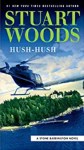
  • When I wrote yesterday’s post about sex scenes, I didn’t have space to mention that some authors have plenty of sex in their novels without writing the scenes. They include a lot of innuendoes but never include the actual encounters. One author I’m thinking of here is Stuart Woods whose output includes his series of Stone Barrington novels. Stone jumps into bed with almost every woman he meets, but we never see it happen. The books are basically crime thrillers.
  • While our drip coffee makers last about 12-18 months, our microwave has lasted at least ten years. Now it’s shutting itself off whenever we cook something on high for 10-15 minutes. So, we ordered a new Hamilton Beach and have it ready to go as soon as our trusty Sharp bites the dust. The appliances my parents bought during, or just after, WWII lasted longer than my parents.  I wish today’s products were just as durable.
  • While working on a short story set in Tallahassee, Florida’s former Smokey Hollow neighborhood, I was surprised to hear from people who said they were born and raised in Tallahassee and had never heard of it. Then it occurred to me that the neighborhood was destroyed by “urban renewal” in the 1960s, possibly before the people commenting online were born. If you live in Tallahassee and want to learn more, I found More Than Just a Place to be a handy reference.
  • I like the idea of authors getting together to support Ukraine, offering their signed work for an online auction that will run from March 19 through April 12. Unfortunately, I heard about it too late to get involved  But what a great idea. I hope the auction raises a lot of money to combat the madness coming out of Russia.

Malcolm

Keeping your book out of the Bad Sex in Fiction Awards

“My whole practical thesis around the craft of writing a sex scene is this: it is exactly the same as any other scene. Our isolation of sex from other kinds of scenes is not indicative of sex’s difference, but the difference in our relationship to sex. It is our reluctance to name things, the shame we’ve been taught, our fraught compulsion to enact a theater of types. It is indicative of the lack of imagination that centuries of patriarchy and white supremacy has wrought on us.” – Melissa Febos in Body Work: The Radical Power of Personal Narrative

Among other things, Febos thinks sex scenes should advance the plot. Writers tend to forget that everything in their novels and stories is supposed to advance the plot directly or indirectly. If they haven’t forgotten this, they forget it when they try to write a sex scene.

According to NY Book Editors, “When you write sex scenes, it’s gonna get raw. There are arms, legs, emotions, sweat, and nipples. If that made you squirm, you’re not ready.”

Apparently, a lot of aspiring writers aren’t ready.

Febos suggests that writers can unlearn all of their incorrect ideas about sex scenes just as they can unlearn other bad habits (such as writing in passive voice). I like this way of looking at it. The problem is, most of the typical bad habits aspiring writers are fraught with are covered in writing books and (usually) bad sex scenes isn’t in the table of contents.

As a reader, I’ve found that some of the best sex scenes in novels not only advance the plot, but leave you thinking, “Gosh, I didn’t know you could do that.” So, perhaps we should add that good sex scenes should be educational. But don’t take notes: if you do, the next time you’re making love, you don’t want your partner to say, “OMG, we’re doing page 43 in Malcolm R. Campbell’s novel The Gigolo Blues.

Let’s forget I said that and suggest we’ve gone past the days when all sex scenes are allowed to sound the same (a common joke about sex scenes in romance novels years ago) and write something that could only appear in the story and with the characters a writer’s working on right now. If the scene sounds like something you read on page 43 of any novel, the author has a problem.

The problem might be a long list of inhibitions that are more advanced than, “What if mom reads this.” NY Book Editors says, “Come back after you’ve eaten some nachos, downed a beer, and thrown modesty out of the way.” They do make some good points, though I think they’ll be hard to put into practice without therapy, a lof practice (with sex or writing), or considering some of the deeper reasons why these scenes are a continuing problem.

Febos’ book might be a good place to start. But first, here’s an excerpt with some ideas worth pondering. If the excerpt makes you squirm, you probably need the book–or a good hypnotist.

Malcolm

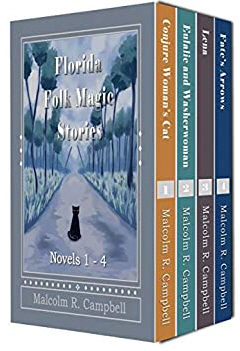
Malcolm R. Campbell is the author of the four-book Florida Folk Magic Series. If you want the entire series, you can find it bound together in one Kindle volume at a savings.