If Schrödinger’s cat were my cat, I’d never open the box. I feel the same about a scene in my novel in progress in which Character A tells Character B that Character C is dead. I don’t want Character C to be dead, so I keep tinkering with other parts of the novel rather than writing that scene. (For those of you who worry about such things, Character C is not Lena the cat.)
Schrödinger proposed the cat in the box thought experiment in 1935 to illustrate the problems he saw with the Copenhagen interpretation of Quantum mechanics. In this interpretation, the cat will be neither dead nor alive until the box is opened. I prefer the Many Worlds interpretation of quantum mechanics because it makes more sense to me than the other ways of looking at the world. But it doesn’t solve my problem because it suggests the cat is both alive and dead when the box is opened and that each version will spin off into a different universe as the cat and the observer become entangled. The universes and those within them are not aware of each other.
Suffice it to say, I’m not writing a novel that branches into two sections, one that you read if you think the character is dead and the other if you think the character is alive. I’ve done things like that in the past with my fiction and readers don’t want to go there. If I did go there, new universes would form, one in which readers finish the book and one in which they don’t.
Now that I’ve clarified the arena where my probable scene remains in limbo, you no doubt understand why I have not written that scene. At present, I either write the scene or I don’t. Either way, the probable universes are infinite.
Unfortunately, the plot–to the extent that I even know it–doesn’t work if Character C is alive.
Perhaps Character C can appear to die but still be around. I don’t think the Many Worlds interpretation allows for that. Or, maybe that happens in a third universe.
Right now, of course, there’s a universe of people who read this post and another one with people who didn’t. I have no control over that because that’s simple reality. As you can see, the role of the writer in this world (or any world) is more complex than it seems.
If you’re a writer or a reader and have time to spare, I hope you’ll spend a few moments considering Sofia Samatar’s “Fiat Lux: On Literary Atmospheres” on the “Poets And Writers” Website. It’s one of their series of craft capsules.
At my age, I usually avoid these craft capsules because I know that the good and bad things I do with words will continue because, really, I’m not going to change. I almost didn’t read this article, but after a few words, I was hooked.
Words create places just as surely as the universe creates a river or a mountain. As Samatar puts it, “To write is to generate a space, with its topography, its temperature, the quality of its air.”
This is what we do when we tell a story.
Reality? Yes, I think so.
And like any other tourist destination, it is–for the reader–a real place just as surely as the Grand Canyon and Glacier National Park are living and breathing locations. And like these places which we may visit more than once, we can visit stories more than once.
As Samatar sees it, “A question of rereading. Once you know what a book contains, why read it again? Because literature is not information. It’s an atmosphere, a location, a space, a landscape you can enter, with its own weather and light that can be found nowhere else.” And also: “Rereading means returning to a landscape: running down ill-lit streets, gliding through radiant fields, climbing up mountains buffeted by the wind.”
Every time I visit a place, whether it’s a friend’s or relative’s house or a widely known location in a travel guide, I see what I missed the last time I was there. The same is true of a novel or a story. It may seem finite inasmuch as the words on the page are the same every time I return. But I am not the same. I experience the story differently every time I re-read it; or, perhaps, I find myself interested in chapters and sections that didn’t wholly capture my attention the first or second or third time through the material.
As writers, we create real places we hope others will visit and one day return to for another look.
I’ve started another Kathy Reichs book, this one titled The Bone Code, and am finding these fun to read. Booklist says this 2021 novel is “A-game Reichs, with crisp prose, sharp dialogue, and plenty of suspense.” It’s a nice change of pace from Dan Brown’s Inferno which I just re-read and a welcome distraction from the mid-1950s resources about the KKK in Florida (mentioned in yesterday’s post). Hmm, it feels a bit warped saying a book about the autopsies of badly messed up people (think of the TV show “Bones”) is a lightweight distraction from KKK atrocities.
It appears that using Grammarly is making my bad spelling and copy editing worse because now I don’t have to try to spell the words right when an approximation of the word brings me the correct spelling out of nowhere.
I’m happy to report that after four days, our new Black & Decker drip coffee maker is still working. In years past, I used to write the birth and death dates of our coffee makers on the engagement calendar to track how long they lasted. Yes, I know, in this Internet age, we’re totally old-fashioned using an engagement calendar. I suppose the fact that I use this kind of coffee pot with Maxwell House coffee is another habit that proves I’m old-fashioned. But then, what do you expect from an old guy?
Here’s an example of writing about one’s traumas in order to help people suffering through similar experiences: “She survived a mass shooting — then created a graphic novel to help others.” More and more writers and readers seem to be discovering this truth nowadays. “It took Kindra Neely years to seek help. Seven years ago, she survived the mass shooting at Umpqua Community College in Oregon, where a gunman killed eight students and one professor, and injured eight more. She has now shared her experience in a debut graphic novel, Numb to This: Memoir of a Mass Shooting, hoping that it will help others.”
As most of you know, I’m cheap and buy swill-level red wine at the grocery short for $10 or less for a 1.5 L size. So it bothers me when the Biltmore House tempts me with a wine sale that includes free shipping from Asheville. I’m not a fan of the so-called standard 750 ml bottle because it’s an expensive way to buy wine. And yet, Cardinal’s Crest is my favorite. We’ve been going to the Biltmore Estate since the 1980s and always stop by the winery to stock up on good stuff to drink. We don’t go for the wine, of course, but for the beauty of the estate and the history and architecture of the Biltmore House. If you’re ever in Asheville, NC, you must stop by this wonderful tourist destination for a visit even though it’s a bit pricey. It’s well worth the time and cost
When I research civil rights issues for the novel in progress, some of what I’m looking at happened while I was growing up there, and seeing it brings back vague memories of stories I saw in the newspaper. I often wonder if Florida’s current residents hear about these incidents in high school and college history classes. Sad to say, these four incidents aren’t the sum of the KKK violence in the state in the past. The first two happened before I was in Florida but were very much part of the conversation. Each of the blurbs below comes from Wikipedia.
Rosewood Massacre
The Rosewood massacre was a racially motivated massacre of black people and the destruction of a black town that took place during the first week of January 1923 in rural Levy County, Florida, United States. At least six black people and two white people were killed, though eyewitness accounts suggested a higher death toll of 27 to 150. The town of Rosewood was destroyed in what contemporary news reports characterized as a race riot. Florida had an especially high number of lynchings of black men in the years before the massacre,[2] including a well-publicized incident in December 1922.
Before the massacre, the town of Rosewood had been a quiet, primarily black, self-sufficient whistle-stop on the Seaboard Air Line Railway. Trouble began when white men from several nearby towns lynched a black Rosewood resident because of accusations that a white woman in nearby Sumner had been assaulted by a black drifter. A mob of several hundred whites combed the countryside hunting for black people and burned almost every structure in Rosewood. For several days, survivors from the town hid in nearby swamps until they were evacuated to larger towns by train and car. No arrests were made for what happened in Rosewood. The town was abandoned by its former black and white residents; none of them ever moved back, none of them were ever compensated for the loss of their land, and the town ceased to exist.
Groveland Four
The Groveland Four (or the Groveland Boys) were four African American men, Ernest Thomas, Charles Greenlee, Samuel Shepherd, and Walter Irvin. In July 1949, the four were accused of raping a white woman and severely beating her husband in Lake County, Florida. The oldest, Thomas, tried to elude capture and was killed that month. The others were put on trial. Shepard and Irvin received death sentences, and Greenlee was sentenced to life in prison. The events of the case led to serious questions about the arrests, allegedly coerced confessions and mistreatment, and the unusual sentencing following their convictions. Their incarceration was exacerbated by their systemic and unlawful treatment—including the death of Shepherd, and the near-fatal shooting of Irvin. Greenlee was paroled in 1962 and Irvin in 1968. All four were posthumously exonerated by the state of Florida in 2021.
Harry T. Moore and his wife, Harriette Moore, also an educator, were the victims of a bombing of their home in Mims, Florida, on Christmas night 1951. As the local hospital in Titusville would not treat Blacks, he died on the way to the nearest one that would, a Black hospital in Sanford, Florida, about 30 miles to the northwest. His wife died from her wounds nine days later, on January 3, 1952, at the same hospital. This followed their both having been fired from teaching because of their activism.
The murder case was investigated, including by the FBI in 1951–1952, but no one was ever prosecuted. Two more investigations were conducted in the 1970s and 1990s. A state investigation and forensic work in 2005–2006 resulted in naming the likely perpetrators as four Ku Klux Klan members, all long dead by that time. Harry T. Moore was the first NAACP member and official to be assassinated for civil rights activism; the couple are the only husband and wife to be killed for the movement. Moore has been called the first martyr of this stage of the civil rights movement that expanded in the 1960s.
The Tyranny of Sheriff Willis McCall
Willis Virgil McCall (July 21, 1909 – April 28, 1994) was sheriff of Lake County, Florida. He was elected for seven consecutive terms from 1944 to 1972. He gained national attention in the Groveland Case in 1949. In 1951, he shot two defendants in the case while he was transporting them to a new trial and killed one on the spot. Claiming self-defense, he was not indicted for this action. He also enforced anti-miscegenation laws and was a segregationist.
He lost his bid for an eighth term shortly after he had been acquitted of the murder in 1972 of Tommy J. Vickers, a mentally-disabled black prisoner who died in his custody. McCall’s notoriety outlived him. In 2007, the Lake County Commission voted unanimously to change a road named in his honor 20 years before because of his history as a “bully lawman whose notorious tenure was marked by charges of racial intolerance, brutality and murder.” During his 28-year tenure as sheriff, McCall was investigated multiple times for civil rights violations and inmate abuse and was tried for murder but was never convicted.
–
For me, this past isn’t that far away. I still get angry about it and find it hard to mention it in my fiction without preaching a sermon. The KKK, the police, and civic leaders were often one and the same group.
–Malcolm
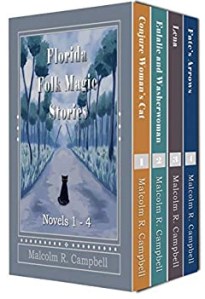
Malcolm R. Campbell is the author of the four-book Florida Folk Magic series set in the early 1950s when the Klan was still active.
All the class websites have a FAQ section. I seldom look at these because I don’t have any questions and/or suspect the page will be a marketing ploy. So this post is for the bold, those willing to go where no one has gone before.
Since you write magical realism, do you really believe in magic?
Yes. In fact, I think that magic is often more true than realism.
Did you always want to be a writer?
Goodness no. I wanted to be a locomotive engineer, a national parks ranger, or a Jungian psychologist. However, I was tricked by the dark side into taking radio-TV writing and production, and journalism courses during the days when a liberal arts education could supposedly get you a job anywhere. It couldn’t.
Is it true that you went into the gigolo business?
On the advice of my attorney, I cannot answer that question other than to say “what do you think?”
If you had a choice between the devil and the deep blue sea, what would you choose?
The sea, always. I grew up on the Florida coast, so water is nearly sacred to me. I’ve crossed both the Atlantic and Pacific oceans by ship and am happy to say neither voyage was made on a so-called cruise ship, a ship that seems more like a floating Disney World than a way of experiencing the sea.
I read somewhere that you were brought up by alligators in the Everglades.
That was wishful thinking that might not have been true.
You were born in California, right?
In Berkeley, the center of rebellion against the establishment. However, my Facebook page says I’m from Florida partly because I am and partly because I think California has become everything we fought against at Berkeley. I left my heart in San Francisco, but I’m not going back for it.
Who are your favorite authors?
James Joyce, Michael Shaara, and Pat Conroy. Yes, I know they don’t exactly have a lot in common. Well, other than me.
Where do you stand politically?
My attorney, John Beresford Tipton, doesn’t want me to answer that question because such answers often lead to name-calling and threats rather than dialogue. I will say this: we have way too much government.
How in the hell do you work on such a cluttered desk?
Creativity comes from chaos. Actually, I think it’s important to create chaos rather than order.
Are you really a Scot?
According to my genealogy, very much so. But no, I wasn’t born there, not in this lifetime. I do favor all things Scottish over anything English. Queen Elizabeth I kidnapped and murdered our queen, Mary Queen of Scots, so I have little positive to say about England and its monarchy. Plus, the English can’t cook.
Are you a dog person or a cat person?
A cat person. It’s my wife’s fault. We’ve probably “adopted” a hundred cats since we got married. Okay, maybe ten cats.
Are you happen being a writer?
Yes and no. Unless you’re James Patterson, it’s more of a hobby than a profession.
This is the first time I’ve re-read this book since it came out in 2013. My feelings now are about the same as they were nine years ago. The storyline is another chase scene in which the bad guys are after Robert Langdon and a young doctor who befriends him through Florence. Florence is one of my favorite cities, so it was fun reading about places I visited. If you’re about ready to travel to Florence, read this book first.
Otherwise, the story drags. Langdon wakes up in a hospital in Florence with a head wound (a bullet grazed his scalp) and has no idea why he’s in Italy. Always a handy plot crutch, retrograde amnesia keeps the main character in he dark about his circumstances while an assassin tries again to kill him–with the help of the U.S. Consulate–along with all the police in the country.
The book is a travelogue with two desperate people running through it. The catcher in the rye is the pariah of a scientist Bertrand Zobrist who advocates letting plagues run wild because that is–according to his research–the only way the Earth’s unsustainable population levels can be brought under control. I must admit that as global warming issues have become more pronounced, his view of the population’s fate is more chilling now than when I first read the book. (I enjoyed Dante’s Divine Comedy more than this book.)
Like all of Brown’s books, the story is heavy on exposition about history and art, in this case, Florence and Dante. If you took all that out of the book, it would be a novella. I re-read this book due to the lack of anything new in the house and really wish I’d picked something else to re-read like one of John Hart’s or Pat Conroy’s books.
Not that we’re addicted, but we watch several of the house hunter shows on HGTV. They’re not quite what they seem. If the rules are the same as when I last looked, those hunting for a house have to actually buy a house before they visit three potential properties on the show. One of them, they already own.
My historic preservation background makes me a bit of a purist in that I think older houses should generally not be redone so that the inside looks like an open-concept 2022 house. Well, nobody asked me, so it is as it is.
It’s hard for me to imagine looking at houses and making a list of move-in projects. Quite often, the prospective owners want to overhaul the kitchen with new paint, new appliances, removing the wall between the kitchen and dining room, new countertops, and a larger, more-spectacular island. Sometimes they ask the real estate agent how much a new kitchen would cost, and hear that it’s a mere $10,000 to $20,000.
Hell, the people are already spending a million bucks on the place, so what’s another twenty grand? It all seems so materialistic and excessive. I don’t get it. If I buy a new house with cream-colored kitchen cabinets, I’m not going into a snit to repaint them white just after we close on the house. I didn’t grow up with this kind of money and, with parents who lived through the depression and ran the household on a teacher’s salary, I’ve ended up with more of a make-do attitude than the spoilt brats buying the houses.
“No one has written more lusciously about that pilgrimage [our temporal voyages into the unknown], nor undertaken it with more elemental daring, than Beryl Markham (October 16, 1902–August 3, 1986). Known to the world as the first person to fly solo across the Atlantic from East to West with the sweep of night, against headwinds and storms particularly ferocious in that direction, she is Amelia Earhart without the pomp, Thoreau with muscle and humor, a luckier Shackleton of the sky.” – “A Different Solitude: Pioneering Aviator Beryl Markham on What She Learned About Life in the Bottomless Night” in The Marginalian
The 1942 book was well-received but went out of print until it was “re-discovered” and re-issued in 1983 when Markham was long forgotten and living in poverty. Even now, most people have never heard of her: the publisher’s description for the 2010 edition says “though most now dispute this claim.” That is not only incorrect but unconscionable. Since that ticks me off, I’m not showing the current cover of the book displayed on Amazon. She lacked the kind of PR team other pilots had. Or, maybe it’s because she was a fierce and promiscuous woman.
When the book first came out, Ernest Hemingway wrote to his editor, “she has written so well, and marvelously well, that I was completely ashamed of myself as a writer. I felt that I was simply a carpenter with words, picking up whatever was furnished on the job and nailing them together and sometimes making an okay pig pen. But [she] can write rings around all of us who consider ourselves as writers … it really is a bloody wonderful book.”
One of my favorite Markham quotes, which was cited in The Marginalian, is “I saw how a man can be master of a craft, and how a craft can be master of an element. I saw the alchemy of perspective reduce my world, and all my other life, to grains in a cup. I learned to watch… I learned to wander. I learned what every dreaming child needs to know — that no horizon is so far that you cannot get above it or beyond it. These I learned at once. But most things came harder.”
I read the book many years ago and felt the same way Hemingway did. And I continue to think what a shame it is that her name and accomplishments remain scarcely known.
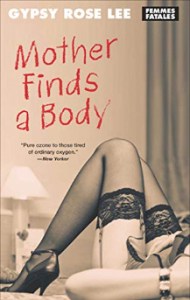
This novel, published in 1942, was considered a sequel to Lee’s 1941 novel The G-String Murders which had been made into a “cleaned-up” film starring Barbara Stanwyck called “Lady of Burlesque.” A read The G-String Murders when I was in junior high school and thought it was a hoot. It suddenly appeared on the family’s bookshelves and then disappeared after I read it and put it back. I never asked questions about why books came and went because that would have diluted our cases of plausible deniability.
From the Publisher
“This encore performance by the author of The G-String Murders is simply “one of the greatest mysteries ever written” (Philadelphia Daily News).
Current
“It’s supposed to be a quiet honeymoon getaway for celebrated stripper Gypsy Rose Lee and Biff Brannigan, ex-comic and ex-Casanova of the Burly Q circuit, settled as they are in a cozy trailer built for two. If you don’t count Gypsy’s overbearing mother, a monkey act, and Gee Gee, a.k.a. the Platinum Panic. Not to mention the best man found shot to death in the bathtub. Strippers are used to ballyhoo, but this time it’s murder.
“Leave it to Gypsy and her latest scandal to draw a crowd: Biff’s burnt-out ex-flame, a sleazy dive owner with a Ziegfeld complex, a bus-and-truck circus troupe, and a local Texas sheriff randy for celebrities. But when another corpse turns up with a knife in his back, Gypsy fears that some rube is dead set on pulling the curtain on her bump and grind. She’s been in the biz long enough to know this ghastly mess is just a tease of things to come.”
Questions were asked whether Lee really wrote the novels or used the ghost writer Craig Rice (aka Georgiana Ann Randolph Craig called the “Dorothy Parker of detective fiction”) Rice said she did not write either of Lee’s novels.
Mother Finds a Body gets off to a quick start:
“A temperature of one hundred and ten at night isn’t exactly the climate for murder, and mother was suffering from a chronic case of both. She pushed the damp, tight curls off her forehead and tapped her foot impatiently on the trailer doorstep.
“‘You either bury that body in the woods tonight, or you finish your honeymoon without your mother.'”
Don’t ask why mother came along on a honeymoon because that seems more sordid than a dead guy in the bathtub.
I used to buy a fair number of mystery thrillers and police procedurals at the Publix grocery store, just down the aisle from the cookies and crackers. With no offense to the authors, I called these books–from Greg Iles, James Patterson, Stuart Woods, and others–“grocery store books” because that’s where I’d see the covers and blurbs and get tempted into buying them.
Now they’re gone.
Could be another supply chain problem or a decision by somebody at Publix that another product would work better in that shelf space. Too bad, because this shelf was the source of a lot of good–usually quick–reading. Recently, while looking for something else, I found 24 Hours, a two-year-old novel by Greg Iles on Amazon. Wow, maybe I don’t have to buy buy grocery store books at Publix or Kroger.
Typical of Iles, 24 Hours didn’t take long to read, maily because the plot–about kidnappers–is constructed in a way that keeps you from putting the book down. They have a fool-proof system, one that they’ve run five times before without a glitch; and without getting caught.
However, this time out, Will and Karen Jennings fight back in part because their kidnapped daughter Abby has diabetes and can’t sit for 24 hours in a cabin without her shots. This introduces a major complication in the kidnappers’ schedule while leading the Jennings to take bigger risks than most victims.
Is the book true to life? Probably not. But once you start reading it, I don’t think you’ll care. You’ll roar through the pages like a crazed grizzley because you’ve come to despise the kidnappers and want to see them kicked into next week without harming Abby. The book reads well with a family-size back of Oreo cookies or steamed broccoli.
–Malcolm
I think this comedy/satire would make a great grocery store book. Publix? Kroger?
 Schrödinger proposed the cat in the box thought experiment in 1935 to illustrate the problems he saw with the Copenhagen interpretation of Quantum mechanics. In this interpretation, the cat will be neither dead nor alive until the box is opened. I prefer the Many Worlds interpretation of quantum mechanics because it makes more sense to me than the other ways of looking at the world. But it doesn’t solve my problem because it suggests the cat is both alive and dead when the box is opened and that each version will spin off into a different universe as the cat and the observer become entangled. The universes and those within them are not aware of each other.
 Malcolm R. Campbell is either sane or insane. Until he’s released from the asylum, he continues to write books like Sarabande.

 I’m happy to report that after four days, our new Black & Decker drip coffee maker is still working. In years past, I used to write the birth and death dates of our coffee makers on the engagement calendar to track how long they lasted. Yes, I know, in this Internet age, we’re totally old-fashioned using an engagement calendar. I suppose the fact that I use this kind of coffee pot with Maxwell House coffee is another habit that proves I’m old-fashioned. But then, what do you expect from an old guy?
 Here’s an example of writing about one’s traumas in order to help people suffering through similar experiences:
  As most of you know, I’m cheap and buy swill-level red wine at the grocery short for $10 or less for a 1.5 L size. So it bothers me when the Biltmore House tempts me with a wine sale that includes free shipping from Asheville. I’m not a fan of the so-called standard 750 ml bottle because it’s an expensive way to buy wine. And yet, Cardinal’s Crest is my favorite. We’ve been going to the Biltmore Estate since the 1980s and always stop by the winery to stock up on good stuff to drink. We don’t go for the wine, of course, but for the beauty of the estate and the history and architecture of the Biltmore House. If you’re ever in Asheville, NC, you must stop by this wonderful tourist destination for a visit even though it’s a bit pricey. It’s well worth the time and cost
 All the class websites have a FAQ section. I seldom look at these because I don’t have any questions and/or suspect the page will be a marketing ploy. So this post is for the bold, those willing to go where no one has gone before.
 This is the first time I’ve re-read this book since it came out in 2013. My feelings now are about the same as they were nine years ago. The storyline is another chase scene in which the bad guys are after Robert Langdon and a young doctor who befriends him through Florence. Florence is one of my favorite cities, so it was fun reading about places I visited. If you’re about ready to travel to Florence, read this book first.
 The 1942 book was well-received but went out of print until it was “re-discovered” and re-issued in 1983 when Markham was long forgotten and living in poverty. Even now, most people have never heard of her: the publisher’s description for the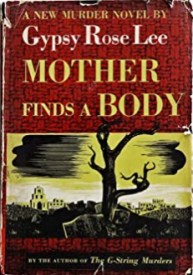


 Malcolm's Round Table