‘Fruits of Eden’ by Patricia Damery

I have mourned the overdevelopment in California (the state where I was born) and the overdevelopment in Florida (the state where I grew up). In both cases, environmentally diverse and beautiful states have been ruined and badly compromised for the sake of tourism and development that left no stone unturned in raping the best areas first. The late Atlanta historian, Franklin Garrett, called this approach to land use within a city “municipal vandalism.” Insofar as California and Florida are concerned, I call it near-criminal destruction of the land.  Years ago, a minister said the real Garden of Eden was in west Florida. If that had proven true, it would have been paved over by now.

So I warn you, I supported this book before I even saw it.

I must also confess that I have known Patricia Damery online for years and enthusiastically reviewed her earlier books. This book comes from the front lines of climate change and bad land-use practices. So, I can’t help but show it to you in spite of my prospective biases. By the way, you can see an interview with Pat here. The book comes in two editions, one with the interior photographs in color, and the other in black and white.

From the Publisher

Damery – Napa Valley Register Photo

In Fruits of Eden, author Patricia Damery takes readers on a thirty-year journey, vividly recounting her citizen activism to protect the world-famous Napa Valley from the ravages of over-development, water plundering, government failures, greed, and damaging tourism.

Damery’s articulate and Illustrative voice is a powerful call that interweaves the story of her ranch with her history, reflections, marriage, and her husband’s onset of dementia. His Alzheimer’s began at the same time as pressure on the ranch’s sustainability became acute. Conversely, there is also great hope. The author’s relationships with colleagues in action for the valley, her children, her grandchildren and friends all share a deep love for this extraordinary place on the planet.

Over the decades Damery and her husband, Donald Harms, developed a way of life that respected the natural ecology of their land in the Napa Valley. They applied organic and biodynamic methods, left large parts in their natural state, and had a herd of goats that lived next to Patricia’s writing studio. Then climate change coupled with egregious overdevelopment overcame them, threatening to destroy their way of life. Destruction of native oaks caused erosion and groundwater depletion, insecticide use disrupted the balance of animal life, including beneficial insects, population density and tourism

I visited Napa Valley multiple times before the nefarious amongst us began turning it into hell. I don’t want to go back there again any more than I want to see again what the fools who created Daytona Beach have done to the once-precious land along the Atlantic coast. But with the help of books like Fruits of Eden and their from-the-trenches authors, maybe we can save some of the endangered Edens that remain.

Malcolm


Malcolm R. Campbell is the author of “Conjure Woman’s Cat.”

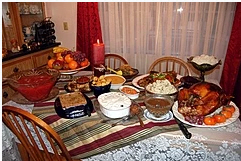
Thanksgiving is a time for visiting family in Maryland

We enjoy visiting my daughter and her family in Maryland at Thanksgiving even if arthritis in my ankles has gotten to the point where I have to use a wheelchair to get through Reagan airport in Washington. We rent a car there and drive to Rockville, MD for a great time.

My daughter Johanna is a planner. That means there’s plenty to do and see in addition to my granddaughters, Freya and Beatrice.

We enjoyed seeing the winter lights at nearby Gaithersburg and a production at the great old Weinberg theater in Frederick. The theater’s been around since 1926 and has, I think, the oldest theater organ in the country that’s still in its original location. I’d like to hear that old Wurlitzer sometime.

Johanna’s husband Kevin could give Chef Ramsay a run for this money. This means a wonderful Thanksgiving dinner.
The trip home was another matter. The storm system that has brought tornados to the southeast brought us a bumpy flight into Chattanooga and one hell of a rainy drive from there to our home in Rome, GA. Our cats were glad to see us after they got tired of being a bit spooky. (They hate thunder.)

It’s hard to keep up with my granddaughters from so far away. Thanksgiving helps us see them in their natural habitat. They are polite and well-behaved, a departure from some of the kids we saw on the trip up and back.

So now we are home. Exhausted, of course. But with good feelings for our kin.

Malcolm

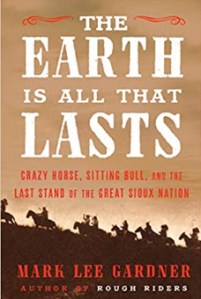
Recent Title: ‘The Earth is All That Lasts’ by Mark Lee Gardner

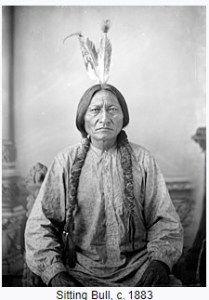
“True West” calls The Earth is All That Lasts “The most ambitious American history published in 2022. For the first time, a major scholar of the West has distilled the known primary and secondary sources equally with heretofore unused Sioux Indian oral history, correspondences, memoirs, and interviews to create the finest dual-biography ever written about Crazy Horse and Sitting Bull. … Through the final pages readers will have taken a literary and historical journey that will leave them with a greater understanding and perspective on one of the most heralded and written about cultural conflicts and wars in United States history.” 

The book, by Mark Lee Gardner (Rough Riders) was released by Mariner Books (Harper Collins) in June 2022 and is featured in the Montana Historical Society bookstore, though the retail price is lower on Amazon.

From the Publisher

“A magisterial dual biography of Crazy Horse and Sitting Bull, the two most legendary and consequential American Indian leaders, who triumphed at the Battle of Little Bighorn and led Sioux resistance in the fierce final chapter of the “Indian Wars.”

“Crazy Horse and Sitting Bull: Their names are iconic, their significance in American history undeniable. Together, these two Lakota chiefs, one a fabled warrior and the other a revered holy man, crushed George Armstrong Custer’s vaunted Seventh Cavalry. Yet their legendary victory at the Little Big Horn has overshadowed the rest of their rich and complex lives. Now, based on years of research and drawing on a wealth of previously ignored primary sources, award-winning author Mark Lee Gardner delivers the definitive chronicle, thrillingly told, of these extraordinary Indigenous leaders.

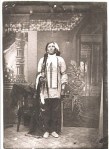
Crazy Horse, 1877, Disputed Photo – Wikipedia

“Both Crazy Horse and Sitting Bull were born and grew to manhood on the High Plains of the American West, in an era when vast herds of buffalo covered the earth, and when their nomadic people could move freely, following the buffalo and lording their fighting prowess over rival Indian nations. But as idyllic as this life seemed to be, neither man had known a time without whites. Fur traders and government explorers were the first to penetrate Sioux lands, but they were soon followed by a flood of white intruders: Oregon-California Trail travelers, gold seekers, railroad men, settlers, town builders—and Bluecoats. The buffalo population plummeted, disease spread by the white man decimated villages, and conflicts with the interlopers increased.

“On June 25, 1876, in the valley of the Little Big Horn, Crazy Horse and Sitting Bull, and the warriors who were inspired to follow them, fought the last stand of the Sioux, a fierce and proud nation that had ruled the Great Plains for decades. It was their greatest victory, but it was also the beginning of the end for their treasured and sacred way of life. And in the years to come, both Crazy Horse and Sitting Bull, defiant to the end, would meet violent—and eerily similar—fates.

Wikipedia

“An essential new addition to the canon of Indigenous American history and literature of the West, The Earth Is All That Lasts is a grand saga, both triumphant and tragic, of two fascinating and heroic leaders struggling to maintain the freedom of their people against impossible odds.”

According to  “American Heritage,” Gardner “An authority on the American West, Gardner has appeared on PBS’s American Experience, as well as on the History Channel, the Travel Channel, and on NPR. He has written for the Los Angeles TimesTrue West, Wild West, American Cowboy, and New Mexico Magazine. He lives with his family in Cascade, Colorado.”

–Malcolm

I’d like to see daily Thanksgiving rather than saving all the thanks for one holiday

When mother served us something for dinner we didn’t like and scarcely touched, he always said there are people in country X who don’t have any food at all. I wasn’t sure how cleaning up my plate would help those people, so after years of hearing her pronouncement I said, “Let’s just mail it to them.” That comment didn’t go well.

Other than those days when mother got into the locoweed and served something strange, she was a great cook 24/7/365. Even though she managed meals on a tight budget, we always had plenty to eat. The older I got, the more I realized that more people than not didn’t have plenty to eat. It made me think we should be thankful for what we had.

If one feels thankful, that feeling changes his/her life. Gone are the feelings of entitlement of rich vs. poor, our country vs. a third-world country, or working people vs. those who don’t work. I don’t think many of us can imagine what it’s like to walk in another person’s shoes, much less find the empathy needed to truly understand those who don’t have what we have–so to speak.

Feeling thankful for what we have and how we live and how our friends and family are there for us doesn’t mandate our giving all of our money to worthy causes. I’ve written posts in the past about the fact many worthy causes suggest only $25 will help, but fail to consider that they are one of 50 charities that have approached us with the same rationale. I like Kiva because it lends money to people who are trying to help themselves. My donation by itself seems rather paltry but paired with hundreds of others, I believe it makes a difference.

I’m thankful for Kiva and the other groups who help those who need help. It gives us a way to reach out to thousands of people. Our lives are not perfect, but there is still much to be thankful for even though all of us meet up with the slings and arrows of outrageous fortune as a matter of course: as part of life itself. I’m sitting here typing this post in a warm office with dinner in the oven. If I weren’t thankful already, I could start with that.

Malcolm

How to make art happen (or writing or dance or painting)

“The students are at the start of their creative lives, and I remember well what those years felt like — when you think you know what art requires, and then the realization comes that you must go deeper and deeper still (if you’re serious at all) into the unknowable, uncomfortable, vulnerable place where the root of creativity lies…which is to say, you must go deeper and deeper into yourself, which can be daunting indeed. Even now, after all these years, I still have days of sharp (or anxious, or befuddled) resistance to this act of deep surrendering…but the joy of age is that I know my own process now, the daily habits, practices, and mindset that will carry me past each block and obstacle and back into the work.” Terry Windling in “When the Magic is working” from Myth And Moor.

This 2014 post from Windling’s blog shows you why I like her work and why I return to her Typepad blog so often for fresh inspiration. I might also note that I read Theoroda Goss’ novels and blogs for the same reason. And so, too the former Endicott studio journal, featuring the work of Windling, Jane Yolen, Midori Snyder, and others. To read their work is to re-discover anew a deep well hidden in a sacred copse where magic lives in the deep water. Drink, and you’re transformed and living within, as Windling wrote, that deep and “vulnerable place where the root of creativity lies.

Life, as philosophers and comedians say, “ain’t easy.” The slings and arrows of daily life wound us again and again until the magic within our souls just about drains away. So we return to the well and drink again.

Every artist/writer/painter finds his/her own muse and his/her hidden well where s/he drinks and is refreshed. It might be an author (or group of authors) and their novels, essays, and poems; it might be the witch who lives down the street, or perhaps the “older generation” in one’s own family. We all must find the source of our magic and what makes it flow through our veins like holy fire.

You may not have anything in common with those who inspire you except for the inspiration they provide. None of the people associated with the blogs and studios listed above know me. We move in different circles. To great extent, they are interested in faerie and mythic worlds while I’m interested in contemporary fantasy and magical realism.

In time, the magic will live within you and you’ll find that you no longer have to return to that well (unless you’re sightseeing) to start your work. You will know what to see in your mind’s eye or how to adjust your breathing or your office or your desk because you will have done it so often that it will become, not second nature, but first nature. First nature for your art perhaps; or first nature for the way you live your life. The second approach works better for me: what I write on the page comes from how I live and what I believe rather than as a prop for making art.

I used to listen to music when I wrote. For one book it was “Nirvana Road.” For Another book, it was “Beneath The Raven Moon.” Music, I find, becomes associated with the work and with the magic behind it. Playing the music is like turning the ignition key in a car–or, these days, like holding down the brake while pushing the “start” button. Then things are purring at the right level and plain of existence, the writing flows because the magic is working.

Malcolm

Campbell

If you remember all that tapping in high school classes, you’re probably old

Do high school teachers still require writing short essays in class? Beats me. And, if they do, how are they written: pen, pencil, computer?

During “my era” we used pencils. Then, when I got into college, the writing-related courses had typewriters: that seemed like a quantum leap, and probably easier for teachers who no longer had to decypher their students’ bad handwriting. Unlike a room filled with laptops, a room filled with Selectric typewriters going at once was rather noisy.

Wikipedia photo

While some students typed like they were trying to poke holes in a pile of clay in art class, I typed fairly fast. Most journalism students did because we all grew up with typewriters. But this isn’t the tapping I’m talking about.

In-class essays were typically about something we purportedly read as homework and were usually a minimum of 150-200 words on subjects like “What was yellow journalism?”

For most students, the word count was more important than the content. So, they’d write a sentence or two and then count the number of words they had. They counted the words by tapping on each word with the point of their pencil. So, it was write, then tap tap tap tap tap, followed sometimes by a sigh when the student realized s/he was lightyears away from the minimum word count.

Naturally, these essays didn’t have a lot of unity, coherence, and emphasis because they kept going until the word count was reached. Finally, after all that tapping and counting up the words, the essay just ended. Most of the essays came back with a lot of red ink that spoke to a lack of organization. I hope NaNoWriMo entries aren’t written this way.

I can’t help but smile when I think about all that pencil-point tapping as students counted and re-counted the words on the page.

On the other hand, some students got to the minimum word count with ease, but ruined the essay by saying “Yellow journalism was caused by a mistake at the ink factory that turned black ink into yellow ink.”

Malcolm

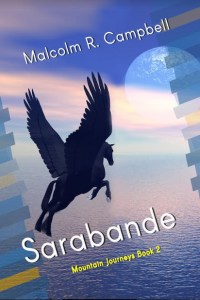
Malcolm R. Campbell is the author of the contemporary fantasy “Sarabande.” The sequel to “The Sun Singer,” “Sarabande is available on Kindle, paperback, hardcover, and audiobook.

Most authors write because they love it

‘The 2020 median pay for writers and authors was ​$67,230​ per year, with the most common entry-level education being a bachelor’s degree. In 2019, there were 131,200 working novelists in the country, and the job outlook for 2019 to 2029 is 2 percent, a small decline. The staff at Indeed posts that the national average salary is ​$49,046​ and ranges from ​$15,080​ to ​$127,816​. Many novelists are self-employed, so this salary will vary based on how many hours you’d like to work and how successful your works are.” – Chron

I’ve never seen money like that except on cops and robber shows where people walk around with suitcases of one-hundred-dollar bills. When I was a technical writer for computer companies, my salary wasn’t too bad. But when I retired from that rat race, my earnings didn’t soar into the James Patterson realm or even the realm of popular mid-list authors.
At my age, the gigolo business is no longer an option.

So, it (the writing) comes down to liking what we do and then guessing whether our royalties each month will be higher or lower than our expenses. Thank goodness for that Social Security check and my investments in diamond mines and oil wells.

We (authors) usually think what we’re writing is a lot more entertaining than the stuff going on around us in “real life.” I’m sure thinking that way is evidence of loco weed, bad whisky, or schizophrenia. According to the May Clinic, “Schizophrenia may result in some combination of hallucinations, delusions, and extremely disordered thinking and behavior that impairs daily functioning, and can be disabling. People with schizophrenia require lifelong treatment.” My lifelong treatment is writing novels (and meds).

They keep me as sane as I can get.

Malcolm

Malcolm R. Campbell is the author of satire, magical realism, and contemporary fantasy.

How did what-his face get back in my novel?

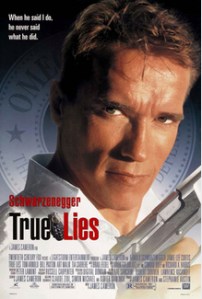
In the movie “True Lies,” Tom Arnold’s character says, “Women. Can’t live with ’em. Can’t kill ’em!”

I feel that way about characters because, what the hell, I’m drinking Scotch and writing the book while they (the characters) do whatever they want.
People think the author is in charge. Yeah, right.

This time out, I threw that dirty cop Vance McNaughton in the slammer in the last chapter, and then, in this chapter, two ladies are talking about this and that over breakfast at the diner when McNaughton shows up. He’s even driving his squad car when, at the very least, he’s supposed to be riding a desk or sitting in a cell until the nefarious stuff he’s charged with goes to trial.

This kind of thing would happen even if I used outlines because characters are in the book and outlines are outside the book in another universe that people like McNaughton don’t know about. If they did, they’d claim it was something the Presbyterian Church would dream up which is why they’re Southern Baptists.

I guess I can make do, however, if McNaughton figures out who one of those ladies is, he’s going to kill her because he didn’t hear the Tim Arnold quote in the movie.

Actually, fiction is all true lies anyway, so whatever happens, doesn’t really happen. Or, if it does, it’s not the author’s fault.

Malcolm

While Malcolm was raised as a Presbyterian, he thought the predestination stuff was a bunch of hooey. Actually, a lot of stuff in this old world of ours is a bunch of hooey. That’s why we have writers who write about that hooey so readers will know which lies are true and which aren’t.

Sunday’s slush pile

  • “I thought the piles of unsolicited manuscripts it was my job to sift through would contain undiscovered gems. Reader, I was very wrong.” – Jean Hannah Edelstein in “The Shocking Truth about the slush pile.”
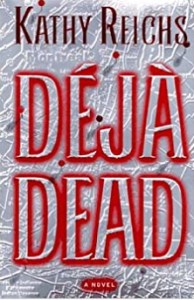
  • I enjoyed reading Kathy Reich’s first book in her Temperance Brennan series Déjà Dead. I doubt it ever saw a slush pile because it’s filled with enough chopped-up bones, high-quality forensic anthropologist work, unco-operative policework, and real scares at Brennan’s house to satisfy any reader of crime novels. Readers will learn a lot about saws, cutting bones, Montreal, and possibly a little québécois. I started the series with the last book, then the second-to-last book, and now the first book. I might have gotten hooked. something I never thought would happen (and am a little embarrassed to admit) with a police procedural. Perhaps this is better called an autopsy procedural.

  • I’m now reading Inland by Téa Obreht to atone for flirting with a crime book. So far, Obreht’s book moves at a more-lyrical pace, not counting the exploits of “The Mattie Gang.”
  • Cold weather has come to Georgia prompting us to remember at 1:00 a.m last night that we’d forgotten to move the more delicate potted plants inside. So, we went out and froze our asses off while making sure the plants didn’t.
  • Facebook has been filled lately with photographs of weird stuff in cooking pans that people are looking forward to eating (the stuff, not the pans). I think most of the “food” in the photographs looks trashcan ready even though these posts get lots of likes and recipe requests. I’m tempted to say that these culinary catastrophes look like stuff swept off the kitchen floor and dumped into a Dutch oven with a quart of water. But I don’t: (a) because I’m a polite person, and (b) because I don’t want people to come back and say that my books look like something vacuumed (or Hoovered if you’re English) out of a slush pile.
  • PW graphic

    I was happy to see this November 8th Publishers Weekly story: “In Written Opinion, Judge Florence Pan Delivers Knockout Blow to PRH, S&S Merger.” According to the judge, “The government has presented a compelling case that predicts substantial harm to competition as a result of the proposed merger of PRH and S&S,” Many well-known authors have been saying this ever since the proposed merger was announced. I agree with them–and the judge. There’s already too little competition due to earlier mergers. You can read the order here in PDF format.

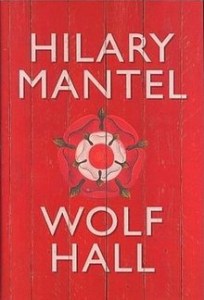
  • Based on my glowing recommendation, a close friend of mine just began reading Wolf Hall, the 2009 historical novel by the late Hilary Mantel. I worry a little when I recommend novels and hope the friend is still speaking to me when they finish the book (assuming they finish the book). I have high hopes, especially when I see experts’ reactions like this one in Wikipedia: In The Guardian, Christopher Tayler wrote, “Wolf Hall succeeds on its own terms and then some, both as a non-frothy historical novel and as a display of Mantel’s extraordinary talent. Lyrically yet cleanly and tightly written, solidly imagined yet filled with spooky resonances, and very funny at times, it’s not like much else in contemporary British fiction. A sequel is apparently in the works, and it’s not the least of Mantel’s achievements that the reader finishes this 650-page book wanting more.”

–Malcolm

Campbell

Briefly Noted: Before His Time: The Untold Story of Harry T. Moore, America’s First Civil Rights Martyr

Those researching civil rights leaders in Florida will find this book a handy resource. The third edition, released by the Florida Historical Society Press in 2017 is the one available on Amazon. Typical of historical society and university press books, the retail price is higher than what you might expect from a major publisher, however, Amazon has used copies available at a great saving.

From the Publisher

On Christmas night, 1951, a bomb exploded in Mims, Florida, under the home of civil rights activist and educator Harry T. Moore.
Harry and his wife Harriette both died from injuries sustained in the blast, making them the first martyrs of the contemporary civil rights movement. They were killed twelve years before Medgar Evers, fourteen years before Malcolm X, and seventeen years before Martin Luther King, Jr.

The sound of the bomb could be heard three miles away in the neighboring town of Titusville, but what resonates today is the memory of the important civil rights work accomplished by Moore.

This new edition of Ben Green s comprehensive biography of Harry T. Moore includes updated material about the investigations into the bombing, and additional photographs commemorating Moore s legacy.

If you follow civil rights issues, you know that there have been several investigations of the crime, the final one yielding the names of probable perpetrators. Two would die of natural causes and one by suicide before the initial FBI investigation was complete. I doubt we will ever find true closure on this crime. The book fills in a lot of details about what made Moore a marked man and what happened in the aftermath of the bombing.

I wish the publisher’s description included, at least, a few generalities about the focus of Moore’s work since he was active so long ago and hasn’t loomed large in mainstream civil rights histories. I found this book very helpful in my research for the novel in progress and recommend it to scholars and others interested in Florida and the Klan.

–Malcolm

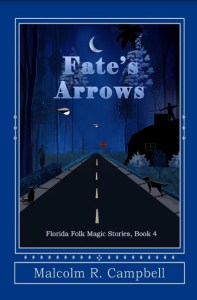
Malcolm R. Campbell’s Florida Folk Magic Series of four novels set in the Florida Panhandle in the 1950s focuses on battles against the KKK in a small town. Conjure Woman’s Cat is the first novel in the series Fate’s Arrows is the fourth book in the series.