Heave Out and Trice Up

When a sailor reports aboard Navy ship right out of boot camp, s/he will have four immediate concerns: (1) Not being fooled by old salts into searching the boat from stem to stern for pieces of equipment that don’t exist, (2) Getting lost, (3) Following the proper General Quarters “traffic pattern,” and (4) learning Navy phraseology.

1MC Speaker

The Navy insists upon standard phraseology in its deck logs, phone talker communications, reports and 1-MC (ship-wide public address system) announcements. 1-MC announcements are accompanied by boatswain’s pipe calls which all sound the same at first.

While I was working on a novel about the sea, I remembered what it was like being transferred to the aircraft carrier USS Ranger (CVA-61) right out of boot camp. Compared to boot camp, the ship was much better duty, but there was still a lot to learn.

When I reported aboard, I was informed that I had been assigned to a floating city with an airport where the residents spoke a foreign language. Soon, I would have to learn what was supposed to happen when we “set condition zebra” (a readiness condition with certain hatches and fittings closed); and that a “shot line” didn’t refer glassware on a bar but to a small-diameter line fired over an alongside ship prior to an underway replenishment (UNREP).

Reveille throughout the city came a lot earlier than one expected even though the chief petty officers in charge of our boot camp companies at Great Lakes had brainwashed us that squared-away sailors loved getting up early. But they didn’t tell us that aboard ship a BMOW (Boatswain’s Mate of the Watch) would announce over the 1-MC to “Heave out and Trice Up.”

My first thought was that everyone aboard ship was being asked to vomit on command in the head. I was wrong. The phrase means get up. If you’re sleeping in a hammock, tie it up. If you’re sleeping in a rack (bunk) tilt it up against the bulkhead (wall). This makes it possible for the sweepers or compartment cleaners to sweep the deck (floor) underneath it. In the old days, a trice hook held the rack/hammock to the bulkhead.
The Public Affairs Officer as the Lone Ranger

Planning to join the Navy and–as we always said–let the world see you? Be ready to learn fast. When it’s time to get up, you won’t have time to study your Bluejacket’s Manual for instructions. But one way or the other, you’ll need to know the difference between heave, heave in, heave around, heave out, heave to, and heaving line.

Scuttlebutt (gossip) isn’t always “the straight skinny” (accurate facts) especially when it comes from the fabled all-knowing (and mythical) “port butter cutter.” With luck, the old salts will soon tire of sending you off to find fictional left-handed crescent wrenches, cans of relative bearing grease, buckets of prop wash, or of asking you stand “mail buoy” (huh?) watch on the bow. Then they’ll remind you (if you need reminding) that all stairs on ships are called ladders and doors are called hatches and dogs are what keep them closed.

Maybe they’ll tell you the handy general quarters acronym FUSDAP so that in the three-minute rush to get to your duty station you’re moving with traffic rather than against it. Forward and up on the starboard side, down and aft on the port side is very handy to know.I hope they don’t have to tell you not to head for the flight deck looking for a Quidditch game when the BMOW comes on the 1MC and says “sweepers sweepers man your brooms.”

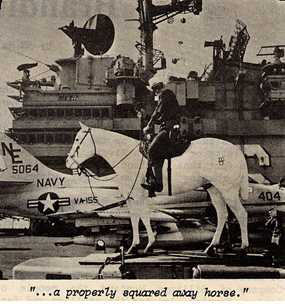
On the other hand, our ship really did have a horse, fiberglass, that is, so if the chief sent you to give it a bucket of oats, it was best to disappear for a while until everyone else in the compartment was done laughing at the joke.

Update: Since this post was written, the USS Ranger was sold for scrap because in all the years it was available to be purchased by a group willing to turn it into a museum, no viable plan was submitted to the navy. Movie stars spend more on their houses than was needed to preserve this ship and all the history it contained. Screwed up priorities, I guess.

Malcolm


AtSeaBookCoverMalcolm R. Campbell is the author of the Vietnam War-era novel set on board an aircraft carrier, “At Sea.” For David Ward, going in harm’s way seems to apply more toward the people back home than life in the sailor towns and the ship.

Montana: Glacier Park Issue

Readers, tourists, hikers, and climbers who are fans of Glacier National Park will enjoy the Summer 2010 centennial issue of Montana: The Magazine of Western History beginning with the John Fery painting on the cover.

The issue not only contains a great overview of the park, but includes dozens of photographs and paintings in support of the text. Read it for the information, then keep it as a collector’s item.

Here’s what you’ll find inside:

“Conceiving Nature: THE CREATION OF MONTANA’S GLACIER NATIONAL PARK” by Andrew C. Harper

“Where the Prairie Ends and the Sky Begins: MAYNARD DIXON IN MONTANA” by Donald J. Hagerty

“Glacier National Park: PEOPLE, A PLAYGROUND, AND A PARK” by
Jennifer Bottomly-O’ looney and Deirdre Shaw

“The Miraculous Survival of the Art of Glacier National Park” by Hipólito Rafael Chacón

Cover Art: “The iconic mountain goat on the front cover is a detail from a painting by John Fery, one of the park’s foremost painters. Fery made it the centerpiece of his untitled collage of Glacier views (n.d., oil on canvas, 65″ x 115″) commissioned by the Great Northern Railway.”

Congratulations to the editors, writers and photographers on a wonderful commemorative issue.

Malcolm

Available in multiple e-book formats for only $5.99

Good writers are a dime a dozen

“Good writers are a dime a dozen. What makes you appealing?” — C. Hope Clark

When we go to a major league ball park, we expect the baseball players’ skill and professionalism to be very basic credentials for their being on the team. Ultimately, a few of them really begin to stand out. Die-hard baseball fans love their statistics, and they can tell you who got the most home runs, the most stolen bases and the best earned run average.

That is, who was better than good?

After a good ball game, fans have plenty to talk about. Often, the beer-and-bratwurst talk after the game focuses on what the players did: who made the best plays of the game and what kind of flair or attitude or extra effort did they display in the process?

In a recent writers newsletter, Hope Clark asked her readers to look at their writing and their writing platforms and figure out what they were doing or saying that might catch the attention of a reader or agent. She used a gardening analogy:

We’re all green plants to an agent or editor. Writers look
alike in that mile-high slush pile of mediocrity. Yes, that’s
how they see us . . . except for those with personality.

I’m more comfortable with baseball and other public figure analogies. So, staying away from the kinds of behavior that gets a lot of negative press, we can sat that some ball players, actors, actresses and (yes) even politicians attract our attention for positive reasons. They stand out from the crowd because they display more dedication, unique qualities and points of view, relevant comments about their profession, and have a style or attitude that calls for our respect and admiration.

Before a man or woman goes out on a date, their friends often advise them to “just be yourself.” That advice works for writers, too, in that you’ll come across as a lot more honest and sincere if you really are who you seem to be. On a date, we need to connect with just one person. As writers, we have to connect with thousands.

Changes in the publishing world are presenting prospective readers with more and more possibilities. Print-on-demand publishing and electronic publishing are bringing more and more writers out to the figurative ballpark where they plan to try out for the team. In this case, the “team” is made up of those writers who meet their goals whether it’s to sell books, win short story contests, find viable agents, have a large public following, or appeal to a specialize niche audience.

Hope Clark might ask what makes you different from the other plants in the yard (including the weeds). But sticking with baseball, I’m asking what do you do at the ballpark that brings fans out to see you play even when the rest of the team is having a lousy season?

Without getting lost in the analogies here, what exactly are you doing as a writer that will make a prospective publisher sell your book or a prospective reader pick it up and then tell his friends about it?

Being a good writer just isn’t enough.

Malcolm

The Sun Singer
Jock Stewart and the Missing Sea of Fire
Garden of Heaven

Odysseys – multiple adventures

We can’t see the word odyssey without thinking of the epic Greek poem attributed to Homer that begins (in Robert Fagles’ translation):

Sing to me of the man, Muse, the man of twists and turns
driven time and again off course, once he had plundered
the hallowed heights of Troy.

Indeed, the word stems from Odysseus’ trip, meaning a long and wandering physical or spiritual quest with multiple adventures and changes of fortune.

My novel Garden of Heaven is subtitled “an Odyssey” because protagonist David Ward ends up in many places with many people before returning to the Montana ranch where he grew up.

The novel has multiple locations: Glacier National Park, the Florida Panhandle, Chicago, Hawai’i, the Philippines, the Netherlands, central Illinois, Pakistan, and the Gulf of Tonkin. In each place, new problems and adventures occur.

But there are some common themes. One is his first lover’s relentless quest for revenge which is caused by a problem of which David is unaware. Another is David’s spiritual journey which begins on a vision quest in Glacier National Park and then haunts and inspires him from one end of his odyssey to the other. And, like Homer’s Odysseus, David also has a way with words, though it remains to be seen whether this is more of a blessing than a curse.

Untangling the lies and truths strewn throughout his journey will take David quite a few years. In the process, he will serve aboard an aircraft carrier, climb one of the most difficult mountains in the world, work as a professor at a small college, and consort with horses, eagles and ravens. Garden of Heaven is not one adventure, it’s many. And, as in “real life,” David’s good fortune often looks like bad fortune, and vice versa.

Garden of Heaven is available as an e-book from OmniLit for $5.99.

For more information about Garden of Heaven, see my August 3, 2010 interview on BookBuzzr.

Glacier by the Grace of God and the Great Northern

“Empire Builder” James J. Hill (1838 – 1916) built the nation’s fifth transcontinental railroad across the top of the country without governmental subsidies. When he threw the weight of the Great Northern Railway behind the failed efforts to create Glacier National Park, Congress listened and the park was born.

Many Glacier Hotel in 1912 GN Brochure
Once the park was born, the railroad was subsidizing the government.

Louis W. Hill (1872 – 1948), who replaced his father as Great Northern CEO in 1907 and board chairman in 1912, made Glacier National Park his personal project. By 1917, the Great Northern Railway had spent twice as much as the Federal Government developing the park. Within another three years, the railroad had outspent the government by a factor of ten to one.

Early roads, trails, power systems, telephone systems, hotels and chalets were built by the railroad so quickly that one suspects that the plans for the region had been on the drawing board for years. As the playground evolved, Louis Hill’s “See America First” publicity campaign brought passengers to the park via Great Northern Trains: Glacier Park Limited, Oriental Express, Western Star, Empire Builder.

Swiftcurrent Lake
Authors Jennifer Bottomly-O’looney and Deirdre Shaw note in the current Glacier Park commemorative issue of Montana The Magazine of Western History that in spite of occasional friction between the railroad and the government, the park service had a sparse budget and welcomed the Great Northern’s investment.

Amrak’s Empire Builder still serves the park today and Great Northern Railway successor line Burlington Northern is the largest contributor to the 2010 Glacier Park Centennial.

Louis Hill visited the park often, taking frequent pack trips out of railroad-built Many Glacier Hotel. But the man who has been called “the Godfather of Glacier Park” was not a John Muir or a George Bird Grinnell. Like his empire builder father, he saw the park as a spectacular place that could also be very profitable.

He once said that “Every passenger that goes to the national parks, wherever he may be, represents practically a net earning.” Author C. W. Guthrie (All Aboard for Glacier) adds that he “had an artistic bent, and that gave him a real feeling for the park.”

Louis W. Hill
In his 1988 book Stars Over Montana, Warren L. Hanna laments the fact that Louis W. Hill is relatively unknown today when compared with the other patriarchs of the park. Hanna says that Louis Hill did more than anyone else at the outset to plan and develop the park and make it known.

“In all of Glacier’s more than 1,500 square mils, there is no peak, pass, lake, valley, or road named for this remarkable pioneer,” said Hanna.

Louis Hill knew a good view when he saw one. He knew exactly where each hotel and chalet should be placed and how to connect them with roads and trails, and he knew best of all how to get the people there to see it all.

More Information

Parallel tracks: Glacier National Park born from Great Northern Railway in the “Missoulian.”

“Producers of a Playground” in Man in Glacier by C. W. Buchholtz.

The lavishly illustrated All Aboard for Glacier: The Great Northern Railway and Glacier National Park by C. W. Guthrie.

Glacier’s Historic Hotels And Chalets: View With A Room by Ray Djuff and Chris Morrison.

“Glacier National Park: People, a Playground, and a Park,” by Jennifer Bottomly-O’looney and Deirdre Shaw in Montana The Magazine of Western History, Summer 2010.

Each purchase of this Glacier adventure benefits the park.

Think twice before listening to the ‘Call to Adventure’

“Every step toward greater consciousness creates a kind of Promethean guilt. Through self-knowledge, the gods are, as it were, robbed of their fire; that is, something that was the property of unconscious powers is torn out of its natural context and subordinated to the whims of the conscious mind. The one who has “stolen” the new knowledge becomes alienated from others.” — Daryl Sharp

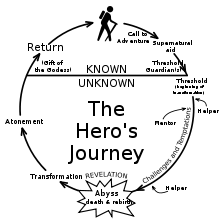
Hero's Journey - Wikipedia drawing
Friends and acquaintances are often the first to urge us to heed the “call to adventure.” That call represents an opportunity. It may be a college degree, a summer abroad, a spiritual retreat, or a new job. If we listen, the new world we experience is likely to be mind-expanding and to change us.

Our friends and acquaintances might be the first casualties, not because we wish to cast them out, but because they don’t want to change and we do. While our new knowledge may result in an inflated ego turning us into the kind of person nobody wants to be around, it’s more likely that the new knowledge is beyond the comfort level and interest of old friends.

In his book Digesting Jung: Food for the Journey, Daryl Sharp writes that “anyone who has found his or her individual path is bound to feel estranged from those who have not.”

I’ve heard published authors say they lost their writer’s club friends the minute they became published. At the outset, everyone struggles together. They have similar problems and concerns. But when success comes, the successful one becomes different because his or her focus and needs have changed.

I’ve noticed that it many groups, there’s a lot of camaraderie in being part of “the resistance” to the status quo. Friends often urge each other to step forward and take charge. Once somebody does step forward, the camaraderie is likely to fade after the initial round of congratulations and celebrating runs its course. The new “boss” is no longer “once of us.”

In Carlos Castaneda’s Journey to Ixtlan, Don Genero tells Carlos that once a man commits to a journey of self-knowledge, he must also commit to leaving the world he knew behind. Those who are not on the figurative “journey to Ixtlan” will appear as phantoms along the road.

There’s more than petty jealousy behind the loss of friends when one takes on new responsibilities, chases his dreams and expands his personal horizons. Simply put, one is no longer compatible with many of his old friends, old pastimes, and old haunts.

In the mythic sense, alienation is the punishment of the gods visited upon a hero or seeker for listening to the call of adventure and sailing out across the wine-dark sea into the unknown. Staying home–refusing that call to adventure–appears to be the comfortable thing to do.

One must ask, I think, do I really want to go where I want to go? At this moment, of course, the conflict begins: deep regrets for staying put and alienation for leaving. This dilemma is the paradox of growth.

Malcolm

Malcolm R. Campbell is the author of the hero’s journey novel Garden of Heaven: an Odyssey.

Garden of Heaven is the story of a man’s spiritual journey through the mountains of Pakistan, the swamps of North Florida, the beaches of Hawaii, the waters of the South China Sea and the ivy-covered halls of an Illinois college as he attempts to sort out the shattered puzzle of his life.

Don’t fence me in

“I categorically resent the trash talk on the street that Atlanta is ‘Marching through Georgia.’ We’re paving through Georgia.” –Jack MacAdam, Metro Sprawl, Inc. in “Worst of Jock Stewart”

“Did you know that only two percent of the land in the Lower 48 is protected under the designation of Wilderness while the overwhelming majority of our nation’s land is open to development and industrial uses?” — The Wilderness Society

When the Homestead Act was passed in 1862, a horde of people–ultimately some 1,465,346 of them–rushed into our untamed areas and began meeting the challenge of “proving up” their 160-acre parcels of land. Successful homesteaders got to keep their land by making improvements to the property.

The Homestead Act has been viewed as significant, enduring, ground-breaking legislation. Nebraska’s National Monument created by President Roosevelt in 1936, reminds us “of the hardships and the pioneer life through which the early settlers passed in the settlement, cultivation and civilization of the Great West.”

Almost 150 years after the passage of the Homestead Act, we’re still being brainwashed by two of its principles, ideas that, while historically valid, are long out of date: (1) Unused land = available land, (2) Improved land is better than improved land.

We enjoy the benefits of civilization: roads, city centers, factories, stores, schools, farms and comfortable houses. Yet, I cannot help but view “developers” with a jaundiced eye because they are so willing to prove-up everything that is as yet unpaved. Like a wild horse, the ground needs to be broken, or so they say.

We need to fix what has already been broken instead of breaking what doesn’t need to be fixed.

Those of us living in the still-rural Jackson County Georgia are watching the tidal wave known as Atlanta gobbling up the countryside in all directions. Here, sixty miles away, one can almost hear the hordes of homeowners, builders, road builders and other advocates of sprawl racing up Interstate 85 in our direction.

It’s too late now to fix the prove-up attitude in north Georgia, though, if I had my way, I would build a giant fence around Atlanta and mandate that everyone who is inside must stay inside. Those of us who don’t like being fenced in by buildings, fast-food restaurants and all the other clutter of the nearby metro area will gladly stay outside the fence without any mandates whatsoever.

The land, I think, is perfect as it is, and we cannot improve upon it. Today, when we meet the kinds of challenges that were noble as part of the Homestead Act, we do so with poor results from loss of animal habitats to the destruction of watersheds to the fouling of forests and wetlands that we–ultimately–need for our survival.

As I look at the smaller and smaller amount of land that has yet to be “improved,” I think of Margaret Murie’s words, “I hope that the United States of America is not so rich that she can afford to let these wildernesses pass by. Or so poor that she cannot afford to keep them.”

Malcolm R. Campbell is the author of “Garden of Heaven” and “The Sun Singer,” adventure novels from which a portion of the sales is donated to Glacier National Park, Montana.

Many Glacier Hotel Hootenanny

Once upon a time, in those days now referred to as “the old days,” employees at Glacier National Park’s Many Glacier Hotel put on skits, talent shows, serenades and a weekly Hootenanny.

Return with us now to Swiftcurrent Valley on July 30 at 8 p.m. for a hootenanny presented as part of the Many Glacier Hotel employees reunion.

The program includes a folk-singing performance by ten groups of musicians drawn from employees of various eras in the Glacier Park Hotels. Musical performances have been presented in Glacier’s Hotels throughout their history.

Hootenanny programs were presented at Many Glacier from the 1960s to the 1980s, and have been revived since 2006. This program will celebrate the musical history of the lodges, engage visitors with fine talent and interpretation, and build community.

Maybe you’ll join in on some of the old songs and learn a few new ones.

Malcolm (Many Glacier Bellman in 1963 and 1964)

Review: John Atkinson’s ‘Timekeeper II’

Timekeeper IITimekeeper II by John Atkinson
My rating: 5 of 5 stars

In John Atkinson’s 2008 novel Timekeeper, Johnnyboy leaves his dysfunctional Virginia home at fourteen after his father “Bugdaddy” beat him again. In Oklahoma, Chief calls him “Timekeeper” and sends him on a vision quest to find himself. He does, but he is not yet whole.

At the beginning of Timekeeper II, scheduled for a September 21, 2010 release from il Piccolo editions, Atkinson writes, “I went to the Sacred Mountain in the flesh, but didn’t see it clearly until I returned in a ghost world dream.” Timekeeper II isn’t a clock-time, linear novel. It’s a dreamtime novel where all the dualities that haunted Johnnyboy must be brought into harmony in order for Timekeeper to face the world and himself as a fully integrated person.

The dualities arise in Timekeeper’s mind like opposing armies: a humiliated, illiterate man in a world where the ability to read is not only mandatory, but presumed; a man of mixed white and Native American parentage who is unaccepted and foreign in both worlds; a seeker on the path who left home to find himself while leaving his mother and first spiritual teacher Morning Song behind to face the wrath of an abusive father who once said, “Don’t turn Indian on me, boy! I’ll kill you dead in your tracks.”

Timekeeper II is a rare treat, a window that opens and re-opens into a dreamer’s world where events and personages from the world of form and the world of spirit mix and interact and sometimes contradict each other. Neither Chief nor the illusive and powerful Round Woman will give Timekeeper clear and definitive self-help lessons. Instead, he must take on the role of a shaman and enter the ghost world and find spirits who will help him heal himself.

Once again, John Atkinson has conjured up a gritty, highly original story where reality itself turns in upon itself and carries both his protagonist and his readers through the fires of transformation into a world where all conflicts disappear. Timekeeper II is highly recommended for all adventurous readers.

View all my reviews >>

Malcolm R. Campbell is the author of “Garden of Heaven,” “The Sun Singer” and “Jock Stewart and the Missing Sea of Fire.”

Let’s stop Underfunding the National Parks

“Our national parks and monuments support $13.3 billion of local private-sector economic activity and 267,000 private-sector jobs. Yet our national parks suffer from a $580-million annual operating shortfall and a backlog of maintenance projects that exceeds $9 billion. — National Parks & Conservation Association (NPCA)

According to the NPCA, tourism in the National Parks was up 5% last year. This brought money into many local economies as visitors stopped at restaurants and service stations, bought souvenirs, stopped at grocery stores for picnic supplies, and stayed in hotels that are either locally owned or that employ many people from the region.

To my way of thinking, investing in the National Parks isn’t optional. At a time when more funds are needed, the President’s requested National Park Service budget for 2011 is $21.6 million less than the 2010 budget. Bluntly put, this is backwards thinking.

We’re looking at a sinking ship that keeps taking on more and more passengers.

In 2008, Dr. Dwight Pitcaithley, a former NPS chief historian, said that “the chronic under-funding of the National Park Service is not now and has not been for the past 50 years a matter of money – it is a matter of priorities!” That year, the $5 billion needed for the park service represented only 0.002 percent of the President’s proposed budget.

As I think of this, I’m reminded of many people I’ve known who purchase a new car every other year, go out to eat several times a week, hold a weekly barbecue and beer party in the back yard for their friends, and then complain that they can’t put a dime in a savings account, attend a concert or buy a novel. They love having skewed priorities and then complaining about how the results are not their fault.

The parks are the same way. When we overlook the the cost of handling the crowds, maintaining roads and trails, fighting fires and floods, and keeping the entire NPS infrastructure sound, we justify the unconscionably low NPS budget request by saying “why the hell do we need to spend all this money on a bunch of trees and lakes?”

We need to spend it because it’s where we live. It’s where our children will live. And it’s all connected to our spirituality and our culture and our air quality and our food supply and our water supply and our weather and to each of us–even if we never set foot on a trail or take a canoe ride down a river.

As the NPCA says, “Investing in the National Parks is investing in America.”

Malcolm

Purchases of my Glacier National Park adventure novel “The Sun Singer” and the e-book edition of my contemporary mythic saga “Garden of Heaven” benefit Glacier National Park through Vanilla Heart Publishing’s “Drop in the Bucket” Program.