The merger between the Glacier National Park Fund and the Glacier Association has been completed, creating the Glacier National Park Conservancy. If you’re a fan of Glacier National Park, you can read about the organization’s current projects here.
The traditional Fall for Glacier event will remain an annual part of the Conservancy’s program. Fall for Glacier is scheduled for September 19-22, 2013 at the Izaak Walton Inn at Essex, Montana on the south end of the park.
Activities include lectures, a photography session, red bus tour, a float trip on the Middle Fork of the Flathead River and hikes. Click here for a list of featured speakers.
The popular Backpacker’s Ball ends Fall for Glacier with dinner, dancing and an auction.
Make reservations soon before Fall for Glacier is sold out.
Karen Stevens (“Haunted Montana,” “More Haunted Montana”) has been collecting Montana ghost stories for thirty years and has been visiting Glacier National Park for forty years. Glacier Ghost Stories brings her passions together in a slim, but informative volume that follows her search for strange and inexplicable events at the park’s historic hotels.
Steven’s book is, in one sense, a reporter’s travelogue: she talks about her investigative trips, the weather, the accommodations, and her interviews with hotel personnel. In the process, she includes a fair amount of park history with details for each hotel: Apgar Village Inn, Belton Chalet, Glacier Park Lodge, Lake McDonald Lodge, Many Glacier Hotel, Prince of Wales Hotel and Sperry Chalet.
Glacier Park Lodge celebrated its 100th anniversary this summer. The other hotels are elders in the lodging business as well. The hotels are busy during their short summer seasons. They’re isolated from the world throughout the rest of the year. The schedule and the wild country are, it seems, the perfect recipe for legends, yarns and a long list of things that defy logical explanation.
While they don’t advertise ghosts in travel brochures, hotel managers and long-time employees had a lot to day about things that go bump in the night: people who suddenly disappear, objects that move when nobody’s looking, doors that lock by themselves, music and other sounds from unoccupied rooms, footsteps in the dark. Stevens includes the room numbers where things seem to happen. Take note of these before your next visit.
Glacier Ghost Stories includes legends about Marias Pass, Going-to-the-Sun Road, Two Medicine Valley and the Belly River. In the book’s postscript, Stevens writes that visitors to Glacier and Waterton parks “follow in the footsteps o those who came before us: Native Americans, trappers, hunters, explorers and others whose spirits even today may roam the land they loved so much in life.”
Stevens does not hear about or witness the over-the-top paranormal happenings we associate with Edgar Allan Poe and Stephen King. She did uncover enough to make us wonder and to look over our shoulders the next time we visit any of the park’s hotels. The book is an engaging portrait from a ghostly point of view.
“From the eastern boundary of Glacier National Park in Montana, visitors can throw a stone and hit any of 16 exploratory wells and associated holding tanks, pump jacks, and machinery used to force millions of gallons of pressurized water, sand, and chemicals into shale rock formations thousands of feet beneath the surface.” – James D. Nations, Ph.D., Vice President for NPCA’s Center for Park Research
Center for Park Research
The existence of wells and the infrastructure of fracking within a stone’s throw of Glacier National Park is unacceptable. Some have said we are powerless to prevent it because those wells are within the sovereign Blackfeet Nation. To that, I ask, does sovereignty extend outside a nation’s borders?
Some years ago, the proposed Cabin Creek mine in British Columbia was stopped, in part, because it was likely to pollute rivers flowing from Canada into the U.S. The same is likely to be true of groundwater outside the immediate proximity of those wells on Blackfeet land.
James D. Nations writes in “Fracking and National Park Wildlife” that a third of the nation’s national parks are within twenty-five miles of shale basins. This means that a great number of wildlife habitats are potentially at risk. These risks come primarily in the areas of habitat fragmentation, water quality and quantity, and noise and air pollution.
There’s an old fashioned Libertarian principle that may finally be taken seriously as we realize more and more that the Earth is one community. The principle is that you cannot do anything on your land that harms your neighbor or your neighbor’s land.
The dangers of fracking and other forms of pollution are not restricted to the property where the industrial development occurs. Air and water carry the negative impacts many miles away. This is not acceptable.
While we may not be able to quickly wean ourselves away from older coal fired power plants where no alternatives are quickly available, fracking is relatively new. The complete nature of its threats and risks are not yet known. We don’t need it any more than we need new coal fired power plants.
We need, I think, to look not only at the threats to Glacier and other national parks, but to the places where we live and work. If we take life seriously, we can no longer permit one company or one nation or one developer to do as he wishes on the land he owns or leases when his actions affect people, habitats and wildlife many miles away.
“The Patience of Pearl: Spiritualism and Authorship in the Writings of Pearl Curran,” by Daniel B. Shea, (University of Missouri Press, November 2012), 296pp, 15 illus.
Pearl Lenore Curran, a St. Louis music teacher, wrote (or possibly channeled) multiple novels and hundreds of poems between 1913 and and 1937 under the name Patience Worth. Curran was not a spiritualist. She tried out a friend’s Ouija board and, depending on one’s viewpoint, she began communicating with either her subconscious mind or a discarnate entity who lived in England in the 1600s.
The lure of spiritualism brought many people to Curran’s door, some of who listen to the readings, reported the phenomena in books and newspapers, and even spoke with Patience through Mrs. Curran. Some suggested Patience was a real spirit. Others said Curran was being coached, for she had no educational background for speaking and writing about 17th century England using many words and phrases that were not common in the 20th century United States.
Regardless of the source of the material, it was not only voluminous, but attracted rave reviews. To learn more about Curran and Patience Worth, see the September 2010 “Smithsonian Magazine” article “Patience Worth: Author From the Great Beyond.”
Like books such as Irving Litvag’s Singer in the Shadows: The Strange Story of Patience Worth and Casper Yost’s Patience Worth: A Psychic Mystery, the “Smithsonian” article focuses chiefly on historical facts and the opinions of spiritualists. Professor Shea’s The Patience of Pearl focuses on the works themselves within the scope of Curran’s life and Patience Worth’s literary voice.
In his introduction, Shea writes that “it does seem odd that a woman who wrote with brief but notorious success less than one hundred years ago could still be, as Lucky Jim once put it, so strangely neglected.” He suggests that the way they were written discredited them from the beginning as part of spiritualism’s table tapping and purported revelations from entities from another time or place.
From the Publisher: “The Patience of Pearl uncovers more of Curran’s (and thus Patience Worth’s) biography than has been known before; Daniel B. Shea provides close readings of the Patience-dictated writings and explores the historical and local context, applying current cognitive and neuro-psychology research…Novelistic in its own way, Curran’s life included three husbands and a child adopted on command from Patience Worth. Pearl Curran enjoyed a brief period of celebrity in Los Angeles before her death in 1937. The Patience of Pearl once again brings her the attention she deserves—for her life, her writing, and her place in women’s literary history.”
In one of her poems, Patience/Pearl wrote:
Lo, are my songs like birds
Within a wicker hung, and thou,
Beloved, hast loosed the latch
And let them free!
As I work through the final edits for my upcoming novel The Sailor, I find myself smiling at all the weird, strange, and often crude navy slang and acronyms that were a part of daily life when I served aboard the four acres of sovereign soil better known as an aircraft carrier or a bird farm.
Since this is a family blog (don’t ya think?), I won’t mention the profane slang other than to say you can find it quickly enough in a Google search.
One of the first things you learn on an aircraft carrier is that the navy does not fly choppers. If you call a helicopter a chopper, you’ll probably be placed on mail buoy watch (more on that later) or sent off in search of various kinds of equipment and supplies that don’t exist. The helicopter is a Helo (hee-low).
A liberty port
Going ashore is going on the beach whether it’s a beach, a pier, or liberty (free time) in a foreign port where you might get screwed, blued, and tattooed. (Oops, I forgot this is a family blog.) Now hear this, if you get back late from liberty you are not AWOL, you are UA. UA = authorized absence, as in, “I was UA” or “Mr. A.J. Squared Away (a sailor with a perfect shave, perfect uniform, etc.) went UA.”
Once you become a member of Uncle Sam’s Canoe Club, called the Gulf of Tonkin Yacht Club during the WESTPAC (western Pacific) Vietnam War days, your first duties involve listening up, taking a good set of notes, and otherwise learning the rocks and shoals (regulations). If the chief (chief petty officer) thinks you’re slacking off, otherwise known as skating, and aren’t learning, he’ll either write you up (put you on report) or send you off to the galley to wash the flavor extractors.
If you get written up, you’ll end up shooting pool with the captain, that is, brought before a captain’s mast hearing after which you might variously be sent to the brig, demoted, or served a big chicken dinner (bad conduct discharge).
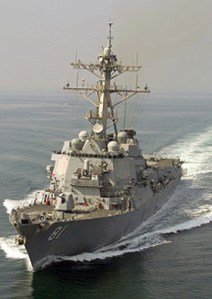
A Tin Can is a destroyer, like the one escorting your carrier, not a metal outhouse.
If you’re serving on an aircraft carrier, you’ll soon learn to stay off the flight deck during flight ops unless you are authorized to be there. If you work on the flight deck, the color of your shirt (yellow, green, white, red, blue, purple, brown or black) identifies the job you’re supposed to be doing. Red is, of course, for crash and smash (firefighters). If you want to watch launch and recovery operations, head up to the windows called vulture’s row in the island (AKA superstructure) where the view is perfect.
Old salts will try to fill your head (brain, not the rest room) full of crap (lies, yarns, and obviously erroneous scuttlebutt) that will only result in your being considered as gear adrift or a good candidate for mail buoy watch. “Mail buoy watch” is mandated by lifers (old salts) when the weather is poor.
During bad weather, somebody (you) is dressed up in foul weather gear and sent topside (AKA, a weather deck) with a hook. Your job will be to watch for the mail buoy, that is to say, the place where the ship’s mail will be waiting because either the COD (the mail plane) or some mythical mail ship can’t deliver the mail in a storm.
Before you head out to snag the mail, your uniform of the day (helmet, life jacket, etc.) will be critiqued by those in the know. Pictures will be taken and then you’ll be on your own in the rain until you realize you’re a victim of the kind of good-natured hazing that will give a guy a lot of grief, a bad cold, and a trip to sickbay for some Corpsman Candy (an ineffective cough drop).
It’s always best to at least look like you know what you’re doing, that is to say staying 4.0 (pronounced four-oh) and squared away during your tour of duty on the big gray ship (BGS). Who knows you might stop saying FTN (you can figure out what that means) and ship over (reenlist). On the other hand, if you’re a bent shitcan, then you’re too hopeless to even be in the navy.
“The heart of it all is mystery, and science is at best only the peripheral trappings to that mystery–a ragged barbed-wire fence through which mystery travels, back and forth, unencumbered by anything so frail as man’s knowledge.” – ― Rick Bass, The Sky, the Stars, the Wilderness
Montana thunderstorm – photo by chrisdat on Flickr
We often use the phrase awe-inspiring to describe sunsets, powerful storms, scenic mountain vistas, our favorite music, heroes and heroines and all manner of other things that are larger and more wondrous and more powerful than ourselves.
Before we can tell memorable stories, we need to discover what in our lives is awe-inspiring and then hold that close in our hearts and celebrate it and allow it to flavor our writing. When we do this, we link up to the readers’ on-going search for the kinds of plots and themes and characters that add magic and wonder to their lives.
Larger than life characters are part of the mix. So, too, exotic locations, the dangers of wind and sea and storms, tranquility and peace so dear one can almost touch their source, memorable choices that place characters at risk, and love in many forms.
If you, as a writer, feel awe as you think about the subject matter, location, plots, themes and characters of a prospective story, you have a better chance of connecting with readers than you would if everything about the project seemed rather flat and monotonal.
Your story need not be something over the top like Lord of the Rings, The Da Vinci Code, Raiders of the Lost Ark or Game of Thrones to inspire awe as you write it and as readers discover it. Quiet moments can also inspire awe; so can low-key plots. The awe comes from you and on how you react to the world.
If mountains inspire you, then you will write of mountains. If children inspire you, they will find their way into your stories. If something attracts and holds your attention and “asks you” to contemplate its beauty, mystery and power, then you will end up the best kind of nourishment for writers.
I find awe and wonder in mountains. I cannot help but write about them. You will find mountains in The Sun Singer, Sarabande and The Seeker and, I hope, a dash of awe. They also contain magic, but you expect that because they are contemporary fantasies!
Glacier Park Lodge: Celebrating 100 Years, byChristine Barnes, photography by Fred Pflughoft, David Morris, and Douglass Dye, Farcountry Press (May 2013), 64 pages.
The Swiss-style Glacier Park Lodge on the eastern side of Montana’s Glacier National Park was built by the Great Northern Railway (now BNSF) one hundred years ago as a tourist destination for railroad passengers. While the railroad sold its lodging facilities in 1957 and ended its passenger service in 1971, the rustic hotel with its central roof supported by massive Douglas firs has endured through the years as the “Gateway to Glacier.”
Christine Barnes has captured the spirit of the historic hotel with an accurate overview of “Big Tree Lodge” accompanied by an extravagant collection of archival and color photographs in GlacierPark Lodge: Celebrating 100 Years.
If the Great Northern Railway’s transcontinental route from Minnesota to Washington was the grand dream of tycoon James J. Hill in the late 1800s, the hotels and chalets built by the railroad at the dawn of the new century were the great vision and legacy of Hill’s son Louis W. Hill.
“Louis had taken over from his father, James J. Hill, in 1907, but temporarily stepped down in December 1911 to devote his time to railway-financed projects in and around Glacier National Park,” writes Barnes. “‘The work is so important I am loath to [entrust] the development to anybody but myself,’ he explained to the press.”
As a book of memories, GlacierPark Lodge: Celebrating 100 Years describes the establishment of the park in 1910, the building of the hotel in 1912 and 1913, the railroad’s back-country chalets, and the area’s mountains and wildlife. The book includes a bibliography of standard Glacier references, recipes from the hotel dining room and travel information.
With the help of three talented photographers, Barnes’ experience as a veteran chronicler of old hotels allows her to distil salient facts and images into this small-format book in an accessible style. Her other books include Great Lodges of the West, Old Faithful Inn at Yellowstone National Park and Great Lodges of the Canadian Rockies. She was the senior consultant and historian on the PBS series Great Lodges in the National Parks which included two companion books.
GlacierPark Lodge: Celebrating 100 Years is a perfect introduction to the hotel for first time visitors and a keepsake for long-time hikers, climbers and other enthusiasts of the Crown of the Continent.
–
In addition to three novels partially set in the park, Malcolm R. Campbell is the author of Bears; Where they fought: Life in Glacier Park’s Swiftcurrent Valley and “High Water in 1964” in the National Park Service’s Glacier centennial volume A View inside Glacier National Park: 100 years, 100 Stories.
Today’s Writing Prompt: “Bubba, if I catch you eatin’ plastic one more time, I’m gonna tan your hide.”
The Real McCoys(lost episode): Luke (Richard Crenna) tells Grandpa Amos (Walter Brennan) that he dreamt of going where no man has gone before. Kate (Kathleen Nolan) overhears the conversation and accuses Luke of fantasizing about Deanna Troi (Marina Sirtis). Grandpa tells Luke to get the stars out of his eyes before the police show up.
Inspiration:Bones, by Smoky Zeidel, “Last month, as we walked along Pebble Beach in Big Sur, enjoying the roar of waves crashing on shore and marveling at the abundance of wildlife on the beach, Scott made the most intriguing find in what I refer to as a bale of kelp hay (who knows what marine biologists call it; bale seems fitting, though). He found a single vertebral bone, tangled in the detritus.”
Only $4.99 on Kindle (I know you can afford it!)
Springtime Giveaway for The Seeker: Congratulations to the winners of the giveaway contest for my new contemporary fantasy novel. The winners are Cynthia, Kathy, Charmaine and Terry. Thanks for entering the giveawat!
Quotation: “If ever there is tomorrow when we’re not together… there is something you must always remember. You are braver than you believe, stronger than you seem, and smarter than you think. But the most important thing is, even if we’re apart… I’ll always be with you.” ― A.A. Milne
Lists: 11 Neil Gaiman Quotes on Writing, by Chris Higgins – “Neil Gaiman is a prolific author spanning genres — he has hits in the worlds of comics, young adult fiction, grownup fiction, television, film, and even nonfiction (I particularly enjoyed Don’t Panic, his Douglas Adams/HHGTTG companion). Here, eleven quotes from Gaiman on writing.” Mental Floss
From the Oh, Well Department: Since previous posts about the USS Ranger here on Malcolm’s Round Table have gotten a lot of hits, I had high hopes for Navy to Scrap Historic Aircraft Carrier Next Year. I thought the USS Ranger Foundation, a group trying to turn the decommissioned aircraft carrier into a museum in Oregon, would see the post and explain why they appear to have given up on the project. This is one post that didn’t get any traction. To bad.
Words to the Wise: “A good storyteller is a person with a good memory and hopes other people haven’t.” – Irvin S. Cobb
Three things are clear about Dan Brown’s novels: The reviews don’t matter because fans are more addicted to them than drugs. Years from now, his fiction will comprise the body of work most-often associated with the spate of globe-spanning puzzle novels linking historic events to modern day criminal plots, even though the form was pioneered by Katherine Neville in The Eight. And, while his style continues to evolve, every book he writes will forever be chasing the sensation of The Da Vinci Code.
Inferno is another Robert Langdon thriller that mixes exotic locations (Florence and Venice) and ancient symbols and texts (Dante and The Divine Comedy) with a world shaking danger (the threat of a plague). Brown uses an interesting plot device here: Landgon wakes up in a Florence hospital with a head wound and retrograde amnesia. He has no idea why he’s in Florence and who may or may not be trying to kill him. (It becomes clear before he leaves the hospital room that somebody is.)
He must simultaneously solve the puzzle of symbols linking a prospective plague threat from a genetic engineer concerned about reducing the world’s population and the personal puzzle about his nightmarish dreams and how they’re connected to the story’s prospective heroes and villains. While solving the puzzle, Langdon and Dr. Sienna Brooks find numerous secret doorways and panels, life threatening moments and people who are determined to stop them for reasons as yet unknown.
In the past, Brown has been criticized by using endless historical and cultural monologues from Langdon and others to fill secondary characters in on the importance of historical events and their related symbolism. Obviously, this device was used as a way of telling the readers how centuries old stories and symbols played into the solution of an urgent problem of the present day.
Brown has toned down those monologues a great deal in Inferno and provided dialogue that more naturally fits into a story with one chase scene after another. You will no longer find five-hundred-word Langdon lectures being delivered while the bad guys are only seconds away. You will find a lot of Florence and Venice travelogue.
Brown describes the streets, museums, and ancient buildings in exhaustive detail. Imagine being chased across a town by the bad guys while having the luxury to notice every building, monument and street corner along the way, including those that don’t pertain to the story. The descriptions slow down the action but are easy to skip.
The descriptions also serve the plot because they tie into Dante and to the mad scientist who’s a Dante aficionado. The travelogues allow physical time to pass in the novel so that Langdon will have an opportunity to process the symbolism as well as the returning snippets of his fragmented memory.
Brown has done a good job stirring the characters into an ever-changing mix of people who–at any given moment–might be trustworthy or untrustworthy. The characters’ motivations and allegiances aren’t engraved in stone. The novel’s over-arching themes are the dangers of overpopulation to humankind’s survival and whether or not one should use cutting-edge advances in genetic engineering to “fix” the problem before Mother Nature solves it by purging the planet of a lot of people.
Since the themes are real, they add a compelling dose of prospective reality to a story filled with symbols, iconography, Italian art and architecture, and the multiple meanings of Dante’s levels of hell. For Langdon and the other characters, a real or figurative hell may well be the story’s destination. Brown, I suspect, hopes readers will ponder whether hell is also Earth’s destiny.
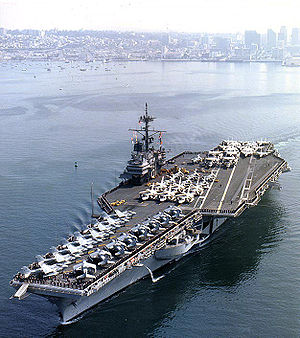
“The seventh USS Ranger (CV/CVA-61) is one of four Forrestal-class supercarriers built for the US Navy in the 1950s. Although all four ships of the class were completed with angled decks,Ranger had the distinction of being the first US carrier built from the very beginning as an angled deck ship.” – Wikipedia (See continuing updates at the end of this post.)
In matters of war, I am a pacifist.
That said, I believe our troops merit our support whether or not the war they’re fighting in is popular or not.
I also think history and historical artifacts, objects and memorabilia are important, for they help communicate the stories of other eras. It’s been a pleasure working with museums as a grant writer and as a collections manager and seeing first hand how excited people can get when shown historic equipment, documents and photographs.
I served aboard the USS Ranger (CVA-61) during the Vietnam War. The war was probably the country’s most unpopular war. When I appeared in public wearing my uniform, I was intentionally bumped into on the street, spat on, and called a baby killer. Yet our history and memories of that time must be preserved.
So, in matters of history, especially those that focus on museums and other educational experiences, I am an activist. In Charleston, I have seen the displays on the USS Yorktown and I have seen the reactions of tourists and school groups as they toured the flight deck, the hangar deck, the mess decks, bridge and ready rooms of the old ship.
When the USS Ranger Foundation was formed in Oregon with the hope of following the examples of those who saved the USS Yorktown in Charleston and the USS Midway in San Diego as museums, I was happy to join up even though I don’t have the financial means to donate money nor the proximity to the ship and selected museum site to volunteer.
Ranger in 1961 – Kemon01 photo on Flickr
First, the educational opportunities here are immense. It’s one thing to read about military history. It’s quite another to walk through a fort, battlefield or restored ship. Aircraft carriers have evolved since the Vietnam War—I can hardly even recognize the modern navy uniform. As I write this, there have been tests of flying drones off of carriers rather than expensive manned aircraft. As a museum, Ranger could have been a piece of history on the Columbia River at the donated site in Fairview for many years to come.
Second, museums and other cultural tourism sites bring dollars and jobs into communities. Many studies have been done showing that a tourist destination such as the USS Ranger can bring in a higher percentage of every tourist dollar than other attractions.
Apparently this is not to be
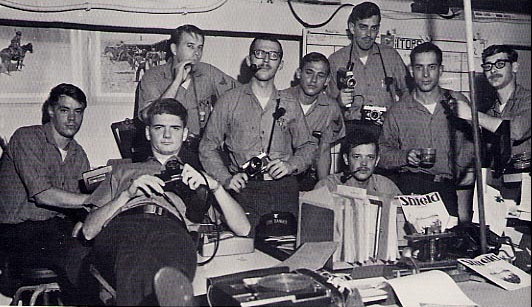
USS Ranger Public Affairs Office on the 03 level. I am second from the right here in 1968.
I salute the long hours and dedicated efforts of the volunteers and directors of the USS Ranger Foundation. But I think I missed a memo.
The application process for the acquisition of a decommissioned navy ship is difficult, expensive and lengthy. Unfortunately, the Foundation’s application was rejected by the Navy last October. (See Foundation to Fight NAVSEA Decision to Scrap Ranger) At that time, the Foundation was looking for ways to have that decision reversed.
Over the Christmas holidays, the Foundation said that constraints were keeping them from having more time to develop their application. Here’s where I missed the memo, I think.
I never heard what those constraints were, what (if anything) was missing or incomplete in the Foundation’s original application, or whether or not the support of influential people in and out of government could influence the Navy to provide more time, reconsider, or otherwise work with the Foundation to save the ship rather than scrapping the ship.
Now, the Foundation is looking for another ship. That’s probably a reasonable backup approach. Nonetheless, I think we need to know:
Why the application was rejected.
What, if anything, could be done to make the application acceptable.
Who, if anyone, could be enlisted to garner political and public attention to urge the Navy to delay the scrapping schedule and,
Who, if anyone, could raise additional funds and increased public support within the State of Oregon to save the ship and bring it to the Portland area.
We don’t know any of these things. Perhaps, in knowing them, we would see that placing a historic aircraft carrier in a Columbia River museum site had too many insurmountable obstacles in it to ever succeed even if the navy waited five more years or ten more years.
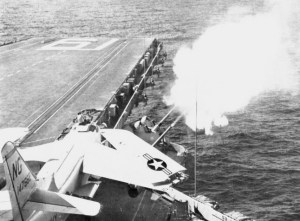
A-4 Skyhawk landing in 1980 – Kookaburra2011 photo on flickr
I have worked with museums and I have seen the impossible done before. Those in the know said “It will never happen.” But it did happen, with money left over and with the partnering help of those who had been thought, by those afraid to ask, to be the least likely to assist a museum.
So it is, that I do not like seeing this project fade away without a ramped up, viral PR campaign and without the help of high-level thought leaders and influencers who might be able to make a USS Ranger museum a reality. A successful aircraft carrier museum helps everyone, including the Navy. A scrapped ship frees up space at a pier and brings in a few dollars, but otherwise helps no one.
Worse yet, our history is lost in the bureaucratic shuffle. Rather than fading away, I would have preferred seeing this project end, if it had to end, with nothing less than a noisy, failure-is-not-an-option, Hail Mary, damn-the-torpedoes effort.
As always, I wish the Foundation fair winds and following seas.
Malcolm R. Campbell, Journalist
USS Ranger Public Affairs Office and Naval Station Great Lakes 1968 – 1970
Update – January 9, 2014
Those of you who live in the Bremmerton area may have a better means of finding out whether the ship has been scrapped already than I do. However, I have checked with the Navy about the rationale for disposing of the ship (in addition to the costs of maintaining mothballed ships).
From the Navy’s perspective, the USS Ranger Foundation’s progress throughout the entire application process was slow and it finally appeared that little or no progress was being made on some fairly large obstacles:
En route to the ship’s proposed mooring site, the BNSF bridge at river mile 80.9 had not been solved. Basically, the ship couldn’t clear the bridge without a major effort on the railroad’s part.
The foundation’s cost estimates for the project were incomplete. They gave an overall figure to the Navy about projected costs, but only documented a fraction of those costs.
The USS Ranger was placed on a donation hold in 2004. Even though the foundation had expressed an interest in the ship in 2003, the application wasn’t filed until 2009. With the ship available for an eight-year period and with major obstacles not being resolved, it seemed unlikely that the foundation would ever present a complete and viable application. Unfortunately, the Navy’s assessment about this is probably correct.
February 12, 2015: USS Ranger departure pushed back – “Mothballed Bremerton aircraft carrier USS Ranger won’t be leaving Feb. 15 for a Texas scrap yard. That was the first tentative date announced by the Navy, but rigging and towing preparations are lagging, said Ray Porter, Puget Sound Naval Shipyard inactive fleet site director.”
 The merger between the Glacier National Park Fund and the Glacier Association has been completed, creating the Glacier National Park Conservancy. If you’re a fan of Glacier National Park, you can read about the organization’s current projects here.










 Malcolm's Round Table