Review: ‘European Travel for the Monstrous Gentlewoman’ by Theodora Goss

European Travel for the Monstrous Gentlewoman (The Extraordinary Adventures of the Athena Club, #2)European Travel for the Monstrous Gentlewoman by Theodora Goss
My rating: 5 of 5 stars

“The Strange Case of the Alchemist’s Daughter” was my favorite novel of 2017. I don’t yet know what this year’s favorite book will be, but I’m happy to see that book two in the Athena Club series, “European Travel for the Monstrous Gentlewoman” is a well-written and wondrous sequel. It does not disappoint.

Like book one, it is highly literate, carefully written, and intensely readable. As with the first book in the series, we find a smorgasbord of of myths and literary characters here, including Sherlock Holmes and Doctor Watson, Dr Jekyll and Mr Hyde, and Doctor Moreau.

I know from Goss’ Facebook page and blog that she Hungarian-born author knows her locations well, and enhances her knowledge of them through yearly travels. This adds a great amount of depth to her books and does the fact that she teaches and researches fairy tales at the college level.

The members of the Athena Club leave London in this story and travel far afield to uncover the nasty projects coming from the rogue members of the alchemist society. One might quibble here that alchemists don’t normally engage in the Frankenstein horrors portrayed in the books, but that’s a small matter. The prospective mix-ups and horrors of travel add to the fun.

Since the novel itself is being written by one of the members of the Athena Club, we see frequent conversations outside the narrative by members of the club as they more or less discuss how they are being portrayed. This is a clever device and provides interesting depth to the story. I do think that it’s used overly much and represents a distraction after a while.

Goss definitely knows what she’s doing here and, when all is said and done, that makes for an exciting story with a lot of overlap with other genres that many of her readers know well. Highly recommended!

View all my reviews

Malcolm

Memories in the Wine: Scuppernong Grapes

Possibly the oldest cultivated grapevine in the world is the 400-year-old scuppernong “Mother Vine” growing on Roanoke Island, North Carolina. – Wikipedia

Yesterday, I learned in a Facebook conversation that both my publisher and I grew up with a love for Muscadine grapes. In my case, it was Scuppernongs, a distinctive variety of Muscadines. I grew up in the Florida Panhandle where many of my junior high and high school friends’ parents had small farms or large rural backyards. Every fall, we ate Scuppernongs right off the vines, usually on ancient, falling-down trellises.  While Muscadines are generally purplish red, Scuppernongs are greenish bronze.

Scuppernongs – Wikipedia photo

The grapes make great jams and jellies–and wine. (Here is one of the many online recipes for Scuppernong jam.) The old-timers had many regional names for Scuppernongs, including “sculpins” Oddly, I was the only one in my family who liked these grapes; my brothers and parents found them too tart and didn’t like chewing on them and having to spit out the skins after all the juice was gone–sort of like chewing on unpeeled kumquats. (I was also the only one in the family who loved boiled peanuts and chewing on the sugar cane sticks that used to be sold in those days by street vendors.)

I normally drink only non-sweet red wines, but while working on my recently released novel Lena, I chilled several bottles of Scuppernong wine to bring back childhood memories. I actually sipped the wine while working on the book because the characters were drinking, as I called it, homemade sculpin wine. It was nostalgic writing a story about a farm with sculpin grapes while drinking a glass of wine made from those wonderful native grapes

Duplin Winery photo

As for that mother vine, I’d love to taste the wine still being made from this ancient vine in North Carolina. As Duplin Winery describes its MotherVine Wine, “This sweet white wine is made from the Scuppernong grapes of the Mother Vine. The Mother Vine is the oldest Vine in the world, and is still producing World Class Wine!” The label shows a photograph of the vine itself which looks quite a bit different than the vines I saw in Leon County, Florida.

Writing the three novels in the Florida Folk Magic series has brought back a lot of childhood memories. First, the people, many of whom still call me “shug (for sugar), as in “Shug, how’s it going?” Second, the wiregrass and longleaf pine ecosystems and the nearby blackwater rivers and Gulf of Mexico coastline. Third, so many of the foods, from rosin-baked potatoes, mayhaw jelly, hush puppies, fry bread, and catfish.

That Scuppernong wine, though, was pure liquid memory, rather like the now-legal moonshine you can find in most liquor stores. (There’s a Mason jar of shine in my pantry.) Now that the folk magic series is complete, I feel like I’ve just stood up and stretched after reclining on a psychoanalyst’s couch, for the writing was indeed a trip back in time where I found many outrageous things I shouldn’t have kept silent about for so many years, and many joyful childhood moments that made me feel as ancient as that mother vine.

Malcolm

The Fairytale Heroine’s Journey

“When I first started teaching fairy tales at the university level, I noticed that certain tales had a similar underlying structure. They were all tales about heroines, from childhood to marriage, and in those tales the heroines went through a series of life stages: they received gifts, they were required to leave home or lost their homes in some way, they wandered through dark forests, they found temporary homes where they could stay for a while, they encountered friends and helpers along their journey . . . I describe those stages in more detail on the Journey page of this website.”

Source: The Fairytale Heroine’s Journey

Author, researcher, and college professor Theodora Goss* is doing for fairy tales what Joseph Campbell did for myths. That is, she is looking for underlying themes that can be found in many tales. It’s a developing process, and I’m looking forward to seeing this website evolve over time.

*Goss is the author of three wonderful novels, “The Strange Case of the Alchemist’s Daughter,”European Travel for the Monstrous Gentlewoman,” and “The Sinister Mystery of the Mesmerizing Girl.”

Malcolm

Malcolm R. Campbell is the author of the heroine’s journey novel “Sarabande.” 

Review: ‘The Store’ by Patterson and DiLallo

The StoreThe Store by James Patterson
My rating: 2 of 5 stars

The story idea is compelling and, what with people talking about privacy issues in an Internet world these days, the plot is also timely. Others here have already said they didn’t care for the writing. Definitely, not anywhere near the best of James Patterson branded novels.

The glaring trouble with the book is the ending. It’s a trick. The ending is based on the fact that certain things earlier in the novel aren’t what they seemed to be. The trouble is, when the ending occurs, the main character turns out to have known the whole time that those things weren’t what they seemed to be. The flaw here is that we are inside the main character’s head throughout the book and know what he’s thinking. There is no way a real person wouldn’t have thought about the on-going trickery at some point. The ending is only a surprise because the authors don’t allow the main character to think about something that he couldn’t help but think about. This is a very large point-of-view error.

In the Amazon/GoodReads review above, I don’t include a spoiler about what happened. In fairness to those who might enjoy this novel in spite of the trick, I’ll leave out the spoilers here as well.

Most publishers’ editors would have told the authors to fix the ending. Maybe they can’t say that to Patterson. However, it’s very jarring and unfair to the reader to conceal the main character’s thoughts about important matters from the readers unless the character is established as unreliable, suffering from amnesia, or hypnotized. None of these options were present in The Store.

The main character Jacob Brandeis participates throughout the story in a planned subterfuge but never once thinks about the fact that he–and others–are role playing. No real person would be capable of doing this. Outside of experimental fiction, no fictional character could help but think about what he’s doing while he’s doing it. With proper finesse and foreshadowing, an author might get around the problem of concealing the third person point-of-view character’s thoughts from the readers.

That was not done here, so we ended up feeling cheated–because we were.

Malcolm

View all my reviews

Announcing ‘Lena’ a new Florida Folk Magic Series novel

Lena, was officially released today by Thomas-Jacob Publishing as book three in the Florida Folk Magic trilogy as a follow-up to Conjure Woman’s Cat and Eulalie and Washerwoman. Both the Kindle and the paperback editions were available earlier than expected, so we’ve beat our planned release date of August 1.

Publisher’s Description: 

When Police Chief Alton Gravely and Officer Carothers escalate the feud between “Torreya’s finest” and conjure woman Eulalie Jenkins by running her off the road into a north Florida swamp, the borrowed pickup truck is salvaged but Eulalie is missing and presumed dead. Her cat Lena survives. Lena could provide an accurate account of the crime, but the county sheriff is unlikely to interview a pet.

Lena doesn’t think Eulalie is dead, but the conjure woman’s family and friends don’t believe her. Eulalie’s daughter Adelaide wants to stir things up, and the church deacon wants everyone to stay out of sight. There’s talk of an eyewitness, but either Adelaide made that up to worry the police, or the witness is too scared to come forward.

When the feared Black Robes of the Klan attack the first responder who believes the wreck might have been staged, Lena is the only one who can help him try to fight them off. After that, all hope seems lost, because if Eulalie is alive and finds her way back to Torreya, there are plenty of people waiting to kill her and make sure she stays dead.

Author’s Comments

This novel is a mix of conjure and crime set in the 1950s when the KKK had a very strong presence in Florida. Many policemen and sheriffs were either members or worked with the Klan and Klan businesses. I wondered how many people I knew were Klan members: it wasn’t something I could ask nor something they would admit if I did ask. My hope is that this series will serve as an immersion into the past and help bring increased understanding about why current attitudes are as they are.

Malcolm

A trip to the dentist

Went to the dentist today. She asked where my teeth were. I took them out of my special carrying case and she was really impressed with hour sparkling clean they were.

I told her that in Florida, we scrubbed our campers’ trying pans with sand and Spanish moss and that from long experience, I’d found this combination does a good job on teeth. I told her I used to use Brillo, but didn’t like the taste of that blue soap.

She said Brillo, along with Sani-Flush, was “overkill” when it came to caring for teeth.

My mother had a problem with plaque. I inherited it without inheriting her auburn hair. That means lots of scraping at the dentist’s office. Fortunately, they use semi-automated equipment these days rather than the old fashioned chisels and sandpaper.

She remarked, as I was opening the suitcase of hundred-dollar bills I always take to doctors’ and dentists’ offices, that, “Red wine is hell on the teeth.” I said, “Look, I gave up smoking 20 or so years ago and have cut back on the coffee, but the red wine is medication.”

She offered me a complimentary glass of red Zinfandel that I didn’t turn down even though the cops are out this week looking for drunks and speeders.

So now, I hear that I’m supposed to use a soft tooth brush rather than a hardy toothbrush. I can’t keep up with the changing rules. I’m supposed to brush for twenty minutes several times a day and floss on the hour even if I’m driving. That’s worse than texting or having sex while driving, isn’t it?

Since it’s as boring in fiction as it is in “real life,” I never describe my characters bathroom habits, including brushing their teeth, in my books. That’s all TMI as far as I’m concerned. However, for the kids reading this blog (yeah, right), I want to state categorically that I’m in favor of brushing one’s teeth and having daily baths or showers. I just don’t write about that stuff in my fiction.

I’m only writing about all this now because nothing more exciting came to mind for a post.

However, I will note that if you’ve just noticed that personal hygiene is good for you and makes those around you happier, that a pressure washer isn’t recommended for use in the bathroom. Please don’t ask me to elaborate.

–Malcolm

If you live in Florida, Tupelo Honey is “the” Honey of Choice

“In practice, because of the difficulties in containing bees, a small proportion of any honey will be from additional nectar from other flower types. Typical examples of North American monofloral honeys are clover, orange blossom, blueberry, sage, tupelo, buckwheat, fireweed, mesquite, and sourwood.” – Wikipedia

In Florida, honey producers are as protective about their Tupelo honey as Georgians are about what can be called a true Vidalia onion. I mention white Ogeechee Tupelo trees in my books because they’re a major tree along the Apalachicola River in the panhandle section of the state. They’re a primary source for Tupelo honey and, less well known, as a source of pecan-sized fruits which taste like limes (sort of) and make a pleasing drink and some great preserves.

Tupelo honey, which I thought was the only kind of honey on earth when I was growing up, is light-colored and has a slightly floral taste and (kind of) smells like cinnamon. When I mention it outside of Florida and southern Georgia, most people have never heard of it.  Being old fashioned–or possibly just old–I remember buying honey in boxes where you got a giant slab of honeycomb which I thought was the best part. Now we get strained honey at most stores. What a loss.

Here’s a great picture from Florida Memory showing Tupelo trees along the Apalachicola River:

1960 photo from Florida Memory

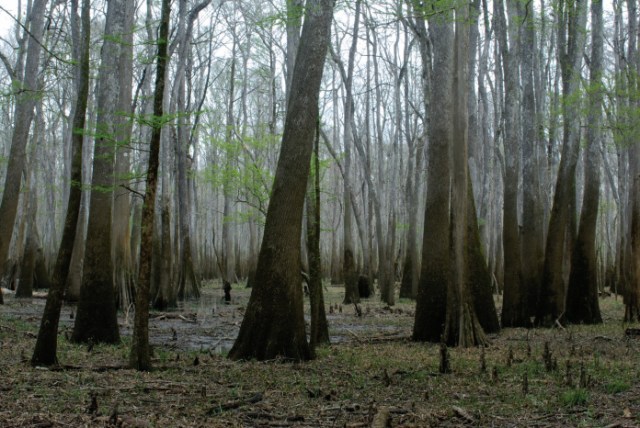
I like the passage in Florida’s Wetlands, Volume 2, about the Tupelo: “Like cypress, Ogeechee tupelos are practically immortal. They can live for hundreds of years and they keep replacing their stems, so they need not reproduce frequently.” Old trees carry the land’s stories if you know how to listen.  You can find these trees most often in floodplain swamps, as shown by this photograph from the Florida Natural Areas Inventory (FNAI):

Tupelo at Torreya State Park in Florida’s Liberty County–FNAI photo.

In Florida, you’ll find these trees primarily in panhandle swamps near the Apalachicola River. This is where a fair amount of Tupelo honey comes from.  For those of us in Tallahassee, that was close enough to have a constant supply of quality honey.

Malcolm

Malcolm R. Campbell’s “Lena” will be released on August 1 as the final novel in his Florida Folk Magic trilogy.


When the muses outdo themselves: Favorite passages from books

Sometimes sentence or paragraph in a novel stops me in my tracks because it’s perfect, perfectly beautiful, dangerously apt, and it flows from word to word like birds or gods singing. Here are a few of my favorites:

  1. The Prince of Tides by Pat Conroy: It was growing dark on this long southern evening, and suddenly, at the exact point her finger had indicated, the moon lifted a forehead of stunning gold above the horizon, lifted straight out of filigreed, light-intoxicated clouds that lay on the skyline in attendant veils. Behind us, the sun was setting in a simultaneous congruent withdrawal and the river turned to flame in a quiet duel of gold….The new gold of moon astonishing and ascendant, he depleted gold of sunset extinguishing itself in the long westward slide, it was the old dance of days in the Carolina marshes, the breathtaking death of days before the eyes of children, until the sun vanished, its final signature a ribbon of bullion strung across the tops of water oaks.
  2. Sunset Song in the Scots Quair trilogy by Lewis Grassic GibbonSo that was Chris and her reading and schooling, two Chrisses there were that fought for her heart and tormented her. You hated the land and the coarse speak of the folk and learning was brave and fine one day and the next you’d waken with the peewits crying across the hills, deep and deep, crying in the heart of you and the smell of the earth in your face, almost you’d cry for that, the beauty of it and the sweetness of the Scottish land and skies. You saw their faces in firelight, father’s and mother’s and the neighbours’, before the lamps lit up, tired and kind, faces dear and close to you, you wanted the words they’d known and used, forgotten in the far-off youngness of their lives, Scots words to tell to your heart, how they wrung it and held it, the toil of their days and unendingly their fight. And the next minute that passed from you, you were English, back to the English words so sharp and clean and true–for a while, for a while, till they slid so smooth from your throat you knew they could never say anything that was worth the saying at all.
  3. The Night Circus by Erin MorgensternSomeone needs to tell those tales. When the battles are fought and won and lost, when the pirates find their treasures and the dragons eat their foes for breakfast with a nice cup of Lapsang souchong, someone needs to tell their bits of overlapping narrative. There’s magic in that. It’s in the listener, and for each and every ear it will be different, and it will affect them in ways they can never predict. From the mundane to the profound. You may tell a tale that takes up residence in someone’s soul, becomes their blood and self and purpose. That tale will move them and drive them and who knows what they might do because of it, because of your words. That is your role, your gift. Your sister may be able to see the future, but you yourself can shape it, boy. Do not forget that… there are many kinds of magic, after all.
  4. The Shadow of the Wind by Carlos Ruiz ZafónEvery book, every volume you see here, has a soul. The soul of the person who wrote it and of those who read it and lived and dreamed with it. Every time a book changes hands, every time someone runs his eyes down its pages, its spirit grows and strengthens. And also this: Once, in my father’s bookshop, I heard a regular customer say that few things leave a deeper mark on a reader than the first book that finds its way into his heart. Those first images, the echo of words we think we have left behind, accompany us throughout our lives and sculpt a palace in our memory to which, sooner or later—no matter how many books we read, how many worlds we discover, or how much we learn or forget—we will return.
  5. All the Pretty Horses by Cormac McCarthy: They heard somewhere in that tenantless night a bell that tolled and ceased where no bell was and they rode out on the round dais of the earth which alone was dark and no light to it and which carried their figures and bore them up into the swarming stars so that they rode not under but among them and they rode at once jaunty and circumspect, like thieves newly loosed in that dark electric, like young thieves in a glowing orchard, loosely jacketed against the cold and ten thousand worlds for the choosing.

You probably have some favorite lines as well, lines you might even copy on to scraps of paper to be hidden away in your wallet or purse for those moment when you need to prove again to yourself that there is still hope for the world.

Malcolm

Operation Paperback, a great place for your gently used books

I used to re-sell my used paperbacks on Amazon. Sometimes I still do. But, for most books, the profits aren’t very good because so many people are selling books for a penny or two, hoping to make a pittance on volume by taking a cut of the amount Amazon allows for shipping. Then, too, you have to buy mailers or boxes and rush to the post office within two days of getting a SHIP NOW e-mail from Amazon.  Selling books on eBay has similar hassles and low profits unless you have something out of print and/or rare.

There’s a used book store in town that takes in used books IF you want to use the value they assign to them and apply that against a purchase in the store. The thing is, if the store is selling used books, I’ve probably already read them.

If you have an eagle eye, you’ve noticed the Operation Paperback logo on the right-hand side of this blog. Anyone can sign up and either donate money or become a shipper, all of this to give our troops books to read. When I was in the Navy, I would have welcomed an occasional box of books from people who cared that I was sitting on a ship in the Gulf of Tonkin with time between watches to use up.

Operation Paperback was founded in 1999 and since then has shipped 2.2 million books around the world and to veterans and their families in the U.S. In my case, I participate in the program via my publisher Thomas-Jacob Publishing. This means that when Melinda runs out of books she’s been stashing under the bed, I send her a few boxes to add to her collection. Then she ships them out to people who are looking for the genres I send.

The literary fiction I read isn’t in high demand. But the Tom Clancy/James Patterson kinds of books are. So, she gets all these because they’re not the kinds of books that lend themselves to reading them multiple times. I mailed her two boxes of books this morning, and snuck in a batch from Jim Butcher’s Dresden Files series. Think of them as cops and robbers with a wizard in the mix!

It’s amazing how much space paperback and hardback books take up in my den. So, I’m happy to have a good place to send those I’ve read. It sure beats throwing them in the trash! And, since I think it’s a crime to dog-ear or scribble in books, mine have no bent pages because I use bookmarks. And, as we used to advertise on eBay, my books come from a smoke-free environment. Of course, it’s possible my books smell like fried chicken, steak or beef stew.

Malcolm


That Elusive Writer’s Platform

Big name writers have writing platforms called the big name writer’s platform.

When James Patterson comes out with a new book, you know who he is and what kinds of stories he tells, so he doesn’t need to go on blog tours or work in a hardware store to stay solvent.

If your name is Joe Doaks, are 43 years old, and live in your parents’ basement where you play video games and hack into the dark web, you only have a writer’s platform if you write a tell-all book about the dark web, especially one that the FBI tries to get banned. Otherwise, you can send the best novel in the universe to a big New York publisher and they probably won’t take it on because you don’t have a platform. That is, nobody has heard of you and you aren’t maintaining a business of some kind that will draw readers to your books.

Most of us who write self-published or small-press books need a platform. Nonfiction is easier than fiction, because our books can be an outgrowth of a strong, nonfiction website that gets thousands of hits a month. That is, if you maintain a popular website in which you provide the real stories behind major crimes, your novel will be seen as part of this and will probably sell well.

If you’re on WordPress, Twitter, Facebook, Instagram, Flickr, and Pinterest, and have lots of followers and comments, you’re better off than those who have no online presence unless you have a high-profile teaching position or other offline work that has made you widely known to many people.

Many of us imagine our writer’s platform looks like this:

When, in reality, it looks like this:

 

But then, for example, after hearing a lot of positive comments on, say, Facebook about a new novel we’re about to release, we realize after it’s been released that very few people on our friend’s list actually bought a copy, and that of the small number who did, few (if any) of them posted an Amazon review.

There have been–and still are–a variety of authors’ networking sites. My experience with these is that most authors are there to sell their own books rather than to buy the books of other unknown authors. While “networking” on the authors’ sites, those people are buying James Patterson, Donna Tart, and John Grisham novels rather than fiction nobody’s ever heard of.

Many small-print and self-published authors depend on Amazon. Some books–mostly nonfiction, it seems–have made a lot of money there. Most fiction by unknown authors doesn’t sell well there because most people never see it and those who do would rather buy books from known authors. While Amazon helps self-published and small-press authors to some extent, it’s still a business that makes more off James Patterson than Joe Nobody.

As others before me have said, those of us who don’t have platforms that get the attention of Oprah’s Book Club or a New York Times reviewers basically have to be content to write in the shadows and earn our money from other jobs. Over time, we may be able so build platforms that attract more prospective readers. My last three novels, for example, were about hoodoo. If I were a hoodoo practitioner (I’m not), then my hoodoo site would be a natural place to promote my book. The same can be true for any other field where you have credentials and a following. Those who have come to your site for facts, are likely to enjoy fiction based on those facts.

You can also build your platform by submitting short stories to literary magazines, including those who only pay in contributor’s copies. The credit line at the end of the story that says something like “Bob Smith is the author of the Andromeda Series of fantasy novels” is a good way to spread your name around to prospective readers. Needless to say, magazine credits, including any where your short story or poem won a contest, give your website something to mention.

I remain skeptical of the paid-for-reviews from the well-known sites who provide these because the reviews are expensive and when published, you cannot be certain those reviews won’t be segregated into a “self-published reviews” category. Labeling them like that pretty much negates the value of the review. Also, if you look at the statistics about the probable sales of a self-published book, the cost of that paid-for-review may wipe out all your profits. So far, I haven’t been willing to roll the dice on reviews or book-of-the-year contests that cost a lot of money and/or advertise the awards are for indie books.

Unfortunately, blogger reviews seem to be of limited help because those blogs don’t attract a lot of attention when compared to the value to a review on a mainstream, traditional newspaper or site. A review from “Bob’s Blog” isn’t really something that’s going to lure a lot of readers away from your mainstream competition. This doesn’t mean you shouldn’t solicit such reviews, only that you recognize going in that they aren’t the New York Times or The Christian Science Monitor.

You can, to some extent, widen your platform by engaging with readers and writers on sites like Facebook. It’s easy to log on to Facebook and upload the same old stuff every week: notices about your books, shared pictures of animals, jokes, and an occasional political rant. It takes more time to go to the sites of those on your friends list an actually say something there rather than simply clicking LIKE. The same is true of the bogs you read where you can click LIKE and also read a comment. When you find books and viewpoints you like, you are building your platform by leaving comments so that the writers/bloggers start recognizing your name.

If you’re on Pinterest, you can post links to your own blogs and the sites you like about subject matter that may interest others. You can also PIN some of the links other people share that fit into the various niche areas that fit your interests and your novels. The thing here is: engage with the users about things that interest them.

Many authors think their novels require and “all about me” approach to promotion and interaction on blogs and social networks. Really, they’re an “all about you” kind of promotion. Talking about why you wrote those books is not nearly as important as showing prospective readers what’s in it for them to read those books.  Your platform needs to be an invitation rather than a memoir about you and how hard it was to write your novel.

Malcolm