New York, NY – February 4, 2019 – Barnes & Noble, Inc. (NYSE: BKS), the world’s largest retail bookseller, today announced that it will host fantasy writer Christopher Paolini for a 10-month author residency to celebrate his internationally bestselling Inheritance Cycle series, as well as his new collection of three stories set in the world of Alagaësia: The Fork, the Witch and the Worm. As part of this national tour, Paolini will appear at 11 Barnes & Noble locations from March through December 2019 with an enhanced customer experience that includes a presentation by Paolini, a booksigning, exclusive trivia, social media photo opportunities with an exclusive backdrop, and an exclusive giveaway, while supplies last.
“We are so excited to be working with Random House Children’s Books to host author Christopher Paolini on this exciting author residency tour,” said Stephanie Fryling, Vice President of Merchandising, Children’s Books at Barnes & Noble. “Fans will have the chance to have an exclusive experience with Paolini and enter the world of Eragon in a way like never before at Barnes & Noble stores across the country.”
Wikipedia Photo
Christopher Paolini is best known as the author of the Inheritance Cycle, a bestselling series comprised of four books including Eragon, Eldest, Brisingr and Inheritance. Paolini wrote Eragon shortly after graduating high school at age 15. The Fork, the Witch and the Worm is Paolini’s newest book in the fantasy series, which debuted at #1 on The New York Times Young Adult Bestseller list.
“It has been such a blast meeting so many Eragon fans while on tour for The Fork, the Witch, and the Worm. I look forward to meeting even more of them on my national Barnes & Noble 2019 Residency Tour,” Paolini said.
The tour will kick off in Paolini’s hometown of Bozeman, MT, on March 4. The full list of tour dates are below.
Barnes & Noble Christopher Paolini 2019 Residency Tour Dates:
Bozeman, MT, Monday, March 4, 5 PM
Boise, ID, Saturday, April 13, 6 PM
Albuquerque, NM, Friday, May 10, 7 PM
Edina, MN, Sunday, June 9, 1 PM
Briargate, Colorado Springs, CO, Friday, June 14, 2 PM
Exton, PA, Saturday, July 13, 1 PM
Akron, OH, Friday, August 9, 7 PM
Springfield, MO, Saturday, September 14, 3 PM
Grand Rapids, MI, Friday, October 11, 6:30 PM
Orem, UT, Saturday, November 9, 2 PM
Stonebriar Mall, Frisco, TX, Sunday, December 8, 2 PM
Many men in my generation grew up watching westerns at the theater and on TV. The first movie I remember seeing was “The Big Sky” based on the A.B. Gutherie’s 1947 novel set in Montana. Name a western movie made between 1940 and 1970, and I probably saw it. Yes, I liked “Shane” and “High Noon,” and some years later, “Lonesome Dove.” Yet, I haven’t read a western in years, much less gone to a western genre film.
You can tell just how long I’ve been away from westerns when I confess that when a friend who was downsizing his book collection gave me a copy of The Hart Brand, I’d never heard of author Johnny D. Boggs even though he’s prolific, viewed by many as the best westerns genre author in the business, and the winner of multiple Spur Awards.
I enjoyed the yarn.
We’re talking about a western for readers who are serious about westerns set in the days of Pat Garrett and the 1890s New Mexico Territory. Greenhorn Caleb Hart, whose father runs a mercantile in Missouri, heads west at 14 to work on his uncle’s ranch and send his paychecks back home to help support the family.
The book’s style and tone remind me of western novels of an earlier era and, for a story about a huge ranch, a hard-as-nails uncle Frank, cattle rustlers, strained family relationships, and frontier justice, the writing is perfect.
The “Booklist” review said, “Boggs writes with a drawling assurance, maintaining a keen eye for the details of life on the range. This is a fine western story about family ties and loyalty, set among cowboys rather than gunslingers, but with plenty enough action to satisfy.”
I don’t plan to go back to reading westerns, but this novel was an interesting change of pace. In a review, I would probably give it four stars. The writing is good enough for five stars but the story, in one form or another, has been told a thousand times. Nonetheless, a fun book. If you’re a fan of the genre, you’ll probably enjoy it.
“Trot your horse wherever he wants to go, putting pressure on with your legs when he goes away from the scary spot, and releasing pressure when he goes towards it. Resist the almost overpowering urge to steer your horse. Trust him! Hold on to the saddle with one hand if he is ‘ducking and diving.’ Keep trotting, he is looking for an answer, let him find it. When he finally goes to a spot in the arena he hasn’t been to yet – let him stop and rest. Just hang out with him there, or get off if it’s time to end your session.” – Logan Darrow
I haven’t ridden a horse in years, but when I did ride, I enjoyed dropping the reins to see where he would go. Logan Darrow’s exercise, posted on The Mindful Horse Woman four years ago, is wise advice for everyone with a horse. I enjoyed trusting the horse and I think he enjoyed the fact I wasn’t controlling what he was doing. In the same fashion, I enjoyed driving my old car aimlessly to see where I would end up. It wasn’t quite the same since I really couldn’t let go of the steering wheel.
But the concept was similar, somewhat like following winds, currents, and tides in a boat: giving up control and enjoying the ride. More often than not, whether it was by horse or car or sailboat, such rides took me where I needed to go even though I didn’t consciously know it. What I saw changed me. Where I ended up the was a person I needed to meet or something I needed to witness.
I feel the same way about poems, short stories, and novels. While we may have a theme, a set of characters, and a general plan for the action, the work ends up better if we trust ourselves and the material enough to drop the reins. No, I’m not advocating typing gibberish or writing while drunk. Yet stories seem to flow in a natural direction once you get them started. Like trying to force water to flow uphill, forcing a story away from its natural direction is not only a lot of hassle, the result looks unnatural.
I was reminded of this several days ago while working on a short story about a man in a rest home. Unusual for me, I intuited how it was going to end. I seldom know that. This time I did know it and I didn’t like it. So, like gently neck-reining your horse one direction or another, I “encouraged” the story to go down a path that didn’t lead to that ending.
A fight ensued. Clearly, like a horse who wanted to head for the barn, the story refused to go anywhere that didn’t lead to that ending. Yes, I know, if you can’t stop your horse from racing to the barn, you’re a poor rider. So, there always needs to be a meeting of the minds between you and your horse about what it is you’re doing. The same is true for a story. So, my story knew we weren’t going to gallop toward that ending on page one. And I learned that no matter what else happened in the story, its natural ending was a destiny the characters couldn’t avoid.
We can’t always drop the reins when we’re riding or writing, but we probably don’t drop them enough. The story’s almost finished now. The ending the story wanted makes sense. It also coincides with what I wanted to say better than ending the story some other way. I have no idea why this process works the way it does. We could speculate, I suppose, but even if we found the answer it wouldn’t change the process for the better.
If you don’t like the story you end up with, you can hide it at the bottom of your sock drawer and move onto something new.
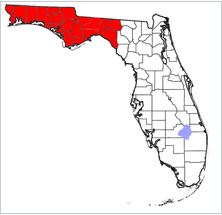
The Florida Panhandle, an informal, unofficial term for the northwestern part of the U.S. state of Florida, is a strip of land roughly 200 miles long and 50 to 100 miles wide (320 km by 80 to 160 km), lying between Alabama on the north and the west, Georgia also on the north, and the Gulf of Mexico to the south. Its eastern boundary is arbitrarily defined. – Wikipedia
My books are set in the Florida Panhandle because that’s where I grew up, learned the lay of the land, and heard the old stories. I lived in Tallahassee which is sometimes considered part of the panhandle and sometimes considered part of the “Big Bend.”
The panhandle is often viewed as more like Georgia than the peninsula part of the state. Panhandle residents often think the peninsula with its tourist attractions has been ruined by overdevelopment and destinations that either don’t belong there or are caricatures of the once wild land they displaced.
The Panhandle features white sandy beaches, often called The Redneck Riviera, but now generally in advertising and promotion are referenced as “The Emerald Coast.”
If you sample the beaches of the Emerald Coast and the Atlantic Coast, you’ll notice that most of the Emerald Coast isn’t covered with the kind of excessive development such as that found around Daytona Beach and other cities. (Gosh, I hope I don’t sound biased.) You’ll also notice the sand, is pure white, in fact blindingly white making sunglasses highly desirable. This sand is much different than the coarser sand of the Atlantic Coast.
Florida Memory Photo
According to Wikipedia, “The Apalachicola River /æpəlætʃɪˈkoʊlə/ is a river, approximately 112 mi (180 km) long in the State of Florida. The river’s large watershed, known as the ACF River Basin, drains an area of approximately 19,500 square miles (50,505 km2) into the Gulf of Mexico. The distance to its farthest head waters in northeast Georgia is approximately 500 miles (800 km). Its name comes from the Apalachicola people, who used to live along the river.”
The river is not only a recreation spot, but highly important in the watershed’s environment as well as the oyster industry in the Gulf Coast town of Apalachicoa. Water usage of the river between Georgia and Florida has been under dispute for years, with Florida saying that Atlanta draws off too much water at Florida’s expense.
Florida Forest Service Photo
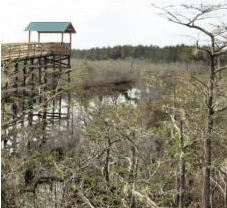
According to the Florida Forest Service, “The natural resources found on Tate’s Hell State Forest are very diverse due to the unique and various natural community types. At one time Tate’s Hell State Forest supported at least 12 major community types, which included wet flatwoods, wet prairie, seepage slope, baygall, floodplain forest, floodplain swamp, basin swamp, upland hardwood forest, sandhill, pine ridges, dense titi thickets and scrub. Currently, the forest contains approximately 107,300 acres of hydric communities such as wet prairie (contains a vast diversity of plant species), wet flatwoods, strand swamp, bottomland forest, baygall and floodplain swamp.”
The area is under restoration to repair damages from the forest’s long-time usage by the a timber industry that logged out many of the older trees, disrupted natural waterflows throughout the region by constructing roads that served as dykes, and a rape the land style of forest management.
Wikipedia Photo
The logging industry also had very poor stewardship over the Panhandle’s once ubiquitous wiregrass and longleaf pine forsts, cutting out the old trees and either not replacing them or replacing cut areas with slash pines. Many native species have been threatened by this policy. The forest service was very slow to understand what Native Americans and early residents understood: longleaf pine forests need fire to survive. For years, fires were extinguished before natural processes could be completed.
Florida Memory Photo
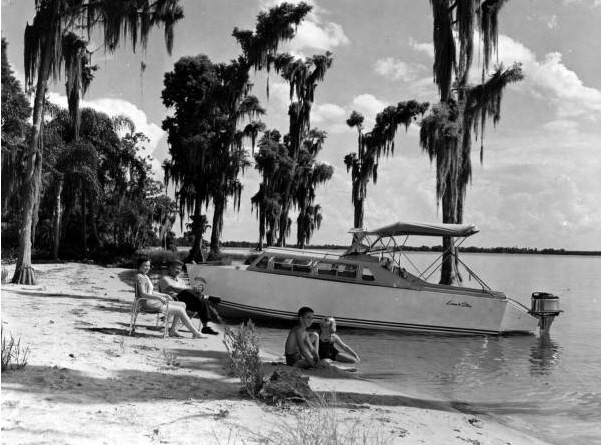
These boats still exist, but I see the 1950s as the heyday of the cabin cruiser. Most of us knew somebody who owned one, and fortunately those people liked to cruise the rivers, head to obscure beaches, and visit the barrier islands (St. George Island and Dog Island).
Florida Memory Photo
The Garden of Eden was once a tourist attraction near the small town of Bristol with signs pointing to places where Biblical events purportedly occurred. A local minister worked out a rather complex theory that sought to prove this spot along the Apalachicola River was the real garden of Eden. The signs are gone now, though a Garden of Eden trail still exists. The unique habitat is managed by the Nature Conservancy as the Apalachicola Bluffs and Ravines Preserve.
Florida Memory Photo
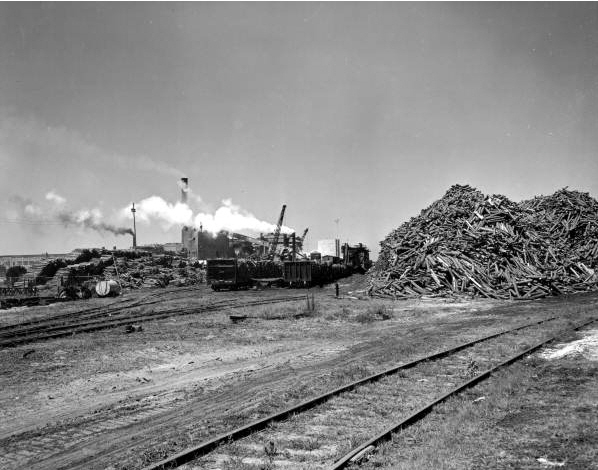
The St. Joe Paper Company was a major economic player in the economy of the Florida Panhandle and probably the area’s largest landowner. Like the Florida East Coast Railway (the old Flagler system route to Key West), the company was owned by Dupont. The tracks that remain are now used by a shortline railroad (Apalachicola Northern) between Port St. Joe on the Gulf coast the town of Chattahoochee near the Georgia Border.
Google Maps
This is where I grew up. You can see the barrier islands just south of Carrabelle and Apalachicola. My friends and I sailed boats between beaches near the junction of highways 319 and 98 to those islands, and my scout troop camped there and in many spots in the Apalachicoa National Forest. The wildlife refuge near St. Marks was a favorite family day trip. My Florida Folk Magic Novels are set near the towns of Hosford and Telogia. The area is rich in history, myths, habitats, recreation, and experiences perfect for a kid growing up who loved being out doors more than indoors.
Following up on yesterday’s post about authors posting material relating to their books, here’s a picture from Florida Memory of a KKK flyer that was similar to many I saw as a child. The Klan was always recruiting, holding rallies, and marching in parades.
1950s Klan Flyer
Officially, the Klan purported to be a friendly organization. I doubt that anyone in Tallahassee and other Florida Panhandle towns was duped by this farce. We read the stories in the newspapers about fire bombings, black churches burnt, black men lynched, and crosses burnt in the yards of white people who spoke out against the Klan. I wonder if we will ever know what percentage of Florida law enforcement officers were members of the Klan. I suspected many of my neighbors were members, including some who went to my church. To paraphase the old Texas song:
“The Klan’s eyes are upon you, All the livelong day. The Klan’s eyes are upon you, You cannot get away.
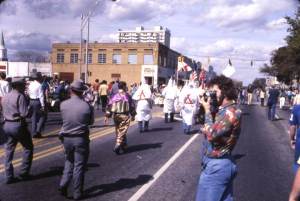
One never knew who one was talking to. I hope the recent emergence of white supremacist groups isn’t returning the country to those times. Those times extended into the 1970s and 1980s. Here’s a photo of a 1970s march in Tallahassee:
Florida Memory photo
KKK rally from the 1950s:
Florida Memory photo
Here we have a crowd watching the KKK burn a cross:
Florida Memory photo
The Klan was very strong in Florida in spite of the state’s pristine, playground image disseminated in magazines and vacation brochures.
The KKK as an enemy organization is a major focus of my Florida Folk Magic Stories novels. In all three novels, a conjure woman is fighting the Klan. That’s why I often call the books crime and conjure stories.
The experts–and I use that term cautiously–tell authors not to write posts, tweets, and Facebook updates that say, one way or another, “Buy my book.” Why not? For one thing, it’s SPAM insofar as others are concerned. For another thing, it’s boring.
I think the experts are right when they say prospective readers won’t flock to your blog or Facebook page if all you’re doing is running a series of advertisements. On the other hand, I’m not convinced that most readers of popular fiction are drawn to mainstream novels because they’re interested in a novel’s location, the careers/hobbies of the characters, or the various tie-ins the novel has to old myths and legends.
Most of us buy books for a compelling story. I read a fair number of black ops books. Right now, I’m reading Agent in Place by Mark Greaney. I picked it up at a CVS and thought it looked interesting. I wasn’t attracted to it because I’m a student of guns, spies, conspiracies, or anything else related to the plot of the thriller. I think a lot of readers are like me in this respect.
We see a few reviews, we hear friends talking about what they’re reading, and we read the back covers of the novels we see in the local Barnes & Noble. I doubt that many of us consider ourselves experts in the subject matter itself except, perhaps, in historical novels where we like certain time periods and dynasties.
So why do the experts tell us to write about the subject matter behind our novels? Obviously, they think that we’re writing for people who like certain subjects and might tend to read novels about those subjects. I can see that readers might choose novels about witchcraft or political intrigue or rogue lawyers. Yes, they may find an unknown author’s novel by using search terms focused on the subject matter and discover his/her novel in the process.
While this seems logical, my experience is that very few of the readers who come to this blog and read about the hero’s journey, hoodoo subject matter, or magic ever purchase my books related to those subjects. They read the blog, enjoy a few hundred words about a subject they like, and then move on. That’s to be expected because most fiction readers buy books by authors they’ve already heard of.
I’m not a typical reader. I buy black ops books and I buy magical realism books. I suspect many readers are like this: they have likes that nobody suspects. Yet, the marketing gurus have to tell little-known writers something. They tell me to write posts about hoodoo, magic, 1950s racism, and Florida. So that’s what I do, but not because I think those who read those posts will zoom out to Amazon to buy my novels. I write posts about those subjects because I’m interested in them.
It’s gratifying to see–from this blog’s statistics–that a fair number of readers have been lured to Malcolm’s Round Table to read those posts. I read similar posts on other people’s blogs and get a lot out of them. In fact, finding readers for our posts is almost as good as finding readers for our novels. We’re exchanging facts and ideas, and that’s a good thing.
As a writer doing research, I love finding blogs and websites created by people who believe in their subjects and freely give away information and ideas. I compare such information to Wikipedia, peer-reviewed books about the subjects, and professional websites hosted by museums, societies, and foundations. One has to double-check everything. But those who offer information for free on their blogs have my respect and admiration. Many hope that I will click on the Amazon links to their books, but as a poor, starving author, I can’t buy from everyone!
I wish I could. I’m often tempted. Yet, months or years later, I see novels by those blog posters and recognize their names. I read the blurb on the Amazon listing or, in bricks and mortar store, the back cover of the book. And I think, “I’ve seen this author’s name somewhere before.” So I buy the book. That’s what most of us hope will happen even if it takes a while.
Me: Thanks for asking. Maybe I should write a post called “I went grocery shopping a day early to avoid the rush.”
You: This post seems to be breaking the temporal prime directive in some way.
Special Weather Advisory. You are screwed. Three inches of snow will fall between Rome and Summerville on Tuesday. Buy bread and stay off the roads.
Me: You may be right. Okay, about the rush. On Tuesday, north Georgia is supposed to be getting three inches of snow.
You: Is that all?
Me: When I lived in a small town named Zion on the Illinois/Wisconsin border, we still had to go to work when we got three feet of snow. A mere three inches, I wouldn’t even notice. I did drive a Jeep with studded snow tires, but still, we just dealt with it.
You: So why are you worried about Georgia snow?
Me: Georgia snow freaks people out. It makes them all go to the grocery store and buy out all the bread and toilet paper. Nobody knows what they do with it because with several exceptions (1986 and 1993) the snow has little real impact and melts off the roads before a family of three can possibly consumer ten loaves of bread and a 55-gallon drum of milk.
You: Goodness gracious.
Me: Nobody says “goodness gracious” any more. When I checked out of the grocery store this morning, the cashier said. “Where’s your bread.” “I don’t need any bread.” “So what are you going to eat if you get snowed in for 35 minutes?” “Salad.” “Oh, you’re one of those people,” she said.
You: What did that mean?
Me: People in my neck of the woods are meat and potatoes people. They couldn’t tell the difference between a salad and yard clippings. Most of us out here have propane stoves, so if the power goes out for 35 minutes, we can still make a pot roast or venison steak with twice-baked potatoes. I did buy some stew beef. If a blizzard comes, beef stew turns into a comfort food.
You: Even if you Southern types freak out, at least you know how to eat well during the emergency.
Those who enjoy FBI and police procedurals, black ops, off-the-grid agencies, and loose-cannon agents will find a lot to like in this story from the long-running Cotton Malone series. Berry focuses on the FBI’s vendetta against the Martin Luther King, Jr. and his death on April 4, 1968. Malone is contacted because some old documents about King’s assassination are about to come to light. The old guard wants them destroyed (if they exist), while current investigators want the truth to come out.
Malone is thrust right into the middle of a playing field of rogue agents and underworld characters that are nothing like the day-to-day life of a JAG lawyer. He has skills, but he’s new at fighting bad guys on the street who are well-practiced at being bad guys. This is the genius of the book: a novice thrust into a volatile mix because those who ask him to go there appreciate the fact he’s a loose cannon.
The story holds together even though the characters Malone confronts have hidden and dangerous agendas or otherwise aren’t who they seem to be.
If there’s a flaw in the book, it’s the fact that it requires a lot of backstory to make sense to readers who weren’t around during the King era. This is the same issue people had with “The Da Vinci Code.” Without Dan Brown’s constant teaching, the story wouldn’t make sense even though that teaching bogged down the book. The teaching in this book bogs it down because quite a few words are devoted to it.
Nonetheless, I found the book compelling. It’s certainly a must read for those interested in the 1960s civil rights movement and the life of Martin Luther King, Jr.
“Most attribute the foundations of Western story structure to Aristotle. His simple idea that stories should have a beginning, a middle, and an end has long served as the template for how narratives have been communicated. Joseph Campbell, by contrast, wisely popularized the idea that the narrative journey was actually a cycle — that every ending brought forth new beginnings, that every death brought forth resurrection and new life.”
I like this Joseph Campbell Foundation essay about the cyclical nature of stories and how they interact with the nature of our lives. You’ll find this in Campbell’s writings about The Hero’s Journey, the idea–as the author puts it–that the beginnings we discover in the new year don’t arise from a blank slate. As Frank Herbert mentioned in his novel Dune, the intuitive can look backward in time and see–like footprints across the sand–the steps one has taken to arrive where they are in life at any given moment.
Put this in a novel, and you call those steps “the plot” or “foreshadowing.” Story helps us identify these kinds of patterns in “real life” just as “real life” suggests to us the stories we tell, both fiction and memoir.


 But the concept was similar, somewhat like following winds, currents, and tides in a boat: giving up control and enjoying the ride. More often than not, whether it was by horse or car or sailboat, such rides took me where I needed to go even though I didn’t consciously know it. What I saw changed me. Where I ended up the was a person I needed to meet or something I needed to witness.
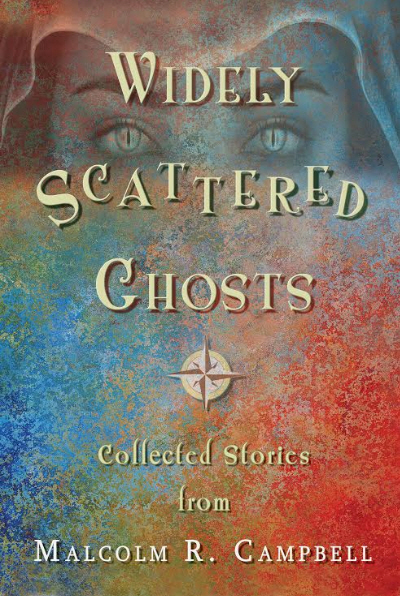
 Coming soon, a collection of nine short stories that more or less did what they wanted.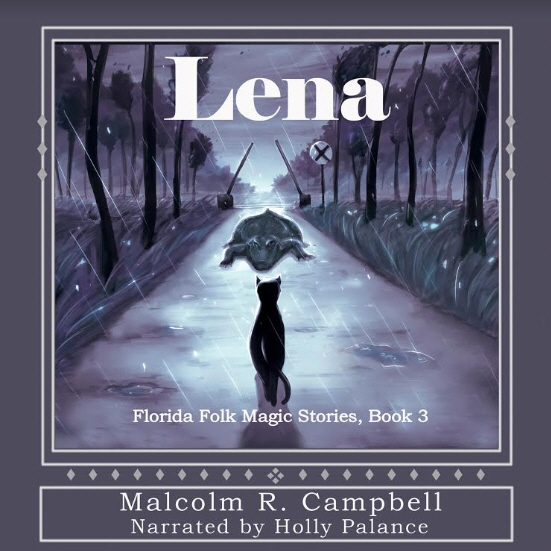








 Most of us buy books for a compelling story. I read a fair number of black ops books. Right now, I’m reading Agent in Place by Mark Greaney. I picked it up at a CVS and thought it looked interesting. I wasn’t attracted to it because I’m a student of guns, spies, conspiracies, or anything else related to the plot of the thriller. I think a lot of readers are like me in this respect.

 Malcolm's Round Table