No, I don’t really want to ban anything.
However, I think many webinars crafted for aspiring and emerging writers are taking a lot of our money for very little information.

- How much does the webinar cost? $150. $250. $500? That seems to me to be a rip off from the outset inasmuch as those producing the webinar could sell the same number of tips in a paperback book or even a downloadable PDF for a lot less.
- When you look at the number of facts in a webinar, you’ll quickly see that the number of words is very low when contrasted to, say, a pamphlet about the same material. Writers don’t earn a lot of money, so I wonder why we are being gouged with high prices.
- Most webinars are not closed-captioned. So, if you’re hard of hearing–and if no transcript is offered–you’re paying for a presentation you cannot hear. That is to say, it’s worthless.
- Webinars are linear. That is, they’re like a tape recording. You have to listen from beginning to end. That means you’re forced to hear the information you already know. Unlike feature films on CD, webinars usually don’t include a table of contents or any other way to access specific parts for the information you want.
- When webinars include guests or panels, a lot of the introductory minutes are used up with that we used to call happy news chatter. That is, the participants introduce themselves, talk about each other’s work, and spend a lot of time (and your money) saying how nice it is to see each other.
- If the information in a webinar we produced in print (or PDF) in a magazine format with subheads, you could quickly go to the information you don’t already know. That is, your eyes could see the entire presentation’s format in a fraction of the time it takes to laboriously listen/view the whole thing from beginning to end.
- One thing many webinars don’t acknowledge is that some promotion techniques lend themselves more to nonfiction than fiction. So, they present promotion as an outgrowth of one’s business. This doesn’t work for fiction writers. Don’t get rooked into spending on a webinar focused on business owners who write books about their businesses when you’re looking for help with a novel.
- Like many written presentations, webinars often spend a lot of time rehashing what aspiring writers already know. If the production included a table of contents, you could see how much of it was new and how much was old before you spent your money.
Frankly, I don’t understand the popularity of webinars. Other than the fact they cost a lot more money than the same facts in printed form, most of us can read faster than we can listen. We can scan a page of type in seconds, but a webinar moves along (relatively speaking) at a snail’s pace.
The advertising for webinars typically suggests that when you pay to listen/view, you’re going to see and hear secrets that are only known to those who created the webinar. Seriously, what a joke. Do you really want to believe some author you’ve never heard of when s/he says his/her webinar will turn your book into a bestseller? Let’s not be naive.
 The author I’m referring to has more books than I can count in print and a very wide following. So, she can break the guru’s rule. Plus, she’s never nasty about things that don’t work out. That’s a plus, I think.
 Over the past several weeks, I’ve been converting a PDF copy of Jock Stewart and the Missing Sea of Fire into a DOCX copy of the newly titled Special Investigative Reporter. The formatting has been tedious since the conversion, using Acrobat, produced a Word file with weird spaces and strange formatting in it.
 Sometimes we have real news. I recently announced the new hardcover editions of Conjure Woman’s Cat, Eulalie and Washerwoman, Lena, and a collection of short stories called Widely Scattered Ghosts.
 This is an interesting article by Kevin Larimer on the Poets & Writers website. It’s worth reading, I think, in spite of its length because many aspiring writers who want their books considered by mainstream publishers and reviewers forget that agents still exist. They are your route to big publishing. Yes, I know, in an era of Kindle Direct Publishing and CreateSpace, nobody thinks about agents or the standard methods for approaching major publishers.

 Otherwise–logic, as Bradbury suggests–gets in the way of our stories and even ourselves. Logic often leads to doubt, even self-doubt, and the frame of mind that arises out of that can easily become a barrier to the story you wish to tell. If you don’t think you can write it, you won’t. If you think you’re not the person to tell the story, you won’t be able to tell it. Our stories lead us down strange roads where it’s best to just keep going rather than thinking, “Holy crap, I’m lost.”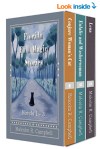


 On that page, I provide four-to-five links a day about recent book news. But my sources are becoming more and more political and making that harder for me to do without politizing the page. That is, I’m finding less information about new releases and author interviews and writing tips, and more information about authors’ views about present-day politics. If I link to such articles very often, I’ve become a political site rather than a books and authors site.
 I’ve never been able to get a short story of mine published by
  Malcolm's Round Table