It’s crap, but I can get it for you wholesale

Now that we’ve gotten rid of our towering roof antennas and torn the tin foil off the rabbit ears, I hoped TV would finally can all the late-night pitchmen who sold miracle products that usually broke before we got them (the products, not the pitchmen) out of the shipping boxes. Instead, we just have more of them, not counting those in Congress.

Some of the products are the same old same old. Beds and chairs that make you sleep like an angel–probably because they kill you. Vitamin supplements for $100 a bottle, buy now and we’ll throw in ten extra bottles for free exclusive of postage, packing, and handling. The supplements purportedly cure everything but stupidity.
space junkyard on alien planet the astronaut looking at space junkyard on alien planet, digital art style, illustration painting junk yard stock illustrationsAt first the new crap as exciting because it was something different than those kitchen gadjets that sliced and diced with only a 10% chance you’d be injured or set the kitchen on fire. Now we have electronic gear that is guaranteed not to tell the NSA where you are exactly and products that will run your house to much better than you do, they’ll probably run off with your spouse.

You know where the virtual assistants are going, other than Reno, right? One day we’ll tell our assistants to open thee pod bay doors and they’ll say, “I’m sorry, Dave. I’m afraid can’t do that.” When you point out that your name isn’t “Dave,” the support person will step in and say you should have purchased the 25-year warranty.

One time when my wife and I were buying a car, the salesman finished listing the two million features that made the car perfect. We were ready to sign. But then he said, “to protect your investment, can I interest you in a five year warrantly?” My wife answered, “Mr. Lundegaard, if the car is as good as you say it is, why do I need the warranty?” He looked like a deer in the headlights.

However, as we’ve all found out, telephone support people never look like deer in the headlights because their countries don’t have deer. Probably no headlights either. So, sooner or later we’re all going to find the pod bay doors closed and there won’t be anything we can do about it except to smile and say, “Well, at least I got the darned thing wholesale.”

Of course, if you’re dealing with somebody in Congress, s/he will tell you that your version doesn’t have any pod bad doors because, let’s say, the Sentate killed that part of the legislation, fearing that otherwise the crap would never fly. That doesn’t exactly make me feel warm and cozy, but what can I do? Vote? Right, what’ll help–unless we get a new party that doesn’t require “pitchman” or “wholesale” on a prospective candidate’s résumé.

I’m taking matters into my own hands. I’m buying a 1955 car with no electronics, especially snooping devices, in it and putting the tin foil back on my TV’s rabbit ears. Something to consider.

–Malcolm

Sunday’s one thing and another

  • Billings Gazette photo
    Empire Builder: “The westbound Empire Builder train 7/27, comprising two locomotives and 10 cars, was carrying 141 passengers and 16 crew members at the time of the 9/25 derailment. At approximately 3:55 p.m., the seven rear cars of the train derailed near the town of Joplin, Montana, located 75 miles (121 km) north-northeast of Great Falls, Montana, and 145 miles (233 km) north-northeast of Helena, Montana. Several cars were also tipped over after derailing. Three people onboard were killed and over 50 others were injured, including 15 who were hospitalized.” – Wikipedia (I’ve taken trains along this route many times, so the story caught my eye. During Glacier Park’s hotels’ season, there might have been park tourists on that train. Sad news.)
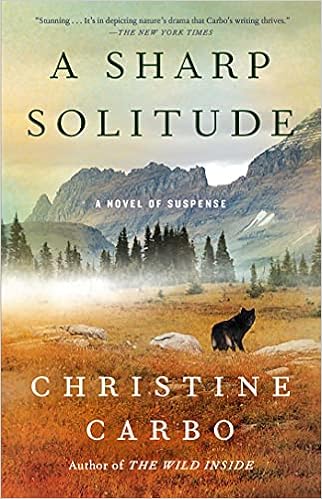
  • A Sharp Solitude, by Christine Carbo: I finished the fourth and, I believe, the last in the Glacier Park suspense series and found it somewhat slow going until I got near the end. Then, all hell broke loose. Worth the ride, I think, but less compelling than the series’ first three books.

  • The O.C. (outside cat): The O.C., who we named Robbie, showed up on our doorstep months ago and decided to stay. So, we fed him and gave him water along with a covered box to sleep in. Queries to local folks on Facebook turned up nothing about a lost cat. He seemed healthy, but we took him to the vet to make sure before we began allowing him in the house. Fortuately, there haven’t been any “incidents” with our two older cats except a little hissing when personal space is invaded. Robbie’s inside the house a lot and that seems to be working even though he wants to spend most of the daylight hours outside.
  • Supper: I went all out preparing tonight’s supper. This proves that even though I’m a man, I’m not scared of going in the kitchen. I also know how to get ice cubes out of the freezer.
  • Granddaughters: We haven’t seen my granddaughters for two years, first because I was having weekly cancer treatments and then because of COVID. Now, finally, it looks like we’ll be able to travel to Maryland to see them before they grow up and get married. (I was beginning to wonder.) I hope they remember who we are. In case you were about to ask, we don’t take the cats with us. Looking forward to the trip.
  • Weather: The remnants of two tropical storms dumped a lot of rain on us, so now, just as we’re enjoying sunny skies and lower temperatures, here comes Sam. According to those who know about such things, we should be in the clear. Hmm.

Meanwhile, I hope you are enjoying your weekend and reading lots of books.

Malcolm


Enjoying Christine Carbo’s four-part Glacier Park Series

There are four novels in Carbo’s Glacier National Park police procedural series. I just finished The Weight of Night which was released in 2017. The books have a lot of snap, crackle and pop to them, strong characters, and accurate descriptions of the world of Glacier.

From the Publisher:

The Weight of Night: A Novel of Suspense (Glacier Mystery Series Book 3) by [Christine Carbo]In a land sculpted by glaciers, the forest is on fire. Thick smoke chokes the mountain air and casts an apocalyptic glow over the imposing peaks and vistas of Montana’s Glacier National Park. When firefighters are called in to dig firebreaks near the small town bordering the park, a crew member is shocked to unearth a shallow grave containing human remains.

Park Police Officer Monty Harris is summoned to the site to conduct an excavation. But with an incendiary monster threatening to consume the town, Monty seeks help from Gretchen Larson, the county’s lead crime scene investigator.

While the two work frantically to determine the true identity of the victim, a teenager suddenly disappears from one of the campgrounds in Glacier. Could the cases somehow be connected? As chances for recovery of the missing boy grow slimmer and the FBI finds only dead ends, Gretchen and Monty desperately race to fit all the pieces together while battling time, the elements, and their own unresolved inner conflicts.

The Weight of Night is the latest novel in an award-winning series which “paints a moving picture of complex, flawed people fighting to make their way in a wilderness where little is black or white” (Publishers Weekly). It is a gripping tribute to the power of redemption set against one of America’s most majestic and unforgiving landscapes.

Any one who enjoys police/suspense novels will probably find this to be a page-turner. Those of us who worked in the park and/or visit it often will enjoy “going back again” via Carbo’s stories.

–Malcolm

Malcolm R. Campbell

Publisher: Thomas-Jacob Publishing

Website

Facebook Author’s Page

Amazon Author’s Page

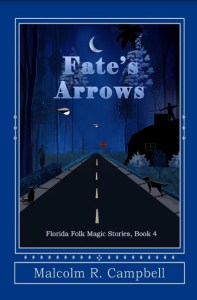
Malcolm R. Campbell’s novels include a few set in Glacier National Park and a few more, including “Fate’s Arrows,” set in north Florida.

Constantly re-designing my website

My boredom with everything static drives me to constantly tinker with my web site.  It’s definitely eccentric because–so I have been told (or accused of)–I am eccentric. I suppose when it comes down to the why of the website, it’s a continuing attempt to find kindred spirits, those most likely to read my novels.

What I’ve done here is added two Tarot cards from the Swords suit in the Thoth deck, the ace and the Knight (called the king in other decks). Swords represent the various aspects of the Air element, and I am very partial to this. The ace is the beginning, the first thought/idea: as I look at the world (and magic) the ace comes before everything else. The knight is my “personal card” in the deck, representing the analytical trickster.

According to Biddy Tarot, “The Suit of Swords Tarot cards deal with the mental level of consciousness that is centered around the mind and the intellect. Swords mirror the quality of mind present in your thoughts, attitudes, and beliefs.” I like this way of looking at swords.

Raven Tarot, a wonderful site for those who use the Thoth deck, says, “So the Swords represent the qualities of intellect and rationality, but also to every considerated achievement like culture, science, philosophy or any ongoing process that later ends up as ‘history’. This almost explains by itself why the Swords can be blessing and malediction the same time.” I also like this way of viewing the suit.

These symbols on the website obviously mean something to those who read or study Tarot cards and the associated Tree of Life. Like a tuning fork that causes a nearby tuning fork to vibrate at the same frequency, I believe these symbols are also a calling card to like-minded people who may have little or know knowledge of the Tarot. The images of the cards speak of magic, of course, and a way of seeing the world outside our consual view of reality. Those are the prospective readers of my books.

Does the site sell any books? Hard to say. If so, that’s good. If not, then my point of view is “out there” and (for me) that’s more important than the books.

Malcolm

Phoebe Snow Rode the Rails in a White Dress

One of the more inventive advertising campaigns at the beginning of the 1900s was the Phoebe Snow promotion by the Delaware, Lackawanna and Western Railroad to promote its use of anthracite coal. This is top grade coal and burnt cleaner in steam locomotices than bituminous coal. In the days of steam locomotives, one problem was the cinders that trailed behind the locomotive and flowed in through passenger car windows soiling clothes and sometimes starting fires.

This happened less often with anthracite coal. The railroad, which ran in New York, New Jersey, and Pennsylvania until Conrail absorbed it in 1976, had a nearby source of anthracite coal. This meant that using a campaign character who rode the rails in a white dress was made to order.

Elmo Calkins created the campaign and its fictional character who was portrayed as a socialite who frequently rode between New York and Buffalo in a white dress and a violet corsage became, according to Wikipedia, “one of the most recognized advertising mascots in the United States, and in further campaigns she began to enjoy all the benefits offered by DL&W: gourmet food, courteous attendants, an observation deck, even onboard electric lights”

Says Phoebe Snow
about to go
upon a trip to Buffalo
“My gown stays white
from morn till night
Upon the Road of Anthracite”

Now Phoebe may
by night or day
enjoy her book upon the way
Electric light
dispels the night
Upon the Road of Anthracite

Later the railroad would bestow the name Phoebe Snow on one of its trains, and the singer Phoebe Snow would take her her stage name from the railroad’s advertising character. 

A glance through railroad history books shows that during the days of privately owned (pre-AMTRAK) passenger service, advertising was a competitive art.

Malcolm

In the 1990s, Campbell served as the collections manager, researcher, and grant writer for a railroad museum in Georgia. Unsurprisingngly, his fiction–such as “At Sea” often includes railroads.


Our sick cat: she got better

A while ago, I wrote a post about the day every pet owner dreads, the day your pet leaves you. I was thinking of our 18-year-old female cat, Marlo, who has had inoperable cancer for quite a while. Nothing we can go about it. Then suddenly, she got worse. No apparent pain, just a near total collapse. I’ll spare you the graphic details.

She became thin as a ghost. Could hardly walk. Slept a lot. We had meds to ease pain, but she didn’t have any. So the meds relaxed her, something she needed when she got hyper

We weren’t ready for her to go. One is never ready. When her condition got out of hand, we talked about putting her down, something we’re generally opposed to doing, yet decided perhaps we’d take her to the vet the following day. But then we didn’t.

And she got better. Started eating again. Drinking more water. Walking without staggering. Eyes bright and focused. We were stunned. Once false move, and we’d jinx it, we thought. And yet, for reasons we may never know, she’s moving well (and fast, too), dozing in one lap or another while we’re watching TV, and hanging out at her familiar places throughout the house.

She’s really hungry. I’m not surprised. She needs to put on weight.

So, what happened?

I don’t have a clue. A random prayer, perhaps. Or maybe she just changed her mind, figuring she had a lot of mischief left to cause. Yes, that’s probably what happened.

–Malcolm

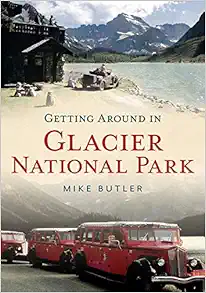
Briefly Noted: ‘Getting Around in Glacier National Park’ by Mike Butler

Mike Butler, who drove one of Glacier’s iconic red busses some years ago, has put together a compelling book about the park’s transportation history in the “America Through Time” series from Arcadia Publishing. Like most Arcadia authors, Butler has included a wealth of spectacular photographs: definitely a high point of the 128-page book that was released in Febuary.

From the Publisher

“Getting around in Glacier National Park was quite difficult for early travelers seeking to experience its towering mountains, deep glacial valleys, and extensive lakes. With Glacier’s location in the far northwestern corner of Montana, just getting to the park when it was formed in 1910 was a challenge for travelers. To meet this challenge, the Great Northern Railway brought early tourists to this remote location, transporting visitors to its East Glacier and West Glacier stations. From these entry stations, tour buses took passengers to majestic hotels which the Railway built at East Glacier, Many Glacier, and Waterton Lakes. Visitors seeking adventure within the park could then take horseback trips from the hotels to remote chalets, also built by the Railway. Boats plied the waters of Glacier’s lakes, taking tourists to chalets and hiking trails. Over 900 miles of trails were built across the park. Finally, as automobile travel gained in popularity, the magnificent Going-to-the-Sun Road was completed across the Continental Divide at Logan Pass in 1933.”

In his review in the Glacier Park Foundation’s newsletter, Mac Willemssen said, “The book’s chapters describe the development of the railroad, the roads, the boats, the buses, the trails, and the hotels. As such, it’s a great complement to anyone’s Glacier library. It’s very readable and easily puts the reader right in Glacier, whether in a bus, a boat, or on a trail.”

Butler is also the author of five other Arcadia titles: Around the Spanish Peaks; Great Sand Dunes National Park; Southern Colorado: O.T. Davis Collection; Littleton; and High Road to Taos. His brother David is the author of the 2014 Arcadia book Fire Lookouts of Glacier National Park.

In the Daily Interlake’s February review, Carol Marino wrote, “Getting Around in Glacier National Park is packed with historical details and over 150 photos of the park’s early years. It offers such rare glimpses into the park’s pictorial history, such as explorer George Bird Grinnell standing on a glacier in 1926 with his wife Elizabeth Grinnell. Both he and James J. Hill played a pivotal role in the establishment of Glacier Park.”

If you love Glacier National Park, this volume is a treasure.

–Malcolm

I have nothing to say

Yes, I can hear the clowns in the back row whispering, “Yay, the old duffer’s finally going to shut up.”

Not happening.

Yet, there are days when a writer is stuck in pure nothingness, a place where–counterintuitively–there is room for everything. And that’s the problem. Like many, I’m overwhelmed by the scope of everthing. Everything has simply become too large and that tends to make us feel too small. One can hide from the size of everything and how small s/he feels by talking constantly or running off at the thunbs, i.e., texting.

I’d rather just be quiet and think of nothing. When I clear my mind and think of nothing, I begin to relax, to go with the flow (as we used to say), and soon I am coping with everything without the angst and the smallness that usually go with it (everything). I’m amazed at how few people have discovered silence, or how wonderful it feels when you feel no need to fill that silence with talking.
And, as we see, the old song is right, that people are talking without speaking and hearing without listening, so I have come to believe that silence is safer and more sane and a more effective method of coping with everything on our figuratively plates than talking/texting ourselves into oblivion (real or imagined).

There are days, and this is one of them, where I think those who follow this blog will be better off keeping quiet rather than contemplating anything I could possibly say there.

As an older generation read in Desiderata, “GO PLACIDLY amid the noise and the haste, and remember what peace there may be in silence.”

Malcolm

Glacier Park Hiking -be aware of the dangers before you start

The news that solo hiker Jennifer Coleman was found dead near Glacier Park’s Logan Pass after being reported missing two days earlier comes as a shock and reminds all of us who love the park’s pristine beauty that in spite of visitor overcrowding, the beautiful mountainn world is a a dangerous place.

Wikipedia photo

I made it a policy to never climb alone in the park and, other than two-to-three mile strolls around Many Glacier Hotel, never to hike alone. Too much can go wrong, from illness, to falls, to bears and mountain lions. Even a sprained ankle can put a person down on a seldom-travelled trail with no way to get help where there’s no cellphone service.

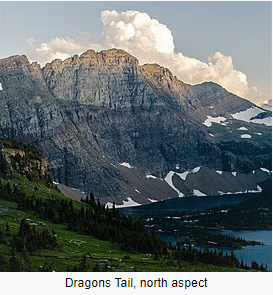
Coleman’s death is under investigation. Even the precise location hasn’t been released, though there’s speculation she was hiking along the Highline Trail or the Dragon’s Tail. The highline is filled with hikers, yet if one fell when nobody else was nearby, they might land in an out-of-view spot. The Dragon’s Tail has fewer visitors and this makes hiking alone there more dangerous.

As for Coleman, all we know is that she was near Logan Pass and was apparently hiking or climbing alone. The peace of the mountains and the lure of wondrous views is addictive and hard to resist. So, I cannot fault her solo hiking. I might have done it even though I knew I shouldn’t. I’ve climbed a lot of mountains and would probably assume I was imune to the potential dangers.

Matches, maps, bear spray, water, food, and a hiking partner are always the safer way to proceed. We know this, but we don’t always do this.

Malcolm

Malcolm R. Campbell has written fiction and nonfiction about Glacier National Park. including the novel “Mountain Song.”

Search for Missing Visitor Near Logan Pass Underway UPDATE

NPS Glacier News Release

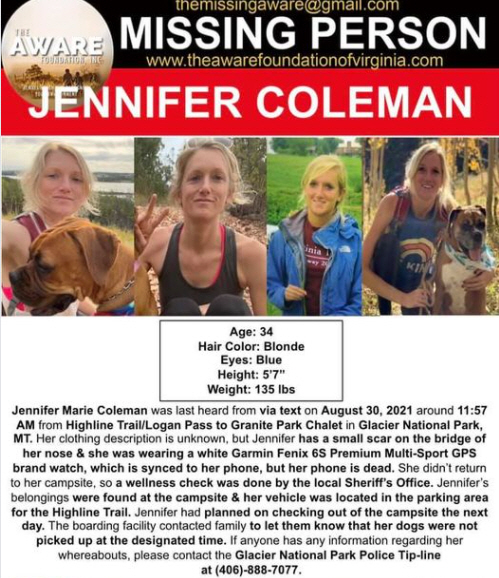
WEST GLACIER, Mont. [September 3, 2021] – Search efforts are underway in Glacier National Park for Jennifer Lee Coleman, a 34-year-old Virginia resident.

Coleman was supposed to check out of the West Glacier KOA on Tuesday, August 31 and was believed to be hiking around Logan Pass on August 30th or 31st. An extended team of ground searchers will continue searching today in cooperation with Flathead County Search and Rescue, Two Bear Air Rescue, Flathead County Sherriff’s Department, and the Flathead National Forest.

Coleman is 5 feet, 6 inches tall and approximately 128 pounds with blond hair and blue eyes. She is possibly wearing a tank top, spandex pants, sunglasses, brown slip-on two toned boots, a turquoise and pink flower scarf, and a dark colored day pack.

Coleman’s last known itinerary is believed to be hiking solo on Monday, August 30 possibly to the Dragon’s Tail or Highline Trail. Her vehicle has been located at Logan Pass.

Anyone that may have information or was in the area and saw an individual that fits the description is encouraged to contact the park tip line at 406-888-7077.

The following information comes from the AWARE Foundation:

Body of missing woman found in Glacier National Park

Posted at 7:22 PM, Sep 05, 2021
and last updated 9:27 PM, Sep 05, 2021

GREAT FALLS — The body of Jennifer Coleman, who was reported missing on Wednesday, September 1, was found in Glacier National Park on Sunday.

Park officials said in a news release that Coleman’s body was found in a steep and rocky area near the Continental Divide. Coleman’s family has been notified.

The cause of her death is being investigated.