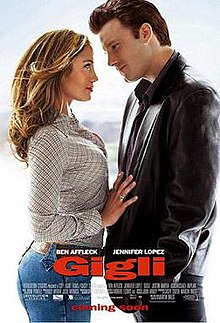
 Writing coaches and writers’ magazines often provide writing prompts to help people practice their craft. A writing teacher of mine had a different approach. Whenever he saw a “bad” movie, he had fun figuring out how make it better. While the probably stayed within the realm of the plot and the dialogue, my Radio/TV undergraduate major causes me to include acting and production values.
According to FilmDaft, “The key ingredients that make a movie ‘good’ are when the acting, directing, writing, cinematography, and overall production value all come together to tell one cohesive, entertaining, and impactful story. In essence, a good movie uses all these tools of filmmaking to tell a compelling story that makes you feel.”
True, but that’s a bit general, so when I consider what would make a bad movie better, I usually stick to the writer’s part of it.
Here I think we can say that if the premise and plot structure are flawed, the movie probably will also be flawed even though everyone and his/her brother probably had a hand in the rewrites before the film was finished.
To make this excercise work, we need to stay away from reviewers and critics and the flaws they see and use the flaws we see. Of course, even good movies may have flaws. For example, “Ladyhawke” is one of my favorite films, but I think the music chosen for it is an abomination and that Matthew Broderick’s character was too flip for the time when the film was set.
When a movie is bad, it’s often because it’s predictable, has unlikely plot twists, is based on a faulty premise, or is jokingly unrealistic within the time and place and subject area in which it was set. Doing this exercise as a writer, I think about:
- How can I make it less predictable?
- What are the worst plot twists?
- Can the premise be altered without throwing out the film altogether?
Did you see the 2003 film “Gigli”? It was considered a failure, often due to general disorganization and a clumsy plot. Okay, these are problems a writer can work with while ignoring critics’ complaints that Affleck and Lopez lacked chemistry. So here the excerise becomes fixing the plot.
Never fear, if you play around with this exercise, you don’t have to re-write the script or even come up with a new treatment for the story. Nailing down what you might do to make it better will, I think, help you see how any story can be made workable.


![Lena (Florida Folk Magic Stories Book 3) by [Malcolm R. Campbell]](https://m.media-amazon.com/images/I/51hh6S3wS8L.jpg)
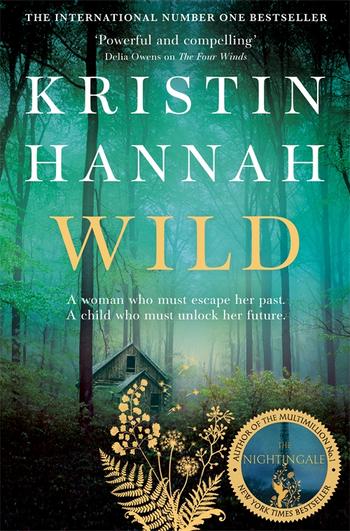 Kristin Hannah: While the subject of Wild was compelling for anyone interested in psychology, I was disappointed in this early novel, believing that Hannah hadn’t really come into her own in nailing down her style and voice. The feel-good ending falls into the characters’ laps without insufficient foundation and the author discounted her own childhood disabilties specialist by having her look up autism on the Internet. As I said in my
  711 Ocean Drive: My wife and I watch a lot of noir movies on TV and this one fit the bill last night. I liked the big shoot-out ending at Hoover Dam (still called Boulder Dam in the film) because I visited the dam when I was young and the scenes in the movie matched my memories of the tour. Apparently, when the film came out, Columbia Pictures said that gangsters were so angry about the film giving away their secrets that the production company had to take out special insurance politices on the primary stars (Edmond O’Brien and Joanne Dru) to keep them safe. The Turner Classic Movies (TCM) host said that notion was probably a PR stunt.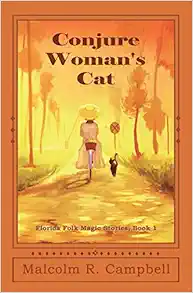
 the garage.
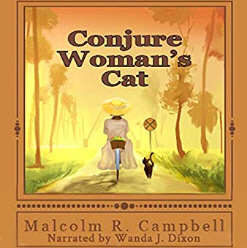 The audiobook edition of Conjure Woman’s Cat continues to be my top selling novel right now. Thanks to those of you who have listened to it and/or read the paperback or Kindle editions which seem to be in second place, saleswise. Naturally, I hope people who love this story will discover the three that follow it in the Florida Folk Magic Series.
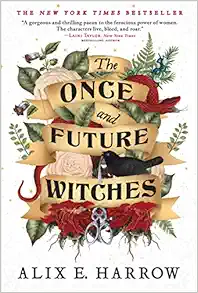 I have been enjoying Alix E. Harrow’s The Once and Future Witches and consider it one of the best fantasies I’ve read in a long time. The plot is compelling, featuring three witches trying to lead a normal life in New Salem. Well, what are the odds of that happening. The witches find magical spells hidden in nursery rhymes and listen to old stories which are included in the book. Harrow writes well and has, I believe, created a masterpiece here that will remain on nightstands for a long time. Perhaps until the cows come home.
 I continue to work on Weeping Wall, my novel in progress, set in Glacier National Park as a sequel to The Sun Singer and Sarabande. I am working slowly because the main character knows more magic than I do and it’s kind of hard to fake that. The Weeping Wall, as shown in the picture, is a feature on the park’s Going to the Sun highway. Yes, it’s a good place to get wet or wash your car.
 Since our 2006 Buick LaCrosse is, shall we say, getting a big old, my wife and I have been looking at newer sedans. As it turns out, the car companies have gotten rid of almost all of their sedans. I looked on line and found out that one of the reasons is that Americans have gotten too fat to get in and out of them. Now it’s all pickups and SUVs, making me remember how not long ago people stopped buying those because they’re gas hogs. As it turns out, the people are the hogs. Apparently the Chinese continue to love the LaCrosse. No, our car doesn’t look like the one in the photograph.
 Okay, this isn’t my Facebook meme. Nonetheless, I apologize for showing it to you. I hope you enjoyed New Year’s Eve. We got into a movie and forgot about it other than hearing fireworks out there somewhere. We were watching “Being the Ricardos” which was especially fun for those of us who watched “I Love Lucy” like it was gospel between 1951 and 1957.


![Waking Plain by [Malcolm R. Campbell]](https://m.media-amazon.com/images/I/61lBtMuXqjL._SX260_.jpg)
 They didn’t touch the credit cards, I said. Too much hassle, he said, lighting one of the cigarettes that probably helped keep im as thin as a rail. I told him I cancelled the cards within an hour of losing the wallet. Smart, he said. I said, well, as you can see, they cleaned out my cash, but can I give you something for your trouble. No need he said, but after hemming and hawing took the $20 and rode off down the highway after we shook hands.
![The White Album: Essays by [Joan Didion]](https://m.media-amazon.com/images/I/51aZNMCWG9L.jpg) I hope the subhead for her
I hope the subhead for her ![Florida Folk Magic Stories: Novels 1-4 by [Malcolm R. Campbell]](https://m.media-amazon.com/images/I/51JM4A8GQFL._SY346_.jpg)
 I’m aware that Pulitzer Prize winning poet Sara Teasdale (1884-1933) was once popular and now appears unknown or ignored. Nonetheless, I’ve never forgotten “The Coin”:
 My favorite poem is “Fern Hill” written by Dylan Thomas in 1945:
 Now, I think, my tastes run more toward the work of poet and sax player Joy Harjo, as in “She Had Some Horses”:
 Malcolm's Round Table