 My late uncle Maury B. Campbell edited this lavish, spiral-bound love letter to San Francisco in 1949. As a child, I was a little scared of the old prospector on the cover but found myself drawn to the photographs inside. If you search for the book on Google, you’ll find it for sale (used) for $30 to $50.
Like Tony Bennet, I left my heart in this town and saw Pay Dirt as a book of dreams about the place where, one day, I would return. After all, the Campbell family could be found in multiple cities throughout the Bay Area where I was born.
The book comes to mind today because there was a thread about it in Facebook’s “San Francisco Remembered” group that my brother Barry and I follow. I said something like “nice to see the book edited by my uncle showing up here.” Barry did me one better, he posted the news release that came out when the book came out. That was a surprise to everyone but me (since I know Barry has scanned in copies of everything).
The book was, I believe, well received by the city’s movers and shakers and is in demand today by people who love Frisco. As for me, I went back a few times and briefly had an apartment there in the Mission District when my ship was in port in Alameda. The J Church streetcar ran past my front door (and still does). I looked at real estate values lately and see that the three-flat building where my aunt lived is now valued at over a million dollars. That’s why I never went back for good.
But, I digress; The news release begins like this:
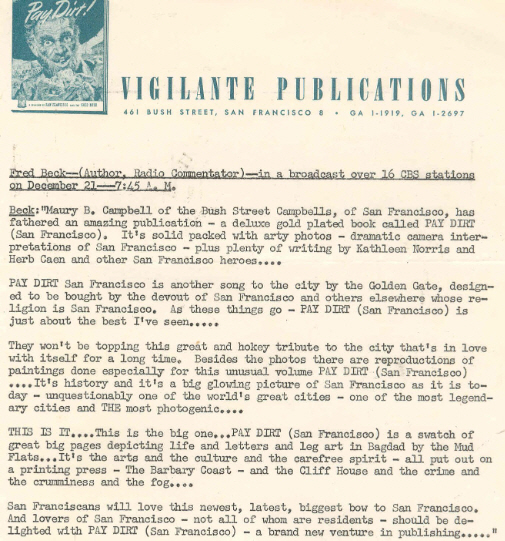
After all these years, how nice to see people are still talking about it and looking for copies.
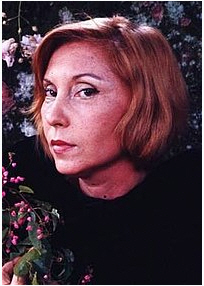 I wonder if all writers feel this way. The quote is often shown in this form, though the complete thought comes from Clarice Lispector’s novel A Breath of Life: “I write as if to save somebody’s life. Probably my own. Life is a kind of madness that death makes. Long live the dead because we live in them.” Now, if you’re a writer do you still agree, or does the second part of the quote change your mind?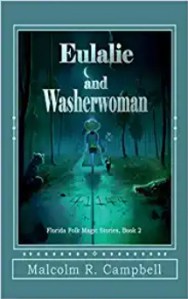
 When I was in his school, I looked at the careers of Salinger, Elison, Bradbury, Ginsberg, Rand, and others and told people that’s what I wanted to do after I graduated from college. Most of them laughed. Now, years later, I see why they did even though then and now I don’t see that laugh as very supportive.


 There’s also a disconnect between FDOT and the damage it does. My primary concern is the endangered Florida Panther. Estimates vary, but there are less than 200 left.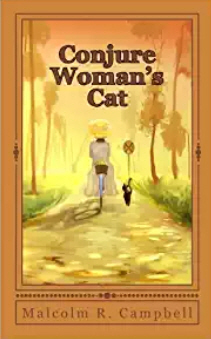
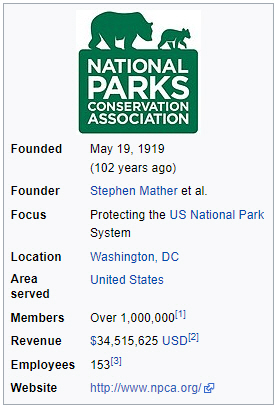 The National Parks Conservation Association (NPCA) is the only independent, nonpartisan membership organization devoted exclusively to advocacy on behalf of the National Parks System. Its mission is “to protect and enhance America’s National Park System for present and future generations.” Founded in 1919 as the National Parks Association, the organization was designed to be a citizen’s watchdog for the National Park Service (NPS) created in 1916. Among the founders of NPA was Stephen Mather, the first director of the National Park Service —

 According to Radio Free Europe, “Russian officials have accused Ukraine of mounting a helicopter attack early on April 1 on the fuel depot located near Belgorod, not far from Russia’s border with Ukraine.” My first thought was, “Stop Whining. You’ve destroyed Ukraine and now you feel put upon when they strike back?” While conceding the depot was a viable target, Ukraine says they didn’t do it. Oh really. Well then, kudos to whoever did do it.
 Spring means watching the yard get shaggy and then trying to figure out what it’s going to take to get the riding mowers running after a winter of just sitting there. One finally cranked up after we put the trickle charger on the battery for a while. Apparently, the other one will need a new battery inasmuch as the charger message said BATTERY SHOT TO HELL.
 I’m looking forward to reading The Librarian of Auschwitz, next up on my nightstand. Written by Antonio Iturbe, the novel is based on the true story of Dita Kraus. Here’s the publisher’s description: “As a young girl, Dita is imprisoned by the Nazis at Auschwitz. Taken from her home in Prague in 1939, Dita does her best to adjust to the constant terror of her new reality. But even amidst horror, human strength and ingenuity persevere. When Jewish leader Fredy Hirsch entrusts Dita with eight precious volumes the prisoners have managed to sneak into the camp, She embraces the responsibility―and so becomes the librarian of Auschwitz.”
 Meanwhile, author Luis Alberto Urrea announced on his Facebook page a soon-to-be-released book of poetry. I like his work a lot, so I’ll be looking forward to Piedra as soon as it becomes available on Amazon and other online sellers. While I’m waiting, perhaps I should re-read my favorite from him The Hummingbird’s Daughter, a historical novel.

 Malcolm's Round Table