Publishers Weekly Leads Petition Drive to End Cuba Book Embargo

Cubans and Americans haven’t had much access to each other’s literature for fifty years. Even though relations are becoming more normalized between the two countries, the overall embargo remains in place.

PWlogoPersonally, I don’t think an embargo on consumer products ever made sense, much less now.

According to the Publishers Weekly article A Letter from PW on the Cuba Book Embargo, “The Cuban people’s desire, and need, for American books was evident during the February U.S. publishing mission to Cuba, organized by PW and Combined Book Exhibit, in close cooperation with Cuban government officials.”

Click on the link in the paragraph above to see why PW thinks the embargo should be lifted. Or, if you already believe it should be lifted, you can read the petition here.

The embargo can only be lifted through Congressional action.

–Malcolm


Briefly Noted: ‘I Do: A Cultural History of Montana Weddings’

“A young and plucky eastern girl moves to the Wild West to be swept off her feet by a handsome and muscular cowboy: it’s the stereotypical plot of countless romance novels set in Montana.” – Montana Historical Society Press

We’ve all seen wedding stories like this in movies, novels and television shows. Some of those stories might even be real. However, historian Martha Kohl, a fifteen-year specialist at the the Montana Historical Society in Helena, found that the reality of Montana weddings over a 150-year period was every bit as romantic and absorbing as the fiction.

If you live in or near Helena, you can meet the author and enjoy the society’s new exhibit “And the Bride Wore…Montana Weddings, 1900-1960” on January 10th, between 6:30 and 8:30 p.m. at the MHS headquarters at 225 North Roberts.

IdoFrom the Publisher:

Through engaging stories of romance, insightful analysis, and historic intriguing photographs, I Do: A Cultural History of Montana Weddings provides an intimate and surprising look at an important tradition. I Do journeys through the last 150 years of Montana history, from the 1860s gold rush to the internet age, to reveal the lives of ordinary people, from Finnish homesteaders, Chinese restaurateurs, and Métis fiddlers to struggling miners, Blackfeet students, and Jewish merchants.

About the Exhibit:

MHSlogoThe Montana Historical Society’s newest temporary exhibit, will examine how history has shaped weddings—and particularly wedding fashion—during the first half of the twentieth century. Sixteen delightful and diverse dresses will be on display, including a hand-stitched dress made of white lace and yellow silk ribbon (worn in Butte in 1907), a Crow elk-tooth dress (worn in Lodge Grass in 1945), and a ballerina-style white dress of synthetic satin, lace and tulle (worn in Hardin in 1957). An opening reception will be held January 10, 2013, from 6:30-8:00. The opening will feature a wedding dress fashion show, a 1950s style cake and punch reception, a book signing by Martha Kohl, author of I Do: A Cultural History of Montana Weddings, and Slovenian wedding dance music. Don’t miss the fun! Viewers will be asked to participate in the exhibit by voting for their favorite ensemble and trying their hand at an old-fashioned Singer treadle sewing machine. The dresses will remain on exhibit through November 2013.

The exhibit is listed on line here with contact information and other details.

Malcolm

A long-time member of the Montana Historical Society, Malcolm R. Campbell is the author of contemporary fantasy novels partially set in Glacier National Park, including “The Sun Singer,” “Sarabande,” and the upcoming new adventure, “The Seeker.” Watch the trailer.

gohFBcover

End of an Era – The last ‘Newsweek’ Print Issue

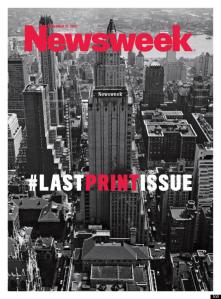
newsweekThe final cover of the print edition of “Newsweek” was revealed in an article in “The Huffington Post.”

Even though I haven’t read “Newsweek” in over ten years, I’m sad to see it go, just as I was also sad to see many of the other weekly and monthly print magazines I grew up with go out of business over the years. With the loss of these magazines, the public (and writers) lost a lot of outlets for short stories, features, commentary, viewpoint and the longer-form journalism that wouldn’t fit in the daily newspaper.

Founded in 1933, “Newsweek” seemed destined to trail behind “Time Magazine” in circulation. However, I found it more accessible than “Time” during the days before it began going down hill. As a subscriber, the first indication of coming hard times was the size of the magazine. It began getting thinner and thinner as pages were cut even though the subscription price increased.

I mourn the death of magazines because they presented in-depth stories most newspapers didn’t have the time or space to cover. Our Internet world is too full of hype, instant-experts, short-attention-span articles, articles filled with opinions and commentary, and all the other rush-to-judgement “facts” and “notions” the social media are famous for. Online “news,” to the extent that it can be called news, has lost most of the traditions of solid, professional reporting.

Blurring Facts and Opinions

Another reason I stopped reading “Newsweek” was due to its blurring of the lines between good journalism and bad journalism. Good reporters never tell you what they feel about a story, much less include ideas/views that aren’t attributed to a reputable source. True, news magazines did present analysis, but “Newsweek” often took that as license to write “news stories” in which the facts and opinions were mixed up into the kind of story I didn’t even expect my college journalism students to be writing once we got a ways into the semester.

newsweekfirstI got so ticked off at “Newsweek” on one occasion, I tore out several of the major news stories and went through them with a red pen marking every opinion and every unattributed fact. I sent it to them with an “F” on top and asked which journalism schools the reporters flunked out of before they were hired by the magazine. I never heard back, of course. Now, what “Newsweek” did has become so prevalent that many news consumers don’t even realized they’re often reading the reporter’s notion about the news rather than the news. When I mentioned the lack of straight news in a Facebook status update recently, one friend said “I know what you mean. That’s why I always rely on XYZ,” whereupon she mentioned one of the most biased news personalities in the business.

So, I lament the loss of “Newsweek’s” print edition along with everything else that used to be considered standard, solid journalism before the “happy news” and it’s foul cousin, “My uninformed view is just as valid as the expert’s informed view” kind of reporting took over.

Now, if you want facts, you’ve got to look farther and farther to find them. Rest in peace, “Newsweek.”

Malcolm

Announcing: New Paranormal Short Story ‘Cora’s Crossing’

coracoverI’m happy to announce the publication of my e-book short story “Cora’s Crossing” released this week by Vanilla Heart Publishing. Priced at only 99 cents, this Florida Panhandle ghost story is already available on Kindle, PDF on OmniLit, and in multiple formats at Smashwords. The Nook version will be available soon.

Ghost Stories as “Local Color”

If you do a Google search like “Florida Ghost Stories” or “Swamp Ghosts” or “Southern Ghosts,” you’ll get hundreds of hits for spooky stories, haunted cemeteries and houses, and ghost hunter expeditions. Stories and legends are, as authors and journalists often say, part of the “local color”—the yarns, history and experiences that make places unique.

Local color in Marianna, Florida, the panhandle town most tourists know as the home of Florida Caverns State Park, includes a local legend about the haunted Bellamy Bridge across the Chipola River a few miles north of the caves. The story has been around for over 150 years and focuses on a young bride who died when her wedding dress caught fire. Since then, she has—some say—taken up residence at the old bridge, and possibly at the wood bridges that crossed the river before that. Local historian Dale Cox writes about the differences between the legend and the real-life Elizabeth Jane Bellamy in his new book The Ghost of Bellamy Bridge.

“Cora’s Crossing” is Pure Fiction

I’ve always enjoyed reading stories in which everyday people suddenly run afoul of ghosts (and other creatures) out of local legends. Truth be old, when I last drove over Bellamy  Bridge, I didn’t see a ghost. However (and this is important), I knew better than to drive over it at night. In “Cora’s Crossing,” two young men do drive over it at night and find more than they bargained for when they discover an injured young woman on the shoulder of the road and learn that the people who put her there are coming back.

The Florida Panhandle is filled with remote coastal areas, swamps, blackwater rivers, and other locations that are perfect for ghosts. Growing up there, I heard hundreds of ghost stories, usually at night when we were on Scout camping trips. Most of them began with, “On a dark and stormy night not far from our camp site. . .” Nothing like falling asleep with a ghost story on your mind. My Boy Scout troop never met up with any of the ghosts in those stories.

But what if we had? Worse yet, what if I had driven my ancient Chevy over Bellamy Bridge on a rainy night? I promise you, I didn’t. This story never really happened. Feel free to go visit the bridge during a thunder storm. Everything will be fine.

Malcolm

Kindle Edition
Kindle Edition

If you’re a fan of ghost stories, you may also like “Moonlight and Ghosts,” a story about the ghosts in an abandoned psychiatric hospital.

Follow me on Twitter and Facebook!

Briefly Noted: ‘Reshaping Our National Parks and Their Guardians’ by Kathy Mengak

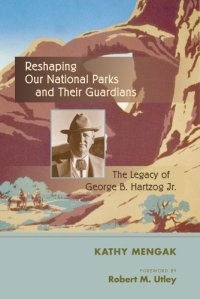
Reshaping Our National Parks and Their Guardians: The Legacy of George B. Hartzog Jr., by Kathy Mengak, with a foreword by Robert M. Utley, University of New Mexico Press (April 2012), 336 pp

When Glacier Park’s Centennial Program Committee received the George and Helen Hartzog Volunteer Group Award for promoting the park’s 2010 centennial, many visitors were unfamiliar with the man who led the National Park Service between 1964 and 1972 or with the award established in 1998 (and subsequently supported via a fund created by his wife) to honor those donating time to help the parks.

Published earlier this year, Kathy Mengak’s Reshaping our National Parks and Their Guardians ably tells the story of the highly successful NPS director who added 72 new parks to the system during a contentious political era in American history. In his book review in the Autumn 2012 issue of “Montana The Magazine of Western History,” Craig Rigdon writes that while the author’s “fondness for Hartzog is evident…she provides a fairly balanced review of his career.”

Originating with Mengak’s dissertation at Clemson University, the book draws heavily on twelve years of interviews conducted with Hartzog and other key officials. Hartzog died in 2008.

Kurt Repanshek (National Parks Travler) writes that Hartzog “was a cigar-chewing, Scotch-loving, Stetson-wearing, lover of fishing, hard-charging director who often knew exactly what he wanted and found a way to get it. One way or another.” His review of the book is posted here.

From the Publisher

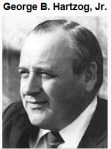
Wikipedia Photo

This biography of the seventh director of the National Park Service brings to life one of the most colorful, powerful, and politically astute people to hold this position. George B. Hartzog Jr. served during an exciting and volatile era in American history. Appointed in 1964 by Secretary of the Interior Stewart Udall, he benefited from a rare combination of circumstances that favored his vision, which was congenial with both President Lyndon Johnson’s “Great Society” and Udall’s robust environmentalism.
 
Hartzog led the largest expansion of the National Park System in history and developed social programs that gave the Service new complexion. During his nine-year tenure, the system grew by seventy-two units totaling 2.7 million acres including not just national parks, but historical and archaeological monuments and sites, recreation areas, seashores, riverways, memorials, and cultural units celebrating minority experiences in America. In addition, Hartzog sought to make national parks relevant and responsive to the nation’s changing needs.

I like Rigdon’s comment that while most people remember the National Park Service’s first two directors, Stephen Mather and Horace Albright, Reshaping Our National Parks and Their Guardians demonstrates that “some of the most critical years in the agency’s history took place during George B. Hartzog’s tenure as director.”

–Malcolm

Malcolm R. Campbell is the author of “Bears; Where They Fought: Life in Glacier Park’s Swiftcurrent Valley” and two contemporary fantasy adventures set in the park, “Sarabande” and “The Sun Singer.”

All three books, from Vanilla Heart Publishing, are available on Kindle. “Sarabande” and “The Sun Singer” are also available in trade paperback.

‘Top Gun’ on the Big Screen in Gresham, Oregon

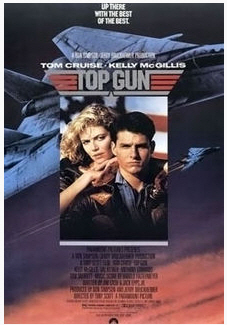
Did you know that many of the scenes in the 1986 action/adventure movie “Top Gun” were filmed aboard the aircraft carrier USS Ranger (CVA-61) pretending to be the USS Enterprise?

Now decommissioned, the USS Ranger is en route to becoming a museum in Fairview, Oregon through the efforts of the USS Ranger Foundation.

In support of this project, the foundation is sponsoring a 25th anniversary showing of “Top Gun” as a fundraising project on Sunday, May 6, 2012 at the Mt. Hood Theatre, 401 E. Powell Blvd, Gresham, OR 97030, 12-3pm.

Click here for more information along with a nice film trailer showing some realistic launch and recovery operations along with the kind of flying hi-jinks you might expect out of any character played by Tom Cruise.

If you live in or near Gresham, this movie will make for a great afternoon of entertainment in support of a good cause!

Malcolm

Harding: ‘Teapot Dome Spirit Pushing Up Oil Prices’

Oilwellfrom Morning Satirical News

Blooming Grove, Ohio, May 2, 2010–With oil prices on the rise, members of the Warren G. Harding Seance and Spook Association (WGHSASA), asked the ghost of the former President at his annual Walpurgis Night appearance if he knew “what’s up with big oil?”

“The Spirit of Teapot Dome is pushing up oil prices,” said Harding (1865-1923), “and this time out, none of my friends are going to take the fall for it.”

Harding, who is often called America’s least-effective President, has appeared to paranormal people on the thirteenth floor of the historic Argus Hotel in metropolitan Blooming Grove near his birthplace every Walpurgis Night since 1924.

When the former President appeared to be a no-show for his yearly Not Nostrums, But Normalcy meeting with CIA operatives, thrill seekers and Presidential hopefuls, WGHSASA members lit an extra bonfire on the hotel balcony and began changing the immortal lines of writer John Hodgman:

Fiddle, diddle, fiddle fee,

Teapot Dome has come for me.

Fiddle, diddle, middle, me,

Harding’s corpse will come for thee.

Harding, who materialized dead-center on an overstuffed couch, shouted, “Who interupts my sleep tonight when the powers of darkness are abroad in the land?”

“It is I, Master, your humble servant, Mikey De Wolfe, president of the Blooming Grove chapter of your fan club.”

“What have you to ask of me, Mikey?”

“We are concerned about Benchmark oil for June delivery prices as reflected in trading on the New York Mercantile Exchange and on the ICE Futures Exchange in London,” said Mikey.

Teapot “Mikey, dear boy, you must always remember my credo, Not Agitation, But Adjustment,” said Harding. “As you ponder oil prices, ponder where the oil is and who has it.”

“Big oil has it, Sir.”

“Have they really?”

Harding leaned back on the couch and seemed to fall asleep. When Hodgman’s immortal lines failed to hold him to the earth plane, Mikey and other WGHSASA members served the traditional post-seance snack of Alaskan King crab to all who had gathered at the Argus.

On-the-scene historians reminded reporters that the meal is a brave tribute to a former President who, some say, died of bad crabs in San Francisco during his 1923 cross-country “Voyage of Misunderstanding,” rail trip.

According to well-placed insiders, “Big Oil” representives attending the seance where “white faced” during Harding’s pronouncements. One grey haired man dropped his teapot.

According to Old Maxie, the elevator boy at the Argus, the hotel doesn’t have a thirteenth floor.

“But every year they come here,” he said, with a grin on his face, “to re-enact Odgen Nash’s most famous epic, A Tale of the Thirteenth Floor. As Nash said, conversations like this are ‘table talk in hell.’ Let’s depart in peace in a spirit of Not Experiment, But Equipoise and let our dearly departed Presidents lie.”

Mikey laughed when Maxie said that.

–Jock Stewart, Special Investigative Reporter for the Star-Gazer. Download his free “Jock Talks…Satirical News” e-book from Smashwords.

JTSATIRICAL

Coming November 21: Blog Jog Day

Put on your running shoes this Sunday and be ready to race from post to post during the astoundingly awesome and deliciously overwhelming Second Annual Blog Jog Day. (It goes without saying that clothing is not required.)

After years of research and a few scrapes with demons, my Blog Jog Day post will be nothing less than splendidly tremendous.

Perhaps you will learn where all the bodies are buried.

Or the long-sought Confederate Gold.

Or Judge Crater (erroneously believed for years to be at the bottom of Crater Lake).

Or the meaning of the Beale ciphers of 1820.

Or why the world forgot about Burma Shave in in spite of those magical little roadside signs with jingles like The wolf is shaved so neat and trim, Little Red Riding Hood is chasing him.

If things get weird on Blog Jog Day, blame the full moon. If they don’t, then make sure to stay hydrated, and happy jogging.

Malcolm

On Sale at Vanilla Heart Publishing

That’s The Way It Is

“It is hard to explain why Cronkite’s death matters today. If you came of news consumption age after the dawn of cable news and the Internet, you have not known a time when commentators did not scream at each other, when they did not express political views, when shedding a tear when the president was gunned down was actually controversial because it showed emotion. — Al Tompkins, Poynter Online

WCTV, the lone television station in Tallahassee, Florida during the 1950s and 1960s, was a CBS affiliate, ensuring that I would grow up listening to the evening news as presented by Douglas Edwards and then Walter Cronkite. With Cronkite’s death yesterday, an era ends–figuratively. I cannot say that it ends in reality for cable and satellite news have, for the most part, stepped away from the best journalism of Cronkite’s era and have replaced it with something unrecognizable to veteran reporters.

I trusted Cronkite for many reasons, the first of which was that he was a real journalist, honing his craft for United Press International in World War II. He was a reporter before he was an anchor. I also trusted him because, other than championing the kind decency any average person would champion, Cronkite seldom betrayed what he thought.

I know what most of today’s anchors think and that’s why I don’t trust them. Walter’s agenda was reporting the news as clearly and as objectively as he could. Many of today’s anchors have expanded their agendas to include advocacy of one political spin or another.

Today’s ratings appear to demand infotainment rather than true journalism for a high percentage of each hour’s broadcast minutes. With Cronkite’s death, perhaps we will stop and think what we have been doing to the art and craft of news reporting for the 28 years since we last heard him end a broadcast with his trademark “That’s the way it is.”

For my latest Jock Stewart satire about the declining state of investigative journalism and newspapers, I invite you to read The Last Investigative Reporter in America.

Copyright (c) 2009 by Malcolm R. Campbell

What’s Your Iran Policy?

“News is a necessity in a democracy, for only those who understand the nature of their world can comprehend the perils and hazards facing them and thus survive the struggle. Men who enjoy a free and open encounter with vital ideas and issues, facts and problems of their epoch can best map their future.” Campbell and Wolseley in “How to Report and Write the News.”

“With Neda’s death, the Iran I know finally has a face. The sequence of her death is the sequence of our nation’s struggle in the past 30 years: The democratic future that 1979 was to deliver collapsing, then trails of blood — that of so many executed or assassinated — streaming across its bright promise. The film of Neda’s death is the abbreviated history of contemporary Iran.” — Roya Hakakian in “Commentary: Pray for Neda

As you watch the protests in Iran on television and read about the importance of Twitter in spreading vital news to those who are otherwise denied access to information, have you formed an opinion about what must be done and developed a policy?

Most often, we are shown only one side of the coin in Iran, and that is of a rogue nation figuratively in bed with North Korea and a long list of other regimes portrayed–and often hunted–like junk yard dogs.

We read of the nuclear threat, of “honor killings,” of rule by divine right, of repression and torture supposedly justified by divine concurrence.

We are busy people, plugged into each others daily lives via Twitter, Facebook, and cell phones, so time and space for Iran on our daily radar scopes is, indeed, quite limited. Perhaps a fleeting glimpse the Ayatollah’s face as we last saw it in a news photograph or a political cartoon, perhaps an image of a nuclear holocaust with stock images out of one of the “Terminator” movies, perhaps an image of protesters marching in the streets.

Understandably, it’s easy for these images to become lost in the great clamor of background noise that is, by the grace of God and circumstance, far away. Even so, you probably have an opinion about it and, perhaps, what our government’s policy ought to be. But your policy, has it reached the drawing board yet?

Some say the U.S. and Israel should, on one pretext or another–whether out of rationalization or a true clear and present danger–attack. Others see this view as absurd.

What then?

Lately, some voices suggested that the U.S. should take care in its statements about Iran’s invalidation of the election and its harsh treatment of the protesters lest the Ayotolla find sufficient “evidence” in our statements to “prove” the protests are being orchestrated by Washington.

In her “Commentary: Pray for Neda,” Hakakian writes that during her first cab ride in the U.S., the driver asked her where she was from. When she said she was from Iran, the driver responded “Eeran … Khomeini?” and then moved his hand across his throat in a knife-slitting gesture.

Hakakian concluded that from this that “2,500 years of civilization was reduced to one vile name and the invocation of a throat being slit. It did not take long for me to learn that between the Iran that I knew and the Iran that Americans knew was a discrepancy as vast as the waters that separated us.”

It’s likely, given our lack of daily attention–especially when Iran is overtly quiet–that our opinion of Iran is similar to that of the cab driver.

And, if we are not among those urging our government to attack, what then is our opinion about our government’s alternatives. Is it “hands off”? Is it “out of sight and out of mind”? Is it wait until “they kill each other anyway”?

In the dedication of her memoir “Escape from the Land of No,” Hakakian writes:

“Between 1982 and 1990 an unknown number of Iranian women political prisoners were raped on the eve of their executions by guards who alleged that killing a virgin was a sin in Islam.
This book is dedicated to the memory of those women.”

From an Iran as a rogue nation perspective, it’s easy to see how you might see the guards full-frame in fron of your face and regard them as vile men who should be shot.

However, Neda’s death and the impact the video of her last moments is having throughout the world represents a potential defining moment in my consciousness and, I suspect, your consciousness as well. The video shows us Neda, NOT the man who shot her. You can see, as I can see, the victim at the other end of the repression, at the bullet’s destination and her eyes are like my daughter’s eyes and perhaps your daughter’s eyes.

Those eyes are an invitation and an opportunity to acknowledge with love and compassion the women the guards raped and executed rather than focusing a powerless hatred upon the guards–or upon the Ayatolla and his like-minded clerics and his soldiers.

May I suggest that while the actions of the Iranian repressors are news, they are not the entire story, and that newspaper headlines and television images that focus only on the rulers at the expense of the victims represent dishonest journalism? How many thousand people, victims with eyes as haunting as Neda’s eyes, do you suppose have gone unseen since the Ayatolla came to power?

Like that cab driver, it has been very easy for us to sweep the oppressed beneath the rug with the rogue nation label on it.

What is your Iran policy today?

Can you look into Neda’s eyes and say, “I love you and your brothers and sisters without condition and count you amongst my extended family?” If so, you will no longer feel the powerless hatred that arises from only staring at the Ayatolla’s image and from only despising the actions of the prison guards. Instead you will see that out of compassion and love, your actions will change and you will become part of a groundswell of news that flows around the world focusing on the struggles and needs and humanity of the Iranian people rather than upon the words and deeds and inhumanity of their regime.

Should the protests be silenced and the headlines fade away, you won’t forget Neda’s eyes will you? You will continue to love her, won’t you, and see to it that you are never silent about the news stories that still need to be told. I hope that will be your policy about Iran.

Copyright (c) 2009 by Malcolm R. Campbell, author of “The Sun Singer” and the upcoming “Jock Stewart and the Missing Sea of Fire.” (This post from my Writer’s Notebook)