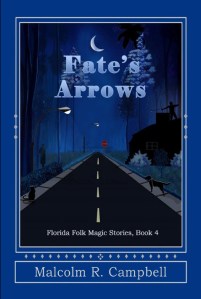
New novel released today, ‘Fate’s Arrows’

Click here for Amazon editions.

Thomas-Jacob Publishing and Malcolm R. Campbell announce the 9/3/20 release of Fate’s Arrows in paperback and e-book. The hardcover edition will be available soon, The novel is the fourth in the Florida Folk Magic Series.

The novel is also available at Barnes and Noble (web site),  Apple, and Kobo, and will be available soon to bookstores via their Ingram Catalog.

Fate’s Arrows Description

In 1954, the small Florida Panhandle town of Torreya had more Klansmen per acre than fire ants. Sparrow, a bag lady; Pollyanna, an auditor; and Jack, the owner of Slade’s Diner, step on fire ants and Klansmen whenever they can while an unknown archer fires fate-changing arrows at the Klan’s leadership. They are not who they appear to be, and while they take risks, they must be discrete lest they end up in the Klan’s gunsights.

When Julia and Eldon, a married couple from Harlem, New York, run afoul of the Klan because of Eldon’s pro-union stance at the sawmill, they find themselves down at the ancient hanging tree where two policemen, hiding their identity beneath white robes and hoods, are the ones holding the noose.

Meanwhile, Sparrow seems to have disappeared. When the ne’er-do-well Shelton brothers beat up the Klavern’s exalted cyclops because they think he harmed Sparrow, they, too, find themselves the focus of a KKK manhunt.

Bolstered by support from a black cat and an older-than-dirt conjure woman, Pollyanna persists in her fight against the Klan, determined to restore law and order to a town overwhelmed by corruption.

Malcolm

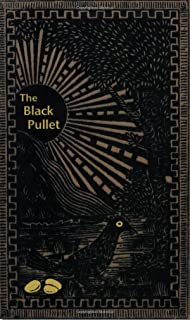
Briefly Noted: ‘The Black Pullet’

The name “Grimoire” is derived from the word “Grammar”. A grammar is a description of a set of symbols and how to combine them to create well-formed sentences. A Grimoire is, appropriately enough, a description of a set of magickal symbols and how to combine them properly. – Internet Sacred Text Archive

While grimoires are typically associated with so-called high magic or ritual magic, the term has lost some of its focus because some people use it as a synonym for the craft practitioner’s Book of Shadows.

The Black Pullet, also known as the hen that lays the golden eggs, is a grimoire and a story combined. Purportedly, the book was written in the 1700s. The book relates the story of a French soldier serving in Egypt with Napolean’s army who is wounded and left for dead next to one of the pyramids. An old man emerges from a secret entrance to a pyramid, takes the soldier inside, and treats his wounds. The soldier discovers that there are a vast library and living quarters within the pyramid. All are richly adorned in the manner one would expect of royalty in those days.

The man says that he has long been the guardian of the deep secrets of the universe and, if he is willing, the soldier will now take his place. The guardian begins to teach the young man about prayers and meditations that will transform him into one who is worthy of the sacred knowledge. Subsequently, the soldier learns of the sacred symbols and words emblazoned on rings and talismans, and how to use them to control nature and the numerous beings that inhabit the universe, most of whom can be very helpful to the one who holds the sacred knowledge.

The book is filled with drawings of talismans and amulets accompanied by the words of power one uses to invoke the desired powers, and that includes creating the black hen that lays golden eggs.

from the Black Pullet’s Preface

The work which we offer to the public must not be confused with a collection of reveries and errors to which their authors have tried to give credence by announcing supernatural feats; which the credulous and the ignorant seized with avidity. We only quote the most respectable authorities and most dignified in faith. The principles which we present are based on the doctrines of the ancients and modern, who full of respect for the Divinity, were always the friends of mankind, endeavoured to recall them to virtue, by showing them vice in all its deformity. We have drawn from the most pure sources, having only in view the love of truth and the desire to enlighten those who desire to discover the secrets of Nature and the marvels which they unfold to those who never separate the darkness which surrounds them. It is only given to those who are favoured by The Great Being, to raise themselves above the terrestrial sphere, and to plan a bold flight in the etheric regions; it is for these privileged men that we write.

While some conjure men and women use seals and symbols taken from this book for protection and as an aid to spell casting, the book appears to stand more as a curiosity than a useful, working grimoire. Many old grimoires and other ancient texts are pulled into craft (witchcraft) and conjure work for power with probable benefits; however, the intent of the book is for use by students of high magic rather folk magic for summoning entities rather than as, say, a strong rabbit’s foot.

Malcolm

If change were as simple as a witch’s ladder

Witches ladders are made by tying a series of knots in thread, yarn, or some other material and that include, at each knot,  a feather, a strand of human hair, leaf, jewelry, pine cone or object that symbolizes the purposes of the ladder. The purpose is generally the creation of a spell or a meditation.

The ladders are known to have been around since the 1870s, but I suspect practitioners of the craft have used them for centuries. Typically, one sings, chants, or recites a specific of general spell element with the tying of each knot. A “simple” ladder often has nine knots and often uses this chant:

By knot of one, the spell’s begun.
By knot of two, the magic comes true.
By knot of three, so it shall be.
By knot of four, this power is stored.
By knot of five, my will shall drive.
By knot of six, the spell I fix.
By knot of seven, the future I leaven.
By knot of eight, my will be fate.
By knot of nine, what is done is mine.

Anyone with patience or the slightest affinity for arts and crafts can make a witch’s ladder, though the example shown here from the Wikipedia article probably shouldn’t be the first one attempted. However, a properly done witch’s ladder is not really simple because for the spell or meditation to manifest, the creator of the ladder must have strong faith/conviction the spell/mediation will work, must maintain a powerful focus upon each knot, and then do nothing to doubt the power of the ladder and the intentions behind it once it’s been completed.

Those who have read this blog for years know that I’m not a big fan of affirmations, statements one repeats daily with the belief that this repetition will bring changes into their consciousness and then into our consensual reality. Émile Coué (1857-1926) was a proponent of this so-called “self-suggestion” and is probably best known for the affirmation “Day by day, in every way, I’m getting better and better.”

Yes, I think affirmations–like the steps in a witch’s ladder–can work if they are not recited more or less by rote and if we live the affirmations after making them. That is, we activate them by doing something in our lives (even symbolically) in support of the statements. That is, if–in the moments before you fall asleep–you say “Day by day, in every way, I’m getting better and better,” then you aren’t really living that self-suggestion if you continue to smoke a pack of Marlboros and drink a quart of whiskey every day while thinking little or nothing about what you would look like or act like or think like if you became better.

So much of what we say and do when confronted with the need for change–as protests around the nation are bringing to our attention–is often (as people have said) little more than lip service to new ideas or a BAND-AID® applied to an old and festering problem.  Saying to the protesters (in person or figuratively), “my thoughts and prayers are with you” is meaningless unless you focus your intent and will power on those thoughts and prayers and then take positive action to back up your intentions.

The real witch’s ladder is not simple, though it need not be considered too complex to utilize effectively. Yet, the ladder is simple if the alternative is doing nothing. The trick, if there is one, is living as though the spell/mediation has come to pass even before you see it with your physical eyes.

Malcolm

Malcolm R. Campbell’s novels include magic because that’s how he sees and lives in the world.


Time machines really don’t cost that much

In 1960, one of my favorite movies was “The Time Machine” based on H. G. Wells’ novel. Perhaps it was the slight crush I had on Yvette Mimieux (unrequited love) or perhaps it was my attunement with old legends about time travel, but the film remains a favorite even though it’s very dated by now.

Now we’re learning more and more about how astronomers’ observations are verifying Einstein’s theories of space/time. My focus on time is more mystic and speculative than science, but I have always thought that one day we would figure out how to do it without breaking Star Trek’s Temporal Prime Directive that prohibits interfering with cultures in a time frame earlier than our own.
For now, though, I’m content to use my imagination as a time machine when I write as well as when I read. My work in progress is set in 1955. Whether it’s the writing or the ongoing research of the period, I feel like I’m bouncing back and forth between 2020 and the 1950s. I feel the same way when I read whether it’s Southern Gothic, which I like a lot, or mainstream historical novels.

I believe in past lives, though I do think they’re occurring simultaneously with our current lives and “future” lives. Aside from that, books do have a powerful ability to transport us to other times and places. How easy it is to fall under the spell of a book or film set in another time and (while reading/viewing) take everything we see and hear as a reality we want to experience.

Do you feel this way when you read? Do you suddenly “see” a period in our nation’s past (or some other nation’s past) as more real than you did before you began the novel? I usually do. It’s almost like magic.

Malcolm


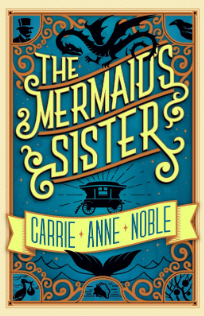
Books: ‘The Mermaid’s Sister’ by Carrie Anne Noble

What a delightful story to re-read on a cold, windy day. I mentioned it here before in a post about magical realism books on Amazon. Published in 2015, this was Carrie Anne Noble’s debut young adult novel and it’s done well. (It has won several awards, has 3,394 ratings on Amazon and is a bestseller in the folklore category.)

Publisher’s Description

There is no cure for being who you really are…

In a cottage high atop Llanfair Mountain, sixteen-year-old Clara lives with her sister, Maren, and guardian Auntie. By day, they gather herbs for Auntie’s healing potions; by night, Auntie spins tales of faraway lands and wicked fairies. Clara’s favorite story tells of three orphaned infants—Clara, who was brought to Auntie by a stork; Maren, who arrived in a seashell; and their best friend, O’Neill, who was found beneath an apple tree.

One day, Clara discovers iridescent scales just beneath her sister’s skin: Maren is becoming a mermaid and must be taken to the sea or she will die. So Clara, O’Neill, and the mermaid-girl set out for the shore. But the trio encounters trouble around every bend. Ensnared by an evil troupe of traveling performers, Clara and O’Neill must find a way to save themselves and the ever-weakening Maren.

And always in the back of her mind, Clara wonders, if my sister is a mermaid, then what am I?

Noble says on her website that her favorite authors are Mervyn Peake, Neil Gaiman, Maggie Stiefvater, Ardyth Kennelly, Catherine Cookson, C.S. Lewis, and J.R.R. Tolkien. If you like any or all of them, you’ll probably enjoy The Mermaid’s Sister as well. Noble published The Gold-Son in 2017.

–Malcolm


The world’s magic is so danged obvious

“Disbelief in magic can force a poor soul into believing in government and business.” – Tom Robbins

I like Tom Robbins’ novels so that probably tells you where I’m coming from on the question of magic. The sins of government and business, we know, but magic isn’t complicit in them. Yet, we scoff at magic. Does anyone use the word “scoff” anymore? Perhaps not, so if you’re too young to know that word, I’ll rephrase: Yet we badmouth magic.

I gotta tell you, I don’t really trust people who scoff (badmouth) magic. I’m sure they mean well even though they might be crazy Or worse.

If you’re a fan of Penn and Teller, you know (I assume) that they’re not doing magic. It’s all tricks, lies, and sleight of hand. They’re fun to watch, though, including on their “Fool Us” television program.  At times I thought maybe, just maybe, the late Doug Henning might have snuck a little real magic into his TV performances, but perhaps not.

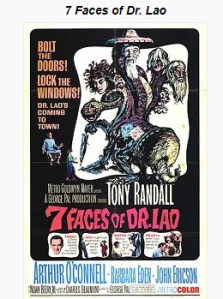
Perhaps I was influenced too much by the movie “7 Faces of Dr. Lao” in which Lao (Tony Randall) had a mysterious travelling show which featured many acts. The strange thing was, audiences often preferred the sleight of hand to real magic. I was studying magic when that movie came out in 1964 and remember getting really ticked off about the clowns in the audience who preferred some kind of trickery over what Merlin could do.

It became obvious to me as the years zoomed by that those who could do real magic had little or no interest in appearing on TV. I don’t blame them. In fact, students of mysticism and other forms of consciousness-raising are often warned about psychic phenomena. Why? Because such things can derail them from their true goal: merging with, shall we say, the cosmos. Yes, mystics may be able to see the future or tell you how much money you have in your wallet, but all that is beside the point. Once derailed into, say, fortune-telling, the fame of it can cut one off from what was originally his or her true goal.

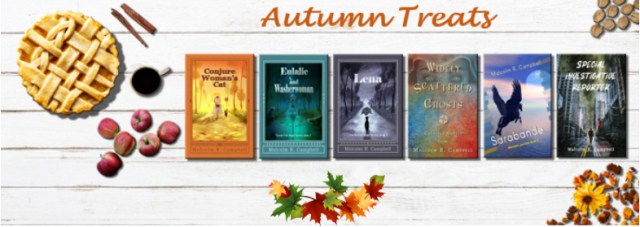
Magic, as opposed to sleight of hand, seems very natural to me. That’s why it shows up in novels such as Conjure Woman’s Cat and Sarabande. Most readers think it’s just part of the story rather than something they could actually do in their lives. But to perform on TV, I couldn’t do that. I’m too much of an introvert. Plus, doing that would gratify the ego rather than what’s important to oneself.

Yet, today more than ever, I have little trust of government and business that I wonder why such things are so important in so many people’s lives. Folks have been fooled so often, yet they keep going back for more government and business. Meanwhile, the solution (magic) is so danged obvious, it’s a shame more people don’t see it. One need not kowtow to the feds, the rich, or the celebrities: they are paper dragons, lies, and sleight of hand.

Yeah, I know, I’m out here whistling into the wind about all this and unlikely to change anyone’s mind. However, I do hope that some of those who read my books might think, “Hmm, maybe there is something to this magic stuff.”

Malcolm


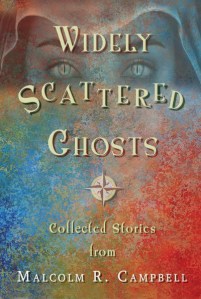
Short Story Collection Released Today (careful, it’s about ghosts)

Publisher’s Description

A readers’ advisory for this collection of nine stories forecasts widely scattered ghosts with a chance of rain. Caution is urged at the following uncertain places: an abandoned mental hospital, the woods behind a pleasant subdivision, a small fishing village, a mountain lake, a long-closed theater undergoing restoration, a feared bridge over a swampy river, a historic district street at dusk, the bedroom of a girl who waited until the last minute to write her book report from an allegedly dead author, and the woods near a conjure woman’s house.

In effect from the words “light of the harvest moon was brilliant” until the last phrase “forever rest in peace,” this advisory includes—but may not be limited to—the Florida Panhandle, northwest Montana, central Illinois, and eastern Missouri.

Widely Scattered Ghosts is available in paperback and e-book at online booksellers and leading bookstores. (If your favorite store doesn’t have it, tell them they can order it from their Ingram catalogue.)

You can learn more about the stories’ location settings on the spotlight page of my website.

Before it was torn down some years ago, this old Florida building was a favorite of ghost hunters. I was in the building when it was a clean and functioning facility.

Buy the Book Here

Amazon

Barnes & Noble

Kobo

SCRIBD

Apple iTunes


I’ve seen ghosts from both sides now

When I was a kid, I read every psychic book I could get my hands on. Some were secular, some were based on religions where mystics were still honored, and others were spiritual in a much different sense than what I saw at church. Somewhere I read that if a person read what I was reading, they’d open themselves up to ghosts and other spirits, precognitive dreams, and waking visions. Well, all that was true enough.

Early on, I noticed a big difference between real shamans, witches, psychics, and mystics and the way all of these folks were portrayed by the organized church all the way back to the inquisition and such purges as the Cathar Crusade (1209-1229). The church saw these folks as heretics and, strangely, as devil worshippers, even though Satan was, more or less, a Jewish/Christian concept and had nothing to do with the spiritual people in the church’s gunsights. Yet, it served the church’s needs to paint everyone who was different as evil incarnate, a point of view that got picked up by Hollywood’s occult movie producers and writers. I’m always on the warpath when it comes to books and movies that turn ghosts, mystics, shamans, and witches into whatever untrue nastiness the writer or producer can imagine and then proceed to kill them in order to save humanity.

In “real life,” it’s still somewhat dangerous to speak out against these lies. Yes, every once in a while, somebody will say so and so is a witch and then look at me awaiting a wink and a nod of agreement. My response is, “So what?” This throws people for a loop, but they usually will tell me that so and so and so worships the devil. “She doesn’t believe in the devil,” I say. “Well, maybe not,” they respond. Okay, that conversation never goes anywhere good and it tends to get me shunned by a lot of people who think maybe I need to be watched carefully.

Fortunately, most people who read ghost stories–or even that phony occult crap–don’t think the authors are practitioners. And, we’re not. I’m not a conjurer, witch, or shaman. I don’t have an altar in my house covered with herbs, candles, pictures, and other arcane supplies. That’s all in my imagination. What I believe an author should do is tell the stories truly. That is, we can tell stories that fit what actual conjurers, witches, and shamans say and do rather than giving them the powers of, say, Voldemort out of the Harry Potter series along a boatload of evil motives.

Magical realism has given me a genre that works because it shows readers the everyday reality they’re used to seeing and then adds conjurers, witches, and shamans in their “natural habitats” rather than in some highly charged occult setting. My “Florida Folk Magic” series of novels is an example of this. On Monday, my publisher Thomas-Jacob will release Widely Scattered Ghosts,” my new collection of ghost stories. Most of these have something in common with my personal experiences, though my imagination may have strayed a bit.

When compared to the ghosts of horror/occult authors, these stories are very gentle even though you will find sadness and confusion in them along with a bit of humor. They’re not for kids. No, it’s not because of devil worship and gore, but from the psychological themes. Above all, I wanted the stories to be as true as fiction allows, and those of you who’ve tolerated this blog for years will know that I believe fiction is allowed to portray realities that facts cannot touch.

–Malcolm

Coming February 18th:


Magic: Crooked Roads

“Improvement makes strait roads, but the crooked roads without Improvement, are roads of Genius.” ― William Blake

Praise the universe for crooked roads.
The misdirection of gods and storytellers.
The ancient spells and scrolls of wisdom hidden inside rocks, waiting.
The combined consciousness and will of liked, loving minds, cosmic valentines.
The stars of which we were made and those of future generations
Praise the universe for crooked roads.
The alternate universes of our salvation, just a glimpse away.
The new paths seekers have yet to create, bypassing old roads going nowhere.
The magnetic attraction of all that is good toward those who desire it.
The old mysteries that have retreated but are never lost.
Praise the universe for crooked roads.
Praise for the dreamers walking the Earth in cloaks of stars.
Praise for the children who see beyond the worlds of the crib and the classroom.
Praise for the wisdom that releases sons and daughters from the dogma of ancestors.
Praise for the special sight of all who see the souls of every rock and bird and horse.
And blessings for all who stumble and crawl along those crooked roads toward true heaven.

–Malcolm

Copyright (c) 2019 by Malcolm R. Campbell


Doubt is the magic killer

“I must not fear. Fear is the mind-killer. Fear is the little-death that brings total obliteration. I will face my fear. I will permit it to pass over me and through me. And when it has gone past I will turn the inner eye to see its path. Where the fear has gone there will be nothing. Only I will remain.”

― Frank Herbert, Dune

I agreed with a lot of the sentiments in Dune. I also extrapolated upon them.

I tend to think we create wherever it is we’re going. If fear is a mind-killer, then I step forward from that thought and think that doubt is also a mind-killer. I’m not against being prepared–as we were taught in the Boy Scouts. Yet, I can’t help but think time spent with negative negative concerns such as fear and doubt is not an example of being prepared. Instead, those repeated concerns not only demonstrate to the universe we have no confidence in what we’re doing (praying, casting a spell, intuiting a situation far away, transmitting healing energies), they also create the very conditions our fear and the doubt are focused upon.

Experts in the I Ching, the book of changes that many use for divination, point out that doing the same reading twice because you doubt the first answer you received will often bring a chiding response from the oracle. I’ve seen that happen. I’ve also seen it happen with Tarot cards.

If I send (serve as a channel for) healing energy multiple times to help a sick friend, what does the second time say about the first and what does the third time say about the first two times? I believe it suggests that we doubt our ability to allow a flow of energy or that we wonder if the first energy we sent knew what it was doing.

Prayer is like that, too, I think. If we ask God on Monday for a certain thing, what’s the result of asking God for the same thing on Tuesday? Does it mean we think She/He didn’t hear us on Monday? Perhaps we are suggesting She/He was too stupid on Monday to know what we were talking about, so we have to offer a wordy explanation on Tuesday? Or, maybe we think God screwed up so we need to give Him/Her another chance to get it right.  Out worst doubt is negating our best efforts.

In conjure, we say that when you cast a spell, don’t look back. Why would one look back anyway? There’s no reason to look back unless one thinks s/he crewed up the spell the first time. The double whammy here is that thinking one screwed up the spell only serves to screw up the spell. As in, say, foot track magic, the magic isn’t just the powder one places in the path of the intended target, it’s his/her intentions for that powder. Looking back weakens your intentions.

I’ve seen people fail when trying to use the law of attraction, first because they say they are trying to use it rather than using it, and second, because after their positive affirmations, they go through the rest of the day filled with doubts and other negative thoughts. If one works to attract money and then worries about getting evicted from his/her apartment for non-payment of the rent, the negative thought becomes a stronger affirmation than the positive thought.

The worst that can come of all this doubt is that one ends up believing prayers and magic and positive thinking don’t work. Oh, they always work. It’s just that one’s lack of belief has become the strongest spell they are using.

–Malcolm

Malcolm R. Campbell writes novels about magic.