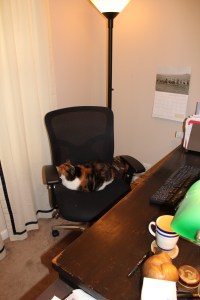
I gotta ask, ‘whose chair is this?’

Every morning it’s the same.

chairwithkatyAfter the kitties are fed and the dishwasher is emptied, I find something figuratively described as breakfast and pour a cup of Maxwell House coffee which will be good to the last drop. Katy, a big-boned or a fat calico (depending on who’s describing her) follows me around while I do this.

Then I take the “breakfast” and coffee to my den. Katy follows. If I forget something, like my glasses, she follows me back to the kitchen while I retrieve them and returns with me to the den like a dog who’s just passed an AKC utility obedience trial and merits as CDX designation.

However, were the trial judge to follow us into the den, s/he would discard the CDX one nanosecond after Katy occupies 55% or more of my desk chair. Katy stays there until dinner, ebbing and flowing–one might say–to occupy smaller or larger portions of the chair. Sometimes, I feel like I’m about to be evicted and say, “Katy, I gotta ask, whose chair is this?”

She thinks it’s her chair. Well, that figures.

Malcolm


Human Trafficking Awareness Month

nativehopeAlthough human trafficking “is a global issue, it is also prevalent very close to home. Native American women and children make up 40% of sex trafficking victims in the state of South Dakota alone. According to federal data, Native women are twice as likely to be sexually assaulted as women of other races. They are also subject to high rates of intimate-partner violence and other forms of assault. These factors, along with poverty, substance abuse, and foster care, can make them vulnerable to exploitation. Secretary of the Interior, Sally Jewell, reiterates the ‘threat of human trafficking to Native communities and sex trafficking of Native Americans and Alaska Natives,” describing the ‘first citizens of the United States as some of the most vulnerable.’” – Native Hope

Read more at Native Hope

According to their website, 88% of the crimes committed against native women are committed by non-Indians. This is a long-standing and intolerable problem and, frankly, the kind of statistic we believe we’re more likely to hear from a third-world nation. Of course, many Indian reservations rank below many third world nations when it comes to health care, employment, sanitation and other services most of us take for granted, and quality of life. Nonetheless, the facts surprise me.

Most of us cannot do anything about this problem by ourselves. Yet, through working with others, we can create meaningful change and improve the lives of countless women.

You can help by clicking on the highlighted link above, learning more, and considering a donation.

And, as the site says, “If you believe someone you know may be a victim or is in a vulnerable position, read our article on signs to watch for. If you are a victim and need help, please call the hotline at the National Human Trafficking Resource Center at 1-888-373-7888.”

See also: National Indigenous Women’s Resource Center  and Wiconi Wawokiya – a Lifeway to a Better Future Without Violence in Our Community.

–Malcolm

The tragic losses of 2016

Americans like statistics almost as much as baseball aficionados. As we wend our way toward the end of a year, we see them, those statistics.

  • Most important news stories
  • Best books of the year
  • Top-earning movies of the year
  • Deaths of famous people.

In the social media, people have been saying 2016 is a bad year for the high number of deaths of famous people, most recently Carrie Fisher and Watership Down author Richard Adams. And a few days ago, George Michael. Those who die younger than some unknown age are said to have died too soon. Even so, the loss of people who have lived well past the normal life expectancy is said to be tragic.

statsCelebrities impact us in larger-than-life ways. So, it’s not surprising that the deaths of well-known people impact us more than the numbers of people who died in Aleppo or the fact that traffic fatalities exceed the death tolls of most (if not all) of our wars.

So, we mourn the losses of the rich and famous whom we don’t personally know as though they are close friends and family. Those we don’t know, aren’t on our radar because–suffice it to say–in spite of the large numbers of dead in Aleppo, there’s no apparent connection between us.

That lack of an apparent connection is one thing that, quite possibly, keeps us sane as individuals, for we do not have the capacity to mourn everyone who dies with the same level of grief that’s present when we lose a spouse, parent, or child–or, apparently, a celebrity.

In some ways, celebrities are stand-ins for the heroes of old, and we celebrate them for doing and being what we believe everyone should be capable of doing and being; likewise, we chide them and turn on them when they disappoint us almost as though they’re our own wayward children.

How odd life and death are. We know in our hearts that everyone dies, yet express surprise when they do. As a writer, I often wrestle with this seeming paradox, but I have to tell you I haven’t come up with a suitable answer to it. In my other blog, I wrote that It’s hard to say goodbye to Princes Leia.  And it is. It seems natural that it is and it seems ironic that it is when those closer to home who are, say, friends of a friend impact me less. I hate to dismiss all this with something lame like “that’s just the way people are.”

Perhaps like Star Trek’s Mr. Spock, I mourned the loss of Janis Joplin in 1970 while wondering why I was mourning her loss. Yes, I liked her music. But I never met her, never saw her in a concert, didn’t have an autographed picture of her, hadn’t memorized her discography, and didn’t drink Southern Comfort. But still, I felt bad about it more than just shaking my head at the lost potential of her “going too soon,” “dying too young,” and the other things people said when when she was gone.

I still don’t understand the tragic nature of death or why the deaths of strangers often impact us more than the deaths of people who, by all reasonable statistics, are much closer to us. But mourning is what we do in good faith and quite naturally, so other than wondering about it as an author might, I can only say that it’s the way things are. That’s okay, I guess.

Malcolm

Another solstice in the cycle of things

“Wherever the creative power of desire is, there springs the soil’s own seed. But do not forget to wait.”

– C.G. Jung, The Red Book

If you are not a winter person, Winter requires patience in addition to bracing oneself against the cold and the extended time of darkness.

yulelogSome folks welcome the solstice because once the shortest day and longest night have come and gone, they feel like they can begin the happy countdown to Spring. Others–and I am one of them–believe Winter and darkness are part of the natural progression of everything throughout nature. Seeds require Winter, a time of waiting and preparing before flowering and fruiting are even possible.

Humans are like that, too, I think, though I’ll admit that being a Winter person becomes more difficult with age. One discards short sleeved shirts sooner, starts wearing heavier jackets, and copes less well with the cold.

Mentally, more than physically, I still welcome a time of patience, of waiting for ideas to germinate, and noting the temporal and spiritual components of ancient Yule celebrations.

As more and more of us become further separated from farms and their harvest cycles, it’s not easy to maintain ones place in the annual cycle of things. This is a pity, I think, for our mental and spiritual development has so much in common with the natural world’s “great wheel of the year” throughout the seasons.

However you see Winter and the solstice, best wishes and seasons greetings.

–Malcolm

Walked into the spam queue and found nothing there

After finishing the festive part of my day–putting up the outside Christmas lights–I gulped down a shot of morphine, calmed my mind, and went down into the WordPress netherworld where the spam queue is guarded by snakes, lost souls, and the ghost of Jack the Ripper.

WordPress spam queue

Fortified against demons and chaos as I was, I felt as strong as anyone does when they confront their personal hell. Maybe I should have studied Jung’s “Red Book” longer rather than taking drugs. Listen, I’m not making this up: neither Carl Jung nor morphine prepared me for the utter and infinite nothingness of an empty spam queue.

An illusion?

Perhaps so. After all, we’ve learned–as I posted yesterday–that we have no clue what reality is all about. Stands to reason, we probably know squat about unreality as well.

Unreality is an empty spam queue

  • It’s like falling into the Chamber of Secrets and finding no secrets–or even a nasty basilisk
  • It’s like going to your late aunt Agatha’s abandoned house to clean out the attic and having a cold feeling that her noxious ghost is there, but not seeing anything and not being able to convince anyone else is time to leave.
  • It’s like watching a horror movie on a dark and stormy night when the power goes out and you feel like you’re not alone.
  • It’s like all kinds of things, but most of them are outside the scope of this post.

The only real thing in the spam queue is the sound of dripping water, or maybe it’s blood or Gatorade–nobody quite knows–but I heard it today and within the vast nothingness of the afternoon, the normalcy of the sound became worse than the sound of the tell tale heart in Poe’s story. Drip…drip…drip. Nobody ever finds the dripping water, or whatever, because the place is jam packed full of spam. Except not today.

It’s not that I miss the spam, those penny Viagra sales, the services that write posts for your blog, the prospective foreign wives who want marriage and a green card before they disappear, the something-for-nothing stock brokers, the SEO experts who say my blog isn’t SEO optimized, the people from Colorado selling pot in oregano bottles, and all the other black market crap that’s actually cheaper at your downtown department store.

No, it’s not that I miss it, I don’t believe it isn’t there. Somehow, the unseemly became unseen like an invisible mirage. You’ve probably seen those horror movies where scary music blasts into your head every time some hapless character opens a closet door–yet nothing bad springs out. You know something the hapless character doesn’t know. What you know is that after 15 closet doors have been okay, the 16th door is hiding something really bad, something so bad that the sound track won’t even tip anyone off that the door should never be opened.

That’s the feeling I had this afternoon in the empty spam queue, you know, that it wasn’t really as empty as it looked, that I’d walk around a corner with my guard down and fall into a pit of maggots selling auto insurance to anyone in my state.

Worse yet, with no visible spam, the place was open to all possible spam, the spam of my nightmares, the spam I think about on lonely roads, the spam people threaten me with during Facebook flame wars–this is the cruelest cut of all, the “empty” spam queue, because the spammers know that the spam of my fears is worse than anything they can ever deliver.

–Malcolm

Malcolm R. Campbell is the occasional author of paranormal stuff (surprised?) like Cora’s Crossing, Willing Spirits and Moonlight and Ghosts.

Who Am I and Why Am I Here?

“We’re not on our journey to save the world but to save ourselves. But in doing that you save the world. The influence of a vital person vitalizes.”

– Joseph Campbell

nightsky2It’s easy to point to great inventors, world leaders, writers, preachers, and leaders of social and environmental initiatives and say those people probably know who they are and why they’re living in the world.

We may be wrong about that because we don’t know their stories inside an out. These people inspire us, though, showing us–among other things–what a person can do through perseverance,  a willingness to fight against their challenges, and to have the strength of will and strength of purpose to reach their goals.

The rest of us can get discouraged when we read biographies or news stories about famous people who accomplished great things that have made the world a better place. How, we wonder, can we live up to that? I don’t think we’re supposed to live up to that. As Joseph Campbell would say, they were following their own paths. We have our own paths and, more often than not, those paths don’t involve being famous and ending up in the history books.

Some people say they are here to live ethical lives, to be loving and compassionate spouses and friends, to do an honest day’s work while interacting with customers and colleagues out of kindness and fairness, to bring up their children with sound values, and to take part in a churches and/or secular groups that address important causes in the community and the world. Such people vitalize the world in ways they may never know when you think of the thousands of interactions and influences they have with others during the course of a lifetime.

What we’re drawn to

Perhaps many of us discover who we are and subsequently why we’re here by looking at the causes, books, issues, subjects, belief systems and people we’re continually drawn to. Others get a strong hint when they enter college and suddenly find a subject fascinating or when they get a job and inadvertently take a company training course that leads their career in ways they never suspected on the first day of work. We find ourselves drawn to certain parts of the country or the world, possibly for what may initially seem to be the most flippant of reasons, only to find new lives there that suddenly define who we are and why we’re here.

While many people can inspire us teach us and show us (by example) what a lifetime might look like, only we can ultimately answer the question “Who am I?” Discovering that answer is often a frustrating and a lonely journey. Sometimes negative experiences get in the way of our goals and then–in time–we learn that who we are is a person who can live with adversity without losing their faith in themselves while finding new ways to define why they are here.

Do we plan our lives before we’re born?

Personally, I believe that before we are born, we know who we want to be and why we want to be here. If that’s the case, then we’ll be drawn to the kinds of people, places and things that facilitate our needs. I don’t believe in coincidences or luck or fate, so even if we don’t have a “life plan” before we are born, I think that we will develop one while we’re here as one thing leads to another. Yes, that often looks like a twisting and haphazard path until one reaches old age, looks back on it, and sees that behind all the seeming chaos of it, there was a central focus toward being who they became.

Being open to spontaneity

People used to say “go with the flow.” I don’t think that applies to mob action, acting like sheep or lemmings, or taking the easy way out. I think it means, as Joseph Campbell put it, following our bliss and doing what enlivens us and enriches us and transforms us. One has to be open to that flow to jump into it and see where it leads; we can’t consciously plan upcoming “coincidences,” “chance meetings,” or “lucky encounters with other people” in advance. We can expect them and be open toward spontaneously embracing those moments when they occur.

“Who Am I and Why Am I Here?” is usually an evolving discovery. Most of us don’t necessarily know that in high school or college or our first full-time job. Life will, I think, help us figure it out.

–Malcolm

Malcolm R. Campbell is the author of the hero’s journey novel “The Sun Singer” and the heroine’s journey novel “Sarabande.”
 

Now is a good time to listen to the blues

Used to be, a lot of folks sang the blues, listened to them, too, because they spoke soul to soul about the troubles they were seeing and would see again the following day and possibly always.

Ma Rainey
Ma Rainey

I grew up listening to the blues, they’ve always spoken to me, and even though I don’t hear them as much now as I once did, I listened to them a lot while I was writing my last two books because those books were about troubles and bearing heavy loads and making things right. I hear Ma Rainey singing in my dreams, whether it’s “See See Rider” or “Boll Weevil” and really those songs are lullabies.

The Presidential election has created a great upheaval, folks shouting and fearful, yelling at friends, becoming argumentative, thinking all is lost no matter which candidate they voted for. There’s not a lot of comfort out there when things are so polarized you have to keep silent unless you agree 100% with what an other person says.

Good people voted for both candidates, but most folks don’t see it that way. Those who like Candidate A say you’re evil if you voted for Candidate B. Those who like Candidate B say you’re evil if you like Candidate A. I think we have to keep working toward consensus on the important issues, focusing on programs rather than fiery labels, and focusing on respect rather than assuming the worst in everyone else.

I swear to goodness, people need the blues so they’ll feel somebody out there knows how they feel, whether it’s the Mother of the Blues (Ma Rainey) or one of a hundred other people who converted their feelings into music that resonated with everyone who needed a lift up or a reminder they aren’t alone.

As it is, a fair number of people have retreated into their quiet living rooms or their like-thinking groups of family and friends. Perhaps that’s a reasonable start. But it isn’t a reasonable end. “Us vs. Them” is a poor way to live. There’s no respect in it,  no giving others the benefit of the doubt,  no chance for agreement.

The blues make a man or a woman human rather than the shouting member of a mob or the defeated person who cannot cope or consent to live the best they can no matter what life throws at them. We need more humanness today, more time to come to terms with whatever sorrows we hold, whatever troubles we’ve seen, more compassion for those we don’t understand, and a chance to keep doing right and honorable things without expecting a gold medal for it, and a way of thinking that leads us to assume those around us are good and trustworthy without their having to wear slogan-covered tee shirts or safety pins or a shrill and self-righteous cynicism on their sleeves.

My prescription: Go to YouTube or iTunes or Amazon and find some blues and settle down for the night with nothing but the music–and possibly a Mason jar of moonshine–and let put the world on hold. Let the blues run through you like a sweet hot knife through willing warm butter. You won’t need to call me in the morning because you’ll be all right with the world–come what may.

–Malcolm


OMG, when bad things happen, people say it’s my fault

Recently, when my wife and I were asked where we live and we said, “Georgia,” the response of the northern lady asking the question was, “I’m so sorry.” Now, in Georgia, the word “sorry” is a synonym for being no good, but since we weren’t in Georgia at that moment, I don’t think this lady was claiming to be no good; more that we had given her bad news to the effect that (I suppose) we lived in some horrid place and she was sympathizing with us.

I told my wife later that at least she (my wife) is a woman and is therefore not part of the problem. What problem? That would be the problem of being a scapegoat. In this case, a scapegoat for about every bad thing that happens.

These days, most bad stuff is purportedly caused by angry old white men who live in (or wish they lived in) the South. I meet all these criteria except the angry thing, but when I say I’m not angry, people say I just haven’t realized it yet.

In “Margaritaville,” Some people claim that there’s a woman to blame, but everywhere else, people claim a white man’s to blame, and heaven help him if he’s also from the South, that part of the country everyone everywhere else loves to libel, mock and belittle in every possible way.

I saw my Facebook picture in the post office on the elitists’ most wanted list:

  • Some kid in Peoria got diarrhea on his 10th birthday party and, like many “crimes” these days, witnesses who weren’t even there told CNN that I did it with some kind of hex or chemical that caused his green apple quick step.
  • One of protesters blocking the 101 freeway in California said he couldn’t cope with the election results and guess who caused Hillary to lose. Even though the young man–one of those with no coping skills and spent Halloween in a safe room at college–said he “just knew” I rigged something and caused Hillary to lose.
  • A man in New Jersey failed to respond to a chain letter and after he met with a horrible demise, his heirs said they were “pretty damned sure” I created the chain letter and all the bad luck that followed in its wake.
  • Some people holding a seance in California, were told by well-meaning spirits that the reason their state is talking about a CALEXIT secession from the Union is–guess who?–me. They even marched on Sacramento and demanded that my California birth certificate be destroyed since–being old, white and in the South–I was “in all probability” the catalyst for all of the nation’s ills.
  • Any time one of the 800+ American hate groups monitored by the Southern Poverty Law Center says or does something abominable, I (and other old white guys) are presumed to have signed off on it even though we haven’t heard of the groups.

I don’t want to complain overly much, but being the default scapegoat for so many diverse ills is a tiring job. Sherman, who is not well liked in Georgia, once said, “I will not accept if nominated and will not serve if elected.” Hell, I wasn’t even nominated as the scapegoat; I (along with all the other old white guys) just got voted into the job by the same kind of elitist attitude that would bring a person to tell my wife and I she’s just so sorry we got stuck in Georgia.

Sure, I have an alibi for every crime on the list attributed to me, but in these interesting times, alibis don’t matter because my so-called “white privilege” (they say) allows me to rig the system and do whatever I want. That’s the assumption when I tell them I wasn’t there when they stubbed their toe on one of their cats or got drunk with hookers and got caught by their wives.

So, when it comes down to it, I can see that people’s perception of me (and my fellow white guys) is a projection they have created and that they now believe is the gospel truth. It’s hard to argue with that because folks think they’re right rather than nuts. Most of these people could be cured with Xanax or pot, but “recreational” cures are slow in becoming legal.

If you ever look at many of the things happening in the world and think the perpetrators are lunatics, you’ll know how I feel about those who blame me for for their problems. On the other hand, I know that blaming me gives many people a way to sleep at night.

–Malcolm

Malcolm R. Campbell is the author of satire, fantasy, and magical realism novels. 


There are days when I wish I hadn’t logged on to Facebook

We call Facebook social media, but it’s often anti-social media.

It offers us a chance to keep up with people–often old friends we haven’t seen since childhood or college–and to hear about new ideas, general news, books, blog links of interest, and a lot of other things that according to communications theories are supposed to bring various cultural groups and nationalities closer together through enhanced knowledge and understanding of each other.

assbookI’m not surprised when people use Facebook and Twitter to disseminate facts, ideas and opinions about causes such as the environment, the treatment of women in Muslim countries, military vs. diplomatic methods of resolving conflicts, and the current Presidential race.

In this country, we’re supposed to be champions of free speech. Among other things, that means defending the right of those who express opposing views to express those views. But somehow, that’s all gotten so polarized that people ignore the facts–or don’t spend time looking for them.

What’s changed?

Perhaps nothing, depending on how old you are and what you’ve experienced growing up through many decades of changing priorities and value systems. My feeling is that people aren’t doing their homework. So, when they feel moved to say something on Facebook, they often opt for a graphic or a video prepared by a biased source. Many of the things quoted during the Presidential race either were never said by the candidate or were taken out of context so they appear to mean something quite different than the candidate intended. Yet this stuff is posted as the gospel truth.

As a former journalist and journalism instructor, I not only think many news outlets have gotten warped, but that they are using their agendas to create public opinions that would be much different if those courses were making every effort to be objective. This skewed, highly managed sound bite “journalism” makes its way onto Facebook in all kinds of ways. Truth is the first casualty here. Oddly enough, if you point out to the person who posts a political graphic that the graphic is incorrect, their solution is to believe it anyway. It’s simply easier!

While I almost never post political statements on my Facebook profile, I often “see red” when I see a graphic or a poster’s opinion that twists a real event into something it wasn’t. Even if I say that I heard the speech the person is quoting and that they’re not reporting what s/he said, they don’t care. What they’re posting coincides with their opinions and the facts don’t matter.

Sometimes people ask me what my sources are. When I answer, some people say, “Oh, well I only listen to news sources I agree with.” Ultimate stupidity. You’re not supposed to agree with a source because that source is supposed to be neutral. If they’re not neutral, they’re not a real journalist. I despair when I see the Fox news aficionados and the CNN aficionados screaming at each other about objectivity when both of those news outlets are very biased. Yes, I know, it’s just easier to be led around by a figurative leash by sources who tell you what to think, but that approach hurts all of us.

I know I shouldn’t comment on those kinds of posts, but it’s hard to resist. The result: a lot of time is wasted and nobody’s opinion is changed. What a waste of time.

Malcolm

Malcolm R. Campbell’s new novel “Eulalie and Washerwoman” will be released Friday, October 14th.

Yes, I can see forever now (on a clear day)

The last post-op appointment for the cataract surgery in my left eye was today. Doc says come back in a year. Sounds good to me. I was supposed to have this surgery earlier in the year, but ended up having appendicitis surgery on the day it was scheduled. When I was in the hospital for that, they discovered the kidney cancer. But, it was early and the surgery saved me and the kidney with no post-off chemo or anything. A big scar, of course, but unless you’re psychic, you can’t see that.

No, this is not my real eye color.

I resisted cataract surgery for a long time because, quite frankly, I don’t like having surgery. Then people who’d had it said, “You know, you’re awake while they’re doing it.”

Holy crap.

The surgery was very strange. Much stranger than the appendix or the kidney surgery, but without the need for pain pills, nurses, being forced to walk down the hall before they let me out, and all that.

The last time we drove to Memphis to see family prior to the cataract surgery, I was driving and missed some turn-offs because I couldn’t read the signs. My wife said, “It’s time.” Unfortunately, I had to agree with her. Now my vision is close to perfect for distance stuff, walking around the house, knocking over liquor stores and things like that. Cheapo reading glasses are required for reading and using the PC.

I don’t know what the hell any of this has to do with writing other than it’s nice to see what I’m writing. Sure, Beethoven was too deaf to hear his own music late into his life. I can’t imagine the talent it takes to make that work. I really don’t think I want to try writing by displaying the words on my screen at 200%. That’s really tedious, but I was doing that before I had the cataract surgery.

If this post is disjointed, it’s because I’m having a glass of Scotch to celebrate not having to go back to the eye doctor for a year. I’m still trying to figure out if I can see the future without having to get out my Tarot cards.

–Malcolm

website