But are you writing? I noted several remarks online where people are saying they are too worried and frantic to sit and write. They’re anchored to 24-hour news, waiting for the latest body count and what’s happening next.
So. . . let me get this straight. . . when things are busy and normal, you don’t have time to write. Then things are abnormal and locking you at home, you can’t make yourself write. – Hope Clark
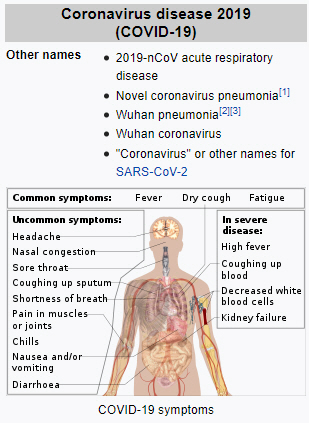
Wikipedia Graphic
It’s really an understatement to say that COVD-19 has disrupted a lot of things. We’re all curious about potential lockdowns and potential vaccines. But sitting in front of a 24-hour news channel watching for updates not only seems like a waste of time, but is the kind of behavior that probably creates more hysteria than what the nation is already coping with.
Frankly, I’m a little tired of people asking why we didn’t have 100000000 testing kits (much less a cure) in stock for a disease nobody knew anything about prior to December. I guess people are watching too many medical dramas on TV and are used to health issues that are solved within an hour.
I agree with Hope Clark, assuming that lockdowns aren’t making us broke or sticking us in long lines to buy toilet paper, we can use our self-quarantines and social distancing to get some other stuff done: tidy up the garden, clean out the garage, finish that novel.
How will that impact each of us? It’s hard to gripe about it when people are dying and others’ lives are being disrupted.
Italy is closed. Travel from Europe to the U.S. is restricted. Many of us wonder how long it will be before travel around the U. S. will be impossible.
Due to my cancer problems last year, I didn’t see my daughter and granddaughters in Maryland. We’d planned to visit them in April and take a few cool side trips while we were there. So far, none of our flights has been cancelled.
But, we wonder. We miss the granddaughters. We dislike going long periods of time without seeing them because their lives move so fast it’s easy for us to get out of the loop and never get back in. They grow up so fast that a year away from them is hard to recover.
So, we worry. My brother and his wife had plans to see Australia. Those fell through when the place burnt down. Now they have plans for a river trip in Europe, but as borders close, that might not happen.
It’s not that we’re worried about getting COVD-19, though that could happen. We’re more concerned about mandatory quantities and travel restrictions.
Do you face similar problems or is it more a matter of whether the toilet paper runs out?
International Women’s Day 2020 campaign theme is #EachforEqual An equal world is an enabled world. Individually, we’re all responsible for our own thoughts and actions – all day, every day. We can actively choose to challenge stereotypes, fight bias, broaden perceptions, improve situations and celebrate women’s achievements. Collectively, each one of us can help create a gender-equal world. Let’s all be #EachforEqual.
I like the theme for the upcoming International Women’s Day on March 8. I hope it will show men–as well as women who haven’t yet signed on to the idea of their equal worth–that we are not only fighting for equality and safety for women, but for a world that’s made better for everyone.
When Elizabeth Warren’s Presidential campaign ended, political commentators were asking, “How did the Democrats begin with such a diverse field of candidates and end up with two old white men as the frontrunners?”
I think we know the answer, but we pretend we don’t.
The status quo favors men while devaluing the majority gender: Women make up almost 51% of the U.S. population, yet they are underrepresented in the House and Senate and most industries.
This situation is 1950s mentality when we “celebrated” the so-called little woman who was good for sex, having children, cooking the meals, and cleaning up the house. Many of today’s clueless reporters–as we saw in the 2016 election with Hillary’s pantsuit coverage–were more concerned about what women wore than what women said.
Thirty years ago, I got into a heated debate with a female co-worker who was probably the smartest employee on the technical writing/testing staff about the fact she did what her husband told her to do because he was head of the household.
When I told her that “head of the household” BS was an out-of-date concept, she said her Christian religion also said the husband is head of the household. When she quoted Bible verses to prove it, I said that her examples all came from the Old Testament in the days when there was not yet a Christian religion. Nonetheless, I didn’t “win” the argument. (Last I heard, they were still happily married. I would have felt bad if I caused a divorce.)
I think of this discussion because I many (most?) men and women still believe that the man is not only in charge of the household, but the office, the Congress, and the country. They believe that 51% of our nation’s wisdom should be confined to the kitchen and laundry room.
As a white man, permit me to say that patriarchy is stupid. Look where it’s gotten us.
“THESE are the times that try men’s souls. The summer soldier and the sunshine patriot will, in this crisis, shrink from the service of their country; but he that stands by it now, deserves the love and thanks of man and woman. Tyranny, like hell, is not easily conquered; yet we have this consolation with us, that the harder the conflict, the more glorious the triumph. What we obtain too cheap, we esteem too lightly: it is dearness only that gives every thing its value.”
– Thomas Paine in “The American Crisis”
Thomas Paine (Common Sense) wrote the essays that comprise The American Crisis between 1776 and 1783. We have had many such times between 1783 and this moment and may, in fact, be living during such times today.
Wikipedia Photo
I have always liked the phrase The summer soldier and the sunshine patriot because those terms encapsulate so many of the oftentimes lazy and safe responses to the ideals we revere as a country as well as to the comfortable people one never finds “down in the trenches” when the moment comes to not only make a commitment but to sacrifice one’s time and money to engrave our ideals into the real fabric of everyone’s daily reality.
In Congress, business, the organized church, and other groups the committee is often mocked as a group that talks and ponders but never takes definitive action. If you want to bury a proposal, assign it to a committee. At the same time, committee members (like groups of concerned citizens talking during barbecues and dinner parties) believe talking and pondering is synonymous with action.
If asked, these summer soldiers and the sunshine patriots will say “I’m very involved with cleaning up rivers and lakes. . .saving and restoring-old growth forests. . .stopping human trafficking and female genital mutilation,” etc.
It’s tempting to respond with: “How many riverkeeper/keep-my-county-beautiful treks have you made to haul garbage bags of trash out of rivers, lakes, and shorelines. . .how many trees did you save or did you plant. . .how many mutilations did you stop?” Or, alternatively, are you an active (that is to say, a working) member of any groups or agencies working to improve the status quo of such issues?
It’s wrong to criticize friends, neighbors, and co-workers in this way, so the typical response to “I’m involved with…” is silence, and that’s one of the reasons why these are the times that try men’s souls.
“Whatever we believe about how we got to be the extraordinary creatures we are today is far less important than bringing our intellect to bear on how we get together around the world and get out this mess we’ve made. That’s the key thing now. Nevermind how we got to be who we are.” – Jane Goodall
When quotations like this appear on Facebook or in news stories and articles, they get a huge number of LIKES and positive comments. I want to ask, “So, after you clicked LIKE or wrote ‘so true,’ what did you do next?”
Likewise, when people encounter charities and various crowdfunding initiatives that are collecting money for programs that will make a better world, I’m curious what people did after donating their $25 or $50. The same thought comes to mind about what people do after signing petitions that are trying to raise the public’s (or an elected official’s) awareness about a problem.
Many people appear to believe that talking about an issue is the same thing as actively working to “fix” whatever needs to be fixed. Being concerned about something, while commendable, isn’t the same thing as putting your money where your mouth is or putting your brains and brawn where your money is.
Needless to say, some people who donate $50 to one group and sign a petition in support of another group really think they’ve done their bit.
I don’t have a list of the things people ought to be doing, but joining nuts and bolts volunteer groups is one place to begin. Once you join, you’ll see an old truism governs how much gets done: 20% of the members usually do 80% of the work.
In churches, the concept of the tithe usually refers to money. Yet, we can also apply it to time, as in, giving 10% of one’s time toward fixing the mess we’re in. Even though some government officials, corporations, and lobbying groups are giving 100% of their time to make the mess worse, if enough people chipped in enough time to thwart those who are destroying nature and freedom and equality and peace, then we might have a chance of actually fixing something rather than talking about fixing something.
One way or the other, we need to take that first step toward action.
Malcolm R. Campbell is the author of “Special Investigative Reporter,” “Conjure Woman’s Cat,” “Eulalie and Washerwoman,” “Lena,” “Sarabande,” “Mountain Song,” “At Sea,” and “The Sun Singer.”
“War with Iran would be disastrous and wholly unnecessary. Military and diplomatic leaders have warned it could bring costs, in both blood and treasure, greater than the wars with Iraq and Afghanistan combined. We now face a stark choice: continue down the current path, with its catastrophic consequences, or immediately de-escalate: walk back aggressive rhetoric, end the cycle of military retaliation, and engage meaningfully in a diplomatic process for peace.
We have been promised that the U.S. will withdraw its troops from Iraq (and the surrounding area) and Afghanistan. And yet, we just can’t seem to do it.
As Marianne Williamson said recently, “The killing of Soleimani is extremely serious, and will almost certainly cause a significant reaction from Iran. It’s not that Soleimani was a good man; he was not. But that’s not what this is about. It’s about the wise versus unwise, responsible versus irresponsible use of military power.”
Unfortunately, the hawks in Congress keep re-authorizing the horrible National Defense Authorization Act which gives the President broad powers to take action purportedly in the nation’s defense without a specific act or resolution from Congress. Supposedly, killing Soleimani saved American lives from actions he was planning.
However, if we weren’t there, Soleimani’s throughout the region wouldn’t be a threat to American lives. Now more troops are headed to the Middle East to shore up a presence we don’t need.
I look forward to the day when the American public says it’s had enough.
When my brothers and I were in school, we believed that if we were ever caught doing or saying anything “bad,” we’d claim we were rehearsing for an upcoming play and all of our real or imagined transgressions would be erased.
We never had to use that excuse. Luck, I guess.
I remember this every time a politician is quoted saying something nasty and then claims s/he misspoke. Or, when the same or a similar politician says or does something really awful and offers a public apology. In both cases, the misspeaking claim and the apology are expected to erase the reality of the moment and restore those politicians real or imagined good graces to the media and the public.
I don’t buy it. And, because the Campbell family motto is Ne Obliviscaris (Forget Not), I don’t forget. Perhaps I’ve been too harsh. After all, like most people, I have good friends who–in one desperate state or another–have said some pretty awful things. But I know them, their history, their deeds, and I see the awfulness as an aberration and not a lifestyle.
With politicians, I’m less sure. Perhaps it’s because even the best of them sooner or later turn out to have skeletons in their closets and tapes of conversations where they misspeak at great length of multiple occasions.
The old reporters’ joke is asking a candidate, “When did you stop beating your wife?” There’s no good way to answer that question that doesn’t lead to political ruin. So, with that in mind, if I were a reporter covering a news conference in which a politician said s/he misspoke, I would ask, “When did you stop misspeaking?”
After they hemmed and hawed, my follow-up would be, “Was it when you got caught?”
It has saddened me over a lifetime that so many people I adored, trusted, and believed in, were caught, claimed they misspoke, (and possibly) apologized. I expect better than that of people. All of us make mistakes. Yet I’ve come to believe that a history of misspeaking is a way of life rather than a mistake.
In fact, misspeaking has become so rife, it’s hard to tell whether people are misspeaking when they claim to have been misspeaking or if they are referring to what they did or said that got them into hot water.
A popular and hackneyed line out of lawyer TV shows is when the witness is asked, “Were you lying then or are you lying now?” I’d enjoy interviewing politicians and beginning with the question, “Will you be misspeaking today or is all that over and done with?”
During the 1960s, folk songs, poems, and books focused on the stormy issues of the day. They seemed to have a large audience, primarily among high school and college audiences. One primary focus was, of course, the war, followed by such things as the military-industrial complex, credibility gap, conscription, ROTC on campuses, and civil rights.
Protest songs and literature seemed to subside for a while; or maybe not. If they did, they have certainly returned now. Sites like Literary Hub, Arts & Letters Daily, and Poets & Writers that post articles and links claim there are more writers speaking out today than ever. The liberal writers, of course, focus their wrath on Trump; the conservative and moderate writers focus their wrath on the Democrats’ move toward the far left.
I think the anti-war movement during the 1960s did finally influence more people to look at what we were doing in Vietnam and whether or not it was worth it. Maybe I’ve just gotten older, but it seems to me that a lot of today’s protests are preaching to the choir; it’s as though the writers have given up on influencing the opposition.
I try to stay away from most of that. For one thing, I seldom write poetry, so I can’t suddenly come out with a new poem that speaks to an issue. While my Florida Folk Magic series targets Jim Crow attitudes and the KKK in the 1950s, I’m not writing present-day fiction that gives me an opportunity to make snarky or wise comments about today’s issues.
I do have hot-button issues such as China’s brutal and illegal occupation of Tibet, so-called honor killings, and the environment, and from time to time, I say something about one or more of these on Facebook. Most people who see my news feed tend to ignore Tibet and honor killing posts while agreeing that we don’t need to be rolling back conservation gains made in previous years. Sometimes I wish I were a badass poet who could write quickly, for then I could speak more about the issues I care about.
So, for the most part, I am silent. Those who champion many issues say that our silence is the same thing as consent. Perhaps so. I feel bad about that at times. However, I’m a long-time introvert, so I’m not going to be out there like AOC with a daily barrage of complaints and finger-pointing. President Nixon popularized the phrase “silent majority,” implying that outside all the shrill protests, a large number of people (presumably) agreed with him. I didn’t like that phrase then and I don’t like it now because it’s just too darned easy to say that the so-called silent majority supports whatever you want.
I do have a volatile Scots temper, so I’m likely to get into serious trouble online if I say what I really think. Plus, I have a general distrust of political parties, so my views are all over the spectrum rather than dictated by the top brass of one group or another. This means that when I do speak out on Facebook, I tend to get bashed by both Republicans and Democrats. General Chesty Puller once said, “We’re surrounded. That simplifies things.” Yes it does, but it’s not a comfortable place to be online.
So, when anybody asks me what I think about the issues, the Fifth Amendment is my friend. That sounds gutless, I know, but at my age, I can’t beat anyone up or run fast enough to get away from them.
In 1952, African American Ruby McCollum of Live Oak, Florida was tried and convicted of murdering a local white doctor whom she claimed had been forcing her to have sex with him for years. The Florida Supreme Court overturned the conviction due to a technicality, but McCollum was judged insane before a new trial could be convened and was placed in a state mental institution. Those who covered the trial think it was prejudicial in multiple ways, including the fact that McCollum was allowed to say little or nothing in her own defense.
DVD About The McCollum Trial
I mention this because, during this case, we heard the term “paramour rights,” the notion–stemming from the days of slavery–that white men could have non-consensual sex with any Black woman they wanted with little if any consequences. In the publisher’s description of one book about the trial, McCollum is said to have murdered her “white lover” rather than killing a man she claimed had been raping her for years. The word “lover” hardly applies.
Danielle L. McGuire writes in her 2004 “The Journal of American History” article, “It Was like All of Us Had Been Raped: Sexual Violence, Community Mobilization, and the African American Freedom Struggle,” Despite a growing body of literature that focuses on the roles of black and white women and the operation of gender in the movement, sexualized violence-both as a tool of oppression and as a political spur for the movement has yet to find its place in the story of the African American freedom struggle. Rape, like lynching and murder, served as a tool of psychological and physical intimidation that expressed white male domination and buttressed white supremacy.”
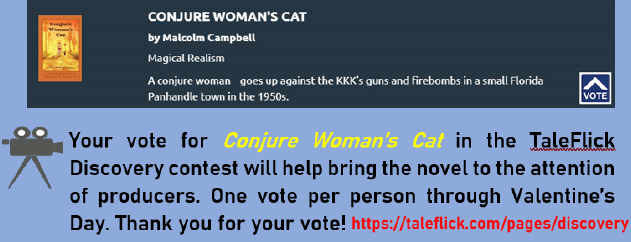
My novel Conjure Woman’s Cat mentions the rape of a black woman by white males. In my fictional account, the police don’t even bother to investigate because this was, sad to say, par for the course. Black women in those days were portrayed, even in official court transcripts, as sexual Jezebels, “Nigger wenches,” and as women who liked being assaulted by white men. When they claimed they were raped in the rare instances such cases came to trial, prosecutors asked if they enjoyed it.
A “classmate” of mine (I put the word in quotes because we didn’t know each other) was one of four men who raped an African American woman at gun and knifepoint. His sister was in my high school class. We knew each other but moved in different circles, so we never discussed the crime or the impact it had upon her or the family. In the high school yearbook, X was a senior and–as such–appears wearing a black bow tie, a white jacket, and a white shirt. He was active in school activities. He didn’t look like a man who would spend the rest of his life on the sexual offender lists.
He and his sister are still alive so I won’t mention their names or the name of the victim who has passed away. I never saw an interview with the victim or any account of long-term psychological damage after the verdict was announced. She showed great courage during the trial as she described the event and never flinched under defense attempts to paint the seven sexual encounters of the evening as what she wanted.
The first surprising fact in 1959 was that X and the three other thugs who committed the crime were arrested. The second surprising fact was that they were held in jail while awaiting trial. They had confessed but claimed the sex was consensual and made light of the whole thing like it was boys having fun. The biggest surprise of all is that they were convicted and sentenced to life in prison. How unusual this way for that day and time.
Those commenting on the disparate approach in the criminal justice system to the rapes of black women by white males and the rapes of white women by black males consistently view sex with a black woman as a rite of passage for young white men. This was probably the case in Tallahassee in 1959. Many think that the late Senator Strom Thurmond’s “affair” with an underage black maid in his family’s house falls into the “rite of passage” or “paramour rights” category.
Few people knew about the segregationist’s black daughter until after he died. His black daughter Essie Mae Washington-Williams, who died in 2013, was silent about her birth father for 78 years wrote an elegant and even-handed memoir (Dear Senator) in 2006 that shows the confusion and disconnect between the black sons and daughters and their white fathers who were fascinated with black women. Commentators were quick to point out that apologists for Thurmond’s relationship with the teenage black maid employed by his family called that relationship an affair rather than statutory rape or sex under duress.
After years of executing black men for raping white women, the 1959 Tallahassee trial was a victory, a wedge driven into the status quo, a precedent showing times might be changing, even though the rapists were out on parole within six or seven years. In Conjure Woman’s Cat, the men aren’t convicted because–in the “real life” of 1954 when the novel is set–they seldom were found guilty of anything. In those days, that was life as usual.
Arts, publishing and books websites are showing us a large number of links about writers and politics these days. Some writers are speaking out (from one side of the aisle or the other) at rallies, via letters to Senators and Representatives, and posts on Facebook profiles. Others are writing poems, entire poetry chapbooks, essays, book reviews, short stories and novels that reflect their concerns about a wide variety of political, economic and social issues that became part of the very polarized national debate during the Presidential campaign.
Somebody–I forget who–once said that all fiction and poetry is at one level or another political. Perhaps so. My contemporary fantasies can’t help but show sadness over a world that relies more on technology than spirituality. My two Florida conjure novels shine a light on the racism of the 1950s. Nonetheless, my primary intent with these novels was telling stories I was passionate about rather than creating “message novels.”
When I think about the folk songs of the 1960s–and a lot of the poetry and fiction as well–I remember them as being intensely political, about “the military industrial establishment,” segregation, poverty, and the Vietnam War. We seem to have come full circle back to writings of protest and resistance against conservative policies as well as writings suggesting that that previous liberal policies created a mess that needs to be cleaned up.
Of course I have opinions about the issues. One opinion of longstanding favors a better approach to the environment, conservation, protection of wild areas and natural resources, and more care about not polluting the environment. Since these views go all the way back to the days when I was in the Boy Scouts and first began to participate in conservation organizations such as the Wilderness Society and the National Parks and Conservation Association, I will keep writing about this–and referring to it in my stories.
While I respect writers and others who feel a need to speak out for or against the issues that now threaten to further divide this country into camps that refuse to work toward consensus, I’m not going to do it. For one thing, I have no credentials that give me any special insight into whether we should be doing ABC or XYZ. For another thing, much of the debate in both the news media and the social media is being driven by biased or skewed news, sensationalism and other misleading information, and voters on both sides of the issue who approach discussion with a “my candidate right or wrong.” All of this divides us further and makes the truth harder to find.
So my “voice” is going to stay focused on environmental issues and in writing fiction even if the two things get stirred up together a little bit. None of the rants–even those I basically agree with–on Facebook and elsewhere are changing people’s minds. Why not? Because they’re skewed toward the far right or the far left rather than a more centrist approach where people can really discuss the issues sanely rather than throwing gasoline on the fire with dueling wisecracks and graphics.
I welcome those journalists and other writers who do their best to look past the hysteria and tell us the facts and/or to carefully analyze the practicality, ethics, and legality of the issues in their news stories, features, essays, poems, and fiction. Anything else is pretty much spitting into the wind.



 Likewise, when people encounter charities and various crowdfunding initiatives that are collecting money for programs that will make a better world, I’m curious what people did after donating their $25 or $50. The same thought comes to mind about what people do after signing petitions that are trying to raise the public’s (or an elected official’s) awareness about a problem.
 With politicians, I’m less sure. Perhaps it’s because even the best of them sooner or later turn out to have skeletons in their closets and tapes of conversations where they misspeak at great length of multiple occasions.
 Protest songs and literature seemed to subside for a while; or maybe not. If they did, they have certainly returned now. Sites like Literary Hub, Arts & Letters Daily, and Poets & Writers that post articles and links claim there are more writers speaking out today than ever. The liberal writers, of course, focus their wrath on Trump; the conservative and moderate writers focus their wrath on the Democrats’ move toward the far left.

 Malcolm's Round Table