Hero’s Journey – Magical Helpers

“What such a figure represents is the benign, protecting power of destiny.” –Joseph Campbell in “The Hero With a Thousand Faces”

When a mythic hero begins his or her journey into the unknown, s/he often receives help from a magical helper or mentor in the form of advice or amulets to ward off or lessen the impact of the dragons and other horrific forces and entities along the hero’s path.

Crones, wise men, elves and other faerie folk, gods and goddesses, totem animals and spirit guides are among the forms of supernatural aid that providence (or the universe) provides.

Campbell writes that no matter how dangerous the evil forces are on the far side of the threshold or portal into the unknown (dark forest, wine-red sea, unconscious), that “protective power is always and ever present within the sanctuary of the heart and even immanent within, or just behind, the unfamiliar features of the world.”

Considering the journey as a spiritual undertaking, the hero–as we learn from mythology–is wise to trust himself and his guardians. In “Harry Potter and the Sorcerer’s Stone” for example, young Harry is called to his journey via mysterious letters arriving from Hogwarts School of Wizardry and Witchcraft; however the nasty Dursley family won’t allow him to read them, much less respond.

But the journey will not be denied. Hagrid, a half giant from the school appears, and rescues Harry via supernatural means. Likewise in “Star Wars,” Obi-Wan Kenobi uses supernatural means (paranormal skills) to extract Luke Skywalker from the planet where he’s been living and then serves as Luke’s mentor as the journey begins.
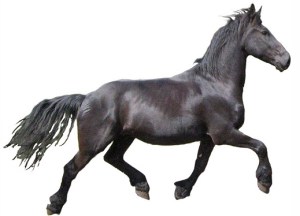
Friesian Horse – Walraven on Flickr

In my novel “The Sun Singer,” young Robert Adams encounters several magical helpers including a large, black horse named Sikimí. In everyday terms, the horse is a Friesian like the one in the picture. Yet, when Robert meets the horse for the first time, he–and the reader as well–are tipped off that Sikimí is somehow more than a horse:

The horse was excessively here in the present tense as though accentuated by the angle of the light into being more now than now and more visible than normally visible.

And then David Ward–a mentor character in the novel–tells Robert that Sikimí describes himself as “night in the shape of a horse.”

The journey, though, belongs to the hero alone. In “The Sun Singer,” neither Sikimí nor David Ward remain with Robert. He says goodbye to them and is on his way. He must trust that they–or whatever he has learned from them–will serve him well when the need arises.

Each mythic hero must merge the magical powers, amulets, advice of the magical helpers or mentors with his or her own willpower and faith to carry out the quest to its conclusion. The amulets cannot be all powerful nor the mentor always present, for then the “hero” would simply be along for the ride with no risks to face nor crucial decisions to make.

Hero’s path myths–and fiction based on the steps of the hero’s journey–are intended (in addition to their storytelling value) as catalysts for readers and their own life’s journeys. The translation of the mentors concept into daily life can be rather straightforward, for there are teachers everywhere as well as books, workshops and courses everyday heroes can use to their advantage.

Most of us do not expect a wide variety of gods to help us in the manner in which they directly helped (or hindered) Odysseus in Homer’s epic poem “The Odyssey.” Depending on one’s belief system, prayer can serve as supernatural help; so, too, the messages of totem animals and spirit guides in dreams and meditation. For others, the magical helpers of myths transform into the positive synchronicity and “good luck” that seemingly appear out of nowhere as a result of one’s positive thinking, trust in himself or herself, and dedication to a course of action in harmony with the universe (or one’s spiritual views).

The prospective hero hears “the call to adventure” and makes the decision to undertake the journey without guarantees. He does not ask to see the mentor or the magical helpers in advance. He walks out the door of everyday life without a script that shows precisely what will happen and how s/he will survive the tasks ahead and make it safely home.

Writer’s Note

As Ted Andrews notes in his book “Animal-Speak: The Spiritual & Magical Powers of Creatures Great and Small,” horse symbolism is complex. His keynotes for the horse are travel, power and freedom. These fit my needs for the book since my protagonist is concerned with all of these things.

The black horse appears in my own dreams and meditations often enough to be considered a totem animal: my own magical helper, so to speak. This means that I “know” a lot more about this particular horse than I need for the book, always a plus for an author.

If horses, wise old men, or other magical helpers and guides appear in your dreams, then they are playing the same role as the supernatural powers of classic myths as well as novels and movies that are structured along the lines of Joseph Campbell’s hero’s journey theme.

–Malcolm

Malcolm R. Campbell is the author of the contemporary fantasy “The Sun Singer,” a hero’s journey novel.
Hints for the Hero on the Path


“A Quest of any kind is a heroic journey. It is a rite of passage that carries you to an inner place of silence and majesty and encourages you to live life more courageously and genuinely.” –Denise Linn, Quest – A Guide for Creating Your Own Vision Quest

“The more you push yourself to understand something that you are not ready for, the less likely you will be to achieve understanding. You must surrender, let it go, and be fluidic. You cannot force this door [the door to your awakening] open. It does not work like that.” –Eric J. Pepin, The Handbook of the Navigator

“Resistance is an opposition, due to some belief, to experiencing something just as it is. It’s an attempt to create from consciousness rather than from awareness.” –Harry Palmer, in The Avatar Journal, Summer 2005.

“Quests are personal journeys, and every step is taken alone.” –Deepak Chopra, The Way of the Wizard

“The hero adventures out of the land we know into darkness; there he accomplishes his adventure, or again is simply lost to us, imprisoned, or in danger; and his return is described as a coming back out of yonder zone. Nevertheless—and here is the great key to understanding of myth and symbol—the two kingdoms are actually one.” –Joseph Campbell, The Hero With a Thousand Faces

If there is a subtle message in my novel The Sun Singer it is this: the great words of the great masters about your life’s journey are—at best—hints.

The words of the masters may suggest to you that there are other worlds and other levels of consciousness and other levels of awareness. And they may also suggest techniques that will help you find the doorways, paths, enlightenments, and awakenings you desire.

After that, the great words are lies insofar as your journey is concerned. The great masters’ great words describe the great masters’ journeys. As such, they are the gospel of the great masters’ experiences.

Your journey is yours alone and cannot be undertaken by following in the great masters’ footsteps or by concretizing the great masters’ thoughts into a recipe book. You alone know the terrain upon which you are walking and when all is said and done, the great masters’ view from the mountaintop will never be yours. Attempting to see what they saw creates blindness.

You alone will write the gospel of your life, and it will be based on your awareness of your own experience. Nothing else matters; nothing else exists. You are both the creator of your path and the one who walks upon it enjoying the scenery and surprising yourself with the wonders you encounter.

Copyright (c) 2005 by Malcolm R. Campbell

The Sun Singer and Jock Stewart and the Missing Sea of Fire are available in multiple e-book formats at Smashwords during Read-an-Ebook Week for only $4.49. Sale runs through March 13.

Favorite Place of Relaxation

Some guided meditation techniques begin with the leader/facilitator saying, “Close your eyes, take deep breaths, and as you slowly exhale, visualize your favorite place of relaxation.”

In most groups, a fair number of people will choose real or imagined sunny meadows, mountain valleys, quiet ocean beaches, and silent lakes. These are soothing places.

I tend to pick actual locations for my favorite places of relaxation because they are so easy to visualize. And then, if the meditation–or shaman’s style journey–calls for me to move around, I can quickly see myself walking along an actual trail I know well.

Whenever I return to that place “in real life,” I find that a psychic bond has been created via my frequent visualizations of it. In ways difficult to describe, I am closer and more attuned to the land, the animals, the trees and the flowers in that location than I would be if I had never visualized the spot in meditations and dreams. The favorite place of relaxation has now become a place of power.

The land “gives back” in response to our appreciation of it. As we honor it, it honors us in return and in greater measure.

Copyright (c) 2005 by Malcolm R. Campbell

Hero’s Path – Not for Self Alone

“What each must seek in his life never was on land or sea. It is something out of his own unique potentiality for experience, something that never has been and never could have been experienced by anyone else.” –Joseph Campbell

This experience comes to each of us, I think, when we step forward on the highway of our life without worrying about where others are going or what others will say about where we are going–assuming we have a destination.

We can share what we know with others, of course, but cautiously, lest they take it as their own gospel. The only path we know is our own. We must have passion for it. But we cannot preach it so strongly that we influence others to copy our experience rather than discovering their own.

The hero on the path blazes his own trail, but never for selfish reasons. He is changed by the joys and perils of the journey. The “road” is a handy metaphor. But we really don’t want wide highways as much as we want an absence of them. Wide highways tell us where others have gone, while deep forests, uncharted waters and endless prairies open up an infinite number of unique possibilities for each of us.

You’ve heard the phrase, “Smooth seas don’t make good sailors.” I used a variant of this in my hero path novel The Sun Singer: “Small hills don’t make good mountain climbers.” Trials and tribulations bring us more opportunities for growth than easy walking. Couch potatoes usually don’t learn much.

The world benefits from the treasures the hero brings back home. S/he is not on the journey for self alone, but for everyone who comes into his or her sphere of friends, colleagues, acquaintances, and fellow seekers. We seek a journey that is ours and we seek a goal that is for everyone else.

If you are interested in the concepts of the hero path, a good place to start looking is the Joseph Campbell Foundation. The foundation has active discussion forums and a lot of source material in addition to Campbell’s books.

Join us here on the Round Table when author Pat Bertram stops by on October 19th and 20th to talk about her new novel Daughter Am I which contains a strong quest story.

Malcolm

Preparation + Certainty

“Stand still – the trees ahead and bushes beside you are not lost.Wherever you are is called “here”… the forest knows where you are. You must let it find you.” – David Wagonner

Dreams, like the natural world, often look romantic and beautiful and easy to traverse at a distance. But sooner or later, you must make a start. As an Eagle Scout, I am a long time believer in the both the citizenship and the woodcraft preparation one receives in such programs.

Whether you’re walking alone into the wilderness or stepping into a new career or a new project, real-world preparation gives you the luxury of spontaneity. If you lose your matches, you’ll still be able to make fire; if you lose your trail, your compass and the landmarks you see will help you find where you are on the map.

Certainty comes through this preparation as well as the faith in oneself that where you are is where you must be. Listening to the environment, noting the signs, learning from the trail, and attending to the voice inside your head that is only audible when you sit in relaxed silence, all provide constant beacons that will help you know where you are within yourself and within the natural world.

Crossing the threshold into the unknown quite often brings doubts, for here the poetry of the journey may seem to be falling away and leaving you wet and hungry and mired in realities that test you and frighten you and bring about despair.

These tests are proof you are going where you are supposed to go. Expect them, for they are the stepping stones to success, a path you will best be able to follow if you have faith in what you have learned in preparation and have faith in what that learning has made of you.

Copyright (c) 2009 by Malcolm R. Campbell