“Everywhere that July in 1963 there were the pines, their long needles shimmering in a faint wind under the hot subtropical sun. In the country there were empty dirt roads, rutted by mule carts. In the towns, sprawled unpainted shacks without windows. Ancient Negro women sat fanning themselves with palm leaves as they stared drowsily from rickety porches at their zinnias and coral vines and heavy-scented honeysuckle bushes. Moss-draped oaks and lacy chinaberry trees shaded sandy dooryards. Scrawny dogs, the flies buzzing at their noses, slept among ragged-feathered chickens poking for scratch feed. Locusts whine from tall magnolias and the steady pitch of power saws. But mostly it was those pines and the tang of their resiny branches and the dark straightness of their trunks. All of it looked like the south of the novelists and the poets, heavy with antiquity, romance and misery.” – Gloria Johoda in “The Other Florida.”
I was in college in 1963 when my friend Gloria Jahoda wrote those words. Like me, she wasn’t born in Florida, but in her now-classic book about the state’s panhandle she observed and wrote about what many long-time residents no longer noticed or took for granted. “The Other Florida” was other because it wasn’t filled with tourist attractions, widely known beaches and movie stars.
Other than a few childhood poems, I wouldn’t write about the other Florida until recently. My family moved there from Oregon just in time for me to enter the first grade. Out of the culture shock of the move, I also saw the place I would live for 18 years through the eyes of an outsider.
Yes, my family went to St. Augustine, Tampa, Daytona Beach and Key West, stopping at many gaudy tourist attractions in between. But all that was crowded and nearly fake with an overlay of commercial glitz and I was always happy to be home even though much of the panhandle was considered backward and impoverished in spite of having the state capital in the middle of it.
The Oaks is abandoned now, but this was my favorite place to eat down at the coast
I haven’t been back to north Florida since the mid-1980s when my parents died and my brothers and I closed up and sold the house the family had lived (by then) for some 35 years.
In my childhood days, I learned the territory like most kids did…swimming in clear, cold sinkholes, camping with the Boy Scout Troop in the piney woods, hanging out with friends at our pristine and uncommercialized beaches, exploring the Florida Caverns at Marianna, deep sea fishing in boats that went out from St. Marks, learning the voices of Snake Birds and Limpkins at Wakulla Springs, delivering newspapers throughout my neighborhood, marching in parades downtown with the high school band. . .
We lived in Tallahassee in a day when mule wagons were still on the streets and many homes were built on unpaved, red clay roads.
I saw what Jahoda saw, partly because I was new, partly because the outdoors was our playground in days before the Internet, and partly because my folks arranged day trips to may special places within the confines of this map. In the days before high gasoline prices, my best thinking place was my 1954 Chevy on a dark country road at night. I don’t know what I solved anything, but I saw a lot on the hundreds of miles of roads I saw every week.
Looking Back
There were 40 pine trees in our yard. Plenty of pine straw to take.
If you’re a writer, I urge you to look back to your childhood places and ponder what it was like, what there was to do, what the people were like, and what kinds of stories and legends you heard. Whether you were happy, sad, or borderline average during those days, the memories are potentially very potent.
In looking back, I’ve written (or am in the process of writing) stories on that map set in Carrabelle and nearby Tate’s Hell Swamp, Marianna and the nearby Bellamy Bridge and Chipola River, Tallahassee, St. Marks, Wakulla County, and the barrier islands. My novella in progress is set at a fictional town not too far from Weewahitchka. You can probably find a similar handful of towns near your childhood home. Each has its unusual traditions, the stories people hope everyone has forgotten, legends, ghostly tales, and plenty of Mother Nature.
Florida seems strange to those who did not live there. The same can be said for other places I’ve lived, worked or visited: Northern Illinois, Minnesota, San Francisco, Montana, North Carolina, and North Eastern Georgia. For a writer, a lot of the appeal of going home (literally or figuratively) for stories is the differentness of the place. That adds a lot of appeal to a story. Take a Florida tradition, add in the weather and the pines, toss in a ghost story, and pretty soon you are telling something fresh and knew and page-turning.
You can ramp up your stories with old memories, smiling again with the the joys, possibly even finding closure for the sorrows; your issues, your cares, your friends, your slings and arrows, your memories can be puzzled and camouflaged into your story. They bring strength and depth because you lived them and know what they were all about.
I’ve about wrapped up my Weewahitchka-area story. It gets a potent childhood issue off my plate of memories. More about that later if the publisher likes the story. I think I’ve written some of my best stuff about the places where I grew up because there is so much “material” there I can turn into fiction. That’s why I often urge other writers to look at the towns where they grew up with fresh eyes and see if they can find some stories there.
–Malcolm
$1.99 on Kindle
My stories with Florida settings include “The Seeker” (Tallahassee, Carrabelle, Tate’s Hell), “Emily’s Stories” (Tallahassee and St. Marks), “Cora’s Crossing” (Marianna), “The Land Between the Rivers” (Tate’s Hell) and “Moonlight and Ghosts” (Tallahassee).
Did you ever notice how tough guys in movies and brainy guys on science shows are always claiming that a darned good bomb can be made out of the contents of a family’s medicine cabinet?
The first time I heard this I was a kid in the days when kids were still allowed to play with fire, cap pistols, bows and arrows and cherry bombs. How exactly would I make a darned good bomb? Would I mix Preparation H and Vagisil? Or, possibly hydrogen peroxide and codeine. (In those days, the feds allowed people to buy codeine, paregoric and other miracle meds).
The thing is, nobody who claimed to know how to turn a medicine cabinet into a bomb ever explained how.
I have no interest in making a bomb, but I wonder what–as a writer–I should do if a character in one of my books was fighting bad guys, needed a bomb, and ran into the bathroom to throw one together. How should one realistically describe what he does?
Look, I’ve read plenty of thrillers written by people who know everything in the world about bombs, guns, aircraft, submarines, martial arts, police procedures, &c. They never say, “Bob grabbed a gun before he got on the helicopter.” For purposes of reality–and to prove to readers they know their subject matter–they state what kind of gun in was, what kind of helicopter it was, and spout out a bunch of stats like they’ve got the owner’s manuals with them.
What about magic?
Rowling has already confessed to using fake spells in the Harry Potter books. They’re kind of cute, actually. But they don’t do squat. I’m sure a lot of people went around shouting Accio Money and Avada Kedavra before Jo told the world she didn’t give us the real stuff.
So now, I’ve got an ethical dilemma as I work on my conjure woman novella. I’m a fanatic about realism because I think it’s a wonderful foundation for the magic. If the stuff people already know is obviously real, then they’ll think the stuff they don’t know is also real. (That’s not logical, but it works in books.)
Suffice it to say, that if Rowling used real spells or if some book called “Mega-Enforcer Dude” gave a step-by-step recipe for making a bomb out out Preparation H, folks would be getting hurt. But, the details have to sound plausible because: (a) you don’t want people who know how to make spells and bombs writing bad reviews on Amazon saying the recipes were a bunch of crap, and (b) you hate being dishonest with your readers.
There’s a wonderful conjuring spell called The Whoopass Wall of Protection (not its real name). As she fights the bad guys, my conjure woman needs to use this spell. But I can hardly say she dumped “a bunch of stuff” out of a sack. Nobody will believe she knows squat or, worse yet, that I (as the author) know squat. I can use footnotes to tell readers that the real Whoopass spell isn’t included, but footnotes turn people off because they start thinking they’re reading a doctoral dissertation and, trust me on this, nothing is more boring that that kind of writing.
Perhaps I should give a few hints to satisfy those craving reality as well as those who really know the spell. “Lucy dumped a sack filled with cornmeal, coffin nails, rue and pepper on her sidewalk.” Okay, that could work, but it doesn’t really plunge the reader into the moment, does it?
This is going to require some careful thought. If you’re a writer, perhaps you can offer some advice about just how much dangerous information should be included in a novel for the sake of accuracy.
If you’re a reader, just how much do you want to know? And, if the novella included the real spell, would you promise not to use in unwisely?
Speaking in Forked Tongues, by Brad Gallaway, Signal 8 Press (April 22, 2014), 306 pages
Brad Gallaway’s dark fantasy/horror novel Speaking in Forked Tongues is inventive, delightfully written tale about a young man who calls demons for a living. When folks can’t solve their earthly problems, they contact Helping Hands agency who sends out a caller with an underworld solution. Callers who have been to hell and back multiple times are the best in the business.
While the publisher’s description claims that protagonist “Bren Barran is a normal guy in most ways,” one might ask whether a young man who was adopted by demons, who grew up in hell, and who brings clients and demons together to fix what nobody else can fix can possibly be normal in most ways. Yet, Gallaway makes Barran seem normal, in spite of a predilection for dark, self-deprecating humor.
Unlike poor Faust who sold all of his soul for help from hell, Barran’s clients usually part with a mere sliver, insuring that the demon on call gets what he wants, Barran’s boss Nareth gets what she wants (a cut of the action), the callers get paid and that the happy clients have enough soul left to bring in repeat business.
What could possibly go wrong?
Even though hell is a well-run, ably governed and a relatively safe place quite unlike what we’ve all heard, there’s room there for jealousy and discord. Truth be told, Barran doesn’t think demonkind is any worse than humankind when it comes to bad traits except for the fact demons are physically larger, have claws, and know dangerous (and harmful) spells. So, when Helping Hand’s callers start disappearing and when Barran starts getting attacked on the street, it isn’t long before (seemingly) all hell breaks lose.
There’s a bit of expected gore in this book and a wonderfully tangled plot for Barran to navigate as he tries to solve his agency’s demon problem while staying alive. Naturally, Mom and Dad want to help, but according to the rules, they also have to be paid. The bad guys in this story are really bad and Gallaway makes them seem uncomfortably plausible while leading readers to an ending they won’t see coming.
On a minor note, a warning to parents: The novel’s listing on Amazon claiming that the book is suitable for ages 1 to 17 is either an error or a devilish promotional trick. Teens and adults of all ages can probably stand the heat, while enjoying the trip.
“Modernity and electronic media in particular is killing the storyteller. ‘When electricity came,’ as they say in Ireland, ‘the fairies flew out the window.’” – Richard Hamilton in “Tell me a story,” Aeon Magazine
Wikipedia graphic
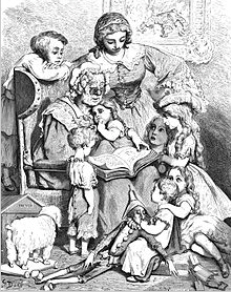
While reading Richard Hamilton’s article about storytelling, I began thinking about how often my parents read me stories, beginning with the old fairy tales. Hamilton quotes folklorist Joseph Bruchac about the spellbinding power of the story when a person hears it being told: “Unlike the insect frozen in amber, a told story is alive… The story breathes with the teller’s breath.”
When my parents and other great storytellers told stories, the stories came alive because of voice tone, volume, pacing, facial expressions, gestures, and the slight variations in the tale that were being dynamically tailored to the moment and to my reactions. Ghost stories told on camping trips could become really scary when the storyteller merged them in with the landscape we saw in the flickering light of the campfire.
The old myths we read, captured in the figurative amber of the printed page or the Kindle screen were once communicated from storyteller to storyteller. They changed in the telling as did many of the legends we have inherited here in the United States from Indian Nations. Time, audience and circumstances impacted the tale. They lived in the moment with those hearing them.
As authors, we know we cannot exactly duplicate (on Kindle or paperback) the aliveness of a story the way a storyteller can. We hope our words, combined with the readers’ imaginations, will make up for the lack of our oral tradition in an Internet world. I am pleased, of course, that two of my books (“Jock Stewart and the Missing Sea of Fire” and “Emily’s Stories) are available as audiobooks. When the narrators do their work well, the audio book can take one back to their childhood days and duplicate a bit of the pleasure of hearing a story told.
When I’m doing research, I dislike podcasts and videos with a passion. Why? Because my eyes can scan a printed page or a PC screen for the information I need much faster than an audio or video discussion of the same subject will provide it. Whether it’s the Internet or video game or cell phone texts or something else, we’re all (it seems) developing shorter and shorter attention spans.
Yet audio books are very popular these days even though they take more time to listen to than it would take for a reader to go through the Kindle or paperback version. I suspect a lot of people are multitasking. They’re driving to work while listening to the book. That’s good and bad, I guess. They enjoy more books: that’s good. Their attention isn’t focused on the story: that’s bad.
As an author, I hope that the audio book narrator’s power of delivering a good story will partly compensate for the fact that the listener is watching traffic and maybe even exchanging small talk with others in the car. We don’t kid ourselves when we write stories to be read and/or stories to be told: we know most of our readers and listeners consider stories as a luxury rather than a necessity. We’re happy that people enjoy the stories even though the distractions around them are taking away some of those stories’ power.
What about you? Do you listen to audio books for the experience of hearing a story read to you by a powerful narrator or do you listen to them because that’s the only way you can squeeze novels into a busy schedule? And, when the story is one that resonates with you, do you try to find time to listen to it in a quiet room with no other distractions, almost the way many of us heard stories when we were young?
Malcolm R. Campbell’s three-story set, narrated by actress Kelley Hazen, is available directly from Audible or from the book’s Audible listing on Amazon.
With all the high-energy buzz surrounding books like Donna Tartt’s The Goldfinch, Amy Tan’s The Valley of Amazement, and John Grisham’s Sycamore Row, I have to look a little harder to find new fantasy fiction, especially contemporary fantasy.
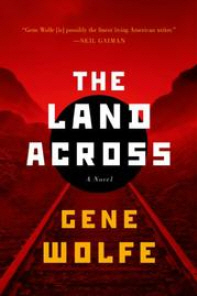
So, I’m happy to see that Gene Wolfe’s (“The Book of the New Sun” tetralogy) new release from Tor Books will appear a few days before Thanksgiving filled with corruption, supernatural powers and a Kafkaesque flavor. The Land Acrossunfolds in an imaginary Balkan country that’s difficult to visit and more difficult to leave–in part because of the secret police and in part because of a cult called the Unholy Way.
Teaser Excerpt from the Novel
Like most countries it is accessible by road or railroad, air or sea. Even though all those are possible, they are all tough. Visitors who try to drive get into a tangle of unmarked mountain roads, roads with zits and potholes and lots of landslides. Most drivers who make it through (I talked about it with two of them in New York and another one in London) get turned back at the border. There is something wrong with their passports, or their cars, or their luggage. They have not got visas, which everybody told them they would not need. Some are arrested and their cars impounded. A few of the ones who are arrested never get out. Or anyhow, that is how it seems.
Wolfe
Reviews
Kirkus Reviews says The Land Across “seamlessly blends mystery, travelogue, authoritarianism and the supernatural.”
Publishers Weekly says “Wolfe evokes Kafka, Bradbury, and The Twilight Zone in combining the implausible, creepy, and culturally alien to create a world where every action is motivated by its own internal logic, driving the story forward through the unexplored and incomprehensible.”
According to Library Journal’s starred review, “Wolfe, in masterful mood, builds his characters, explores the puzzles, links the elements together and contrives to render the backdrop both intriguingly attractive and creepily sinister. Sheer enjoyment.”
And Booklist writes, “Master fantasist Wolfe feeds into every tourist’s worst fears in this cleverly constructed travelogue though a country figuratively accessed through a looking glass. When an American travel writer, Grafton, sets out to document his experiences traversing a small, exceedingly obscure Eastern European country (the land across the mountains), he winds up in a nightmarish predicament from which there appears to be no escape.”
I like contemporary fantasy because, in blending magic into the real world, it brings us plots and characters that seem somewhat more plausible than swords and dragons on far-away planets. Almost everyone who has traveled has worried about being lost in an unfamiliar and unfriendly place. Wolfe’s protagonist is a travel writer who should know his way around the risks, but he’s nonetheless trapped in a place where mere unfriendliness would be a plus.
Malcolm R. Campbell is the author of contemporary fantasy novels, including “The Seeker,” “The Sailor and “The Betrayed.” Released this month, “The Betrayed” features a young English teacher at a small campus where lies and deceits take precedence over literature, history and science.
The Decatur I knew from many childhood vacations to visit my grandparents on West Wood Street no longer exists. My grandparents house, featured in novels The Sun Singer and Sarabande, has been torn down for reasons unknown.
The interurban trains and the streetcars are long gone and the old transfer house where people changed trains and buses in Lincoln Square is now an heirloom in a city park. Since I haven’t been to Decatur for years, I don’t know whether the pungent odors from the Staleys plant still blanket the city when the wind is blowing the wrong direction.
Fairview Park is still there–minus the passing interurbans–and I see from maps and park brochures that it has evolved over the years. It still sits a few blocks away from the place my grandparents’ house once stood. It was perfect for day trips and–a half century later–equally perfect as a location setting in my novels. As children, my brothers and I hiked in nearby Spitler Woods.
Greenwood
I’ve heard that the notorious Hell Hollow has been cleaned up, but that on certain evenings one can still see ghostly lights in Greenwood Cemetery. The Haunted Decatur website claims that the dead still walk and, quite frankly, that is something I would like to see. A few miles down the road, the trails of the widely known Allerton Park echo in my memory as well as in my novel The Sun Singer which was named after the famous statue in the park.
Childhood’s Magic Calls Me Back
As an author of contemporary fantasy–that is to say, fantasy mixed into real locations as in the Harry Potter series–I have variously used Glacier Park, Florida’s Tate’s Hell Swamp, Decatur and other locations as story settings. I have mixed the old and the new by tangling up personal memories and the histories of these locations in my work.
Robert Adams in The Sun Singer visits Allerton Park and has a psychic experience–as I once did–beneath the Sun Singer statue. In my upcoming short story “The Lady of the Blue Hour” for “Aoife’s Kiss Magazine,” I blend myths and history from the days when Illinois was a French Province with a young man who lives on West Wood Street next to my grandparents’ house. And, in my soon-to-be-released novel The Betrayed, I set much of the action at a fictional college and tangle that up with the streets and houses in Decatur’s West End Historic District (not too far from where the Transfer House once stood).
While I enjoy mixing contemporary fantasy, location setting history and personal memories together in my stories, I don’t necessarily advise other writers to do it. It makes it difficult at times to separate real memories from one’s fiction. The real location settings make fantasy more believable, I think. The real-life experiences–readers don’t know which events those are in the story–make fantasy more dear to the author during the writing process.
Sun Singer at Allerton Park in nearby Monticello
This quote from author P. L. Travers (author of the Mary Poppins books and a primary character in the new feature film Saving Mr. Banks) closely approximates my beliefs about the stories I set in Decatur: “We cannot have the extraordinary without the ordinary. Just as the supernatural is hidden in the natural. In order to fly, you need something solid to take off from. It’s not the sky that interests me but the ground. . . . When I was in Hollywood the [script] writers said, surely Mary Poppins symbolizes the magic that lies behind everyday life. I said no, of course not, she is everyday life, which is composed of the concrete and the magic.”
Naturally, my stories about ghosts, flying horses, magic avatars’ staffs and alternate realities and universes cannot be published under the banner of realism or mainstream fiction. So, while much of what I write about Decatur and Glacier Park and Florida Panhandle swamps is real, I’m officially a contemporary fantasy author. I don’t mind: I read a lot of fantasy.
And, when I read fantasy, I wonder how much of the magic is real and how much of it is truly fiction. However, since this is another of my “on location” posts, I assure you that Decatur, Illinois is real–or mostly real, depending on who you ask.
–Malcolm
Malcolm R. Campbell is the author of Conjure Woman’s Cat
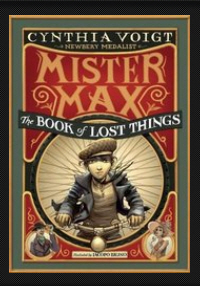
Newbery medalist Cynthia Voigt (“Kingdom,” “Tillerman” and “Bad Girls” series) brings her considerable storytelling experience to an inventive adventure with a unique and resourceful protagonist. Intended for readers from 8-12, Mister Max: The Book of Lost Things is the first in a planned trilogy about the likeable and realistically drawn twelve-year-old Maximilian Starling.
Day to day, he’s just Max, a schoolboy who doesn’t quite fit in with his peers because his parents are larger-than-life and excessively flamboyant theater people who find drama in everything. Just Max is just “different.” Max’s has a nagging problem: his parents are lost. They’re lost as in missing, misplaced, misunderstood, potentially kidnapped, or enacting a drama without due regard to Max who’s been left behind in an empty house.
Fortunately, his grandmother lives nearby. Unfortunately she is, in Max’s opinion, inclined to be bossy. They agree, however, that it’s better for Max’s school to assume Max is on a trip with his parents. After all, that was the plan before William and Mary Starling of the Starling Theatrical Company disappeared. Grammie and Max also agree that the authorities, whoever they may be, need not know about Max’s mostly empty house.
Readers will identify with Max because, like any twelve-year-old with lost parents, Max is a bit overwhelmed by the questions and emotions racing through his head. However, he is determined to meet the challenges of independence head on. He needs money and that means he needs a job even though nobody seems to be hiring twelve-year-old applicants without experience.
Voigt has blessed her protagonist with a skill he doesn’t immediately see has having any value outside the walls of the Starling Theatrical Company: he knows about roles and costumes. While he doesn’t really want to call himself a private detective, the world of roles and costumes and his preoccupation with that which is lost make him adept at helping others–at a reasonable fee–find what they need to find.
The story is filled with memorable characters, humor and a series of lost and found adventures that will stir up the imaginations of young readers who might speculate about what they would do if their parents were lost. Voigt’s words, which (figuratively, of course) dance and sparkle on the page, are supported by Iacopo Bruno’s magical illustrations.
The illustrations and plot twists bring a heady 19th-century daring-do to a story that sweeps toward a suitably over-the-top cliffhanger ending that should satisfy readers while Voigt decides how Max is going to find his way out of his next dilemma. Young readers will find that Mister Max is filled with wonder, mystery and plenty of adventure.
I used Glacier National Park’s Iceberg Lake in “High Country Painter,” of the three short stories in my family-oriented e-book/audio book Emily’s Stories.
Where Is It?
Iceberg Lake is a 5.9- mile hike from Many Glacier Hotel on the east side of Montana’s Glacier National Park. The lake, which is frozen over during the winter months, is named for the chunks of ice that float in it throughout the summer. It’s one of the most popular trails in the area.
En route to the lake from the hotel, the elevation increases 1,200 feet, however most of the uphill sections of the trail are gradual. For those who haven’t yet gotten used to the elevation or long walks, the hike provides a half-day of exercise.
In his book The Best of Glacier National Park, Alan Leftbridge lists Iceberg Lake as one as one of Glacier’s seven best day hikes. His level of difficulty for the hike is moderate. Hiking in Glacier calls the hike strenuous. (I guess it depends of whether or not one is out of shape!) If you don’t have a hiking guidebook, this web site provides a good overview of the trip.
How I Used it In the Story
Trail to Iceberg Lake – Photo by GlacierGuyMT
Young Emily Walker and her family travel from Florida to Glacier National Park for a family vacation. She accompanies her father on the hike while her mother spends the day around the hotel. Since she occasionally talks to birds and spirits, she knows something unusual will happen at the lake.
Why I Used the Lake
Iceberg Lake
Emily and her father are used to the sinkhole lakes and blackwater rivers in the Florida Panhandle. I wanted to put them into a new environment. The arête in the picture is called the Garden Wall and it not only provides a lot of ice and snow to look at, but frequent mountain goats as well.
The lake sits in a cirque, a carved-out bowl left by ancient glaciers, and since it’s such a popular spot, hikers will almost always find ground squirrels and chipmunks there begging for food. The lake sits in bear country, so it’s always good to check with the rangers for to see if there have been any grizzly bears in the area before you begin your hike.
The hike also features many wild flowers as well as some very different views of the mountains than one sees from the hotel. There are good views of many rock formations and other features of glaciation,
The first mile of the hike is on the paved road that connects the hotel complex to the camp store and the campground; park your car at the store to save a bit of walking.
Excerpt from Emily’s Stories
Available on Kindle and as an audio book
The horizon was hidden by a grey wall of rock which, according to the pack, also concealed incoming storms; now, carrying rain jackets on a sunny day made sense. By the time they passed the noisy waterfall and strolled through lacey-white bear grass (without bears) and scattered Indian paintbrush that gentled the grey rock (“limestone,” her dad said, descriptively), Emily was ready for lunch.
Deep snow lay hard-packed around the lake’s far shore where the limestone wall created a playground for mountain goats running across their grey and white world as nimbly as Southern chameleons ran along the Walters’ brick house. Sunny Florida was, as advertised, sunny and hot, but here deep summer had only melted the ice off half of the lake’s surface.
“I am astonished,” said Emily, dropping her knapsack on the ground and running down to the water. The water was as cold as it looked.
“Punkin, ‘astonished’ is a new word for you,” her dad said. He knelt down and splashed water over his
face.
–
Summing Everything Up
My teenaged protagonist talks to birds and spirits, so her stories are always set outdoors. Like other visitors to the hotel, the hike to the lake is one she would probably take. It provides great scenery for Emily to experience with her father as long with the possibility a bear might appear.
I worked at the hotel as a bellman for two summers and walked up to this lake many times. Using it in the story is an example of a writer writing what he knows.
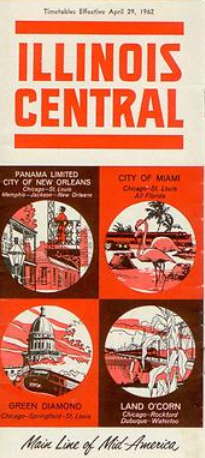
Known as The Main-Line of Mid-America, the Illinois Central (chartered in 1851), connected Chicago with Sioux City, Omaha, Mobile, New Orleans and points in between. Perhaps its most famous train was the City of New Orleans which began running in 1947 and still operates today under Amtrak. Steve Goodman’s 1971 folksong “City of New Orleans,” celebrates that train with its “Good morning Anerica how are you” in recordings by everyone from Judy Collins to Willie Nelson.
When I was in college in Florida and working in Glacier National Park in the summer, I traveled by train. Even though the Great Northern Railway sold its historic park hotels in 1950, the railroad still provided low-cost tickets to seasonal park employees such as bellmen, maids, desk clerks, and waiters. On my return trips, I rode the Illinois Central’s lesser-known train called the Seminole. Since Tallahassee had no north-south rail service, I got only as far as Albany, Georgia (100 miles away) where my parents picked me up.
Passenger Timetable
My worst experience aboard that train came one winter when I was coming home from a visit with friends in Chicago. Somewhere north of Albany in Central of Georgia Railway territory, the train stopped in the middle of a forest recently glazed over by an ice storm. A trainman came through after a while, and said we were free to get off and stretch our legs because we were going to be there a while. A huge tree lay across the tracks. The train crew, with help from the passengers, attacked that tree with fire axes. It took four hours and many blistered hands to clear the tracks. (My parents saw more of Albany that day than they planned.)
Nostalgia Through Fiction
In my recent contemporary fantasy The Seeker (Vanilla Heart Publishing, April 2013) my main character travels from Chicago to Albany via the Seminole to see his girl friend. Since I rode that train many times, it was fun re-creating ambiance of 1960’s train travel in the novel.
Several months later, the sequel called The Sailor, included some of my memories of the Great Northern Railway. In fact, my protagonist David Ward got to do what I always wanted to do: run the train.
In both novels, train travel is a relatively minor part of the action. But I like to make my settings real as well as historically accurate. Train travel was by no means perfect, but it was how we got where we wanted to go when airline travel was still too expensive for most people. There’s nostalgia in the memories, and that’s another reason I included them in my fiction.
Illinois Central Excerpt from The Seeker
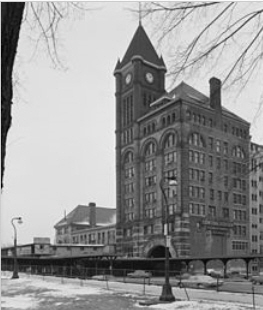
When the taxi dropped David off beneath the clock tower of the 72-year-old Romanesquestyle Illinois Central terminal in Chicago for his May 1 trip to Florida on IC train #9, the Seminole, he wondered if Anne still considered the spontaneous marriage proposal he sprang on her while the Empire Builder raced between Williston and Minot, North Dakota last September with a no-holds-barred, unconditional, leap-of-faith yes.
I loved IC Station in Michigan Avenue. It was built in 1893. It was torn down in 1974 when municipal vandalism won out over preservation and common sense.
Thirteen stories up, the clock read 4:00 PM. Roughly 21 hours later and 940.7 miles down the Main Line of Mid-America, Anne would meet the Jacksonville-bound train at Albany, Georgia as —she claimed—a “different person.” “Za aníwaz?” Eagle would ask. Had she become a blonde? Taller, thinner, shorter, heavier? Or, more like Katherine Hepburn and less like Elizabeth Taylor?
As he found his seat in the old heavyweight coach in the chocolate and orange colored train, the “different person” comment, made so lightly on the phone several weeks before, played on his mind in a minor key.
By the time the pair of General Motors E9 diesel locomotives eased the train out of the station at precisely 4:45 PM, the minor key was dangerously close to a dirge. He was going south from Chicago with love, but was his blind date Daniela Bianchi, playing the sexy Tatiana Romanova with the bedroom eyes; or Lotte Lenya as the sinister agent Rosa Klebb with a lethal knife in her shoe?
At 63rd Street, he opened Barnard Malamud’s A New Life to the first page in hopes that “S.Levin, formerly a drunkard” would be entertaining enough to distract him from idle speculations about the Wicked Witch of the West vs. the Good Witch of the North.
Journey’s Beginning
Dinner—between Champaign and Effingham—distracted him. For one thing, he shared a table with Ed and Mary Saunders of St. James Street in Waukegan, Illinois, who were heading to Miami for their gala fiftieth wedding anniversary celebration at the Fontainebleau, and Mary had a lot to say about Ed’s failure to book them on the more luxurious City of Miami instead of the more utilitarian Seminole. For another thing, the Canapé Lorenzo set before him on the railroad’s coral china was actually quite good—as were the Athens Parfait (compliments of Ed Saunders who, according to the waiter, was a snake when it came to forgetting the tip) and coffee for desert.
David fell asleep south of North Cairo, Illinois, soon after Laverne told S. Levin, “I’ve never done it before with a guy with a beard.” He awoke abruptly 245.9 miles later in Haleyville, Mississippi. A New Life lay on the floor at his feet. He looked at his watch, almost 5:00 AM. The car was quiet until a woman leaving the restroom at end of the coach misjudged the uneven movement of the train through a pair of switches, screamed “shit” in a voice loud enough to wake the unborn before falling against the push-down door handle and careening out into the noisy vestibule. The sleeping passengers’ heads moved, shoulders scrunched or unscrunched, feet slid out into the aisle or were pulled in tight, and arms stretched out like the legs of large insects in a continuing wave from the front to the rear of the car. And then all was at rest again.
Then the squalling wheels in the coach’s rear truck in a tight curve fetched up the memory of the caterwauling panther of a nightmare that must have stalked him thirteen miles up the track at Hackleburg … he had been running between small ponds beneath a bright moon … Coowahchobee sprang out of the dark stand of hatrack cypress and chased him through shallow water … trapped, suddenly, in an unyielding thicket of titi … the small white flowers exploded over head like a dying constellation when … brown eyes above a deep growl that ran through him seconds before the claws snagged his left arm … as the large cat dragged him away from the water, he was conscious first of the pain and then of the dance of its exceptionally long tail … a vague sound deep in the swamp—the novel hitting the floor or the horn of the diesel at an ungated crossing—brought him back to his reclining coach seat on the southbound Seminole. The name Anne wrote in her last letter—Coowahchobee—was the Seminole name for the increasingly rare Florida panther. He had looked that up in the college library.
Kindle Version
David wandered into the dining car a little before 8:00 AM as the train arrived in Birmingham. Couldn’t sleep. Every time he closed his eyes he saw the panther’s eyes. He tried to read, but S. Levin’s fate—teaching English composition in a college with no love of the liberal arts—ticked him off. Was he destined to end up like that? Long before Laverne commented about his beard, Professor Fairchild told Levin to focus on the college’s pet grammar book and “give your students plenty of wholesome, snappy drill.” Holy shit. Death by panther was a more merciful fate. Ed and Mary were nowhere to be seen, and that fact alone almost nullified the impact of the Coowahchobee nightmare. He ate his bacon and egg soufflé in peace and drew strength from the sunny Alabama morning.
–
I hope you enjoy the book, including my memories of the old trains.
Today’s guest on Malcolm’s Round Table is Kelley Hazen, an artist who has appeared in multiple stage, screen and television productions. You may have seen her in “Nightingale in a Music Box,” “What Women Want,” and “Grey’s Anatomy.” She also lectures for the renowned Griffith Observatory in Los Angeles, CA.
Recently Kelley founded Storyteller Productions in Southern California with her husband, Bruce Carver. The boutique, state-of-the-art studio offers full recording services featuring intuitive narration. My three-story collection called Emily’s Stories, from Vanilla Heart Publishing, was Storyteller Productions fourth audio book.
Malcolm: When I listened to your narration of “Emily’s Stories,” I was reminded of my childhood when parents and grandparents read my favorite books to me on long, rainy afternoons and before I fell asleep at night. How do you achieve the being-there-with-the-listener effect?
Kelley: We have an amazing microphone – the vintage Sound Deluxe E49 – we selected that mic because of its perfect union with the timbre of my voice. As an artist and reader of audiobooks, I strive for a sense of…almost “sitting on the listener’s shoulder,” a quality of being in their heads, in their imaginations – a very intimate experience. I think when you combine that artistic goal with the technical mechanics of the right hardware you have the opportunity to create that sense of “being there with the listener.”
Malcolm: When you appear on the stage or work as a lecturer at the Griffith Observatory’s planetarium, there’s constant feedback from the audience. Is it difficult to change mindsets and figuratively work in a vacuum with voice-over work and audio book narration?
Kelley: No not at all, it’s actually strangely freeing because quite simply the story’s the thing. There is no hidden agenda, no coughing while I’m trying to make a point. : ) It’s just me, the mic, the story.
Malcolm: Can you walk me through what a typical narration project includes beginning with the first time you see the book or printed manuscript through the final production of the audio file? How do you prepare?
Kelley: We’ve usually gotten a feel for the book or the writer by either submitting an audition or pitch for the book, or because we’ve dealt with the publisher or author before. So we’ve either seen excerpts or been able to ascertain some sense of who we are dealing with. We believe that often, if not always, artists (writers/actors/publishers & editors if they do their job fully) have an underlying sense of how they want to be perceived in the world, what message they are sending, how they want to impact the greater good. At Storyteller we try to embody that – after all we are a conduit to get across the message that the writer is trying to convey by gathering these particular words together in this way.
Malcolm: I like that approach. Once you grok the story and its message, what additional preparation do you have?
Kelley: Then we just start breaking it down – a chapter at a time. That’s why it is most helpful when an author can send us the manuscript in electronic form. Although I will say our last two books were old school – regular ‘ol page-turning bound books. And it was a welcome respite from iPad’s and Word docs. But we always need two copies because the engineer, my husband Bruce, follows along as I record to watch for missed or mis-spoken words, but also has his own notations as he works for the editing and clean up. So I take it a chapter at a time – realizing the story, assessing the number of characters and their demands, looking up words I don’t know, learning languages.
Pine Siskin
Our last two books – I learned fragments of three different languages and multiple dialects for the 25+characters in Petty Magic. For Maria of Agreda: Mystical Lady in Blue, a nonfiction about the life and efforts for canonization of a 17th century cloistered nun, I not only had to go to school to understand the Old World process of becoming a saint, but since the book was almost entirely set in Spain, accurate pronunciations of Kings, Viceroyalty, Popes, cities, mountain ranges, etc. were essential. For Emily’s Stories I found pictures of the birds that became such important characters for Emily and clips on YouTube by avid birders who had recorded the cry of each of these birds. Then when I gave the bird characters voices or imitated their calls, I tried to make it sound as much like that bird in real life as I was able. Also something just as simple as knowing where to take the breath to maintain the understanding of a line as it is read. All this work is done beforehand.
Malcolm: The pine siskin in my story “High Country Painter” thanks you! There’s more pre-narration work involved here than I imagined.
In the Studio
Kelley: Then we go into the studio and begin to record. We have to make sure that I don’t consume too much dairy so there is not too much phlegm to cause constriction in my voice. I have to eat so my stomach doesn’t growl. You would be amazed at what the intimacy of and the quality of these current day mics can pick up. It’s like HD for the ears. We usually record in two hours sessions. We can often do two session a day depending on our schedule. We keep separate files of snippets of new characters when they come along, once I’ve found their voice, so that when we come back to them I can hear how I did it the first time and keep it consistent. Consistency is key for the structure of a good audiobook.
Malcolm: Do you alternate the studio work and the preparation ?
Kelley: Anywhere from two to five chapters are prepped at a time. And during my prep time Bruce begins to edit. He listens to the whole thing all over again watching the book to look for missed words or times when I started again on a section but also any kind of outside noise or mouth noise or popping. He looks at an actual wave of my voice frequency–its in a program called Pro Tools. So he can hear but also see when extraneous sounds are present and cut them out or re EQ them by changing the sound around the errant noise. If I’ve missed anything or there is anything he can’t get out, we have a fix session.
Kelley also narrated “Hunting Heartbreak” by Vanilla Heart author Marie Hampton.
Then he renders the files from a very sophisticated WAV file that is very “lovely dark and deep” to an Mp3 format which is a much smaller file and easier to download, etc. And then we “deliver” the book electronically to the publisher. Usually they have some kind of review process and if they find any mistakes, they write us and tell us, we fix it, send it again. And at some point they sign off and it goes up for sale. But just as important as consistency, there is a point where I must get lost in the story, become enveloped in it and in the world the writer has created. And that is the lift off, the miracle, the joy of it for me.
Malcolm: On your Facebook page, you said narrating a book is almost like living in your own imagination. How does this differ from getting in character and performing in front of a camera or an audience?
Kelley: When I am in front of a camera or an audience I am always aware they are there. That awareness gives me information to shape my performance to be effective. When I am reading in my dark little room behind my heavy sound barrier curtains and walls, I can be transported in my imagination anywhere I want to go, anywhere the authors take me, and no one is looking. I am there – wherever “there” may be. It is very easy to get lost in the moment, to be completely free. It is, quite literally, transcendent.
Malcolm: What led you and Bruce Carver to start a recording studio that includes the production of audio books?
Kelley: When you try to make a living via your art, all the work you take is not always as fulfilling as you hoped it would be. Particularly for an ‘educated’ artist – I’m an MFA, Florida State/Asolo Conservatory and Bruce is a Masters of Music, Northwestern Univveristy. That sounds very snobbish. Don’t get me wrong. It’s great, fun work when you get it, but also, – well let’s put it this way – I’ve played about a dozen different moms for TV whose child has been either murdered, raped, kidnapped, abandoned, abused, molested… the list goes on.
Likewise, I lost my dad in 2012 and that is always a big wake up call. Bruce and I at the same time came to the realization we wanted to do work we cared about, we wanted to do work that moved people, that felt important, we wanted to support other artists who were trying to get their voices heard, we wanted to work together, we wanted to hold the reins and we wanted to be able to take our dogs to work. Go to the Dog Blog page on my website. and you can meet Angel and Maggie – our husky and lab/chow that work on every book right beside us. They are Quality control.
Malcolm: I like the great critter pictures. Our three cats are constantly checking up on me while I write, purportedly for quality control purposes. In addition to the audio books, what other projects do you have at Storyteller?
Storyteller’s home page backdrop.
Kelley: We are also very excited that we are about to embark on a new recording angle – audio description. Audio Description has been described as “a literary art form. ” It’s a type of poetry – a haiku. It provides a verbal version of the visual: the visual is made verbal to convey the visual image that is not fully accessible to a significant segment of the population. These services apply in various multimedia settings including theater, dance, opera, television, video, film, exhibits, museums, educational venues, but also circuses, rodeos ice skating exhibitions and a sporting events.” The 2010 Telecommunications Act, signed into law by President Obama will, in a series of progressive requirements, make audio description a required part of our cultural accessibility. I am attending a conference this week, offered by the American Council for the Blind & the Audio Description Project to learn those skills and Bruce and I would like to make that a part of the services we provide in our studio.
Malcolm: How do coordinate studio work with the ever-shifting demands of the film and television productions in which you appear?
Kelley: Because film and TV are ever-shifting its become a way of life for us. Because our studio is in our house we can ‘go to work’ whenever we want or need to – Middle of the day or middle of the night. But also because our lives are ever-shifting we decided to pursue our own business in recording for some structure, some calm, some control.
Malcolm: Where will film and television audiences see you next?
Kelley recently told the story of Mexico’s Popocatepetl volcano as part of the observatory’s “All Space Considered” lecture series.
Kelley: I have a new independent film coming out this fall, BLACKMAIL – very fun, smart, black comedy about truth and consequences. Also a new comedy BOOT THE PIGEON is in production, about dating and the adult male. Bruce will be the signature sound for the upcoming Starz series (pirate prequel to Robert Louis Stevenson’s Treasure Island) out in Jan 2014, BLACK SAILS. Like us on Facebook at Storytellerproductions and we will keep you up to date on what we are up to.
Malcolm: Thank you for visiting Malcolm’s Round Table, Kelley.
 I was in college in 1963 when my friend Gloria Jahoda wrote those words. Like me, she wasn’t born in Florida, but in her now-classic book about the state’s panhandle she observed and wrote about what many long-time residents no longer noticed or took for granted. “The Other Florida” was other because it wasn’t filled with tourist attractions, widely known beaches and movie stars.


















 Malcolm's Round Table