Here be dragons, yeah, right

Here’s the thing. About 100000 times a year, I read that old maps used to place the words HERE BE DRAGONS in areas that nobody knew anything about. The odd thing is, nobody has ever found an old map with those words on it.

It’s quite possible that I was a cartographer in a previous lifetime, though I’ll claim that I misspoke if I’m ever asked any questions about that by a Congressional committee.

Florida Photographic Collection

Maps fascinate me. Always have. Maybe this character flaw began when I was growing up and got bored between stops on long family vacations. We always went by car. After a while, the landscape outside the windows got repetitive, so I’d turn my attention to the service station maps we carried and made a game out of predicting when we would arrive at various locations down the road. Now, our cell phones do all this for us. But then it was fun.

In those days, I could predict within a few minutes when we’d pass the cities limits sign of every town down the road. Now I spend time trying to figure such things out when my stories involve people traveling. If a character is walking, riding a horse, on a train, in a car, or flying, when will they arrive where they’re going? I find myself looking up lengths of stride, terrain, and all sorts of things so that a hike in my story takes the same amount of time as the hike would take in real life.

In one recent short story, a father and his daughter were driving from Tallahassee, Florida to St. Marks, Florida while listening to a Scott Joplin recording. I kid you not, I timed out the lengths of the songs with the mileage so I could say stuff like “as they passed through Woodville, such and such a song was playing.”

When I was working on my two Glacier Park novels, The Sun Singer and Sarabande, I had a hiking map on my desk. Since I had hiked most of the trails in the section of the park where my stories were set, I knew how long it took to get from one place to another if one walked at a steady pace. Along with the map, I had a trail guide. That reminded me what the landscape looked like at each fraction of a mile along the trail.

While many authors look at me like I’m crazy when I mention such things, I don’t think I’m the only author who does this. I read a lot of novels set in a lot of cities and many of them are very specific about what a character can see while walking down one named street or another.

I guess it comes down to wanting to orient my characters in the places where they are just as I have always liked feeling oriented in the places where I am. If you have a compass and a map, but don’t know where you are, you can take sitings of recognizable landmarks and find the answer. I’ve always done this. So now, I’ve passed that trait along to my characters and maybe a few readers. And, if I’m lucky, maybe a dragon or two.

–Malcolm

Malcolm R. Campbell is the author of the recently released collection of short stories called “Widely Scattered Ghosts.” You won’t be surprised to hear that it includes a story named “Map Maker.”



Briefly Noted: ‘The Hart Brand’ by Johnny D. Boggs

Many men in my generation grew up watching westerns at the theater and on TV. The first movie I remember seeing was “The Big Sky” based on the A.B. Gutherie’s 1947 novel set in Montana. Name a western movie made between 1940 and 1970, and I probably saw it. Yes, I liked “Shane” and “High Noon,” and some years later, “Lonesome Dove.” Yet, I haven’t read a western in years, much less gone to a western genre film.

You can tell just how long I’ve been away from westerns when I confess that when a friend who was downsizing his book collection gave me a copy of The Hart Brand, I’d never heard of author Johnny D. Boggs even though he’s prolific, viewed by many as the best westerns genre author in the business, and the winner of multiple Spur Awards.

I enjoyed the yarn.

We’re talking about a western for readers who are serious about westerns set in the days of Pat Garrett and the 1890s New Mexico Territory. Greenhorn Caleb Hart, whose father runs a mercantile in Missouri, heads west at 14 to work on his uncle’s ranch and send his paychecks back home to help support the family.

The book’s style and tone remind me of western novels of an earlier era and, for a story about a huge ranch, a hard-as-nails uncle Frank, cattle rustlers, strained family relationships, and frontier justice, the writing is perfect.

The “Booklist” review said, “Boggs writes with a drawling assurance, maintaining a keen eye for the details of life on the range. This is a fine western story about family ties and loyalty, set among cowboys rather than gunslingers, but with plenty enough action to satisfy.”

I don’t plan to go back to reading westerns, but this novel was an interesting change of pace. In a review, I would probably give it four stars. The writing is good enough for five stars but the story, in one form or another, has been told a thousand times. Nonetheless, a fun book. If you’re a fan of the genre, you’ll probably enjoy it.

Malcolm


Fast-Paced Books are the Pacifist’s Drano

Okay, the Drano comment isn’t totally fair. Many fast-paced books are well written, have inventive and cohesive plots, know how to keep readers guessing, and when all is said and done, sell to millions of readers. There’s a lot of art and craft to them in addition to marketing savvy.

I might have told this story here before. If so, bear with me. When the TV program “24” was running, a friend of mine and I realized that while we both have non-violent and anti-break-the-rules philosophies about police work and spy work, we puzzled out why we watched that series without fail. We decided that it was because the show brought us closure. That is to say, things got done, the bad guys went to jail, and the good guys (i.e., most of the population) weren’t made to sit in limbo waiting for government red tape and partisan politics to finally fix a problem.
I’m sure many of the viewers of shows like NCIS believe in the right to privacy, yet tolerate the show’s agents illegally hacking into private records because, at the end of the hour, the bad guys are dead or behind bars. I can understand why so many in the police and spy biz say the rules are tying their hands and why we keep hearing that our trusted agencies are doing things they shouldn’t do. Those things get results even though they go against everything this nation stands for.

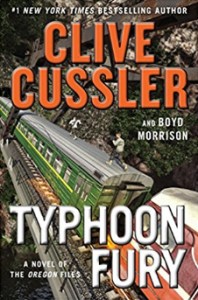
In “real life,” I can’t support the black ops, off-the-grid actions of private agencies such as those in novels like Typhoon Fury. Half the stuff that happens is illegal as hell–and that’s the good guys. In the imaginary world of the novel, the bad guys get shut down. In the real world we live in, they probably don’t. Or if they do, they cause a lot more collateral damage before they’re stopped. Nonetheless, seeing the bad guys shut down in a novel provides a small measure of relief to all the frustrations that arise in the real world–and in my belief system.

So, I read these novels as a coping mechanism. As a writer, I also find it interesting to see how these novelists handle plots and characters and keep readers reading. But the closure is the important thing, even if it’s only in my thoughts and not in the world I see on the news. Perhaps these books are my heroin. Or maybe they’re the Drano that flushes out my anger at both the criminals and the government for (a) creating problems that harm us all, and (b) for creating regulations that compromise our privacy and other rights in exchange for more security.

Some people turn to booze, some to sex, some to violent sports, some to drugs, some to music, and others to staying late at the office when they really don’t need to ignore their families and stay late at the office. We all have our ways of coping with the realities around us that are over the top. I can’t say that these methods, or reading James Patterson and Clive Cussler, are the best possible solutions.

But until we find and implement the best possible solutions, these escapes keep many of us out of mental institutions. I can’t say I’m proud of that, but I do feel better after flushing a lot of my frustrations about the way the world works out of my system with a slam-bang novel. And when my frustrations are flushed out, I’m less tempted to go over to the dark side.

Malcolm


Thank you

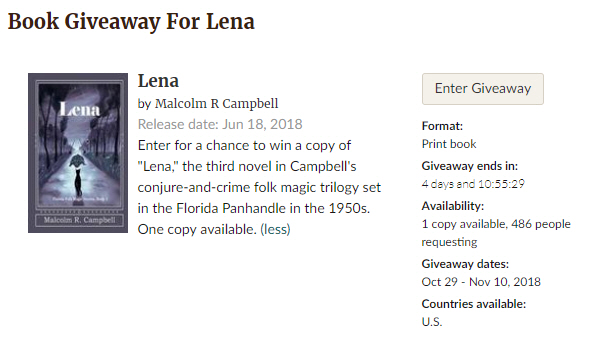
I appreciate the 486 people who have entered the GoodReads giveaway for a paperback copy of Lena. The giveaway runs through November 10th. I enter these kinds of giveaways, too, and have won a free book several times. So, winning is possible.

If you win, I hope you enjoy the book. Lena is the third and final novel in my Florida Folk Magic trilogy.

Ghosts

Meanwhile, my publisher and I are putting together a collection of ghost stories to be called Widely Scattered Ghosts. I’ve been writing another story for the collection, this one set in an old theater. The story is based on a real theater in Florida that those in the ghost hunter business claim is haunted. The main character is named Emily. She appeared in my collection called Emily’s Stories, now out of print except in translation and audiobook editions.

Boxed Set

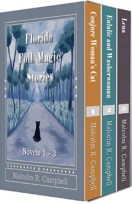
Amazon Kindle cover.

If you haven’t read any of the Lena and Eulalie stories, you might consider buying the three novels in a boxed set. This is cheaper than buying Conjure Woman’s Cat, Eulalie and Washerwoman, and Lena separately. The edition is available in Kindle, Nook, iTunes, and Kobo.

I’m hopeful we will find a narrator for a Lena audiobook. Meanwhile, I hope you enjoy the collection of all three novels in this recently released e-book.

As for those who have been asking, there isn’t going to be the fourth book in this trilogy. There might be a related story, but I think the Lena and Eulalie stories have reached a natural conclusion. Authors always have to figure out when they’ve written all they need to write with one group of characters or another. What we don’t want to do is write a story too far; that is to say, writing past the stories we intended to tell.

Malcolm


Playing fast and loose with the supernatural

A few days ago I saw a discussion among readers of so-called cozy, witchy romances in which most of the fans preferred fantasy versions of witchcraft over novels that made even a lightweight attempt at reality. What we’re talking about here is contemporary fantasy, stories that take place within our own world as opposed to those set on another planet.

This is what I find when I search for witchcraft on a clip art service. While it’s what we think, it isn’t reality.

Wisely, I think, I said nothing. I’ve read a few of those cozy witchcraft novels and, even though the storylines were interesting, my primary thought was that the authors were playing fast and loose with the supernatural. That is, the stories had little or nothing to do with either real Wicca or real traditional witchcraft. The witches in the stories were given powers and rituals that real witches don’t have OR they continued to follow the long-time portrayals (by Hollywood and the Christian Church) of witches as satan worshippers.

While that’s a convenient approach, it’s about as irresponsible as telling a story about–say, the Presbyterian Church or General Motors or Walmart that doesn’t stick to established facts about these organizations. Yes, I know, if makes novels more exciting if a Presbyterian a minister has a wand and can use spells out of the Harry Potter books. But it’s false.

The practices of real witches are very tame when compared to the cozy romances and horror novels written about them. Maybe that’s why authors and a lot of readers like the phony fantasy versions. During the 1950s and 1960s, at a time when the triple feature horror-rama presentations at drive-in theaters were doing big business, the silver screen was awash in symbols from multiple religions and belief systems that–for the sake of a scary story–were turned into a cesspool of evil to earn a buck.

In addition to witches, mystics, shamen, psychics, healers, herbalists, visionaries, and others have been slandered by the mainstream as people associated with evil and/or scams of one kind or another. This has given authors and filmmakers an “anything goes” license to make up whatever nastiness they want about the supernatural and those who believe in it. You may think the Salem witchcraft trials are far away, but the attitude behind them is still with us.

Humans seem predisposed to distrust anyone they can label as “other.” Most often, this ignorant habit focuses on other races, foreigners in general, and people from another part of the country. But it also includes witches, shamen, and healers. Why does this happen? Brainwashing from mainstream religions that routinely accuse people who don’t even believe in the devil as being worshippers of the devil. And, the fact that mixing long-time fears about the supernatural into a riveting movie or novel will bring in a lot of dollars.

The majority of our population seems to fall into two camps of people: (1) Those who believe the supernatural is bunk, and (2) Those who believe the supernatural is evil. If one ever pointed out that many church-going people believed in Christian (and other) mystics of the past, we were told that such people don’t exist now. Sure they do. They’ve been frightened into keeping quiet.

All of us have mental capabilities we can develop: hunches and premonitions, intuition about our ailments, feelings about our connections to the Earth as a living organism, and the ability to strongly influence the course of our lives. It’s sad that we overlook all of this because we’re told it’s evil or mindless superstition. So no, I don’t like those cozy witchy novels and Hollywood movies that play fast and loose with the supernatural because those things are holding us back.

–Malcolm

Malcolm R. Campbell is the author of the three novels in the Florida Folk Magic series that portray hoodoo as it really is.


Review: ‘Hope in the Shadows of War’ by Thomas Paul Reilly

When injured Vietnam War veteran Timothy O’Rourke returns home in 1973, an open wound accompanies him. Today, we might call it PTSD or survivor’s guilt. When his helicopter was shot down and then attacked by the Viet Cong on the ground, he was able to save one of the men with him–but not both. The prospective roles of fate, destiny, fairness, and second-guessing oneself plague him as surely as a virus

Vietnam War veteran Thomas Paul Reilly saw the war for himself and subsequently applied that knowledge and his degrees in psychology as an author (Value-Added Selling) and public speaker focusing on the importance of hope, attitude, and value. He effectively uses this background to create a realistic, yet troubled protagonist in this novel which will be released on Veterans Day.

In the chronicles of war and returning veterans, Timothy’s issues aren’t unique, but in an era where veterans’ issues were not well understood, he believes he is alone in trying to heal his psychological wounds. He’s attending college, works multiple jobs, drives a falling-apart old car, has a steady girlfriend named Cheryl, and remains one step ahead of bankruptcy. Friends and family either can’t or won’t help him when he’s confronted with unexpected expenses such as replacing the ancient furnace in his mother’s house where he is staying. Cheryl has money to lend, but he refuses to accept it.

Co-workers at a Christmas tree lot where he’s working to earn extra money tell him that college and dreams aren’t for “guys like us” and that he needs to quit college and get a real job. In almost every area of his life, he is without hope. Among other things, he’s driving away Cheryl, who unconditionally loves him, by constantly telling her he’s not good enough for her.

Reilly has created a character who epitomizes veterans who have reason to believe fate and their country are conspiring against them. Broke and in ill health (emotional or physical), they end up living on the streets as one of society’s festering wounds that seems impossible to heal. A co-worker, Hoffen, at the Christmas tree lot casually talks to Tim about hope, perseverance, and attitude. The man speaks like a sage down from the mountaintop, but will his advice be enough to convince Tim that the open wound he brought home from Vietnam will never heal until he lets it heal?

If Tim were in therapy, his analyst might ask him if he wants the wound to heal. His memory of the helicopter crash–which is well written and rings true–replays over and over as though he either wanted to be rescued from the wounds it caused or return to the scene and die along with the buddy he couldn’t save. Tim is a character who is easy to admire for his dilligent attempt to save his dream against great odds. He is less easy to like because his overly hopeless attitude, as demonstrated in his thoughts and his conversations with Cheryl and others, comes close to whining, justified though it may be.

The book would be stronger if the plot focussed on the major highs and lows of the story and left out the step-by-step “transcripts” of minor–or recurring–thoughts and actions. The inspiring ending would be stronger if readers felt that, other than his stubbornness, Tim had played a more active role in making it happen.

Reading Hope in the Shadows of War should be a cathartic experience for struggling veterans and those who want to understand veterans’ issues and motivations. This is the story’s strength. So is the message of hope from Hoffen and others. Readers will probably take that message with them after they finish the novel.

Malcolm


Review: ‘Doña Barbara’ by Rómulo Gallegos

Doña BarbaraDoña Barbara by Rómulo Gallegos
My rating: 5 of 5 stars

Perhaps the greatest testimony to Rómulo Gallegos is the very rich literary prize named after him in honor of his work and influence. The prize has been awarded to Mario Vargas Llosa, Gabriel García Márquez, Roberto Bolaño and other masterful authors whose powerful books are said to be the cornerstones of magical realism and South American literature.

Sadly, we seldom hear Gallegos’ 1929 novel “Doña Barbara” mentioned in the same company as the well-known books that have received the Gallegos prize. In his forward to the 2012 edition, Larry McMurtry writes that the novel “is in its way a paean to the Venezuelan Llano” a vast grassy plain that, in the novel, “is steamy, tumescent, lust driven.”

In “Doña Barbara,” the characters often say that the land does not relent. In fact, its horrible and fated barbarism and its magical and conscious beauty are as intertwined as surely as the destinies of the powerful female rancher Doña Barbara and the college educated and idealistic protagonist Santos Luzardos. When Luzardos returns to the Llano ranch, Altamira, of his distant youth, he finds that it has been depleted and nearly forsaken by incompetent, greedy overseers who couldn’t resist their complicity in Doña’s schemes. Through magic, sex, paid-off judges, and raw power, she has enlarged–at her neighbors’ expense–her adjoining ranch El Miedo (fear) into a sprawling country unto itself that expands outward through manifest destiny.

Readers may well be reminded of Luis Alberto Urrea’s “The Hummingbird’s Daughter” as they immerse their souls in “Doña Barbara,” because both novels view the land in epic proportions, beautifully described and inseparable from the lives of its people. The land is essentially the main character or, at the very least, an infinite circle of hell where the well-drawn, multi-dimensional characters are driven to kill or be killed as fate decrees.

Like two gladiators who have been chained together, Doña Barbara and Santos Luzardos cannot both survive in an enchanting, sadistic world where every action appears pre-ordained even when it isn’t. The novel ends the only way it can, but the story’s characters and readers won’t realize this until they reach the last chapter.

View all my reviews

Review: ‘The Store’ by Patterson and DiLallo

The StoreThe Store by James Patterson
My rating: 2 of 5 stars

The story idea is compelling and, what with people talking about privacy issues in an Internet world these days, the plot is also timely. Others here have already said they didn’t care for the writing. Definitely, not anywhere near the best of James Patterson branded novels.

The glaring trouble with the book is the ending. It’s a trick. The ending is based on the fact that certain things earlier in the novel aren’t what they seemed to be. The trouble is, when the ending occurs, the main character turns out to have known the whole time that those things weren’t what they seemed to be. The flaw here is that we are inside the main character’s head throughout the book and know what he’s thinking. There is no way a real person wouldn’t have thought about the on-going trickery at some point. The ending is only a surprise because the authors don’t allow the main character to think about something that he couldn’t help but think about. This is a very large point-of-view error.

In the Amazon/GoodReads review above, I don’t include a spoiler about what happened. In fairness to those who might enjoy this novel in spite of the trick, I’ll leave out the spoilers here as well.

Most publishers’ editors would have told the authors to fix the ending. Maybe they can’t say that to Patterson. However, it’s very jarring and unfair to the reader to conceal the main character’s thoughts about important matters from the readers unless the character is established as unreliable, suffering from amnesia, or hypnotized. None of these options were present in The Store.

The main character Jacob Brandeis participates throughout the story in a planned subterfuge but never once thinks about the fact that he–and others–are role playing. No real person would be capable of doing this. Outside of experimental fiction, no fictional character could help but think about what he’s doing while he’s doing it. With proper finesse and foreshadowing, an author might get around the problem of concealing the third person point-of-view character’s thoughts from the readers.

That was not done here, so we ended up feeling cheated–because we were.

Malcolm

View all my reviews

Announcing ‘Lena’ a new Florida Folk Magic Series novel

Lena, was officially released today by Thomas-Jacob Publishing as book three in the Florida Folk Magic trilogy as a follow-up to Conjure Woman’s Cat and Eulalie and Washerwoman. Both the Kindle and the paperback editions were available earlier than expected, so we’ve beat our planned release date of August 1.

Publisher’s Description: 

When Police Chief Alton Gravely and Officer Carothers escalate the feud between “Torreya’s finest” and conjure woman Eulalie Jenkins by running her off the road into a north Florida swamp, the borrowed pickup truck is salvaged but Eulalie is missing and presumed dead. Her cat Lena survives. Lena could provide an accurate account of the crime, but the county sheriff is unlikely to interview a pet.

Lena doesn’t think Eulalie is dead, but the conjure woman’s family and friends don’t believe her. Eulalie’s daughter Adelaide wants to stir things up, and the church deacon wants everyone to stay out of sight. There’s talk of an eyewitness, but either Adelaide made that up to worry the police, or the witness is too scared to come forward.

When the feared Black Robes of the Klan attack the first responder who believes the wreck might have been staged, Lena is the only one who can help him try to fight them off. After that, all hope seems lost, because if Eulalie is alive and finds her way back to Torreya, there are plenty of people waiting to kill her and make sure she stays dead.

Author’s Comments

This novel is a mix of conjure and crime set in the 1950s when the KKK had a very strong presence in Florida. Many policemen and sheriffs were either members or worked with the Klan and Klan businesses. I wondered how many people I knew were Klan members: it wasn’t something I could ask nor something they would admit if I did ask. My hope is that this series will serve as an immersion into the past and help bring increased understanding about why current attitudes are as they are.

Malcolm

When the muses outdo themselves: Favorite passages from books

Sometimes sentence or paragraph in a novel stops me in my tracks because it’s perfect, perfectly beautiful, dangerously apt, and it flows from word to word like birds or gods singing. Here are a few of my favorites:

  1. The Prince of Tides by Pat Conroy: It was growing dark on this long southern evening, and suddenly, at the exact point her finger had indicated, the moon lifted a forehead of stunning gold above the horizon, lifted straight out of filigreed, light-intoxicated clouds that lay on the skyline in attendant veils. Behind us, the sun was setting in a simultaneous congruent withdrawal and the river turned to flame in a quiet duel of gold….The new gold of moon astonishing and ascendant, he depleted gold of sunset extinguishing itself in the long westward slide, it was the old dance of days in the Carolina marshes, the breathtaking death of days before the eyes of children, until the sun vanished, its final signature a ribbon of bullion strung across the tops of water oaks.
  2. Sunset Song in the Scots Quair trilogy by Lewis Grassic GibbonSo that was Chris and her reading and schooling, two Chrisses there were that fought for her heart and tormented her. You hated the land and the coarse speak of the folk and learning was brave and fine one day and the next you’d waken with the peewits crying across the hills, deep and deep, crying in the heart of you and the smell of the earth in your face, almost you’d cry for that, the beauty of it and the sweetness of the Scottish land and skies. You saw their faces in firelight, father’s and mother’s and the neighbours’, before the lamps lit up, tired and kind, faces dear and close to you, you wanted the words they’d known and used, forgotten in the far-off youngness of their lives, Scots words to tell to your heart, how they wrung it and held it, the toil of their days and unendingly their fight. And the next minute that passed from you, you were English, back to the English words so sharp and clean and true–for a while, for a while, till they slid so smooth from your throat you knew they could never say anything that was worth the saying at all.
  3. The Night Circus by Erin MorgensternSomeone needs to tell those tales. When the battles are fought and won and lost, when the pirates find their treasures and the dragons eat their foes for breakfast with a nice cup of Lapsang souchong, someone needs to tell their bits of overlapping narrative. There’s magic in that. It’s in the listener, and for each and every ear it will be different, and it will affect them in ways they can never predict. From the mundane to the profound. You may tell a tale that takes up residence in someone’s soul, becomes their blood and self and purpose. That tale will move them and drive them and who knows what they might do because of it, because of your words. That is your role, your gift. Your sister may be able to see the future, but you yourself can shape it, boy. Do not forget that… there are many kinds of magic, after all.
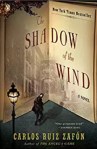
  4. The Shadow of the Wind by Carlos Ruiz ZafónEvery book, every volume you see here, has a soul. The soul of the person who wrote it and of those who read it and lived and dreamed with it. Every time a book changes hands, every time someone runs his eyes down its pages, its spirit grows and strengthens. And also this: Once, in my father’s bookshop, I heard a regular customer say that few things leave a deeper mark on a reader than the first book that finds its way into his heart. Those first images, the echo of words we think we have left behind, accompany us throughout our lives and sculpt a palace in our memory to which, sooner or later—no matter how many books we read, how many worlds we discover, or how much we learn or forget—we will return.
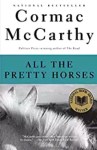
  5. All the Pretty Horses by Cormac McCarthy: They heard somewhere in that tenantless night a bell that tolled and ceased where no bell was and they rode out on the round dais of the earth which alone was dark and no light to it and which carried their figures and bore them up into the swarming stars so that they rode not under but among them and they rode at once jaunty and circumspect, like thieves newly loosed in that dark electric, like young thieves in a glowing orchard, loosely jacketed against the cold and ten thousand worlds for the choosing.

You probably have some favorite lines as well, lines you might even copy on to scraps of paper to be hidden away in your wallet or purse for those moment when you need to prove again to yourself that there is still hope for the world.

Malcolm