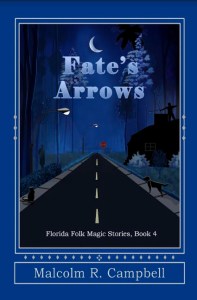
When a cousin we hardly knew died without a will, the State of Oregon tracked us down

Mostly, she ignored our side of the family. Old family films and photographs show us playing together during our preschool years.  Afterward, little or nothing.

I’ll refer to her as G.
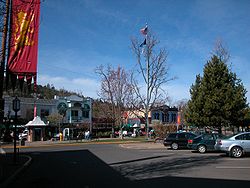
G probably shopped in this plaza

I never knew where G was or what she was doing. She wanted it this way for reasons I’ll never know. Now the State of Oregon has found my two brothers and me while looking for relatives, notably one who lives in or near Ashland who could handle the estate. Fortunately, an Oregon relative turned up and agreed to handle an estate that consists mainly of household items and a car.

I have no idea what happened to G’s husband.

I feel like a voyeur. I don’t want to know about her now because when G was alive, she didn’t want me to know her then. In a sporadic letter to one of my brothers, she once informed us that our favorite aunt had passed away months before. To me, this kind of slap-dash approach to family was unconscionable.

So, when I did know something, I was usually ticked off.

Now I’m suddenly an heir and that ticks me off, too.  I want to remain just as anonymous as she was.  I don’t want to see an accounting of the personal items in her house or the loose change in the glove compartment of her car.

Or maybe there will be a 1960s letter from my mother in a box in the attic. If so, it will be friendly and chatty, ending with “Why don’t you ever write?”

G never answered that question. If the answer lurks within the confines of G’s estate, I don’t want to hear it now.  Hearing that G died was more than I wanted to know. Is that cold? If so, I’m slow to forgive.

–Malcolm
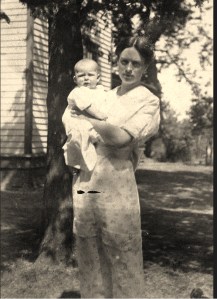
Edyth

One picture sits on my desk, my 24-year-old grandmother Edyth standing next to the farmhouse holding my infant mother Katheryn in her arms. We can see the side of the house, a shade tree, and in the background, a steam tractor. I like Edyth’s no-nonsense expression.

This picture sits on my desk because I think I would have liked my grandmother and it reminds me I still need to learn how to forgive my grandfather and my step-grandmother for never mentioning Edyth, much less telling me she was my real grandmother.

I grew up believing Edyth’s sister Laura was my grandmother. Laura was a wonderful person. When my grandfather’s eyesight began to fail, he taught Laura how to shoot the pesky squirrels in the backyard and I taught her how to drive.  She aced her driving test and wiped out a lot of squirrels until the cops showed up and asked why she was firing a .38 in the yard.

Edyth was shrouded in mystery, Laura’s sister who died of typhoid from the family well in 1914. My grandfather married Laura and this was something they kept quiet about because marrying your deceased wife’s sister didn’t look good. However, they kept it so quiet that their grandsons, my two brothers and I, were never told until after Joe and Laura died.

This lie kept Edyth and all the stories and memories of Edyth out of our consciousness because she was not mentioned in family yarns and memories. I think my brothers and I could have handled the truth about Laura and Edyth when we were in high school if not sooner. My parents respected my grandparents’ wishes to keep quiet about it. I wouldn’t have.

So it is that I still haven’t forgiven my grandfather and step-grandmother or my parents for covering up just who Edyth was. I know I should. The photo on my desk reminds me that I should. So far, I can’t because it made me feel discounted when I finally learned the truth, i.e., that  I couldn’t be trusted to know my real grandmother’s name.

Many miles and many years after Edyth died in 1914 in Illinois and Joe married her sister, Laura, there was no longer a reason to keep that part of our family’s history secret. So it is that the photo on my desk helps me understand who I am, who my mother was, and who my grandmother was. I have yet to forgive those who kept me from knowing Edyth–sad to say.

–Malcolm

Mother’s Day Thoughts

My mother’s life was, I hope and believe, a happy one, most especially her rich and enduring marriage, though truth be told, I was a volatile child and she might well have thought on multiple occasions that I was the fly in the ointment. To her credit, she supported my hobbies, projects, and writing, so  I suspect she had a forgiving heart, and though she never knew it, she was the primary reason I chose not to emigrate to Sweden where I would be safe from the draft and the Vietnam War and potentially never see my parents or brothers again.
I’ve always liked this picture, though I have no idea when or where it was taken. She was a farmer’s daughter. Perhaps that’s why the picture resonates with me from the family archives where it sits with others from the decade in which I was born.

Mother was born and died during times of family hardship.

Her mother died the year she was born: typhoid from contaminated water from the family’s well. Her father remarried and subsequently mother had a younger sister who was born with spina bifida and lived only six years. Mother would have been twelve, I think, when Betty Jane died. The family home was destroyed by fire when Mother was eight.

Mother died of a heart attack when she was seventy-two, a condition she hid from my brothers and me while she was looking after our bedridden eighty-three-year-old father. She wanted to keep him in the house they knew, and while this was wonderful support borne of that giving heart, it strained finances and probably shortened her life.

Among the other slings and arrows of family life with a husband and three boys who were pratical jokesters, mother learned to laugh and (I hope) take pleasure from our shennanigans. She had a habit, for example, during Sunday dinner or saving the last piece of meat on her plate for the  last bite. Since we ate this meal in the dining room, she came and went from the kitchen multiple times bringing more iced tea or Parker House rolls. While she was gone from the table, I tended to hide that last piece of meat. When she couldn’t find it, there was first confusion because she remembered leaving it there, and then a smile when she realized that some low-life person had hidden it (usually me).

Every year she placed a manger scene on the mantle, and every year, something unusual appeared in it, usually a tiger or some other critter that didn’t belong there. Her loud exclamation of surprise was they moment we were waiting for. Suffice it to say, the missing piece of meat and the tiger in the manger scene did not represent the totality of weird moments that happened around the house. She took them all in stride and that fact, above all others, is what I remember the most today thirty seven years after she left this world for a better place even though our home was usually filled with laughter.

–Malcolm

Home from the north country

My wife an I spent a wonderful Thanksgiving week with my daughter and her husband and my granddaughters in Maryland. We hadn’t seen the family in two years due to my cancer radiation treatments and the COVID pandemic. We spent a lot of time just hanging out at their house enjoying being together again. Johanna’s husband Kevin fixed the Thanksgiving dinner after which I told him that if he wants a new career path he can become a chef.
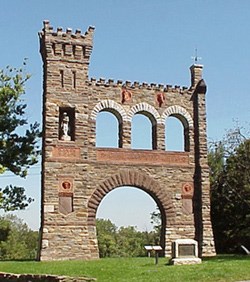
War Correspondents Memorial ArchMy daugher, who admits she is a planner, set up some great activities. I already posted about the pinball games in the grocery store. We visited a museum of civil war medicine, the war correspondents memorial arch at the Antietam Battlefield park, and enjoyed walking through the beautiful festival of lights at nearby Gaithersburg.
Both granddaughters (Freya and Beatrice) are enjoying their ballet. In fact, both of them are dancing in the Metropolitan Ballet Theater’s production of the “Nutcracker” and “The Nut Cracker Suite this past weekend and next weekend in Rockville, Maryland.

Both of them like puzzles, Bebe (Beatrice) likes morning “nature walks” with her mother, and Freya carries around a sketchbook which she focusses on with persistance and passion. Both of them smile a lot and play together in a way that makes me smile and try to remember what life was like when I was that young.

Fortunately, our flights up and back went smoothly and were on time. Standing in the TSA line, especially at Reagan airport in DC, was tiring, and tedious. Flying while wearing a mask, while no doubt necessary, was unpleasant. While we were gone, our three cats were  checked on daily by a neighbor friend just down the street. We’re both still tired from the trip. Not long after we got home, I fell asleep in the living room recliner and the cats all climbed aboard.

What a great Thanksgiving! The granddaughters grow and change to fast, we don’t like missing out on visits. Their parents grow and change, too, but I’ve been instructed not to take pictures of them. I may have accidentally taken a couple <g> but I’m not posting the evidence here. Lesa and I hope we can dream up some more great experiences for next year, hopefully with fewer pandemic mandates and other hassles, perhaps at a place without those low temps and cold winds.

Malcolm

Here’s a sleigh full of gift ideas, all available in e-book, audiobook, paperback, and hard cover editions. Click on the graphic to buy the books from Amazon. You’ll also find them online at Barnes and Noble and other venues.

Pack mule, old accident story

Yeah, I know, that’s not a mule.

If you hike enough trails in Glacier National Park, you’ll sooner oer later come along a pack train of mules hauling supplies to backcountry chalets, fire towers, and ranger stations. If I’d worked on one of those instead of as a bellman, I wouldn’t be spending all this time looking at YouTube videos about how to pack a mule and how to harness a mule.

Why do I care? One of the characters in my novel in progress hauls goods around the area in a mule train. So now I need to learn how he handles the mules and the tack. If I were in the Matrix movie, I could just download all that info into my brain and be an expert.

This is the kind of detail that really slows down the writing.

Old Accident

Here’s a two-door version.

When we lived in Eugene, Oregon during the time I would have been in kindergarten, we seemed to have family and friends throughout Washington, Oregon, and California. So, we were on the road a lot in our giant, four-door 1950 Nash 600.

On one of those trips, we were passing a flatbed truck. Mother was driving, Dad was riding showgun, and my younger brothers and I were in the back seat. In those days, it seemed to be customary to tap the horn twice before passing somebody. Mother did that and then started doing around the truck when it swerved  into our lane to pass a smaller car in front of him. Mother honked again and put on the brakes.

The truck driver saw us, over-corrected, and went rolling down through a field. I have know idea who called the police, but we were parked off on the shoulder for ages. After the officers figured out what happened, filled out their paperwork, we were allowed to go on.

The odd thing about this is that after it happened, my folks never spoke of it. Growing up, I didn’t think of it often, so never asked for details. The subject just never came up, and if there were injuries or fatalities in the truck (which seemed certain to me), I can see why my parents wouldn’t want to speak of it. Otherwise, I have no idea why–at least when I ws an adult–I never asked, “What do we know about the near collision with the truck when I was five?”

I’ve been searching digitized newspapers, but so far haven’t found anything. It would help if I knew for sure which state we were in when it happened. In an Internet age when we seem to hear about everything, most of which isn’t important, it’s frustrating to look back in time and find nada, zip, and endless void.

Malcolm

Malcolm R. Campbell is the author of Fate’s Arrows, available in e-book, audiobook, paperback and hard cover editions. 

Family murder never solved

My uncle, Frank M. Campbell, was murdered in Fort Collins, Colorado in November 1919 while he was walking to church. The murder was never solved. Some said it was probably a holdup attempt. Some said it was a case of mistaken identity. He was twenty years old, and the loss would haunt my father all his life and, from time to time, it haunts me even now long after the fact.

Some years ago, I tried to find out if the police department had any information. They didn’t. The case was open but too far back in time to be relevant. I even asked a psychic. He told me it was an ether-related crime, this at a time when ether was a drug problem like heroin and cocaine are today. My assumption was that Frank was approached by somebody who needed money to support his habit.

My grandparents and their three other children left Fort Collins and moved to California (the Los Gatos area) where they still were when I was born many years later in Berkeley. I don’t think this kind of crime ever leaves a family unscathed. My father and his two siblings, and of course their parents, carried this moment with them forever.  Even now, over a century later, I find myself angered and perplexed by it.

I wonder as I read the daily news about crimes across the country, when (if ever) the horrific memories of violent crimes ever fade away. I think the survivors never forget even though the news stories are gone with the wind.

–Malcolm

Malcolm R. Campbell

Publisher: Thomas-Jacob Publishing

Website

Facebook Author’s Page

Amazon Author’s Page

The Big Grape-Nuts Shortage

Just to clarify. The shortage of this venerable Post cereal, created in 1897, is big, not the Grape-Nuts. Who do we blame for this? Consumers. Cereal sales had been falling until the pandemic sent millions of people to the cereal aisles they didn’t know existed.

When I was a kid, my brothers and I campaigned for Sugar Crisp and Frosted Flakes while our parents stocked up on Grape-Nuts, the now discontinued Grape-Nuts Flakes, and the now discontinued Krumbles. When Krumbles went away, I switched over to Grape-Nuts.
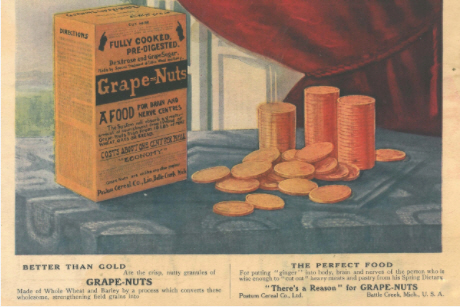
My claim was that grape nuts were really scuppernongs that were harvested so late in the season that they couldn’t be eaten off the vine, much less turned into wine and jelly.

Our grandfather claimed that he’d been eating Grape-Nuts since he was a farmer in Illinois because he was ahead of his time and lined up for the first ready-to-eat cereal. However, he claimed it was made out of soybeans and that the smell that once hovered over Decatur, Illinois from the Staley Company was soybeans roasting over an open fire to be shipped to C. W. Post for the cereal.

Our parents said the cereal was made from wheat flour and malted barley flour and other stuff. The “other stuff,” it seemed, left room for either soybeans or scuppernongs.

According to Post,  “So, why is it called Grape-Nuts? As with many great emblems in history, there are two versions of the story. One says that Mr. Post believed glucose, which he called ‘grape sugar,’ formed during the baking process. This, combined with the nutty flavor of the cereal, is said to have inspired its name. Another explanation claims that the cereal got its name from its resemblance to grape seeds, or grape ‘nuts.’”

Years after our family’s debates about soybeans and scuppernongs, Grandfather died, and when we read his will we found that he had left each of us 100 pounds of Grape-Nuts because, as the old ad said, “they were better than gold.” Unfortunately, wevils ate away our riches at the warehouse, and this explains why we didn’t go to Harvard or Yale or the Riviera.

Nonetheless, I’ve been loyal to the cereal for old times’ sake.

Malcolm

My books include Fate’s Arrows, The Sun Singer, and Special Investigative Reporter.

Do you know what it was like to be 13?

My oldest granddaughter is now 13.  A teenager. Beginning what is supposedly an angst-filled and uncertain time for humans.

I have no clue what it was like to be thirteen years old. My family sent out a Christmas letter. They’ve been collected into a notebook which I use whenever I want to know what I was doing at a certain age. Checking the records, I see I was a Star Scout, diligently working on merit badges. Once I read this in the Christmas letter archives, the memories come back and I remember the Scout meetings and the camping trips and family trip to a lake near Rhinelander, Wisconsin where we tried (without success) to catch Pike and Muskies.

I know my granddaughter’s primary focus is ballet lessons. She’s been in Girl Scouts. She likes the scariest rides at Disney World and other theme parks. Goodness knows I, as her grandfather, don’t know how to handle ballet lessons or perform on stage. So, no wisdom from me on being a teen.

Not that she’d ask.

She’s a vegan even though her sister and parents aren’t. My wife and I wonder where that came from; perhaps she heard about it from another kid at school and the approach to eating made sense.

I can’t help with that.

I know she can be very stubborn, very focused on what she wants to do. I can identify with that. Seriously, I was a horrible teenager mainly because I had no respect for authority and didn’t like being told what to do or what not to do.

My daughter won’t let me say anything about what I felt at thirteen. I don’t blame her. Yet, I worry, because being an outlier can be a lonely road. If we saw each other more often (she lives in MD and I live in GA), I could listen and hope listening is all she wanted.

So, she’s slowly turning into an adult, a time when parents are often skeptical about the value of too much contact with grandparents. My parents often thought my grandparents were a bad influence. That meant that I thought my grandparents were a good influence.

I was very independent as a teen. I think my granddaughter will be, too. I’m both happy and concerned about that. Her IQ will get her into trouble that I hope she’ll figure out how to get out of.

Grandpa’s sort of a rebel. Best that I don’t let her know.

Malcolm

Malcolm R. Campbell is the author of the contemporary fantasy novel “The Sun Singer.”