A combination of incongruous things

“pot·pour·ri n. pl. pot·pour·ris – 1. A combination of incongruous things: “In the minds of many, the real and imagined causes for Russia’s defeats quickly mingled into a potpourri of terrible fears” (W. Bruce Lincoln). 2. A miscellaneous anthology or collection: a potpourri of short stories and humorous verse. 3. A mixture of dried flower petals and spices used to scent the air.” – The Free Dictionary

  1. I’ve about finished reading An Uncertain Age by Ulrica Hume. That means you’ll be seeing a review of the novel here soon. According to the publisher (Blue Circle Press), Justine’s life is uncertain when she meets Miles Peabody on the Eurostar. She has lost her job, her fiance, everything except her dream of becoming an artist. Miles Peabody, a retired librarian and beekeeper, has always led a cautious, philosophical life. Now, faced with his mortality, he needs a miracle. Drawn inexplicably to each other, their relationship is tested when Miles invites Justine to join him on a Santiago de Compostela pilgrimage. But before she can answer, Miles goes missing. Desperate to find him, and nudged by the French police, Justine slips into a dark night of the soul. A fascinating theme!

  2. I you keep up with publishing news, you know that the Independent Publishers Group and Amazon could not agree on Amazon’s slice of the pie. Consequently, Amazon turned off the buy buttons for the 4,000 e-books from the author’s IPG represents. In a post called “What Should an E-book Cost?,” IPG compares print and e-book pricing. Not being one to keep quiet about such issues, I posted “The low prices of e-books are bad for writers” on my Sun Singer’s Travels blog.
  3. While I’m happy that The Artist, Meryl Streep and Christopher Plummer won Oscars last night, I’m also happy that I only watched the last 15-20 minutes of the event on TV. It was long, ending a little after 11:30 p.m. (Eastern), but not as long as it has been before.  Had I watched all of it, I think I would have agreed with Andrew O’Hehir’s assessment in a piece he wrote for Salon: “From Billy Crystal’s cringe-worthy act to the obvious winners, the Academy Awards felt old, tired and out-of-touch.”
  4. My brother Douglas has entered the world of fiction writing with a fantasy/allegory called Parktails. The novel tells the story of a massive forest fire in a national park from the animals’ point of view. In many ways, Parktails is a quest story; the animals are seeking answers and inspiration and must travel many miles to learn how to keep their community together. Doug teaches art at George Fox University in Oregon. He is also the author of Seeing: When Art and Faith Intersect,  published in 2002.
  5. I have been updating my website to better display my books. Among other things, I needed to add my recently-released free e-book Celebrate Glacier National Park. The 48-page PDF about Glacier’s history, personalities, facilities, plants and animals can be downloaded from the Vanilla Heart Publishing page at Payloadz. In addition to the website, you can learn more about my 2011 contemporary fantasy novel Sarabande on my Sarabande’s Journey weblog where my most recent post was “Check your imagination at the door.” If your book group or class is planning to read and discuss the novel, you”ll find a list of sample discussion questions here.
  6. If you’re an author and/or an avid reader, I invite you to stop by my daily list of links for book reviews, book news, contests and writing tips called Book Bits. It’s usually posted in time for your lunch-time web surfing. Tomorrow’s edition will include a feature for writers called “Know Your Competition” and a review of Kate Alcott’s The Dressmaker.
  7. You can still download Vanilla Heart Publishing’s free, Valentine’s Day e-book called A Gift for You. The book, which features fiction, nonfiction and poetry focused on love, includes my short story “Those Women” as well as work from authors S.R.Claridge, Janet Lane Walters, Anne K. Albert, Chelle Cordero, Marilyn Celeste Morris, Collin Kelley, Melinda Clayton, Charmaine Gordon, Smoky Trudeau Zeidel and Joice Overton.
  8. Even though it’s not yet spring, I’ve already had the lawn mower out once to trim the front yard. I’m always somewhat surprised when it starts right up without a lot of tinkering, oil changes, or a trip over to the auto parts store for a new spark plug. The yard looks better now and even somewhat green due to our recent thunderstorms. We’ll have to decide soon whether to clean out the garden in the back yard and then fight with the deer all spring and summer over our vegetables. Oddly enough, they seem to be drawn to the hot peppers–I thought they would leave those alone.

Wherever you live, I hope you’re seeing signs of spring.

Malcolm

contemporary fantasy for your Kindle

First Christmas, First Book – and it was Mother Goose

Contrary to popular belief, I am not older than Mother Goose.

In fact, there’s a fair amount of debate about who, if anyone, Mother Goose was.  Some say “Mother Goose” was a lady named Mary Goose. Perhaps. There’s a gravestone in Boston from the 1690s that tourists like to visit. Looking way back, we find the name in Charles Perrault’s 1695 book, subtitled “Tales of my Mother Goose.” It was translated into English in 1729. However, the primary association of Mother Goose and nursery rhymes probably began with  John Newbery’s 1791 collection called Mother Goose’s Melody

All that happened many years before my time.

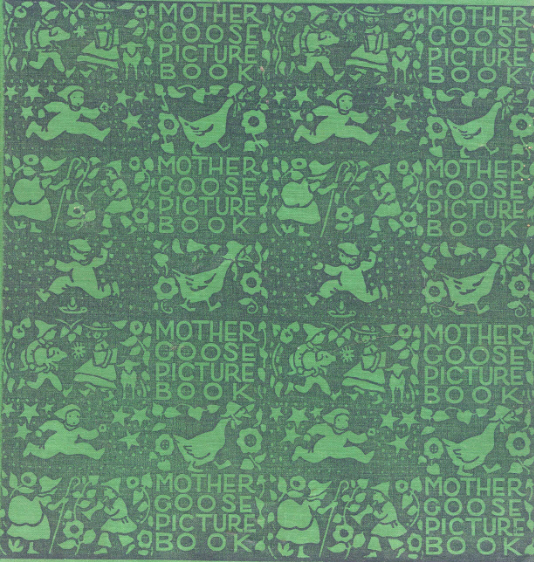
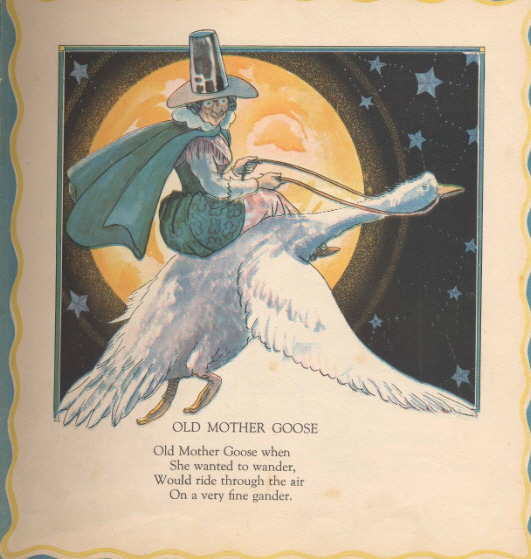
Since then, a lot of authors and artists have produce collections. One of my gifts on my first Christmas was Berta and Elmer Hader’s Picture Book of Mother Goose published by Howard-McCann in 1930. (Also before I was born.)

Berta and Elmer Hader were a prolific husband and wife team, producing many books beginning in the 1920s.  They won the Caldecott Medal for illustration in 1949 for The Big Snow. They died in the 1970s, having left a wonderful legacy of books and rich illustrations such as the one shown here.

I liked picture books when I was young because I could create my own stories for the pictures with my imagination when nobody was around to read to me.  Years later, my daughter would enjoy illustrated books for the same reason, though when she was a child, the books by Richard Scarry were probably more popular than Mother Goose.

Later, I had quite a few shelves of books, many of them the Little Golden Books with stories like “The Little Red Hen.” While I like magical realism and fantasy now, my reading goes back to “Old Mother Goose,” “Hickory, Dickory Dock,” and “Polly, Put the Kettle On.” I’m sure my parents made use of the lullabys in my Mother Goose book, though I have no memory of it. Or, perhaps they pointed out all the drawings of sleeping children in the book and hoped for the best.

I’m not sure why or how this old book is still on my shelf rather than being packed away. Nostalgia, perhaps.

–Malcolm

Kindle Edition

Pick up your Valentine’s Day Gift Here

If you’re here looking for chocolate, roses or Champagne, you won’t find them here.

You’ll find something that will last much longer (maybe as long as this antique Valentine’s Day card I saw on Wikipedia): a free, PDF e-book of fiction, nonfiction and poetry celebrating love written by the authors of Vanilla Heart Publishing:

  • S.R.Claridge
  • Janet Lane Walters
  • Anne K. Albert
  • Malcolm R. Campbell
  • Chelle Cordero
  • Marilyn Celeste Morris
  • Collin Kelley
  • Melinda Clayton
  • Charmaine Gordon
  • Smoky Trudeau Zeidel
  • Joice Overton

A Gift for You includes my short story “Those Women.” The book is available as a free download from PayLoadz. Enjoy the stories, novel excerpts, essay and poems. Share them with all your valentines while they enjoy the roses, chocolate and  Champagne you found at your handy neighborhood Kroger, Safeway, Trader Joe’s, Ingles, Food Lion or Albertson’s.

Malcolm

Review: ‘Identity: Lost’ a legal thriller by Pascal Marco

When I review a book, I check the publisher’s description online and on the back cover to make sure I don’t inadvertently divulge plot twists and other surprises that readers won’t know when they start reading. I was a bit surprised to find a blurb on Pascal Marco’s Identity: Lost from an author claiming that this “electrifying debut puts him firmly in the hunt to succeed John Grisham.”  Really?

By the time I finished reading this intricate and heartbreaking legal thriller, I decided that blurb might be right.

After twelve-year-old James Overstreet witnesses a 1975 murder in a lakefront Chicago park in a dangerous neighborhood, his life changes dramatically because police and prosecutors botch the trial. James identifies the black gang members who killed the 85-year-old white man in Burnham Park. But once the judge says, “I have no choice but to find the defendants not guilty of murder,” James and his family know their lives are at risk if they ever go home again.

Readers know going into this book that thirty years later James Overstreet will no longer be James Overstreet, but a man named Stan Kobe who has gone to law school, learned his craft well, and become a successful prosecutor in Maricopa County,  Arizona. Savvy readers will guess that even though James has been reincarnated as Stan 1,400 miles away from the scene of the crime, one way or another, “Ice Pick” and the Oakwood Rangers will cross his path again.

Crime shows on TV often imply that once a person goes into the Witness Protection Program, life is safe and good. Pascal Marco does a wonderful job of counteracting that myth. When James becomes Stan, nobody can know. All ties to his past, and his parents’ past are cut. Even if Stan is good at pretending he didn’t come from Chicago and knows little or nothing about the town, there are a hundred ways a chance statement or a chance meeting will bring the Oakwood Rangers to his front door. While James/Stan might be a bit more paranoid about such things than most, his fears are not without cause.

Marco’s plot is complex, for any future encounters between the young man who was torn away from his favorite lakefront park and plunked down in the Southwest must be handled carefully. If not, the novel would appear to rest on a string of unlikely coincidences. While the novel slows down a little while James is going to law school and turning into Maricopa County’s “most ruthless prosecutor,” Identity: Lost moves forward at flank speed through a labyrinth of thrills and chills en route to a surprising and satisfying ending.

Electrifying is a reasonable superlative for this novel. Marco, a native Chicagoan and current Arizona resident, uses his streetwise knowledge of both locations to great advantage in bringing this story to life. The characters are richly and realistically created from James/Stan to Chicago detectives “Stick” and “Timbo” to Ice Pick and his Rangers to Manny Fleischman (the victim) who once played for James/Stan’s beloved White Sox. Identity: Lost is a well-told tale with a fine mix of courtroom, Chicagoland and baseball ambiance and many dangerous moments.

–Malcolm

Malcolm R. Campbell is the author of four novels, including the 2011 contemporary fantasy “Sarabande.”

Free e-Book: Celebrate Glacier National Park

During Glacier National Park’s 2010 centennial, I wrote quite a few posts about the history, personalities, facilities and environment of Montana’s shining mountains for this weblog. Now, Vanilla Heart Publishing has compiled a selection of those posts into a free PDF e-book that you can download from PayLoadz.

Highlights of the 49-page e-book

  • Fast Facts and Photographs
  • All Aboard for Glacier National Park
  • Glacier by the Grace of God and the Great Northern
  • Mountains and Rock
  • Remembering James Willard Schultz
  • Glacier’s Long-Ago Mining Town
  • Remembering George Bird Grinnell
  • Those Historic Red Tour Buses
  • Kinnikinnick
  • Glacier’s First Ranger
  • Heavens Peak Fire Lookout
  • Mary Roberts Rinehart

The Scenery Behind My Stories

While working as a bellman at a Glacier Park hotel, I fell in love with the park. I’ve been back several times, but it’s too far from northeast Georgia for easy commuting. I returned in my imagination, though, while setting three novels in the park: The Sun Singer (contemporary fantasy, 2004), Garden of Heaven: an Odyssey (magical realism, 2010) and Sarabande (contemporary fantasy, 2011). If you’ve visited Many Glacier Hotel on the east side of the park, you’ll recognize many of the settings in all three books from Swiftcurrent Lake to Grinnell Glacier

I hope you will enjoy Celebrate Glacier National Park and the scenery behind my stories with a bit of the history of how Glacier came to be and who took part in developing it as both a park and a playground. Of course, you need to do more than read about “backbone of the world” in northwestern Montana.

How about a trip? You’ll need to stay for a couple of days so you have time to see both sides of the park, experience Going-to-the-Sun Road, hike to Sperry or Grinnell Glacier, take a launch trip on Lake McDonald, Swiftcurrent Lake or Lake Josephine, and ride in one of those ancient red buses with the top down so you can enjoy the mountain air.

–Malcolm

Kindle edition

Review: ‘The History of My Body’ by Sharon Heath

“The Bible says that in the beginning was the void, and it hasn’t escaped me how fast the Lord moved to take care of His own particular vacuum—dividing day from night, spitting out vast oceans, carving out competing continents that would one day have the power to blow each other up. What an inspired series of creations to keep the devil of boredom at bay. No wonder God kept seeing that it was good.”

So begins the story of Fleur Robins.

Fleur Robins is called creepy child, poor child, little monster, odd duck, space cadet and assorted other synonyms for “weird” by almost everyone who notices her existence and tries to figure out whether she is gifted, autistic, simply hopeless or hopelessly simple. Fleur’s imagination contains many worlds because—as she explains life as the fifteen-year-old narrator of The History of My Body—positioning her body and mind “just this side of the lurking pit of nothingness” requires constant vigilance and ingenuity.

Whenever the void looms too large for her to handle, Fleur flaps her arms, bangs her head, pinches herself, emits strange noises and makes oddly literal pronouncements that simultaneously appear to miss the point and contain cosmic truths. No school will take her. An alcoholic mother loves her, but spends her days drunk or asleep. A mean-spirited father dislikes her, but fills his days with a pro-life crusade while filling an entire nursery wing of the family’s large house with children rescued from the “devil abortionists.” An odd-duck household/nursery staff cares for her, but is too busy to overtly save her from the void.

Fleur is her own teacher. She makes lists, keeps diaries, consults the dictionary frequently, and assembles the often-confusing puzzle pieces of information from others to make sense of the external world. She listens to the voices of her heart and her infinite imagination to define her internal world and to explore far-flung probabilities beyond the ken of “normal people.”

When she’s told that a woman who walks down the street every day in a bathrobe has lost her mind, Fleur falls into a figurative pit considering the ramifications:

“What kind of God would let people lose their minds? And was there some kind of cosmic Lost and Found where He kept them? I tell you, it gave me a serious case of the heebie-jeebs, thinking of God feeling so empty and alone that He needed to steal people’s minds to stuff into His own unfillably huge one.”

In her wise, superbly crafted debut novel, author Sharon Heath connects a series of highly improbable events into a tightly knit story about a self-taught young girl who believes her coming of age is a wonderful example of the butterfly effect: or, as Fleur came to understand nonlinear systems, a personal development with a sensitive dependence on initial conditions. Potential events spin off in all directions when Fleur finds a dying baby bird in the garden; while those that ultimately manifest as her body’s history could never have been predicted, they represent a meaningful synchronicity if not harmony.

Fleur’s phases of growth (incarnations, to her way of thinking) unfold as a metamorphosis out of the chaos of her childhood. Her progress isn’t ugly duckling to swan. It’s more like a butterfly transitioning from egg to larva to pupa to adult, or like the unfolding of the beloved David Austen roses she tended on the grounds of the childhood home of her first incarnation.

In The History of My Body, Sharon Heath masterfully combines darkness and light, tragedy and comedy, and the sublime and the ridiculous into a dazzling and beautifully ironic dance of opposites that create an unusual and endearing protagonist with an unforgettable tale to tell.

Malcolm R. Campbell is the author of four novels, including the recent contemporary fantasy “Sarabande.”

BOOKS: Are we raising the cute baby alligator that will ultimately eat us alive?

Small juvenile crocodilians are deceptive – they seem easy enough to handle, and persuasive dealer talk can easily convince people to part with their cash. But do not be fooled. As they grow larger, crocodilians rapidly become stronger and more boisterous. After only a year, many people can no longer handle their animals and it is very common to see 1 to 2 year old animals being given away or illegally released into the wild. Larger crocodilians are, without a doubt, extremely dangerous animals. – crocodilian.com

“The evidence is, in fact, absolutely conclusive that the Standard Oil Company charges altogether excessive prices where it meets no competition, and particularly where there is little likelihood of competitors entering the field, and that, on the other hand, where competition is active, it frequently cuts prices to a point which leaves even the Standard little or no profit, and which more often leaves no profit to the competitor, whose costs are ordinarily somewhat higher.” – Eliot Jones. The Trust Problem in the United States 1922

Human beings are strange animals in that they rush hell-bent-for-leather to participate in their own demise.

When I was a kid, one of the first things I learned about people and their money is that the most powerful bragging rights come from getting something cheaper than your neighbor got it. Woe be unto the guy at the neighborhood barbecue who paid five cents more for a sparkplug or a hundred dollars more for a new car than the guy flipping chickens on the grill.

When economic times are tough, saving a nickel on a sparkplug or a c-note on a car makes logical sense. People are trying to scrape by everywhere they can. In fact, scraping by has almost trumped bragging rights over buying something cheaper than our neighbor bought it for.

Looking Down the Road

In Florida where I grew up, a lot of folks thought it was cute to buy baby alligators. How cute. Certainly more exciting than a puppy, cat, or a goldfish in a bowl. If one kid got one, his friends all wanted one. It was all the rage, rather like bragging that you were the first person to drive to the edge of town and shop at the new big box store. (When I was a kid, one of the first things I observed about people is that they feel powerful when doing things are all the rage and that they feel sheepish when they’re not doing them.)

Baby alligators grow up and when they do, their not as cute as they once were. So it is, that on a dark and stormy night, the alligator is wrestled out to the nearest lake or swamp before it figures out, “hey, I can eat the family.” In the wild, it may go off and live a beautiful life or it may lurk around the fringes of the neighborhood where it hunts for pets and small children.

Remembering Ida Tarbell

One of the first term papers I ever wrote when I got into one of those classes where we were taught how to find sources and use lots of footnotes was about Ida Tarbell and her 1904 book The History of the Standard Oil Company. When Standard put up a new gas station in town, they offered low prices until all the other gas stations went out of business trying to compete with them. Ultimately, the company was broken up even though its remnants, including Exxon in the U.S. and Esso in Canada are doing quite well.

Bragging rights about cheap products followed by the need to scrape by have both been powerful incentives for helping build the businesses that ultimately got big enough to eat us alive. Perhaps Standard Oil is too far away into the past to be a good case in point. Okay, think Walmart and every other big box store that showed up in your home town and ultimately killed all the local businesses.

Statistics show that more dollars leave a community when people shop at big box stores than when they shop at the locally owned shops in what’s left of the down town. Few people care because, truth be told, they feel really sheepish admitting that they paid 15 cents more for a gallon of paint at Bob’s Hardware than their neighbor paid for the same paint at Home Depot. And goodness knows, who wants to admit they paid 10 cents more for a pound of hamburger meat at Jenkin’s IGA than they would have paid at Walmart?

Amazon Used to Be Cut, but It’s Still All the Rage

Baby alligators grow up and become angerous. While Amazon has grown up, most people don’t view it as dangerous in spite of the all the charges that surfaced over the Christmas holidays about predatory practices, removing the middle man, wanting to be the only publisher in town, and offering “democratic, be-your-own-publisher” deals to authors who claim “New York Publishers” are a vicious monopoly that won’t let them in the door.

But Amazon is selling books at low prices. Isn’t that all the justification we need for helping the cute little bookselling company make its way in a cruel world where everyone wants to scrape by—if not brag about getting great books cheaper than the bricks-and-mortar and other online booksellers are offering them for.

Well, as The New York Times noted in a yesterday’s feature story about whether Barnes & Noble can survive, Amazon is now worth $88 billion. It’s almost big enough to eat us alive. When Powell’s books is gone and when Barnes & Noble is gone, will we still be able to brag about lower prices when Amazon is the only bookseller/publisher/distributor in the country?

I wonder. And as I wonder, I think about all the people who rushed out to buy gasoline at the Standard Oil Station because it was cheaper than the gasoline over at Bill’s Friendly Service Station. When Bill’s folded up, there was hell to pay, but (what with bragging rights over low prices) the handbasket ride toward monopoly was a heady experience. Bob’s Hardware is gone, too, as is Jenkin’s IGA.  In fact, pretty much the entire center of town stands empty.

According to that article in The New York Times, we’ve lost 20% of our independent bookstores in the United States since 2002.  Sure, the economy has been bad and now e-books are all the rage. When people want paperbacks, there are bricks and mortar and online alternatives to Amazon. When people want e-books, Amazon isn’t the only game in town. But now, by default, they run to Amazon.

Will Amazon eat us all alive one day? I wonder. At $88 billion in assets, I guess it can eat whoever and whatever it wants. But maybe it won’t. Maybe everything will be okay as long as we keep our pets and small children inside the house reading the books purchased from the full-grown set of jaws on the edge of the neighborhood.

Malcolm

“Book Bits” provides daily information for writers and readers

Writers like keeping up with contests, tips and techniques, publishers and magazines where they can submit their stories and articles, and advice on how to market their work once it’s published.

Readers like keeping up with their favorite writers, upcoming books in the genres they read the most, and information about authors’ future book signings and other appearances.

Book Bits brings you the links to this kind of information six days a week.  Quite simply, Book Bits is a blog in which every post is a list of links covering the latest reviews, books and author features, contests,  marketing and social networking advice, “writer’s how to” posts, and essays and features about authors, books and publishing.

Book Bits Titles

Book Bits is numbered from the first issue onward toward infinity. The higher the number, the more recent the post.  The titles are designed to attract attention, so they include the names of authors/events most likely to lure people into the post. For example, the title for this morning’s post looked like this:

Book Bits #117 – Hedy Lamarr, Roberto Bolaño, Elmore Leonard and more writing news

So now you know I’ve made 117 posts. This one included a review of Roberto Bolaño’s latest novel, a biography about Hedy Lamarr, and an article about author Elmore Leonard who, says “why not,” when asked why (at age 86) he’s still writing.

This morning’s Book Bits had 24 links.  In addition to those attention-getting names in the title, the other offerings featured a link to a blog hop where you might win a Kindle, a story about the return of the Lit Fest to Haiti, and the names and novels of the ten finalists in Georgia’s Townsend Prize for Fiction.

Naturally, some posts will bore you. My top picks on those days will be authors you’ve never heard of or genres you never read. I try to include a variety, though, in hopes that every time you stop by, you’ll find at least one link you want to click on.

Some posts will take over you’re entire day because, heck, you’ll want to click on every feature, news story and review. The reviews will tempt you to read books. The contest announcements will tempt you to write books, or maybe short stories or poems.

This morning, you might have followed the link to this review:

  • Review: Grave Mercy by Robin LaFevers – “With characters that will inspire the imagination, a plot that nods to history while defying accuracy, and a love story that promises more in the second book, this is sure to attract feminist readers and romantics alike.” – Booklist

Or the link to this advice:

  • Lists: 10 Ways to Get Paid for Online Writing, with Lior Levin – “Selling words for dollars is easy, if you are aware of two things: -How to put down the words together. -How to sell your piece in the right market.”

I invite you to surf over to Book Bits, read a few posts and see what you think. That’s sort of like kicking the tires on the car you just might want to buy. Unlike the car, Book Bits is free.

Sure, you’ll see some banners at the ends of the post with links to my author’s site and my novels. Maybe those banners will tempt you. If not, have fun. Goodness knows, I have a lot of fun every day finding the news and rev iews for each post. I tell me wife I’m working, but I think she suspects I’m just surfing the net for the heck of it.

Coming in tomorrow’s Book Bits, a link for a wonderful piece of satire that pokes good-natured fun at the Antiques Road Show (imagine people bringing in crime evidence rather than antiques) and some pithy advice for authors planning to self publish their books. Oh, and reviews, too. There are always reviews.

Malcolm

P.S. When the “Book Bits” title is short enough for me to squeeze in an extra word, I add the #bookbits hashtag to help people find the posts on Twitter. Now, here’s an example of a book banner:

contemporary fantasy for your Kindle

Books You May Have Missed in 2011

I reviewed over forty books this past year, some from major publishers and some from small presses. Sad to say, many small press books are overlooked by the general public, book reviewers and major media outlets. While writers and small publishers are talking these days about the so-called democratic publishing available through print-on-demand and e-book technology, the public remains oblivious to most titles that don’t come from large presses with major marketing campaigns.

Here are a few books from 2011 that I wish more people were discovering and talking about:

  1. Blood on the Roses by Robert Hays – “Blood on the Roses is a frank and honest story that does justice to its splendid east Tennessee setting, stunning from beginning to end in its juxtaposition of raw ugliness and beauty and its historical veracity that captures both the engaging qualities of the Southern people and the terrible wrongs of discrimination and outrageous acts of pure racism carried out by a few.”  Book Review from Hunting News Net. Personally, I found this book to be a shining example of the fine work being published by small presses. While I avoid reviewing books from my own publisher, I found Hays’ novel to be exceptional.
  2. The Uncertain Places by Lisa Goldstein – “An ages-old family secret breaches the boundaries between reality and magic in this fresh retelling of a classic fairy tale. When Berkeley student Will Taylor is introduced to the mysterious Feierabend sisters, he quickly falls for enigmatic Livvy, a chemistry major and accomplished chef. But Livvy’s family—vivacious actress Maddie, family historian Rose, and their mother, absent-minded Sylvia—are behaving strangely. The Feierabend women seem to believe that luck is their handmaiden, even though happiness does not necessarily follow. It is soon discovered that generations previous, the Feierabends made a contract with a powerful, otherworldly force, and it is up to Will and his best friend to unravel the riddle of this supernatural bargain in order to save Livvy from her predestined fate.” Book review from Malcolm’s Round Table.
  3. Snare by Deborah J. Ledford – “Native American pop singer/songwriter Katina Salvo’s career is about to take off. There’s one problem: someone wants to kill her. Katina and her bodyguard, Deputy Steven Hawk, are attacked during an altercation at her first live concert. Could the assailant be a mysterious, dangerous man from her youth? Or her estranged father recently released from prison for killing her mother? Performed against the backdrop of the picturesque Great Smoky Mountains of North Carolina, and the mysterious Taos Pueblo Indian reservation, Snare is a thriller fans of Tony Hillerman will appreciate.” Book review from Malcolm’s Round Table.
  4. Bog Meadow’s Wish by Terry Kay – “When Cooper Coghlan arrives in Ireland with the cremains of his grandfather, Finn Coghlan, he has one instruction: Let my ashes blow in the wind. You’ll know the place when you come to it. I’ll be there, telling you. He also has tender memories of his grandfather’s exaggerated stories of Irish wonder and magic–stories of leprechauns and legends and the mysterious power of fate. But he does not have the story of why his grandfather left Ireland as a young man.” Book Review from Literary Aficionado.
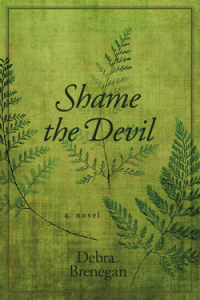
  5. Shame the Devil by Debra Brenegan – “Shame the Devil tells the remarkable and true story of Fanny Fern (the pen name of Sara Payson Willis), one of the most successful, influential, and popular writers of the nineteenth century. A novelist, journalist, and feminist, Fern (1811-1872) outsold Harriet Beecher Stowe, won the respect of Nathaniel Hawthorne, and served as literary mentor to Walt Whitman. Scrabbling in the depths of poverty before her meteoric rise to fame and fortune, she was widowed, escaped an abusive second marriage, penned one of the country’s first prenuptial agreements, married a man eleven years her junior, and served as a nineteenth-century Oprah to her hundreds of thousands of fans.” Book review from Smoky Talks Books.

You may also like: Holiday Guide: Six Fantasy Picks for 2011 on my “Sarabande’s Journey” blog.

Malcolm

a young woman's harrowing journey

Review: ‘The Devil’s Elixir’ by Raymond Khoury

Reading Raymond Khoury’s The Devil’s Elixir can be hazardous to your sleep cycle! You won’t be able to put the book down until you reach the last page.

Once again, Khoury pairs up FBI agent Sean Reilly and archeologist Tess Chaykin whom long-time Khoury fans already know from their tangled and dangerous destinies in The Last Templar and The Templar Salvation. (See also my review of The Templar Salvation.) In this high-energy thriller, Reilly and Chaykin shift their focus from Templar and Vatican mysteries to a potentially more dangerous secret extracted and resynthesized out of the South American rainforest.

Eusebio, the priest who learned about a psychoactive alkaloid from a tribal shaman in 1741, viewed the “sacred brew” as a catalyst that could lead a seeker toward mystical enlightenment. Álvaro, his Jesuit brother at the mission, called the drug the devil’s elixir. In the hands of a present-day drug lord named El Brujo the drug represents not only a belief-changing experience but a chance for unlimited profits with a potion more powerful than meth, cocaine and heroine combined.

Reilly is is drawn away from New York into the high-body-count world of drug cartels and kidnappings when a former girlfriend calls to report her life is in danger. Former DEA agent Michelle Martinez’s story is so compelling that Reilly packs his bags and heads for San Diego immediately. Soon, his life will be at risk as will Chaykin’s. One way or another, sparks fly when Reilly and Chaykin are involved in a case. This time out, there are a couple of additional complications, one being that Reilly never told Chaykin about his earlier relationship with the “seriously hot” Martinez.

Khoury’s story moves briskly with alternating chapters from the perspectives of El Brujo, southwestern FBI operatives, the drug lord’s foot soldiers, Reilly and Chaykin. This approach heightens the intrigue by showing the reader thrills, chills and plot twists that the primary characters have yet to discover. Reilly is a strong-willed, indefatigable FBI agent who gives everything he has to keep his loved ones safe while keeping the devil’s elixir out of the black market supply chain. At the same time, his conscience constantly asks him whether the ends justify his means.

Readers new to Khoury’s fiction may think as they finish each chapter in The Devil’s Elixir, “certainly things can’t get any worse than this.” Those who have  read The Last Templar and The Templar Salvation know things never get better until the story’s over because following a Khoury plot is similar to riding a snowball through hell.

The Devil’s Elixir is a delightfully breath-searing ride.

Book Details

The Devil’s Elixir by Raymond Khoury

Hardcover: 384 pages

Publisher: Dutton Adult (December 22, 2011)

Language: English

ISBN-10: 0525952438

ISBN-13: 978-0525952435

Malcolm R. Campbell is the author of four novels, including the recent contemporary fantasy Sarabande.