As I re-read Amanda Coplin’s The Orcharist (2012), I’m reminded–as I always am when I read a great book a second or third time–of the treasures the author’s words present that might be overlooked the first time through by reader’s focus on the plot.
 David Abram (The Spell of the Sensuous) speaks of the languages of the forest that most of us miss because we either don’t understand them or aren’t paying attention. In addition to animal tracks and calls, there are things that move (leaves blown across the sand, for example) that are another language we could learn if we wanted to understand the planet.
When I took a typesetting course in college as part of my journalism degree, the professor said that the best way to learn about a new typeface was to take a printed copy of it and trace every letter on an overlaid sheet of tissue paper. To know type, you need to see all of the thick and thin places, the ascenders and descenders, the legibility of the face on the page, and whether or not the type works best for headlines or text.
When we pay attention to a novel on a second or third reading, rather like noticing the language of a forest or the personality of a typeface, we see more than we saw the first time we read it. I’ve read The Prince of Tides and A Scot’s Quair at least five times, and each time I find a new nugget of gold or a hidden diamond. I usually let a fair amount of time go by before I’ll read a book again. That tends to make it seem newer when I pick it up for another reading.
I see on the Internet that some people track the number of books and their titles each year. I’m not sure why. I guess that’s okay, though it might emphasize quantity over quality, including making it harder to insert time in the schedule for re-reading one’s favorites.
Reading a book once seems to me to be similar to buying anything else and using it only once. Okay, maybe it’s not similar at all. But once the book is there on the shelf or on the display in one’s Kindle library, it still has things to say to us.
–Malcolm
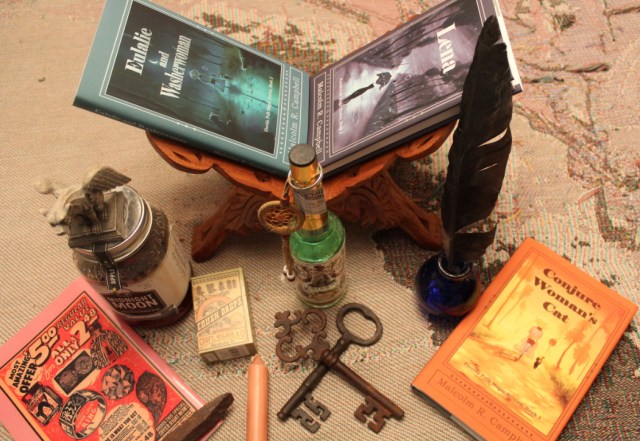
Malcolm R. Campbell is the author of Conjure Woman’s Cat.
 At my age, a vigorous, bone-crushing, muscle twisting workout comes from spending several hours on the riding mower. While recuperating, I found a few links you might enjoy. Or you might not. Long-time readers of this blog know that ever since high school, I’ve been fascinated by writings about Carl Jung, alchemy, and quantum mechanics (the many worlds interpretation), so I’m happy to see a review of a very readable book that has uncovered multiple levels and/or universes of meaning (Item 2) since we’re all entangled one way or another.
 Opinion:


 Sometimes I’m surprised. I was looking for magical realism books this morning and found one on Amazon that came from an author I’d never heard of from a publisher I’d never heard of that had almost 4,000 customer reviews. After getting rid of a few initial feelings of jealousy, I wanted to find out how they did this. Usually, 4,000 customer reviews is something you expect for titles by famous writers. So how does somebody “come out of nowhere” and get that kind of response?
 Peter Ruffell’s short foreword tells the reader that these 17 little stories, and the poem which completes the book, started life during writing sessions at Off The Cuff, a writing workshop in Weymouth. The length of these stories reflects that: they’re a little longer (and, thus, meatier) than flash fiction, but short enough to read one while you’re enjoying (say) a mid-morning cup of tea.
 News:
News: 






 Malcolm's Round Table