So far this year, my posts have had 15,506 views, the most popular post being an old one Barebones Structure of a Fairy Tale with 2,086 views and my navy slang post Heave out and Trice Up with 923 views. It’s also an old post.
For a while, my post about the White House Boys, the survivors from Florida’s nasty Dozier School and its transgressions received many views. Those began to fade as the story about the search for graves on school property fell out of the daily news. I thought some of those readers might find yesterday’s post about the school and Colson Whitehead’s bestselling novel The Nickel Boys ( Colson Whitehead’s ‘The Nickel Boys’ Takes Kirkus Prize for Fiction) that was based on the school. So far, only three views. That surprises me.
 After all these years posting on this blog, which began on Blogger and was moved to WordPress in 2008, you’d think I’d know what I was doing. But I don’t. The posts I think nobody will notice get lots of views and the posts I think everyone will notice are slim to none in the popularity category. In “real life,” I don’t believe in fate, much less in the fates of Greek mythology (Clotho, Lachesis, and Atropos, et. al.). Yet, sometimes I wonder.
Are three ladies truly spinning thread that represents our lives, measuring it, and then snipping it off? Gosh, I hope not. Yet, “fate” is a popular notion even in our age of science and technology about things that happen for no discernible reason. Others are more comfortable saying “God moves in mysterious ways.” (I don’t mean to imply that God reads my blog. <g>)
Why anything happens when it happens is usually tangled up in so many variables that understanding all but the most simplistic parts of it are beyond human ken. We might say that a person was injured in a car accident because somebody ran a stop sign. The police report usually covers that part. What they don’t cover is why the two cars involved happened to arrive at that intersection at the same moment. There are lots of theories about what “Why” but most of them don’t sync up with our consensual logic about the world so all we can do is ponder them.
Many newsletters these days have within them the code (often within a pixel) which the sender can use to see who reads them. If you don’t read them for a while, sooner or later you’ll get a message that asks if you will want the newsletter. Usually, I do. But I have to logical reasons for why I read it some days and skip it on other days. Sure, there are obvious reasons: I was sick, I was out of town, &c. But then there are the times when my brain is shorted out already and I don’t have the patience for reading something I normally like.
I don’t think that’s fate, but I can’t prove it. I’m happy that so many of you keep coming back to this rather eccentric blog and are reading so many posts. So thank you for being fated to read what you read <g>.
 Excerpt from Widely Scattered Ghosts: “On the band bus ride home, the stunning, first chair flute player Melinda Wallace sat beside him. She had no clue how he felt about her, not that he’d said anything. The empty aisle seat next to a clarinet was, he guessed, preferable to sitting in the back with the band’s borderline criminal element of raucous drums and tarnished brass. Melinda smelled like wildflowers and her unruly light brown hair smelled like the wind. When the band played ‘The Stars and Stripes’ Forever’ in concert and Melinda stood up into the light for her piccolo solo—the sweetest banshee cries the world has ever known—her blue eyes were frozen into ice for thirty-two measures of leaps and trills, while her hair could not be restrained.” – The Lady of the Blue Hour in “Widely Scattered Ghosts”
 Since I’m not a fan of housekeeping, I procrastinate on the housekeeping chores that go along with having a website and a blog. On the website, I’m likely to let pages sit for a while without a constant supply of fresh material so that return visitors have something new to read. Here, I’ve uploaded quite a few posts, but didn’t touch the pages that display on the menu across the top of the screen for a long time.
 My view of websites and blogs is that, other than talking about my books and related subjects, they are all about you rather than all about me. I wrote an article for a magazine for nonprofit organizations in which I said that many of them were missing the boat when they advertised events and exhibits. Like commercial advertising, nonprofit news releases which appeared in the newspaper should be about the reader, that is, showing him/her why the event would be fun, entertaining, and otherwise worthwhile.
 Posts I’ve forgotten about suddenly appear in my blog’s stats with dozens of visits, and that sends me out to them to see what I might have said. You know, did I insult a celebrity, inadvertently announce a cure for ten horrid diseases, or post nude pictures I didn’t know were available? Of course, I keep waiting for the post that goes viral, the one that attracts the attention of major movie studios who get into a bidding war for my books. So far, that hasn’t happened.

 I realize that social service and environmental groups have to be more careful than other bloggers because they don’t have to luxury of posting rants or even reasonable debates because such things are construed as the voice of the organization rather than how the blogger happened to be feeling one day. So, most likely, blog posts have to be approved by upper management–or by the publicity department–and that can be time-consuming. However, I think an out-of-date blog creates about as much damage as any inadvertent post that headquarters may not like.
 Sometimes, I do a Google search to see if the subject of an old post that suddenly has hundreds of hits has been in the news. This time, it’s my 2011 post


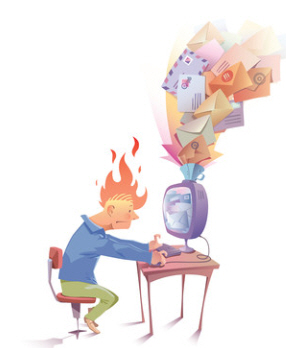 Most of the SPAM weeded out by WordPress starts with something lame: “Hi, I want you to know that I read your blog every day and intend to tell my friends about it.” And then there’s a link to an online store or service that I don’t want.
 My latest book
  Malcolm's Round Table