College Avenue, released June 3 on Kindle, features three short stories and four poems. The title story “College Avenue” is set in 1965, a time long before cell phones gave women on dark streets a viable means of calling for help. In this story, Anne tries to communicate to her far-away boyfriend how an assault by another student took place and how it has changed her.
“Mr. Déjà vu Upsets the Apple Cart” is a fanciful story about a girl selling apples who thinks a conversation with a customer has happened before. “Storybook is about a long-ago society that used a meaningful event from a young man’s formative years as a basis for his adult name. As he stands in line waiting for his new name, our protagonist can’t think of a single memorable event from his childhood. And, in “Again and Again Throughout the Long Night,” a son must tell his Alzheimer’s-stricken father that his wife has died–and that’s problematic and hurts both the father and the son.
The poems in the middle of the book are a varied batch, my hope being that each reader will find one or two that s/he likes and then move on to the rest of the stories.
From the ABA: When Sherman Alexie announced that he was cancelling an appearance at Malaprop’s Bookstore/Café in Asheville, many North Carolina booksellers expressed fear that an author boycott would have a chilling effect on free speech as well as inflict economic damage on booksellers who support LGBTQ rights. To address this fear, the American Booksellers Association has joined several groups in issuing a statement supporting free speech and urging authors and illustrators and their publishers not to boycott bookstores.
The following authors may evaluate attending conferences and festivals in North Carolina, but will still participate with libraries and bookstores;
Writers often dream about mountain and seaside cabins as places to escape daily life and concentrate on on their writing. Some lease vacation rentals while others create their own hide-ways on their own property. Others take advantage of writing retreats and writers-in residence programs. For examples of retreats, check here: 25 Incredible Writing Retreats to Attend in 2016.
All of these are ways to get away from it all and concentrate on the writing and research needed to complete, say, a novel or a collection of short stories. In some cases, wishing for that cabin in the woods might simply be an excuse; for others the time away is desperately needed.
In the current issue of Poets & Writers Magazine, “Arts Organizations Offering Prizes More Valuable than Cash'” suggests that grants–for which there will be more competition–offer strong support than a hide-way and and a suitcase full of money.
“As mainstream publishing becomes more fixated on finding the next best-seller and arts funders begin to understand that for many talented poets and literary authors success requires more than simply finding time to write,” says Michael Bourne. “A small number of arts organizations are taking a more hand-on approach–including, in some cases, arranging meetings between their winning writers and publishers who might be interested inn taking on their books.”
Many widely known authors have followed versions of the grant approach, including Karen Russell and Aracelis Girmay. If you can find a copy of the magazine, read the full article for details. Otherwise, here are three grant-awarding organizations you may wish to explore:
If you’ve heard about magical realism, but haven’t knowingly sampled it yet, the top sellers on Amazon are a wonderful place to start.
The Night Circus, by Erin Morgenstern, September 2011. I read this as soon as it came out and it became one of my favorite books. It edged out The Tiger’s Wife as that year’s favorites as I wrote in this post. The fact that it’s still number one, shows it has staying power and that people continue to find it. It has a long list of starred reviews, telling me the critics also like it. A circus shows up out of nowhere, displays breathtaking feats of real magic as though they are mere illusions, and then disappears. What a joy to read.
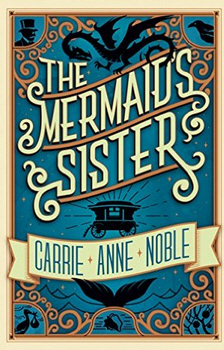
The Mermaid’s Sister, by Carrie Anne Noble, March 2015. This book is the 2014 Winner of Amazon’s Breakthrough Novel Award for Young Adult Fiction. I haven’t read it yet, but I’m impressed with the general tone of the reviews and what I can see via the book’s “Look Inside” feature. The cover is delightful and the publisher’s opening words about the story are tempting: “There is no cure for being who you truly are…In a cottage high atop Llanfair Mountain, sixteen-year-old Clara lives with her sister, Maren, and guardian Auntie. By day, they gather herbs for Auntie’s healing potions. By night, Auntie spins tales of faraway lands and wicked fairies. Clara’s favorite story tells of three orphan infants—Clara, who was brought to Auntie by a stork; Maren, who arrived in a seashell; and their best friend, O’Neill, who was found beneath an apple tree.”
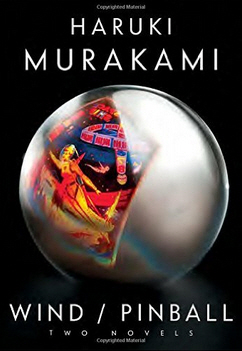
Hear the Wind Sing and Pinball, by Haruki Murakami are two novels issued in this one volume set for release next month. They haven’t previously been available in English. According to the publisher, “These powerful, at times surreal, works about two young men coming of age—the unnamed narrator and his friend the Rat—are stories of loneliness, obsession, and eroticism. They bear all the hallmarks of Murakami’s later books, and form the first two-thirds, with A Wild Sheep Chase, of the trilogy of the Rat.” I am tempted by this book, but more tempted by the book sitting in position number five.
God Help the Child, by Toni Morrison, April 2015. I have read most of Morrison’s work and have this book on order. While the cover is disappointing, the reviews are positive. The publisher describes the book this way: “At the center: a young woman who calls herself Bride, whose stunning blue-black skin is only one element of her beauty, her boldness and confidence, her success in life, but which caused her light-skinned mother to deny her even the simplest forms of love. There is Booker, the man Bride loves, and loses to anger. Rain, the mysterious white child with whom she crosses paths. And finally, Bride’s mother herself, Sweetness, who takes a lifetime to come to understand that ‘what you do to children matters. And they might never forget.’” I’ll stipulate that so far, I’ve only read what I can see via “look inside,” but based on that, I think it will be difficult for any author in 2015 to match the power of this story.
Mr. Penumbra’s 24-Hour Bookstore (audio version), by Robin Sloan, October 2012. I read this book when it came out and found the story and characters strange and compelling. I don’t care for the cover but, like Morrsion’s book, the reviews are positive. And, what can be more tempting for an author than a publisher’s description that (1) starts out like this: “A gleeful and exhilarating tale of global conspiracy, complex code-breaking, high-tech data visualization, young love, rollicking adventure, and the secret to eternal life—mostly set in a hole-in-the-wall San Francisco bookstore” and (2) begins like this: “Lost in the shadows of the shelves, I almost fall off the ladder. I am exactly halfway up. The floor of the bookstore is far below me, the surface of a planet I’ve left far behind. The tops of the shelves loom high above, and it’s dark up there–the books are packed in close, and they don’t let any light through. The air might be thinner, too. I think I see a bat.” I hope the world will always have bookstores that can be described this way. The book kept my attention, but not enough to re-read it as I have The Night Circus.
There’s a lot to like here if you’re of a mind to sample the latest magical realism. Then, stop by Malcolm’s Round Table on July 29 when I’ll be taking part in a magical realism blog hop.
–Malcolm
Malcolm R. Campbell is the author of the magical realism novella set in the Jim Crow era of the Florida Panhandle, “Conjure Woman’s Cat”
It’s hard to believe the novel Cool Hand Luke is fifty years old and that the Paul Newman film is forty eight.
We liked the book and the novel in the 1960s because we liked poking at the system. The chain gang where Luke serves his time is a bad system, personified, perhaps by the joint’s Captain played by Strother Martin. When something didn’t work out right, the Captain famously said, ‘What we’ve got here is failure to communicate.”
We were all saying that in the 1960s every time the latest lie from “the establishment” came down the road to bite us.
“Luke: I wish you’d stop being so good to me, Cap’n.
“Captain: Don’t you ever talk that way to me. (pause, then hitting him) NEVER! NEVER! (Luke rolls down hill; to other prisoners) What we’ve got here is failure to communicate. Some men you just can’t reach. So you get what we had here last week, which is the way he wants it. Well, he gets it. I don’t like it any more than you men.”
The book and movie seemed real because the author, Donn Pearce (Nobody Comes Back, 2005) served time after being convicted as a safe cracker.
Kirkus Reviews’ Gregory McNamee looked back at Cool Hand Luke at 50. I wish I’d written the first paragraph of the essay:
“Donn Pearce’s Cool Hand Luke is a hot book. A hot, sweaty book. A hot, sweaty, stinking book. When you read it, having worked vicariously on a chain gang in a Florida July, you’ll want to take four or five showers—and you’ll give up any thought of a life of crime, especially one south of the Pee Dee and east of the Atchafalaya.”
I appreciated the story, in part, because I grew up in Florida and saw a lot of chain gangs working the roads. The Kirkus piece is called an interview, though that’s questionable since it doesn’t have any Q&A in it. I wish McNamee had contacted the 86-year-old author and ask him how the story speaks to us in 2015.
Goodness knows, the story should speak to us because, what with the near-weekly revelations of lies–and/or people who “misspoke”–we have plenty of reasons not to trust “the establishment” even if we don’t call it that any more.
In June, the Florida Department of Corrections said that it’s looking at a new model. It’s called “transformative rehabilitation.” Big words. Are they real, or another failure to communicate? Rather than simply managing the inmates’ time in jail, these words mean the inmates will be prepared to re-enter society.
We can hope without holding our breath. Our country is addicted to its prisons with more people in jail than any other modern, advanced nation. There are a lot of Lukes out there and that seems ensure the story will probably keep speaking to us.
–Malcolm
Malcolm R. Campbell is the author of the novella “Conjure Woman’s Cat” set in the Jim Crow era of the Florida Panhandle.
Thomas-Jacob Publishing released a new edition of Smoky Zeidel’s The Storyteller’s Bracelet today, bringing the novel back into print after a twenty-two month absence. The book is available in e-book and Kindle editions. You can watch the novel’s trailer here.
From the Publisher
“It is the late 1800s, and the U.S. Government has mandated native tribes send their youth to Indian schools where they are stripped of their native heritage by the people they think of as The Others. Otter and Sun Song are deeply in love, but when they are sent East to school, Otter, renamed Gideon, tries to adapt, where Sun Song does not, enduring brutal attacks from the school headmaster because of her refusal to so much as speak. Gideon, thinking Sun Song has spurned him, turns for comfort to Wendy Thatcher, the daughter of a wealthy school patron, beginning a forbidden affair of the heart.
“But the Spirits have different plans for Gideon and Sun Song. They speak to Gideon through his magical storyteller’s bracelet, showing him both his past and his future. You are both child and mother of The Original People, Sun Song is told. When it is right, you will be safe once more. Will Gideon become Otter once again and return to Sun Song and his tribal roots, or attempt to remain with Wendy, with whom he can have no future?”
Smoky’s Description of the Cover’s Symbolism
“I’ve gotten a lot of questions about the meaning behind the symbols on the new edition of The Storyteller’s Bracelet. The wavy lines at the bottom represent water, which plays a life-changing role for my male protagonist, Otter/Gideon. The stairway through the clouds represents the gateway to the 5th World in Hopi mythology. The arrows point to the four cardinal directions and their colors represent the direction people of color scattered at creation. (These colors can vary from one tradition to another; these are the colors the Hopi use.) Finally, the rattlesnake is a symbol of new life, of transformation. Rattlesnake sheds her skin and begins life anew.”
You May Also Like
Smoky also released a companion short story on Kindle called Why the Hummingbird is So Small, “the enchanting story of Sun Song, a storyteller for her tribe, as she visits Fuss, her hummingbird friend, on the day before she is to leave for Indian School in the East.” You can visit Smoky’s website here.
When we use traditional collective nouns for groups of animals, we speak of a congregation of alligators, a colony of ants, a swarm of bees, a herd of buffalo, a clutter of cats, a murder of crows, a pod of dolphins, a flock of geese, a charm of hummingbirds and a pandemonium of parrots.
Humorous collective nouns have been suggested for writers, including an absurdity of, an allegory of, a gallery of and scribble of. Some of the funnier suggestions are less than flattering. When I was interviewed for a regional magazine along with other authors from the county, the article was titled “A Truck Load of Authors.” We were all packed into a vintage pickup truck, a picture was taken, and the magazine had a great illustration.
Since I had no viable way of getting all the authors together who have appeared on this blog directly through guests posts and interviews or indirectly through reviews together and posing them on a raft, railcar or a team of wild horses, I’ve settled for the word “batch.”
The Batch at Malcolm’s Round Table
If this blog has a niche–or a partial niche–it’s books and writers. Since I read a lot, the batch of writers here has included a lot of reviews. Some of those were BIG PUBLISHING BESTSELLERS but most were not.
So yes, I reviewed Dan Brown’s Inferno and talked about Donna Tarrt’s The Goldfinch. I liked The Night Circus, The Tiger’s Wife, and Long Man a lot and you probably heard about those more than once. Of course I talked about my own books but, well, that’s because I can’t help it and I try not to go on and on about them even though I might be going on and on anyway.
But, to move on. . .
However, it was much more fun talking (in reviews or notes) about books by some wonderful authors you weren’t hearing about everywhere else, L. S. Bassen, Seth Mullins and Smoky Zeidel (who has a new edition coming out soon).
Guest Posts and Interviews
Sara Ann grave in PA. Bob Salerni photo.
When an author has delved deeply into a subject while researching a book, it’s fun to have them to stop by and do a guest post. The most unusual guest post was author Dianne K. Salerni’s (“We Hear the Dead,” “The Caged Graves”) Mortsafes: Protection FROM the Dead or FOR the Dead? Spooky stuff.
Interviews are something special because even though they are conducted via e-mail, my guests and I try to make they read very much like conversations.
Most recently, Marietta Rodgers stopped by to talk about her debut book The Bill. Laura Cowan has been here twice, most recently to talk about her magical Music of Sacred Lakes. Nora Caron, a Canadian author lured into Mexico and the American southwest has written a wonderful trilogy that includes New Dimensions of Being. Melinda Clayton, a psychologist who’s now focusing her observational skills on fictional characters spoke about her novel Blessed Are the Wholly Broken. Two audio book narrators, R. Scott Adams and Kelley Hazen stopped by do tell me how they do what they do. Adams brought his talents as a dialects specialist to my novel Jock Stewart and the Missing Sea of Fire. Hazen brought her experience as an actress to narrate my three-story set Emily’s Stories.
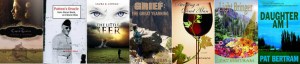
Diane Salerni’s research into Mortsafes made for a wonderful book in Caged Graves. Novelist Robert Hays used his background as a journalist and journalism educator to write the well-received nonfiction book Patton’s Oracle: Gen. Oscar Koch, as I Knew Him. Laura Cowan (“The Little Seer”) contributed a close-to-my-heart guest post Speculative Supernatural Novels and the Growing Fantasy Genre. Novelist Pat Bertram (“Light Bringer,” “Daughter I Am”) also wrote the nonfiction Grief the Great Yearning which brings together her experiences with loss in an guest post called The Messy Spiral of Grief. Beth Sorensen (“Crush at Thomas Hall”) wrote a sparkling thriller/romance in her novel Divorcing a Dead Man.
Helen Osterman worked as a nurse for 45 years. During her training, her rotation she witnessed hydrotherapy, Insulin coma therapy and electroshock. Her background served her well when when she turned to fiction writing in Notes in a Mirror. Vila SpiderHawk’sForest Song novels are magical. She stopped by to talk about Finding Home. I thoroughly enjoyed Deborah J. Ledford’s Staccato, Marsha Forchuk Skrypuch’s Dance of the Banished and Rhett DeVane’s Suicide Supper Club.
Memory Lane
As you see, memory lane is a long street. It would be even longer if I kept better records, so I’m sure I didn’t find all of my interviews and guest posts. I’m planning to bring you some more new posts in the coming months. I hope you’ll stay tuned and, from time to time, sample the authors’ stories.
–Malcolm
Malcolm R. Campbell is the author of “Conjure Woman’s Cat”
Today’s guest is Marietta Rodgers, author of The Bill (Second Wind Publishing, January 6, 2015). In the novel, Representative Joe Herkieze is trying to get his Hunger Relief Act passed and teenager Hope Price has taken a summer job in a slaughterhouse looking for enlightenment. This juxtaposition screams dark humor and satire.
Malcolm: Your novel The Bill is a political satire. Did you select this genre because you tend to view the world through a satirical lens or because satire seemed like a fitting approach to a story about a Congressman?
Marietta: I do view things through a satirical lens sometimes, but the lens are more like reading glasses, where I wear them as needed as opposed to all the time. Satire is a good tool for highlighting flaws or short-comings, but it is also a way to goad individuals, groups and governments into improvement, by juxtaposing reality with absurdity and not having a giant chasm in between. The misnomer is that satirists are pessimists, or even misanthropes, but usually it is just a way to unlock human potential.
Malcolm: Did you have to do a considerable amount of research to write about the process a Representative follows to write, promote and get a bill passed?
Marietta: I did research the process of a bill from the time of its inception to its fruition, because it isn’t as straightforward as people might think. These bills can get watered down or so bogged down in a committee, that they never see the light of day. It’s good that we have checks and balances, but unfortunately what we have currently, is nothing more than obstructionism, that has little or nothing to do with the bill themselves, but more to do with party lines.
Malcolm: Obstructionism is bad for the country but good for satirists. Your book also features a slaughterhouse whose foreman is aptly named Piggy. I must confess, I haven’t read anything about a slaughterhouse since I read Upton Sinclair’s muckraking book The Jungle in school. How did you happen to select this industry for your novel, and how did you learn enough about a slaughterhouse to write about it?
Marietta: I did have to do research on slaughterhouse practices, because I too read The Jungle and thought I would be working away from that, but people would be surprised to note that some of the horrifying practices that took place then still occur. John Lennon famously said, “If a slaughterhouse had glass walls, we’d all be vegetarians.” I think that is definitely true.
Malcolm: I understand George Orwell’s “Animal Farm” is among the books that have influenced you. Is it partly responsible for your choosing satire as a genre and possibly for naming a slaughterhouse foreman “Piggy”?
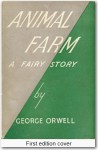
Marietta: I wrote, The Bill as a satire, because it just felt natural. George Orwell could have written, Animal Farm (I’m sure he would have titled it something else) as a straight forward tale, without the use of satire, or the metaphorical use of animals to convey his dismay over Stalinism, but it would have been a halfhearted jab, as opposed to the knock out punch it delivered instead. It would have definitely lost a lot of bite in the telling. The slaughterhouse foreman’s nickname is Piggy, which was given to him by the other workers. I chose that name for him, because he is the head of an entire slaughterhouse machine, which slaughters not only pigs, but really human dignity as well.
Malcolm: Do you have a new satirical novel in the works or have you shifted your focus for your next book?
Marietta: I wrote a novel called, Loony Bin Incorporated, which is a satire of big business. It is tentatively scheduled to be available for sale, June 1, 2015. This was another novel, that I felt was better told as a satire. It employs a lot more lighthearted humor than, The Bill though. Currently, I have shifted my focus to writing short stories, that each revolve around the lives of tenants in a particular building in New York City.
Malcolm: What did I forget to ask you?
Marietta: “Vanity Fair” does the Proust Questionnaire, based on the famous questionnaire of the French writer, Marcel Proust. One of the questions they ask authors that I like is, what is your current state of mind? The answer: always a chaotic preoccupation of ideas.
Malcolm: I’ve found that chaos is often a writer’s best friend. Thanks for dropping by the Round Table today to talk about The Bill and the ways and means of satire.
Dance of the Banished, by Marsha Forchuk Skrypuch, Pajama Press (February 1, 2015), young adult, 288 pages. In her sixth book set during the Armenian Genocide, Marsha Forchuk Skrypuch’s Dance of the Banished brings young adult readers a heartbreaking account of the World War I-era ethnic cleansing in the Anatolia region of Turkey and the Canadian paranoia that sent thousands of purportedly dangerous immigrants to internment camps.
Armenians, who are traditionally Christian, and Alevi Kurds, whose religious views differ from those of Sunni Kurds, predate the arrival of the Turks in Anatolia. The discord brought into the region by the Turks is a centuries-old fight. “Dance of the Banished” begins in 1913 on the brink of Turkey’s entry into World War I on the side of the Central Powers with the story of two betrothed Alevi Kurds who are soon separated by hard times and a very wide ocean.
Ali chooses to go to Ontario, Canada where jobs are available. He plans to send money home to his family and to save enough to ultimately pay for Zeynep’s passage to Ontario. She views his departure as a betrayal, as practical as it may be, and wonders if they will ever see each other again.
Subsequently, Zeynep also leaves town to work in a hospital in a Harput, a city between the Tigris and Euphrates rivers, where she is swept up into the horror of revolution, war and poverty. Ali begins work in Canada only to find himself rounded up on trumped up charges and sent to a prison camp where he’s pressed into service at a minimal age. Both wonder why they don’t hear from each other.
The book’s sections, which alternate between Zeynep’s and Ali’s stories, are presented as journal entries written in the form of letters to each other. In time, she learns that the Armenians who have been allegedly drafted to fight in World War I are being exterminated and he learns that he is part a growing group of imprisoned Ukrainians, Turks and others who came to Canada for freedom only to end up without it.
The power of this novel comes in part from the age of its two protagonists and how their view of the world is forced to change. Young and in love, they see life through a different lens than their parents and grandparents. While their focus is on being reunited with each other, their journal entries begin with typical day-to-day activities and then change from initial disbelief at the persecution around them into grim accounts of their own involvement and means of survival.
Their growing horror and their continuing hope and perseverance during the cruel years of 1913 to 1917 combine for a poignant love story and a stark account of genocide close up and very personal.
The book is enhanced by the inclusion of internment camp pictures and an author’s note about the story’s historical background.
–Malcolm Malcolm R. Campbell is the author of the upcoming novella “Conjure Woman’s Cat.”
Stewart: Before you start asking me questions, I want to know where the hell your copy editor is. Look at the title. Makes me look like I’m lame. The questions and answers are lame. “Sea of Fire” isn’t a loose biographical tail, it’s a loosely biographical tale.
MRT: Thank you for acting like a grammar nazi before we hit the questions your readers came here to read. So, tell us about yourself?
Stewart: That’s not a bloody question, it’s an order and I don’t like it. What it shows me is this: you didn’t do your homework before starting this interview. If you had, you’d be asking me questions like, “Were you really raised by alligators in a Florida swamp?” and “Why did you ditch gossip columnist Monique Starnes in favor of shacking up with the mayor’s wife.” But I’m not talking about that. As for me, I’m a newspaper reporter of the old school. Old school reporters smoke cigarettes, drink, shack up with women and do their homework before interviewing people.
MRT: Where do you get your ideas?
Stewart: God help us from questions like that. I get them from the editor. He says, “Stewart, get your ass in here.” Here is is office which is filled with cigarette smoke. There’s usually a gun on the desk. Then he says, “A source told me somebody got killed behind the windmill at the miniature golf course. Go out there and find out who’s dead, how they died, and whether the windmill was damaged in any way.”
MRT: Does “any way” mean blood stains or bullet holes?
Stewart’s Boss
Stewart: It means anything that shuts down the golf course so the kids can’t stop by an drop a few grand playing the links. Last year, the victim was left out there on the 9th hole for a couple of days and he just became another hazard. Business picked up for a while.
MRT: So, when did you first know you wanted to be a writer?
Stewart: That day still hasn’t arrived. But, if you want to know why I work for a newspaper, it’s because I think people need to know what’s happening. That requires writers. My dear old daddy once told me that I wasn’t going to amount to squat and, looking at my career, you can see that he was right. I tried too prove him wrong by going into the gigolo business, but things didn’t work out.
MRT: Where can people find you on the web?
Stewart: They can’t.
MRT: Where can they find you.
Snowden – NSA sketch artist drawing
Stewart: If it’s Saturday night, I’m sleeping it off in the slammer. If it’s lunch time, I’m eating lunch. If it’s bedtime, I’m in somebody’s bed. Seriously, I really don’t want to see the kind of people who are usually looking for me.
MRT: What are you working on now?
Stewart: I’m working on getting the hell out of this lame interview as soon as possible. Interviews like this are a dime a dozen. That’s why you see this same list of questions on so many blogs. If you’re talking books, which I guess you must be, my work in progress is called What Edward Snowden Does When He’s Not Taking a Leak.
MRT: I hope you did your homework before you interviewed him and didn’t start out with something lame like “Tell us about yourself.”
Stewart: You’ve got that right. Before I got to Putin’s bedroom, I knew more about Snowden than all the other reporters in the free world.
MRT: Putin’s bedroom?
Putin – Predator drone imagery
Stewart: People said they were probably in bed together. He wasn’t there, but what with all the Ukrainian separatists, the place was kind of crowded. Snowden has a rich, full life–to the extent that’s possible in a country that was filled with commies a couple of years ago and is trying to revert back to a police state mentality.
MRT: I’m looking forward to the book?
Stewart: Want to be a beta reader?
MRT: No.
Stewart: Good, because real writers don’t need beta readers to tell them how to write. God help us from people who write by committee, it you know what I mean.
MRT: I think I know, but I need to check with my blogging team here to see how to best respond to that question.
Stewart: Figures.
This interview first appeared on the Junction City (TX) Star-Gazer where people found it worked much better than the comics for lining parrot and hamster cages.
 College Avenue, released June 3 on Kindle, features three short stories and four poems. The title story “College Avenue” is set in 1965, a time long before cell phones gave women on dark streets a viable means of calling for help. In this story, Anne tries to communicate to her far-away boyfriend how an assault by another student took place and how it has changed her.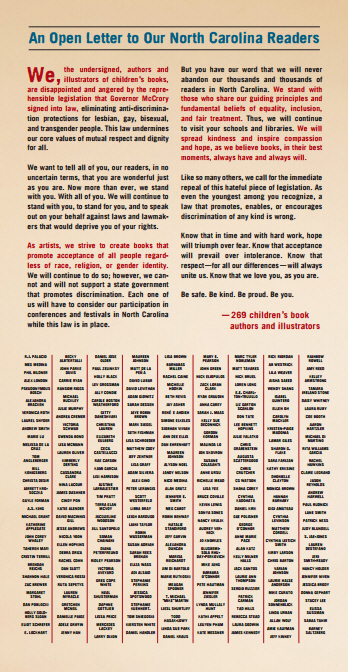
 Writers often dream about mountain and seaside cabins as places to escape daily life and concentrate on on their writing. Some lease vacation rentals while others create their own hide-ways on their own property. Others take advantage of writing retreats and writers-in residence programs. For examples of retreats, check here: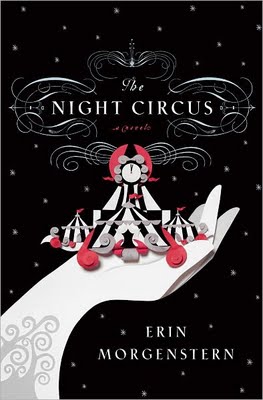





 Diane Salerni’s
  Helen Osterman





 Malcolm's Round Table