I enjoy watching the Olympics in spite of all the reasons people have for not watching the Olympics. As a so-called “winter person,” I liked the winter Olympics best, though I’m a fan of the swimming, diving, and gymnastics in the summer games. One thing I noticed during reporters’ brief talks with the medalists is the athletes’ coments that they’ve been working all their lives to reach–and triumph in–the Olympic games.
I think all but the most avid sports enthusiasts are unaware of most of that work. We may hear about the hours of training, but we don’t see (or know about) the meets and competitions that lead up to a place on a country’s Olympic team.
 While sports is quite different that the careers most of us choose, I think those of us in many areas can say we’ve been working a lifetime to move up the chain of command (instructor to full professor, line supervior to middle manager, resident to fellow to attending physician). I see this, of course, as a writer sees it as s/he “moves up” from a staff writer, to a paid freelance, to a successful novelist or nonfiction author. Other than reaching bestseller lists or winning prizes, the “best” authors appear at convocations and panels, serve as faculty in MFA programs, and/or teach upper level college writing courses.
When comparing a writer’s version of working for a lifetime with an Olympian’s version of working for a lifetime, most people in both groups are those who either don’t make the team or–if they do–don’t medal. For writers, we at least don’t have careers that can be cut short so quickly by physical injury of age. (You don’t know how much it raises my level of hope to see that Clint Eastwood, at 91, is coming out with yet another movie.)
Needless to say, there aren’t a lot of Olympic sports that have 91-year old competitors. It’s sad that whether it’s the Olympics or other sports, the window in which competing is possible is so short. Writers and actors and directors and doctors have more time. Yet time is always mving fasters than it appears: what seems like forever to a young writer (for example) suddenly becomes a time crunch with age.
So, we keep at it, happy that we don’t have to hang up our skiis or gloves or rackets (not counting the Williams sisters) when we’re only forty. The snare, of course, is always thinking tou have plenty of time. Ha! You might write your best book when you’re reach Eastwood’s age, only it doesn’t take off, only nobody believes in it enough to nominate it for a Pulitzer, only when the book fades from the scene, you feel no closer to your goals than you did when you were 18,
Time runs on so many continuums: sports figures probably have the shortest, college teachers don’t have forever to advance in rank; neither to officers in the military where the phrase is you either move up or you move out. Perhaps writers have it easy: we “get” to keep working on our lifetime dreams long after people our ages have already retired in other disciplines.
But we know what it means when an Olympic athlete a third of our age says, “I’ve been working a lifetime to get here.” I watch the Olympics partly because I enjoy the compeditors’ success. And, I feel sad then they come in .002 seconds behind the bronze medalists. “All glory is fleeting,” General Patton supposedly said. Yes it is. But experiencing it for a moment is a special honor whether you write or direct or care for the sick or swim 1,500 meters into the history books.
–Malcolm
Malcolm R. Campbell
 Publisher: Thomas-Jacob Publishing

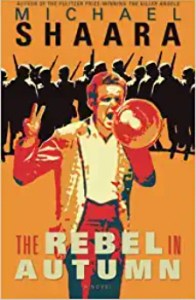 But that’s not the half of it. His best novel The Rebel in Autumn, written prior to The Killer Angels, never found a publisher in his lifetime. Written about the protests of the 1960s, it was (perhaps) too current for publishers to accept. Like his baseball novel For The Love of the Game, which became a Kevin Costner film in 1999, Rebel was published through the influence of his children Jeff and Lila (both are authors) posthumously in 2013.


 You’re reading a compelling novel like Cormac McCarthy’s Cities of the Plain and here come your characters right in the middle of it, talking the dialogue right out of the book (You got a girl? Shit no. You sound like you’ve had some bad experiences. Who aint? You fool with them and that’s the kind you’ll have.)
 You’re watching one of the final episodes of “How to Get Away with Murder” and after Annalise Keating says, “Prayers are for the weak–I’ll stick to beating your ass in court,” one of your characters blurts out “Say which?” and you find yourself writing dialogue for your book while people on the show are getting away with murder.
 Taylor Swift is singing “The Man” and you get it mixed up with Burl Ives’ “The Big Rock Candy Mountain because your story is pushing on your hand like the dog that’s not getting petted.
 Several student responses are likely: (1) A dozen synonyms for said. (Yes, there’s a difference between “he said,” “he yelled,” and “he whispered.”) But they don’t help if the words that are said don’t sound any different in tone, structure, word choice, accent, and focus than the three other people in the conversation. (2) The student thinks up a list of eccentric phrases and distributes these amongst the characters, rather like dealing out cards, so that EVERYONE TALKS FUNNY. The teacher is likely to say, “The people sound like they just escaped from a carnival freakshow.”
 Many of us are not successful novelists, as the industry views the phrase, because we don’t write every day. We may have a few published books out there via small presses or self-publishing, yet we write more from the perspective of hobbyists than professionals. I suppose that if a writer’s books have never made money, then s/he finds it hard to see himself/herself as a professional. If you’re not making money or slowly gaining a list of satisfied readers, there’s no incentive for writing 200 words or a thousand words a day.
 I’ve been an environmentalist for a long time, so Stalling’s words resonate with me. My response in my fiction has usually been to celebrate the natural world. Perhaps this is not enough. It appears that more people want to celebrate suburbia than the world as it was created. So, how do writers approach that point of view?

 Malcolm's Round Table