 William Blake (28 November 1757 – 12 August 1827) was scarcely known during his lifetime, was considered mad by those who were aware of him, sold very few copies of his work, and was buried in a mass grave with borrowed money. Now that he can no longer profit from his works, he’s considered favorably as a poet and engraver.
His introduction to this volume of poems, written and engraved in 1894, shows the style of the work. Readers definitely need the illustrations in order to enjoy the intended scope and meaning of the work.
 This edition promises the engravings that belong with the work.
From the Publisher
“This stylish reissue of Blake’s timeless work is sumptuously packaged in burnt-orange casing with gold sprayed edges, which allude to the treasures within.
“Songs of Innocence and of Experience is a rare and wonderful book, its seeming simplicity belying its visionary wisdom. Internationally recognised as a masterpiece of English literature, it also occupies a key position in the history of western art. This unique edition of the work allows Blake to communicate with his readers as he intended, reproducing Blake’s own illumination and lettering from the finest existing example of the original work. In this way, readers can experience the mystery and beauty of Blake’s poems as he first created them, discovering for themselves the intricate web of symbol and meaning that connects word and image. Each poem is accompanied by a literal transcription, and the volume is introduced by the renowned historian and critic, Richard Holmes. This beautiful edition of The Songs of Innocence and Experience will be essential for those familiar with Blake’s work, but also offers an ideal way into his visionary world for those encountering Blake for the first time.”
Wikipedia notes that, “Geoffrey Keynes says that Blake, as the prophet ‘calls the Fallen Man to regain control of the world, lost when he adopted Reason (the ‘starry pole’) in place of Imagination.’ Earth symbolizes the Fallen Man within the poem. Blake (‘the voice of the Bard’) calls him to awake from the evil darkness and return to the realm of Imagination, reassuming the light of its previous ‘prelapsarian’ state. Reason (the ‘starry pole’) and the Sea of Time and Spece (the ‘watr’ry shore’) “are there only till the break of day if Earth would consent to leave ‘the slumberous mass'”
As a reader biased in favor of Blake’s work, I feel that time spent with this volume is time well spent.
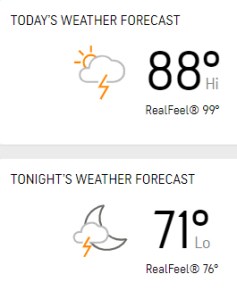 As you can see by the AccuWeather graphic, our heat wave in North Georgia has eased up a bit, leaving us with an outdoor sauna bath without anyone handing out fresh towels and cold beer. At present, my desktop weather simply says “rain off and on.” Other than not having fresh towels, we’re also not having grass dry enough to mow. The yard’s not looking its best right now. About all I’m doing outside these days is pulling the wheelie bin out to the road and going out to buy groceries (which ensures that I’ll have to keep moving garbage from the house to the road).
 I was happy to see this news: “Novelist Jesmyn Ward has become the youngest person ever to win the Library of Congress Prize for American Fiction.” Her words are well controlled and still carry magic in them. According to Michael Shaub’s story on Kirkus, Ward said, the award “not only because it aligns my work with legendary company, but because it also recognizes the difficulty and rigor of meeting America on the page, of appraising her as a lover would: clear-eyed, open-hearted, keen to empathize and connect.”
 We’ve been watching old movies at night because most of our “regular shows” have taken their usual long summer vacation. How long has it been since saw you Sydney Pollack’s neo-noir “Absence of Malice” from way back in 1981? Since my wife and I started out as journalists, it was fun seeing an old-style functioning newsroom. As Wikipedia notes, Variety called it “a splendidly disturbing look at the power of sloppy reporting to inflict harm on the innocent.” I always liked Melinda Dillon, Wilford Brimley, and then, Paul Newman wasn’t bad either. I kept expecting Sally Field to show up looking like the flying nun or Forrest Gump’s mom in which she’d explain the whole box of chocolates thing to Paul Newman.
 On a completely irrelevant side note, our local Food Lion grocery store has finally started carrying Newman’s Own salad dressings and other products. The product shown here not only tastes great on a tossed salad but also works as a great marinade for steak. According to the company’s website, “When Newman’s Own first began, Paul Newman declared that 100% of the profits would go to good causes. The mission continues today through Newman’s Own Foundation. In total, more than $570 million has been donated to good causes since 1982.” By the way, Newman wasn’t wearing that crown in the movie.
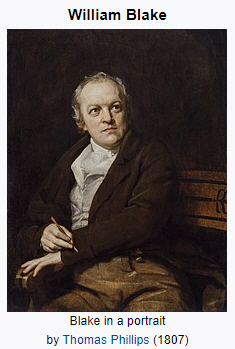 Those of you who know me, whether you’ll admit it or not, know that I’m a fan of poet/engraver William Blake (1757-1827). So I was happy to see a story about him in The Marginalian,
 Praise the universe for crooked roads.
 Malcolm's Round Table