‘The Zohar’: the heart of Kabbalah

The Zohar (Hebrew: זֹהַר, Zōhar, lit. “Splendor” or “Radiance”) is a foundational work of Kabbalistic literature. It is a group of books including commentary on the mystical aspects of the Torah (the five books of Moses) and scriptural interpretations as well as material on mysticism, mythical cosmogony, and mystical psychology. The Zohar contains discussions of the nature of God, the origin and structure of the universe, the nature of souls, redemption, the relationship of Ego to Darkness, and the “true self” to “The Light of God”. – Wikipedia

I once had a multi-volume copy of The Zohar in Hebrew and English, but donated it to a library when we downsized during the last move. I miss the volumes and hope that students will discover the books and along with them, the inner and outer universes.

According to My Jewish Learning, “The Zohar, however, is now one of the better-known works of kabbalistic literature, thanks to the early 20th-century scholarship of the German-born Israeli philosopher Gershom Scholem and to recent English translations. Though difficult to understand, due to the dense and obscure cosmological system the text inhabits, even in translation, the Zohar invites those willing to explore it into a fantastical universe filled with spiritual contemplation and insight.”

The Kabbalah Center, a website worthy of checking out if you are new to Jewish mysticism, says, “The Zohar is a holy book. Its origin is Light. Its purpose is to bring Light. Its nature and substance are Light, so much so that the mere possession of the Zohar can repel darkness and surround those who possess it with merciful protection. As Rav Berg wrote, ‘The Zohar represents humankind’s best hope of a solution to the chaos that has afflicted it since the beginning of history. Through the Zohar, we shall assuredly transform this planet into one of peace and tranquility.’”

Other reading and courses at sites like The Kabbalah Center, I suggest a good starting point book for discovering The Zohar is an overview such as Zohar: Annotated & Explained edited by Daniel Chanan Matt.

From the Publisher

“The best-selling author of The Essential Kabbalah now offers readers the best introduction to the Zohar.

“The splendor and enigmatic appeal of the Zohar, the major text of the Jewish mystical tradition, has never intrigued readers of all faiths more than it does today. But how can we truly understand it?

“Daniel C. Matt brings together in one place the most important teachings from the Zohar, the cornerstone of Kabbalah―described as a mixture of theology, mystical psychology, anthropology, myth, and poetry―alongside facing-page stories, notes, and historical background that illuminate and explain the text. Ideal for the first-time reader with no prior knowledge of Jewish mysticism.

“Guides readers step-by-step through the texts that make up the Zohar―midrash, mystical fantasy, commentary, and Hebrew scripture―and explains the inner meanings of this sacred text, recognized by kabbalists as the most important work of mystical teaching, in a way that is both spiritually enlightening and intellectually fascinating.”

After that, you might look into one of the English translations such as The Zohar in English by Tzvee Zahavy (Author), Maurice Simon (Translator), Harry Sperling (Translator), and others.

From the Publisher

“The Zohar is called the greatest work of Jewish Mysticism. From the Middle Ages to today people of all faiths have studied and pored over the Zohar to explore the mysteries of God and the universe and to seek knowledge of when the redemption of the world will arrive.

“The Zohar is a mystical novel whose hero is Rabbi Simeon son of Yohai, a rabbi and disciple of Rabbi Akiva from second-century Israel. The original Aramaic work describes how Rabbi Simeon and his companions wander through the hills of Galilee, discovering and sharing mystical secrets of the Torah.

“This large format 750-page edition presents the entire work in one volume in eloquent English as translated by several great scholars of the 20th century.”

The journey will take a lifetime. You’ve been warned.

–Malcolm

Those wonderful Tarot aces

Tarot aces are powerful cards. Even so, I often think of them as similar to unborn children that, until birth and the unfolding of their lives are, pure potential as yet unknowable and unmanifest. In the Qabalistic Tree of Life, they are associated with Kether at the top of the tree which is also unknowable and unmanifest.

The aces represent the classic elements, Fire (Wands), Water (Cups), Air (Swords), and Earth (Disks). So, when one appears in a reading, as something unmanifest of course, you know that Fire elements are generally seen as creative and imaginative, Water as emotion and feeling, Air as intellectual and logical, and Earth as material and the body.

So, what we see at first glance is that the ace of a suit represents possibilities within the realm of its classic element that unimpeded end up as the princess of that suit. (As DuQuette says in his Thoth tarot book, we worship the ace and adore the princess.) Inasmuch as the aces are usually considered the roots/seeds of the powers of Fire, Water, Air, and Earth, the numbered–as yet to manifest cards–are contained within their aces rather than below them in some hierarchy.
As the initial potential on the Tree of Life exists within Kether (the crown or point) and is not manifest until the sephira Chokmah, the potential with an ace is not manifest prior to the two of the suit. The progression through the numbered cards is the same as the progression through the sephira of the Tree of Life. Suffice it to say, understanding the energy of each sephira as well as the paths between them, helps us understand the cards.

I agree with those who say that reading cards is primarily intended to help one develop his/her psychic abilities rather than predicting the future. Either way, I think a lot of readers have trouble with the aces because dealing with potentialities seems foggier than working with where that potential first arrived in the world we can see, hear, taste, and touch.  That is, we see potential as uncertainty rather than a direction.

I identify strongly with the classic element of Air, most especially the knight (king in most decks), and appreciate the possible futures associated with the Swords suit. Each of us, I think, has a suit of preference. We know it intuitively. The challenge for the reader is applying the intuition that comes so easily for one ace to the aces of the other three suits.

–Malcolm

The Dance of Sun and Moon – Stages on the Journey

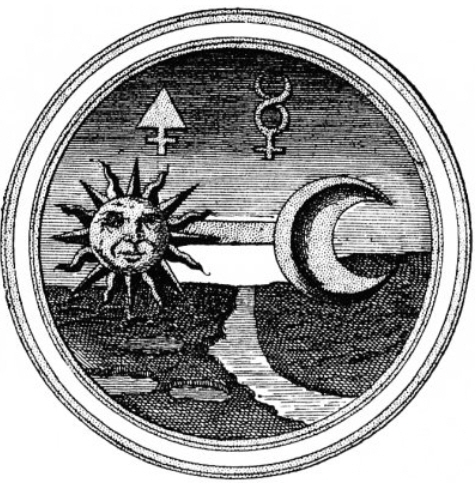
When the Sun and the Moon are viewed within the arena of Western esoteric traditions, including alchemy and the Tarot, they represent opposites that approach and retreat from each other even though they are destined to be merged into one. In these traditions, the Sun represents fire, masculine, positive (polarity), rational, visible world, and the consciousness mind. The Moon represents water, feminine, negative (polarity), intuition, hidden world, and the unconscious mind.

It is said that the enlightened being, often called The Wonder Child or viewed as the Philosopher’s Stone, is born from the merging of these apparent father/mother, king/queen opposites as depicted in the old art work shown here.

One of the many ways of illustrating the steps on the path to enlightenment, the goal of the hero’s and heroine’s journeys, is through the sequence of Major Arcana (trumps) cards in a Tarot deck. The Major Arcana  cards begin with “0 The Fool,” who is considered the innocent initiate at the beginning of the journey/quest and end with “21 The Universe,” which represents ascension. En route, the seeker finds “18 The Moon” and “19 The Sun.”

I like the description of the Moon and Sun  cards in the ancient quests of  knights for the Holy Grail. The Moon, then, is the Grail in the lake (beautiful water symbolism here) and the Sun represents the Grail lifted up into the pure light prior to completing the quest. Afterwards, the initiate/seeker reaches “20 Aeon” which is viewed as the rising of the Phoenix from the ashes prior to ascension.

Many Paths = One Destination

There are multiple layers of symbols here when we overlay the hero’s/heroine’s journey paths with all their traditional associations, including the Lesser Mysteries and Greater Mysteries, the cycles of the seasons around “the wheel of the year,” the Tree of Life, Tarot, alchemy and astrology. One need not study all of this, or even any of this, to understand seeker’s journey. The journey is who we are and what we are about. All of the paths to enlightenment are pointed toward the same end: transformation. Each of us focuses on the symbols we’re most comfortable with and attuned to.

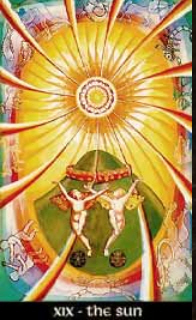
Some experts say that we’re impacted by these symbols even if we are not consciously aware of them or understand the little we may have heard about them. I am a novice in using Tarot and understanding the cards’ many connections to the Tree of Life, spiritual alchemy and the cycles of the seasons. Generally, though, I like the symbolism of the Thoth Deck of Cards. The Moon and Sun cards shown here are from that deck and have a fair amount of symbolism.

  • Moon: The overall tone here is night. In the Book of Thoth, the Moon is called the “Gateway of Resurrection.” During night and Winter, the waiting Sun is diminished or absent. The landscape here is severe and the stream is mixed with blood. The sacred scarab holds the sun in its darkness while the moon occupies the mind and cosmos.
  • Sun: The overall tone here is light, with the twelve major rays standing for the signs of the zodiac. The light emanates from a rose-like sun, standing for the flowering of the solar influence. The children above the green and fertile earth are forever young and innocent. They represent the seeker’s and/or humankind’s next stage.

The Writer’s Raw Materials

moon
moon

As a writer, I love the relationship of symbols and story ideas. They can strongly impact plots, themes and characters. There are many ways to characterize a journey. For example, readers of my hero’s journey novel The Sun Singer  will find numerous references to light and the other aspects of the so-called solar journey. For more information, see the Journey Page on my website and explore the information on the Joseph Campbell Foundation site. The book’s Glacier Park setting reminds park visitors and fans of “Going to the Sun Road” and the expanse of light one sees from high mountain trails.

Likewise, readers of my heroine’s journey novel Sarabande will find numerous references to water and the other aspects of the so-called lunar journey. The Heroine’s Page and the Sarabande Page on my website have more details. While the book’s story begins in the mountain high country, the plot (which is oriented around the moon’s phases) becomes more focused on rivers, dreams and the so-called “Underworld.”


sun
sun

For more information about Tarot cards in general, you might enjoy exploring one of my favorite sites: Raven’s Tarot Site. Here you’ll learn more about the Major Arcana (trumps), Minor Arcana (suits), and their correspondences with the Tree of Life, the classic elements, and astrology.

My first intention in both of these books is telling an exciting story. Both stories have many associations with myths and symbols. Those who know the myths and symbols will, perhaps, smile when they see the references. Those who do not consciously know the myths and symbols will still be subject to their spells.

As Rumi said, “What you seek, seeks you.” So, perhaps when you’ve finished reading the stories, you’ll be drawn into the “inner stories” behind the actions of Robert Adams (The Sun Singer) and Sarabande (Sarabande). When that happens, you’ll find that what you are looking for will begin to appear more often in your life in the form of books, websites and links, things you see on the way to work or on a hike, people who are interested in these subjects, and your dreams.

Meanwhile, as you read the novels, I hope you’ll enjoy the action while you are dancing with the Sun and the Moon—as they dance with each other.

–Malcolm