WASHINGTON – The National Parks Conservation Association (NPCA) and park advocates across the country are demanding the Trump administration put an end to devastating staffing cuts that will wreak havoc on the National Park System. The Department of the Interior will exempt 5,000 seasonal positions under the current hiring freeze, while simultaneously terminating 1,000 National Park Service employees, just as visitors are planning their spring break and summer vacations to national parks.
Unfortunately, today’s cuts will leave parks understaffed, facing tough decisions about operating hours, public safety and resource protection.
Statement by Theresa Pierno, President and CEO for the National Parks Conservation Association (NPCA):
“Allowing parks to hire seasonal staff is essential, but staffing cuts of this magnitude will have devastating consequences for parks and communities. We are concerned about smaller parks closing visitor center doors and larger parks losing key staff including wastewater treatment operators.
“Exempting National Park Service seasonal staff from the federal hiring freeze means parks can fill some visitor services positions. But with peak season just weeks away, the decision to slash 1,000 permanent, full-time jobs from national parks is reckless and could have serious public safety and health consequences.“
“Years of budget cuts are already weakening the agency’s ability to protect and preserve these incredible places.
“National parks fuel local economies across the country, generating billions of dollars for area businesses and supporting hundreds of thousands of jobs. Slashing staff could have a ripple effect on gateway businesses and communities that depend on parks for survival.
“Park staff work tirelessly to protect our nation’s most treasured places, from Yosemite to Gettysburg. They educate visitors, safeguard history and preserve what makes our country special. This isn’t how we treat the places we cherish or those who protect them. We’re calling on our leaders to prioritize our parks and the staff who keep them safe and running.”
Unfortunately, today’s cuts will leave parks understaffed, facing tough decisions about operating hours, public safety and resource protection.
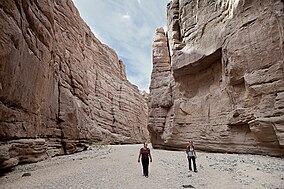
Mecca Hills, part of the Chuckwalla Natl. Monument
WASHINGTON– Today, President Biden established Chuckwalla National Monument, protecting over 600,000 acres of public lands in the California desert. The National Parks Conservation Association (NPCA) joins the Protect California Deserts coalition and partners in celebrating this historic designation, decades-in-the-making.
Named after the iconic Chuckwalla lizard, this remarkable landscape bridges the gap between Joshua Tree National Park and the Colorado River, protecting critical wildlife habitat, connecting migration corridors and preserving centuries of cultural history.
“Chuckwalla National Monument is a cornerstone in a vast network of protected landscapes across the Southwest. Stretching from Joshua Tree to the Grand Canyon to Bears Ears, this corridor forms the largest swath of protected lands in the continental U.S.,” said Theresa Pierno, President and CEO for the National Parks Conservation Association. “This designation protects an extraordinary stretch of the California desert, preserving a landscape shaped by millennia for those who find inspiration in the timeless beauty of our national parks.”
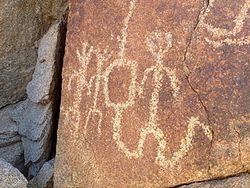
Petroglyphs at Corn Springs
Chuckwalla National Monument is part of the Biden administration’s legacy of landscape conservation. By connecting protected lands from Southern California to Utah, the monument becomes a keystone in the largest connected and protected landscape in the lower 48 states, covering nearly 18 million acres.
This corridor connects national parks, monuments, and protected public lands, including Joshua Tree, Grand Canyon, Capitol Reef, and Mojave National Preserve.
“This 18-million-acre corridor links the Mojave Desert to the Colorado Plateau, providing safe migration routes for wildlife like the iconic desert bighorn sheep and ensuring clean water flows through the Colorado River and its tributaries. It protects sacred sites central to Tribal nations for countless generations, and welcomes millions of visitors each year, inspiring exploration and bringing lasting economic strength to surrounding communities,” said Theresa Pierno. “NPCA has been proud to work locally and nationally for decades to preserve the extraordinary landscapes in the California desert and beyond.”
Designating Chuckwalla National Monument would honor Tribal sovereignty and protect a cultural landscape, boost the economy, and ensure access to nature for local residents.
A proposed Chuckwalla National Monument near Joshua Tree National Park would protect the threatened Mojave Desert tortoise and help many other species thrive, including people.
Chuckwalla is home to the desert’s most iconic and vulnerable species, including the Mojave Desert Tortoise, which relies on roughly 400,000 acres of protected habitat within the boundaries of the new national monument. The designation also ensures connectivity for wildlife migration, supporting desert bighorn sheep, golden eagles, burrowing owls, and more.
Luke Basulto, NPCA’s Ruth Hammett California desert program manager, has dedicated his career to desert conservation, working with local communities to protect the delicate desert landscapes.
“Growing up as a desert kid shaped me into the California desert advocate I am today, and I couldn’t be prouder to see Chuckwalla National Monument become a reality,” said Luke Basulto. “This landmark designation expands one largest desert preserves in the world, teeming with wildlife like the Mojave Desert Tortoise and bighorn sheep and is home to multiple plant species found nowhere else on the planet.”
Beloved destinations like Painted Canyon and the historic Bradshaw Trail will now be permanently protected, offering opportunities for hiking, camping, backcountry exploration, and stargazing. For nearby communities, where extreme heat and pollution pose daily challenges, the monument provides equitable access to the beauty and solace of the California desert.
Audubon Map
“For communities in the East Coachella Valley, Chuckwalla offers a place to visit, to connect with the desert landscape, and to find respite. Experiences like this are what build a passion for these special places,” said Luke Basulto. “Protecting this landscape isn’t just about today; it’s about creating a legacy of conservation that future generations can experience and connect with, just as I did.”
The area within Chuckwalla National Monument is sacred to several Tribes, including the Iviatim, Nüwü, Pipa Aha Macav, Kwatsáan, and Maara’yam peoples. These lands hold centuries of cultural and historical significance, preserving sacred sites, traditional practices, and historic trade routes.
While the designation of Chuckwalla National Monument is a monumental victory, the work to protect the California desert continues. Expanding Joshua Tree National Park to restore a key piece that was historically a part of the park area remains a vital next step for a more connected and resilient desert landscape. Congress now has an opportunity to ensure that Joshua Tree National Park is made whole once again.
There are two kinds of Facebook quizzes, those created by users which usually consist of a list of countries, states, National Parks, widely known attractions, etc., and ask how many of these have you visited. The other is the silly quiz operated by who knows who that asks a question like which historical character were you in a past life; to find out, you click on a link, answer a few questions, and then end up with a graphic on your profile page showing a famous person with words like Malcolm used to be (or is just like) Teddy Rosevelt.
I avoid the second kind because everyone says they’re sponsored by agencies trying to find information of use for advertisers.
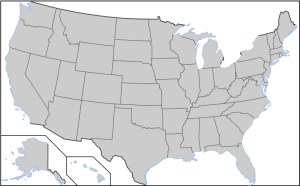
The user-made quizzes are kind of fun, but more trouble because to play, you have to copy, say–a list of states out of one user’s profile, paste it in yours, delete the YES answers from the previous respondent, and then type in YES next to each state you’ve visited. Since I’ve been to every state except for Alaska and Maine, I usually leave the YES answers from the previous user and add my own.
These quizzes are more fun when they start discussions. People who’ve only been to a couple of states often say why they’ve done so little traveling. Those of us who’ve been to a lot of states often had parents who lived and worked in multiple places and/or went on a lot of family vacations when during the summers of their K-12 years. It’s interesting to see these little glimpses in the lives of one’s online friends.
One odd thing about visiting states when one is in elementary school is how fast the memories fade by the time one’s an adult. I visited Washington, D.C. once with my parents and once with my high school band. I knew where we went, but when my wife and I visited the Capital with our extended family several years ago, my having been there before hardly mattered when it came to getting around the city or remembering specific sites. So, it’s nice to go back as an adult–and take pictures–and see places that have long been a distant memory.
I suppose there’s vanity involved in these quizzes asking what states we’ve been to and what foreign countries we’ve been to. When people have been everywhere, they like telling people they’ve been everywhere. I’ll confess, when I see the list of countries, I’m very much aware of the fact I’m one of the few people to say YES next to Vietnam, Hong Kong, and when it’s on the list, East Germany.
Whether or not my answers make anyone jealous, I have no idea. I do know that I’m jealous of people who’ve visited places I always wanted to see. So it goes.
“In a car you’re always in a compartment, and because you’re used to it you don’t realize that through that car window everything you see is just more TV. You’re a passive observer and it is all moving by you boringly in a frame.
On a cycle the frame is gone. You’re completely in contact with it all. You’re in the scene, not just watching it anymore, and the sense of presence is overwhelming.” ― Robert M. Pirsig, Zen and the Art of Motorcycle Maintenance
Interstate highways accentuate the problem. They take you past the real territory whether it’s small towns with local character or countryside made up of differing ecosystems that all blend together outside the car window with the same unreality as the background in cheaply made theater/tv cartoons. Even the exits look alike, featuring the same chain gas stations, fast food restaurants, and hotels as the exits one saw five hundred miles ago.
Wikipedia photo.
I remember my first trip through the peninsula part of Florida. Looking back, the homespun roadside attractions all seem rather tacky and low grade when compared to the destinations everyone’s racing to see in and around Orlando or Tampa or Miami. All that homespun was real and very different from town to town when compared with today’s tourist destinations. Even now, I prefer the numbered U.S./State/County roads where one can experience the local cultures and local environments. I’d rather eat at Mom’s Diner than another Applebee’s or another Cracker Barrel.
Chain restaurants offer a bit of security, I guess. When you walk into an Applebee’s or a Cracker Barrel, you already know what you’re getting. With Mom’s Diner, you don’t. When a see chain restaurants, I think of the old Pete Seeger song “Little Boxes,” a slam against suburbia, and I think, yes, all these buildings are made of ticky tacky and look just the same.
When you race through Florida on I-4, I-10, I-75, and I-95, you’re really out of alignment with the territory and can no longer say (obviously) that the journey is more important than the destination. Using the contents page of one of my favorite books about Florida’s wetlands, when you travel an Interstate you don’t see, much less differentiate, between seepage wetlands, interior marshes, interior swamps, coastal intertidal zones, and mangrove swamps. Likewise, hardwood hammocks, pine flatwoods, and savannahs fly past your car window (like TV) at a mile a minute.
Wikipedia Photo.
I see that Disney World and other theme parks are raising prices again. So, there goes a hell of a lot of money, long lines, crowds of people bumping into each other, submerged within Orlando’s ticky-tacky sprawl, and then home again via Delta Airlines or the Interstate. Missing from this experience is, of course, the real Florida. You missed the whole thing except for the so-called Magic Kingdom that features everything but real magic.
I’ll admit that when my daughter was little, we took her to see Seaworld and Disney World. And we recently went back again with her family so that my granddaughters could see the best of the best at Universal and Disney. Yes, we had fun. Probably, the kids had even more fun. I hope the kids will grow up and discover the real Florida someday, that is to say, a beach other than Daytona with its crowds and condos and hotels, the real magic of grasses, wildflowers and trees in one of the state’s diverse environments.
One Interstate is pretty much like another, but the stuff outside the car window isn’t the same from state to state. It’s too bad the good stuff gets passed by. It’s even worse when you realize most people don’t think anything’s outside the car window.
According to Being in the Shadow, 39% of the people in the United States live within 300 miles of the eclipse. We’re well within that distance of scaring ourselves by the fast-moving moon shadow racing across the sunny (hopefully) sky, so we’re going. Our trip to the North Carolina mountain rental cabin where eight of us will meet is only 188 miles,–according to MapQuest, that’s three and a half hours on the road.
Artist’s conception of an eclipse.
We’re arriving at the cabin several days in advance because if all Americans within 300 miles decide to travel to a great viewing location, that’s 127 million people on the road. So far, we’ve seen estimates for north Georgia of about 60,000 extra cars on the road.
This is the post-eclipse estimate of people streaming back toward Atlanta minutes after the totality period is over. I-85 backs up every Thanksgiving, so–even if we still lived in an Atlanta suburb–we’d travel on a different day. That’s the good thing about being officially retired and working at home: we don’t have to rush back to work.
Initially, my attitude about driving so see the eclipse was kind of “ho hum.” I maintained that I saw eclipse conditions every night after it got dark. Nobody else in the family bought this. We have the shortest drive. Four people are coming from Maryland and two are coming from central Florida. It will be fun getting together in a cabin where we have plenty of room. Of course, as soon as we get there, we’ll check out how much sky is visible from the cabin’s deck.
We’re getting ready to go. We have our approved eclipse glasses (the cops say don’t wear them while driving). The car has new tires and a recent oil change. We have somebody coming by the house here in NW Georgia to check on our cats. We have extra wine. We have dinner reservations on eclipse day, compliments of my wife’s tireless planning efforts. And we have a nice list of places to go and things to see while the eclipse isn’t happening–depending on traffic. As for pictures, I’ll post some if I can capture anything that looks exciting other than the black rectangle.
What are your plans? If you don’t live along the eclipse track, are you giving there?
Every year thousands of people enjoy the views from Glacier National Park’s engineering marvel known as the Going-to-the-Sun Road. Whether you’re looking at the scenery from the seat of your bicycle, a red tour bus or your car, the trip from St. Mary’s to Lake McDonald provides some of the best high country ambiance in the Rocky Mountains.
Up close and personal, you will notice the rock formations. They are stunning and colorful but, unless you have a good tour guide or a handy reference book, the geology on display may remain incomprehensible.
Geology Along Going-to-the-Sun Road, Glacier National Park, Montana will meet your needs perfectly. First published by the Glacier Association in 1983, this practical, well-illustrated guidebook has met the test of time. The book is organized into twenty-one stops from east to west along Sun Road that illustrate many of the park’s geological features.
Sun Road Tour Stops Sun Road's Logan Pass - NPS PhotoThe book includes color photographs of both the far-away and the close-up features. For example, you can compare what you see when you look at Curly Bear Mountain 3.9 miles from the entrance station with a diagrammed photograph that illustrates the mountain’s visible rock formations.
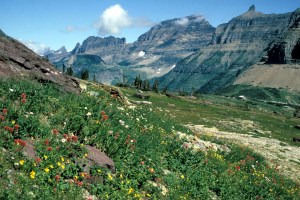
Or, at Stop 5, “Grinnell Formation,” text and close-up photographs in the book help you better understand this colorful red rock. Logan Pass, Stop 10, at 6,680 offers excellent views of the horn-shaped mountains created by glaciation, including Clements Mountain (shown in the book).
In addition to the stops, the book includes a glossary, information about rock colors, a list of the park’s rock formations and a handy shaded relief map of the road. Written by geologists in a language intended for non-scientists, the guide adds to a visitor’s understanding and enjoyment of a highway that has thrilled millions of tourists since its completion in 1932.
–


 There are two kinds of Facebook quizzes, those created by users which usually consist of a list of countries, states, National Parks, widely known attractions, etc., and ask how many of these have you visited. The other is the silly quiz operated by who knows who that asks a question like which historical character were you in a past life; to find out, you click on a link, answer a few questions, and then end up with a graphic on your profile page showing a famous person with words like Malcolm used to be (or is just like) Teddy Rosevelt.
 The user-made quizzes are kind of fun, but more trouble because to play, you have to copy, say–a list of states out of one user’s profile, paste it in yours, delete the YES answers from the previous respondent, and then type in YES next to each state you’ve visited. Since I’ve been to every state except for Alaska and Maine, I usually leave the YES answers from the previous user and add my own.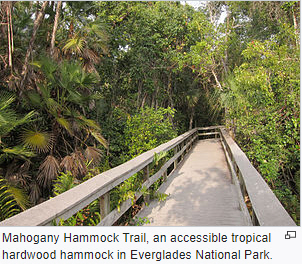


 Malcolm's Round Table