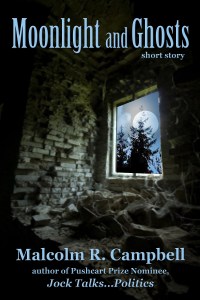
It’s really spooky: ‘Moonlight and Ghosts’

I’m happy to announce my really spooky short story “Moonlight and Ghosts” was published today by Vanilla Heart Publishing in an e-book format.

Publisher’s Description: On a moonlit night, Randy’s intuition is drawing him back to an abandoned psychiatric hospital where he once worked. He and his friend, Alice, have heard the ghost hunters’ claims the building is haunted, filled with strange lights, apparitions and the voices of former patients calling for help. The Forgotten point Randy and Alice to a crime in progress… and there’s not much time to save the victim.

That abandoned building…

There used to be an abandoned psychiatric hospital and developmental center near the house where I grew up. Before it was converted from a secondary hospital for use by the state department of mental health, I visited patients there–and it all seemed normal enough. It closed for a variety of reasons, including lack of funding and ended up sitting as an abandoned and often vandalized building for over two decades.

During this time, it became a magnet for ghost hunters. The more I looked at the pictures on line, the more my imagination started tinkering with an idea for a story. Like the main character in the story, I once worked as a unit manager at a center for the developmentally disabled. Fortunately, I never worked in this building. But what if I had and what if I went back on a moonlit night and found several ghosts waiting for me with an emergency message?  Hmmm…

I hope you like it!

Price: 99 cents on Kindle, and in multiple formats, on Smashwords.

Watch the Book Video on YouTube

Read the beginning on Amazon (use “look inside”) or on Smashwords (use “view sample) for free.

Malcolm

Take a few notes: you might write about this place some day

In fiction writing, we have the freedom to create settings of our choice. But readers will pick up on phony settings pretty quickly. The more realistic and more interesting your setting, the more likely the characters who inhabit it will be believable and interesting to the reader. — Robert Hays (“The Life and Death of Lizzie Morris”)

Liberty Port in the Philippines
When I was in high school, I tried multiple times to keep a log or journal. But that required more extended discipline than I had. While I began each attempt with the best of intentions, the entries quickly morphed from wordy and detailed into sketchy and infrequent.

A little discipline then could have saved me a lot of trouble when I began writing my novel “Garden of Heaven.” It uses settings I should know well: Glacier National Park, Montana; Tate’s Hell Forest and Tallahassee, Florida; Olongapo, Philippines; the aircraft carrier USS Ranger; Decatur, Illinois; Gronigen, Netherlands.

Each of these places holds memories for me that fit the plot and themes of the novel. Yet, when it comes to nitty-gritty details, memory can be tricky. When exactly did the USS Ranger leave Alameda for Vietnam in 1968 and what stores existed on Tallahassee’s College Avenue a few years before that? What year did the Decatur transfer house get moved and how far was the Galaxy Bar from the main gate?

Fortunately, books, magazines and online research helped fill in the gaps. So did e-mail correspondence with people at Glacier, Tate’s Hell, and Decatur. Frankly, a good journal would have taken me a lot less time. Not that I would have recorded everything I might have needed in a novel written decades later. But recording my observations would have given me a good start.

USS Ranger (CVA-61)
Since it’s quite likely that a writer will end up using places he has a passion for or where defining moments occurred–whether it’s the town where he grew up, the theater where his military service unfolded or the destination for his favorite vacation–I’m thinking it just makes good sense to become a bit more of a packrat.

In addition to photographs, a few notes, brochures, newspaper clippings, ticket stubs, itineraries, and other materials will not only reinforce the writer’s observations when he’s there; they’ll support his memory years later when he puts his protagonist into the deep swamp he saw when he was a kid or the sailor’s liberty town he saw when he was in the Navy.

Such details don’t need to turn into the pages and pages of description readers of today’s novels often skip over. They do bring a place to life. They’re the difference between a setting with depth and one that appears plastic and ill-formed.

And if you have the discipline, keep a diary, log, journal or notebook: your readers will thank you and your writing will be all the stronger for it whether you’re writing about stealing cookies on the mess-decks of an aircraft carrier or the sound a panther makes in a notorious Florida Swamp.