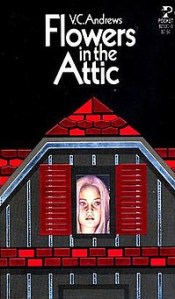
 Of course, I read it. After all, there was a war on, I was addicted to Southern Gothic by running with a bad crowd and was working for an employer who tapped my phone (not because I read the book, though I’m not sure about that).
I like the Wikipedia comments about the book: “A review in The Washington Post when the book was originally released described the book as ‘deranged swill’ that “may well be the worst book I have ever read”. The retrospective in The Guardian agreed that it is deranged but called it “utterly compelling.”
Sure, there were claims that it might have been based on a true story. I didn’t care. There were also claims that its author V. C. Andrews was as messed up as her novel. I saw that as a plus. People are still arguing about such things thirty-seven years after Andrews died. Where there’s smoke, there’s fire? I think people want there to be fire even though the evidence about real fire is rather slim.
Last year the New York Post said, “Real life of ‘Flowers’ author VC Andrews was as creepy as her gothic novels.” The post based that view on a book about Andrews: “While the new book “The Woman Beyond the Attic: The V.C. Andrews Story” (Gallery Books) by Andrew Neiderman may not be as salacious as “Flowers in the Attic,” it’s surely worth its own Lifetime Original Movie.”
I don’t think so, but the reporter never called me for a comment.
While one can hardly say the book is “just good clean fun,” everyone wants to find some reason anyone would write such a novel, and then follow it up with more or the same.
How or why it all happened seems irrelevant to me as an author. The story stands for itself. What it means and/or what the author meant are the kind of swill we get from English departments that think novels must be explained–and possibly the authors as well.
Flowers in the Attic was, for me, a compelling story.
–Malcolm

 Malcolm's Round Table