NPS to proceed with ill-advised restoration of Many Glacier Hotel Staircase

Today’s news release from NPS Glacier National Park notes that restoration work on Many Glacier Hotel is continuing, especially in the annex (officially annex 2) where many rooms will be refurbished; the kind of structural, safety and stabilization that were done in the main annex of the hotel will also be carried out in annex 2. This coming summer, half of the hotel’s rooms will be closed during the project’s completion.Original double-helix staircase - NPS photo
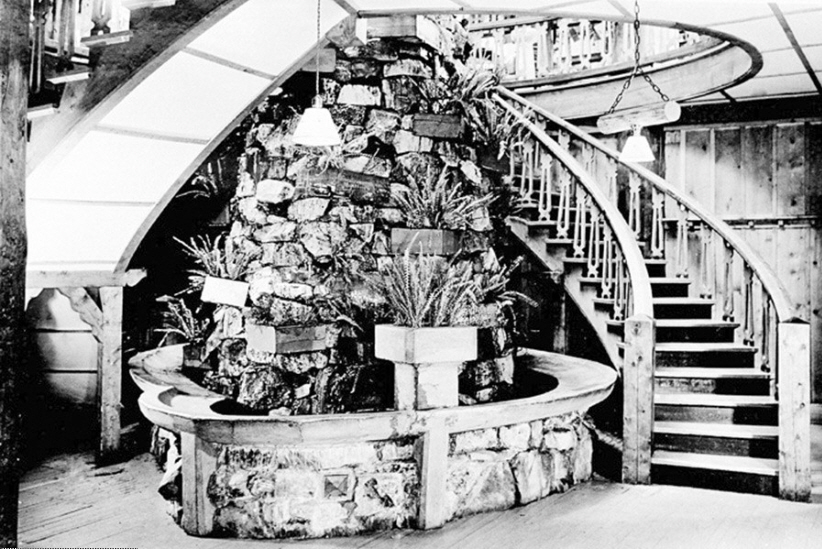
In a separately funded project, the long-removed spiral staircase will be returned (rebuilt) in the hotel’s lobby connecting the main floor with the lake level rooms below.

As I’ve written in my blogs previously, I would have opposed the removal of the staircase in 1957 had I been working there at the time. While many old timers have (rightfully) mourned the loss of that staircase which had been in place in 1915, I firmly believe restoring the staircase now is not only a huge mistake by violates one of the preservation standards of the NPS’ parent Department of Interior.

Why This is a Mistake

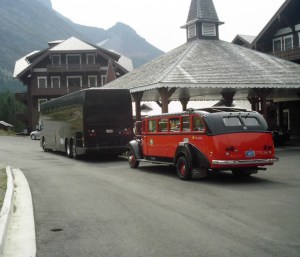
  • The NPS is not removing this porte cochere to make the front of the hotel look like it once did.
    The NPS is not removing this porte cochere to make the front of the hotel look like it once did.

    The Department of Interior’s preservation standards state that “Changes to a property that have acquired historic significance in their own right will be retained and preserved.” This means that you cannot, within preservation best practices, convert a structure to the way it was in an earlier time since it’s ambiance, usage and looks have evolved over time. Buildings evolve, and the lobby without the staircase has more years of history than the lobby with the staircase.

  • The rebuilt staircase will alter the rooms below. The St. Moritz room stage will be removed, making it impossible to set up musical groups, much less return to the historic summer musical productions that were a long-time and historically significant offering by hotel employees. Ranger Naturalist talks will also be removed from the hotel, because the lake level renovations will remove their Lucerne Room venue when the gift shop is moved from the lobby downstairs.
  • The gift shop will probably not fare as well in the lake level where it will be out of sight and out of mind.
  • Others have complained that the staircase will be an open vertical “corridor” that will carry noise and cooking odors from the lake level up into the lobby.
  • To be consistent with the logic replacing the “historic” staircase, the NPS would also have to replace the former Many Glacier swimming bool and remove the added-on  porte cochère at the main lobby entrance that protects car and bus passengers from rain upon arrival. Other smaller-order changes have been made to the hotel since I worked there: I note that the NPS isn’t advocating returning those areas to their original as-built configurations. While I understand the urgent need several years ago to stabilize the hotel’s foundation, taking the historic “kinks” out of the lake-level “stagger alley” hallway was a very non-preservationist in approach. Does NPS plan to restore these kinks?

My comments to the Department of Interior and NPS-Glacier National Park about the park service’s justification for the violation of the standard prohibiting the return of buildings to earlier configurations have received no response. It appears that the NPS has overlooked its own standards in favor of sentimentality.

As a former Many Glacier Hotel employee, I’m done with the hotel because the new eyesore in the lobby will be nothing I want to see. As a former Historic Preservation Commission chairperson and preservation grant writer, I dislike the precedent of this violation of standards. Once the staircase is returned, anything can be returned and that’s a mess I don’t want to contemplate at Glacier National Park or any other unit in the system.

Malcolm
The textures of old buildings

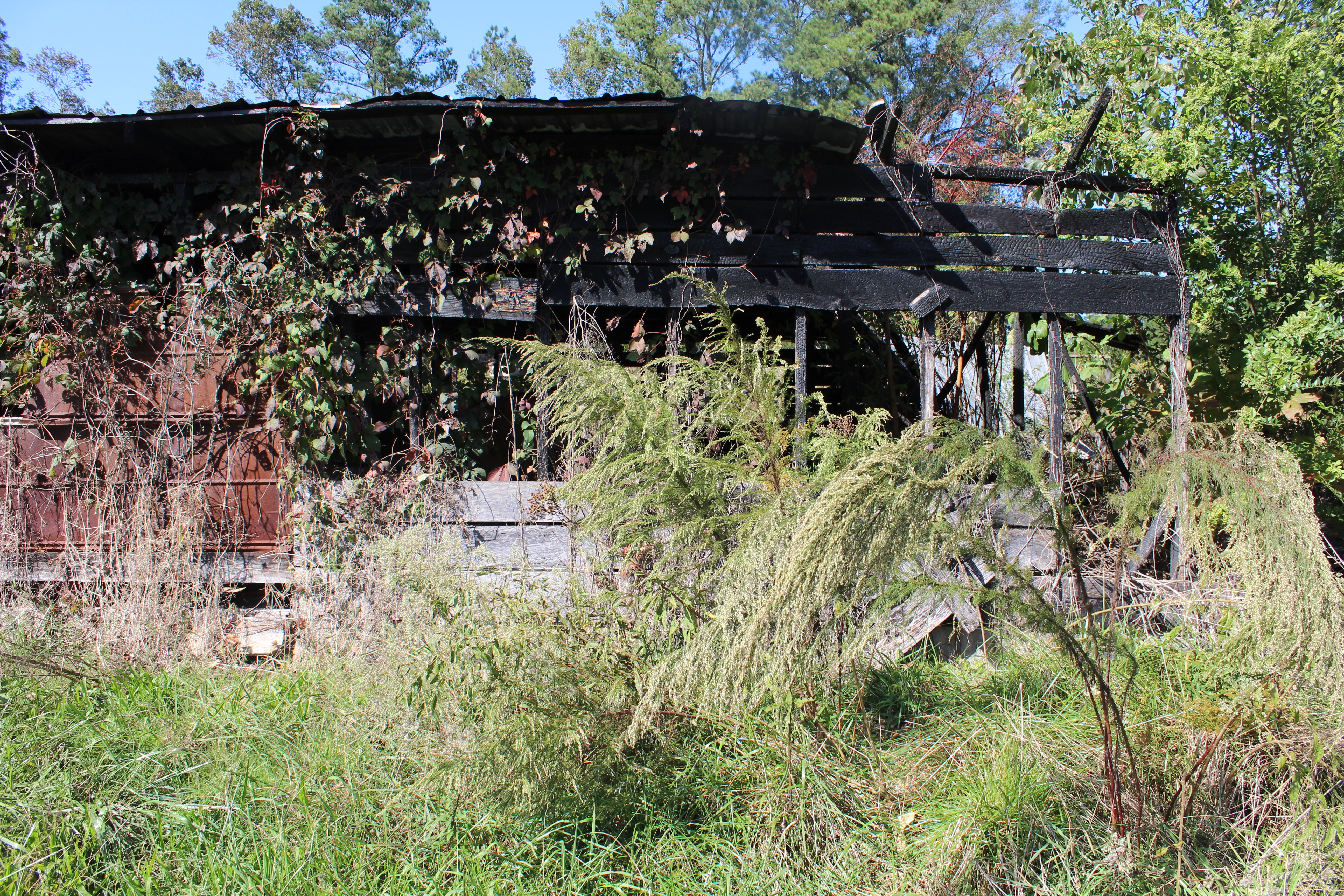
Fire damage is clearly evident on this end of the building
Fire damage is clearly evident on this end of the building.

When we moved in January to a new house on a corner of the farm where my wife grew up, we ended up with a variety of outbuildings that had had minimal use for years. We’re using the old garage for our riding mower and other lawn tools. Since it sits near our house, we had the old smokehouse restored.  So far, we haven’t decided what to do with the old chicken house.

Ten years ago, a fire destroyed two other buildings and damaged the chicken house. Except for wandering free-range chickens (if any), a chicken hasn’t been in there for ages. My wife’s folks stored hay in the building before the barn was built. Since her dad was a contractor, the building became a convenient place to store lumber left over from one job or another.

As the pictures show, Mother Nature keeps an eye on abandoned buildings, waiting for an opportunity to reclaim them for wild

Vines do their work slowly, but thoroughly.

things, nature spirits and haints. We had’t gone inside this building since we moved here. Well, obviously any rehab of the building is going to have to start with a lot of clearing away around the outside. Once we get fences put in, we’re probably going to get a few goats.

Could one end of the building be turned into a shelter for them? Maybe. Could some of it be used for storage. If so, we might be able to put the tractor in there. Right now, it’s taking up half of the old garage which sits much closer to the house. The tractor hasn’t been cranked up since last year; it needs a new bush hog if we’re ever going to use it for some of the grass that we’re currently mowing with the riding mower.

On the plus side, there’s probably enough lumber stored inside the building to rehab the building. We might need some more tin, though. (No, we’re not going with a copper roof in one of the colors currently in vogue in subdivisions.)  Well weathered tin and old one-by-sixes are part of the textured charm of old buildings. More often than not, buildings like these were never painted. You don’t see a lot of “barn red” around here.

This lumber will keep us from spending a fortune at Home Depot.

When I served as the chairman of a historic preservation commission in the small town where we used to live, our group championed the cause of adaptive re-use. Our old cotton mill, for example, had been converted into a world of shops. This preserved the old building and also the character of the town. Atlanta has had some success preserving old brick factory buildings and using them for loft apartments.

We don’t need (or want) a chicken house. While a very conservative preservationist might tell us to make the building a chicken house again even if we never bought any chickens, there’s no evolution in that. We can adapt. For one thing, if we made it a chicken house, it would sit unused rather like a museum display. Nature would start working on it around the door frames and the gaps in between the shiny new sheets of tin. For another thing, having a ready-to-use chicken house sitting there is probably unlikely to help us resell the property some years down the road.

Idly, I wonder what we’ll do with the leftover lumber.  That’s not a big concern, because I think it will find its way somewhere, a place where it will keep its texture while serving a brand new purpose–like any old building or retired person.

–Malcolm


KIndle cover 200x300(1)Malcolm R. Campbell is the author of the Pushcart Prize nominated “Conjure Woman’s Cat,” magical realism set in the Jim Crow era of Florida. A conjure woman ends up battling the local KKK with folk magic and, as the title suggests, the help of her cat.

Conjure Woman’s Cat web site


Why should my town look like every other town?

I’ve always disliked homogenized milk. There’s no cream on top. Dwight Young, in Preservation Magazine, laments the loss of distinctive and historic local names, stores, cafes, and hotels as chains sweep through homogenizing the country so that “everyplace gradually turns into anyplace.” The disappearance of local cream is a great loss.

In his article “Name Dropping” in the magazine’s September/October issue, Young speaks of the “homegrown flavor” that’s now long gone from Plainview, Texas where he grew up. He misses Bryan’s Food and West’s Pharmacy. When I return to Tallahassee, Florida where I grew up, I no longer find the Florida Theater or Leon Federal Savings & Loan or Duval’s IGA Grocery. While I accept change as a constant, I wonder if we’re often in too much of a hurry to replace the old with the new.

Sure, we can be part of what “everyone’s talking about” online when McDonald’s replaces the “Seven Steers” with its comforting, you-know-what-you’re-getting food no matter where you are. But the food really isn’t better, is it? Goodness knows, the streamlined, cookie-cutter architecture from everywhere else really isn’t the real Plainview or the real Tallahassee.

Towns with pro-active historic preservation commissions have, at least, been able to mandate that when the chains move in, they must move in to local architecture. No, it’s usually not the adaptive re-use of an old building, but the new that is built is made to appropriately fit in with the old that remains.

Anything else is, as Atlanta’s late historian Franklin Garrett often said, “municipal vandalism.” He ought to know, for Atlanta is famous for vandalizing its heritage.

Young is, I think, realistic when he writes that “we can’t resurrect all the long-gone institutions we once knew, but we can certainly cherish the ones that are left. Heeding the familiar admonition to ‘buy local’ is good for the soul as well as the economy.” To keep the cream, you might have to pay a bit more, but a greater percentage of the dollars you spend stays in town and helps local businessmen and local families.

And that’s better in so many ways than having to say goodbye to the Florida Theater, Rich’s Department Store and West’s Pharmacy.

Copyright (c) 2009 by Malcolm R. Campbell, author of the new comedy thriller “Jock Stewart and the Missing Sea of Fire.” Read a free sample from the Vanilla Heart Publishing sampler at Smashwords.